Tea Parties And “Going Galt”

Ken AshfordEconomy & Jobs & Deficit, Obama OppositionLeave a Comment

Outside the Beltway's Alex Knapp:

I’ve been following the growing “Tea Party” and “Going Galt” movements with no small amount of amusement, in part because there is really just too much sweet, delicious irony surrounding both of these groups of people (who, I might add, are largely the same people). Here’s a few observations:

  • The “Tea Parties”, of course, started springing up in response to Obama’s stimulus package, a package whose largest fiscal component is a tax cut that will largely benefit the people in the income brackets who make up the Tea Party movement. That I find funny.
  • The folks in the blogosphere largely cheerleading the Tea Parties are the same folks in the blogosphere who cheerleaded the war in Iraq. So apparently, government intervention to the tune of $650 Billion is okay to spend when it comes to an unnecessary war that in no way advances American interests, but not okay when it comes to building bridges, cutting taxes, helping state governments meet budget shortfalls, or making sure that Americans don’t get covered in lava. Gotcha.
  • Some of the biggest proponents of the “Going Galt” bandwagon in the blogosphere and at Pajamas Media are Glenn Reynolds and his wife, both of whom have jobs (Professor of Law at a public university; forensic psychiatrist) that are dependent on public, taxpayer-funded institutions.

Let’s call the “tea party” and “going Galt” nonsense what it is: unprincipled partisan hackery. If these were truly principled protests, they’d have been around all through the Bush and Republican-controlled Congress years, too.

Yup.

And Knapp gets bonus points with me for pointing out that the Ayn Rand Institute is a non-profit corporation.

Schilling Retires

Ken AshfordRed Sox & Other SportsLeave a Comment

His blog is down — probably from the deluge of hits — but he announced today that he is leaving baseball, at the age of 42, with "zero regrets".  He was out all last season with a shoulder injury, and his best days are behind him, so it's not a major blow to the Red Sox. 

But still, he was the man for a while, and will always be remembered for this:

OpYlfaLv  

PPIP aka “The Geitner Plan”

Ken AshfordEconomy & Jobs & DeficitLeave a Comment

Get used to that acronym.

It's the shorthand term for the plan, unveiled today, about how to deal with the "toxic assets", which is at the core, the epicenter, the root, of all our current economic woes:

Here it is in a nutshell:

Under the new so-called "Public-Private Investment Program", taxpayer funds will be used to seed partnerships with private investors that will buy up toxic assets backed by mortgages and other loans.

The goal is to buy up at least $500 billion of existing assets and loans, such as subprime mortgages that are now in danger of default.

Treasury said the program could potentially expand to $1 trillion over time, but that the hope is that the program would not only help cleanse the balance sheets of many of the nation's largest banks, which continue to suffer billions of dollars in losses, but help get credit flowing again.

The government will run auctions between the banks selling the assets and the investors buying them, hoping to effectively create a market for these assets.

To kickstart things, the administration said it will commit $75 billion to $100 billion and would consider how the program is progressing before committing more money.

As a public service, I copy from Brad Delong's "Geitner Plan FAQ", which attempts to explain it in simple terms:

Q: What is the Geithner Plan?

A: The Geithner Plan is a trillion-dollar operation by which the U.S. acts as the world's largest hedge fund investor, committing its money to funds to buy up risky and distressed but probably fundamentally undervalued assets and, as patient capital, holding them either until maturity or until markets recover so that risk discounts are normal and it can sell them off–in either case at an immense profit.

Q: What if markets never recover, the assets are not fundamentally undervalued, and even when held to maturity the government doesn't make back its money?

A: Then we have worse things to worry about than government losses on TARP-program money–for we are then in a world in which the only things that have value are bottled water, sewing needles, and ammunition.

Q: Where does the trillion dollars come from?

A: $150 billion comes from the TARP in the form of equity, $820 billion from the FDIC in the form of debt, and $30 billion from the hedge fund and pension fund managers who will be hired to make the investments and run the program's operations.

Q: Why is the government making hedge and pension fund managers kick in $30 billion?

A: So that they have skin in the game, and so do not take excessive risks with the taxpayers' money because their own money is on the line as well.

Q: Why then should hedge and pension fund managers agree to run this?

A: Because they stand to make a fortune when markets recover or when the acquired toxic assets are held to maturity: they make the full equity returns on their $30 billion invested–which is leveraged up to $1 trillion with government money.

Q: Why isn't this just a massive giveaway to yet another set of financiers?

A: The private managers put in $30 billion and the government puts in $970 billion. If we were investing in a normal hedge fund, we would have to pay the managers 2% of the capital and 20% of the profits every year. In this case, the private managers' returns can be thought of as (a) a share of the portfolio's total return proportional to their 3% contribution, plus (b) a "management incentive fee" of (i) 0% of the capital value and (ii) between 0% (if the portfolio returns 3% per year) and 9% (if the portfolio returns 10% per year)–much less than hedge-fund managers typically charge. the Treasury is only paying 0% of the capital value and 17% of the profits every year.[1]

Q: Why do we think that the government will get value from its hiring these hedge and pension fund managers to operate this program?

A: They do get 17% of the equity return. 17% of the return on equity on a $1 trillion portfolio that is leveraged 5-1 is incentive.

Q: So the Treasury is doing this to make money?

A: No: making money is a sidelight. The Treasury is doing this to reduce unemployment.

Q: How does having the U.S. government invest $1 trillion in the world's largest hedge fund operations reduce unemployment?

A: At the moment, those businesses that ought to be expanding and hiring cannot profitably expand and hire because the terms on which they can finance expansion are so lousy. The terms on which they can finance expansion are so lazy because existing financial asset prices are so low. Existing financial asset prices are so low because risk and information discounts have soared. Risk and information discounts have collapsed because the supply of assets is high and the tolerance of financial intermediaries for holding assets that are risky or that might have information-revelation problems are low.

Q: So?

A: So if we are going to boost asset prices to levels at which those firms that ought to be expanding can get finance, we are going to have to shrink the supply of risky assets that our private-sector financial intermediaries have to hold. The government buys up $1 trillion of financial assets, and lo and behold the private sector has to hold $1 trillion less of risky and information-impacted assets. Their price goes up. Supply and demand.

Q: And firms that ought to be expanding can then get financing on good terms again, and so they hire, and unemployment drops?

A: No. Our guess is that we would need to take $4 trillion out of the market and off the supply that private financial intermediaries must hold in order to move financial asset prices to where they need to be in order to unfreeze credit markets, and make it profitable for those businesses that should be hiring and expanding to actually hire and expand.

Q: Oh.

A: But all is not lost. This is not all the administration is doing. This plan consumes $150 billion of second-tranche TARP money and leverages it to take $1 trillion in risky assets off the private sector's books. And the Federal Reserve is taking an additional $1 trillion of risky debt off the private sector's books and replacing it with cash through its program of quantitative easing. And there is the fiscal boost program. And there is a potential second-round stimulus in September. And there is still $200 billion more left in the TARP to be used in other ways.

Think of it this way: the Fed's and the Treasury's announcements in the past week are what we think will be half of what we need to do the job. And if it turns out that we are right, more programs and plans will be on the way.

Will it work?

One of the biggest difficulties in getting the program off the ground was how to price the soured assets. If the government paid too little, banks would take the hit. But if the government overpaid, then already-soaked taxpayers would feel the pinch.

One nagging concern, however, is whether the government's involvement will actually spur banks and private investor groups, such as hedge funds, pension plans and insurance companies to participate.

Administration officials indicated Sunday they had gotten support from private investors and banks who have been briefed about the program. But some analysts questioned whether the government's help would be enough to push investors and banks toward figuring out a price.

At the same time, there are fears that investors may be reluctant to participate in light of the fact that Congress has retroactively altered the terms of many of the government rescue programs so far.

Regulators indicated, however, that they had few other attractive alternatives.

Letting banks continue to hold these assets on their books, for example, would only drag out the crisis and could put the country in a position similar to what happened in Japan during that country's so-called Lost Decade in the 1990s.

But if the government bought all the bad assets on its own, taxpayers would take on all of the risk. By investing with private firms under the current plan, the expectation is that taxpayers would share the risk — as well as any potential returns.

So it may work, it may not.  DeLong thinks so.  But Paul Krugman (the Nobel Prize winning economist and a guy who is rarely wrong) writes this about the plan:

This is more than disappointing. In fact, it fills me with a sense of despair….

[T]he real problem with this plan is that it won’t work. Yes, troubled assets may be somewhat undervalued. But the fact is that financial executives literally bet their banks on the belief that there was no housing bubble, and the related belief that unprecedented levels of household debt were no problem. They lost that bet. And no amount of financial hocus-pocus — for that is what the Geithner plan amounts to — will change that fact.

You might say, why not try the plan and see what happens? One answer is that time is wasting: every month that we fail to come to grips with the economic crisis another 600,000 jobs are lost.

He goes on to explain that the Geitner plan isn't really "new"; it's just an extension of the Paulson plan, which didn't work.  The problem with the Geitner plan, Krugman says, is that it assumes that the banks are solvent.  We don't know this, of course, because nobody knows the value of the "toxic assets" which the banks hold.

Krugman is of the opinion that the government should simply nationalize the banks because they are (for the most part) not solvent:

There’s a time-honored procedure for dealing with the aftermath of widespread financial failure. It goes like this: the government secures confidence in the system by guaranteeing many (though not necessarily all) bank debts. At the same time, it takes temporary control of truly insolvent banks, in order to clean up their books.

That’s what Sweden did in the early 1990s. It’s also what we ourselves did after the savings and loan debacle of the Reagan years. And there’s no reason we can’t do the same thing now.

Where do I come down on this?  I'm not sure I even understand it entirely.  But clearly, the Obama Administration is doing something just short of nationalization of the banks. 

There may be political reasons for this.  With the Geitner plan, no congressional approval is needed.  For nationalization of the banks, Congress will have to approve.  And they won't unless it can be shown to them that all other options are exhausted. 

Kevin Drum argues that if nationalization is the last resort, and Treasury wants to show it tried everything else first, the Geithner plan may eventually put Congress in a position where it has no other credible choice.

Like it or not, there's only one way to get this support: show that (a) one or more of the big banks really is insolvent and (b) every other option for rescuing them has been exhausted. Geithner's plan does both. If it works — well and good. But if it fails — if nobody is willing to participate, or if the auction demonstrates that the market price for toxic assets really is accurate — then banks will be forced to mark their assets to those prices. Plug in those marks to Geithner's stress tests and it's likely to prove to everyone's satisfaction that some of our big banks really are insolvent. At that point, even skeptics will be forced to accept nationalization as the only remaining alternative.

Politically, I don't see any other way forward. Bank nationalization will be complex, costly, and contentious. To work, it will almost certainly have to include a broad guarantee of all bank system obligations, something the public won't be happy about. Congressional support won't be easy to come by. Geithner's plan will either work or else it will pave the road for that support. It might not be pretty, but that makes it a plan worth trying.

So the PPIP might be a good move politically.  But it might, as Krugman warns, simply delay the only solution, which is nationalization of the banks.  And the more we delay, the more our economy tanks and jobs get lost.

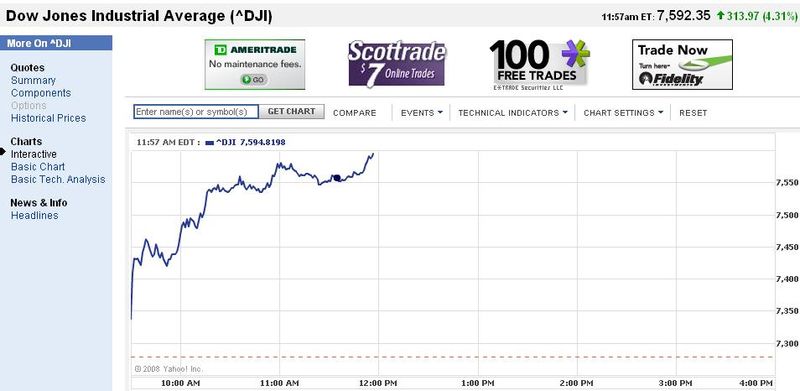
UPDATE:  I'm not one for using the Dow as a barometer for the wisdom (or lack thereof) of Washington goings-on, but the fact that the market is up 312 points (as of noon today) is encouraging.
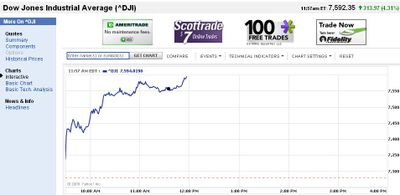
Dow20090323   

The Natives Are NOT Happy

Ken AshfordLocal InterestLeave a Comment

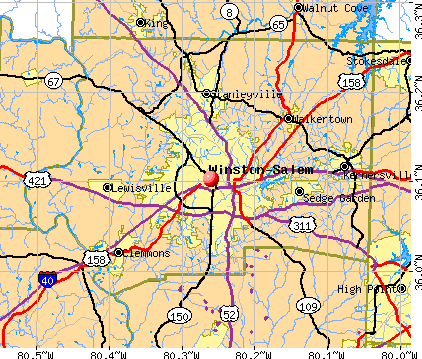
Readers comments at the local Winston-Salem newspaper:

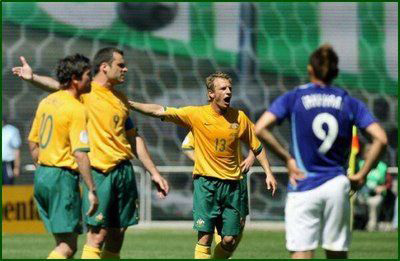
  • Deflated I too am a devoted Wake fan but was so embarrassed last night. In fact, I need to go pull my 'Proud to be a Deacon' sign from my yard!! and maybe burn it? These kids are very talented and started their season GREAT. But lack of an outside shooter and bad coaching didn't sustain them. What a shame. But let's keep rolling and supportive. And don't count out our football team! Football hasn't even started yet! Sure, we lost a lot of key defensive players but there are more that will step up hopefully. See you in the stands! GO DEACS!
  • I'll admit – it got to a point I couldn't watch the game. All I could do was check back periodically to check the score – and that game was a heartbreak, and our guys just didn't look like they wanted it as bad. But could you all possibly crucify Gaudio any worse??? Yeah, he's a good guy – he's also a good coach. Nothing beats the "Monday morning quarterbacking" that's been a constant against Dino and our players since our 16-game win streak came to an end. Besides, how many of you were considered for the job before Dino was chosen to take Skip's place??
  • Dino desperately trying to get the team to listen with 1 minute left said it all. That was a sad scene and it looked like a first year rec league guy trying to pull the Bad News Bears together. After zero game plan adherence against Maryland, they decided to "free-style" again. Dino's a really nice guy, but he can't handle these kids. Skip used to bring in Mike Drum and sit Strickland to deal with discipline. That didn't work either, but Dino just doesn't enforce ANYTHING. The sad fact is that we haven't actually played with discipline since Odom left. I've had the same take all year in my comments around the web, but I actually thought our talent could carry us a bit. The ironic thing is that these teams this decade are the antithesis of the University. Wake is a grind and demands utter discipline from every student; our basketball teams lately make a mockery of that reputation. I am a seriously devoted Wake fan, but I finally have to admit that I don't like this team.
  • Just a complete embarrassment tonight for Wake fans and the ACC. The turnover saga continued as it appears a lack of coaching that should have made the statement that Aminu and Johnson are NOT dribbling guards!!!. I'm married to a UNC grad which always delivers to me more hope of a winning team. But hey, we even beat them in the early season. WHAT HAPPENED?
  • This is what happens when a group of good players with coaching play a group of great players without coaching. Dino seems like a good guy who is in over his head. VCU has a fine young head coach who gets everyting possible out of his players and would be a great fit. His teams have never been an embarassment like last night. Time to turn the page.

Palin Rejects 31% Of Federal Stimulus Money

Ken AshfordEconomy & Jobs & Deficit, Education, Election 2012Leave a Comment

First Mark Sandford, Governor of South Carolina.  He rejected stimulus money.

Now Sarah Palin.  She's rejecting 31% of the federal stimulus money.

What do these two have in common?  They both have their eye on a 2012 presidential run.  They want to be able to get up before the crowds and say, "I said 'thanks but no thanks' when they offered my state federal stimulus money."

What is most alarming is what she is taking money for, and what she is refusing money for?

She is accepting $642 million in federal stimulus money for highways, water and sewers, medicare, and…. uh…. a boat (that's one boat) costing $116 million.

What is she REFUSING money for?  She's rejecting $288 million, most of it for education-related stimulus ($177 million) including special education, technology, "fiscal stabilization" money, emergency food assistance and school lunch programs, immunizations, infant learning and additional funding for schools with a high proportion of poor students.

Nice, Sarah.  Way to keep 'em stupid.

A lot of her constituents, and many in the Alaska legislature are none too happy.

How Do You Solve A Problem Like Sarah Gronert?

Ken AshfordWomen's IssuesLeave a Comment

Sarah_gronert 22 year old Sarah Gronert is a professional tennis player. 

Sarah was born with male and female genitalia. She retired from tennis at 19 because of her condition, and the locker room jeers that came with it.  She then had gender reassignment surgery, having the "male" removed, and is now medically certified as a woman.  Then she rejoined the tennis circuit.

She is facing criticism from coaches and peers who claim she should be ineligible to play on the women's tour. A coach of an opponent said, “There is no girl who can hit serves like that, not even Venus Williams.”  Many have said that she "serves like a man".

Right now, she's ranked No. 619, but she's climbing. In six months, most expect her to be in the top 50.

What do you think?  Should she be able to play on the women's circuit?  Does she have an unfair advantage because she is, at least on some level (arguably), a man?

More on Sarah here.

Obama on Leno

Ken AshfordObama & AdministrationLeave a Comment

Driving into work today, I was listening to the BBC.  The topic of discussion was Obama's appearance last night on Leno.  One commentator was opining that it was beneath the dignity of the presidency for the American president to appear on a "chat show".  Jeez.  The Brits can be such snoots sometimes.

I think it was wise of Obama to go on.  There is a populist wave running through America, and people actually like that their President can be a regular guy.  Not so much "the guy you want to have a beer with", but a guy who is serious, responsible, and knows the import of his job, while still being personable and agreeable.

That's how Obama came off last night.  Sure, it was a softball interview.  But it was a way for him to speak about the nation's problems without the media filter.  He was upbeat, funny and optimistic when he needed to be, and serious and throughful when he needed to be. 

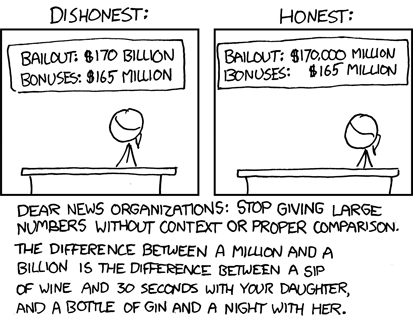
Sadly, Leno focussed on the AIG bonuses far too much for me.  (In fact, I think everyone is focussing on the AIG bonuses far too much for me.  In the big picture, financially, they are nothing.)

Slight gaffe when he compared his bowling skills to the "Special Olympics".  The right wing is trumpeting the faux pas by saying "Obama insults the disabled", which, of course, he wasn't (he was denigrating his own bowling skills).  No doubt Rush will have something to say, and irony alarms will sound throughout the country; it was Rush who literally did insult the disabled when he said that Michael J. Fox was exaggerating his tremors in order to get sympathy.

But all in all, a good show.

Top Ten Reasons Why I Don’t Follow NCAA Basketball

Ken AshfordPopular CultureLeave a Comment

College-basketball (10)  It's just a bunch of pituitary cases throwing a rubber ball around.

(9)  The last 4 minutes of any game is all that matters.  The rest is all hype and foreplay.

(8)  It's a game that's more fun to play than to watch.

(7)  The single-minded obsessiveness of its fans, what with office pools, etc.  I mean, you would think it was something important, like, say, the Oscars.

(6)  The deification of coaches — who, incidentally, look like they all buy their clothes from Sears.

(5)  The cinderella team coming from nowhere, beating the big favorites in early rounds, like in Hoosiers?  They don't make it to the finals.  Ever.  They get their asses kicked in the quarterfinals.

(4)  I can't prove this (yet), but the refs just make it up as they go along.  I mean, seriously.  Offensive foul, or illegal block by a defending player?  The refs don't know!  It happened so fast!  They're just guessing.

(3)  The language.  "Brackets" are what you use to attach bookshelves to walls.  "Seeds" are what you put in your garden to make vegetables grow.  'Nuff said.

(2)  For every moron who gets a scholarship to play basketball at an esteemed university, someone else is denied scholarship money, or even denied acceptance to that school.

and the #1 reason why I don't follow the NCAA……

(1)  The whole concept dumbs down America.  I mean, you would think that one of these "college" players would stop mid-game — mid-dribble – and say, "Wait a second.  UCLA is playing in the Eastern Conference, and Connecticut College is playing in the Western Conference?  That's whack."

********

Okay.  I know I've ruffled feathers.  Have at me….

Orgasmic Birth

Ken AshfordWomen's Issues1 Comment

I'm no expert on women's sexuality and biology, but this strikes me as highly implausible:

Amber Hartnell did not intend to have an orgasmic birth – it just happened. "Trying to have an orgasmic birth defeats the object," she says, "I just got into this ecstatic state where I had these peaks of orgasm. There were these rolling waves coming through me where I was laughing and crying. I didn't feel like I was having contractions. They were more like rushes. I did not actually experience pain, I experienced intense sensations."

My favorite quote:

Whether you believe in orgasmic birth or not, labour is not so unlike sex, says Christine Grabowska, senior lecturer in midwifery at Thames Valley University.

And eating is not so unlike vomiting, I suppose.  But the experience of them could not be more divergent.

I guess you could put me in the "skeptic" camp on the issue of orgasmic birth.  More to the point, I think there are probably better and less combersome ways to achieve climax.

******

OTHER BIRTH-RELATED NEWS: 

NASHVILLE – Legislation that would require death certificates be issued for abortions performed in Tennessee has likely failed this session.

The measure sponsored by Rep. Stacey Campfield, a Knoxville Republican, was withdrawn from consideration in the House Health Care Facilities Subcommittee on Wednesday. The companion bill has stalled in the Senate Judiciary Committee since last month.

Currently, each induced termination of pregnancy in Tennessee must be reported to the office of vital records.

Also withdrawn from consideration in the subcommittee was a bill requiring stillborn deaths to be placed in vital records and legislation that would define "inception of human life" to mean "the moment of conception."

Source.

AND THIS:  More babies were born in the United States in 2007 than in any other year in American history [NYT].

40% of the births were to unwed mothers, with the greatest rise among white women.  And don't think we're talking about unwed teens.  That number, while not as low as 2005 (the record low), is still near its lowest point.