Renee Montagne, Steve Inskeep, Corey Flintoff, Korva Coleman, Dina Temple-Raston, Nina Totenberg, Renita Jablonski, David Kestenbaum, Cherry Glaser, Sylvia Poggioli…..
What do these names have in common?
They're all names of NPR personalities AND (as names go) they're all pretty unreal.
Did you ever notice that… i.e., that the people on NPR have pretty cool names?
Oh, sure – there's an occasional Ira Glass, Terry Gross, Robert Siegel or Michele Norris wandering the NPR airwaves.
But when they kick it over to Kai Ryssdal or Lakshmi Singh, isn't there a little part of you that is kind of envious of the kickass names?
Well, blogger Liana Maeby and her boyfriend Eric did. And they decided to come up with some simple rules so that you can have your own special NPR name.
It's quite simple. You take your middle initial and insert it somewhere into your first name. Then you add on the smallest foreign town you’ve ever visited. (This method offers you a little flexibilty, so have fun with it).
NPR's blog Monkey See caught wind of the three day old fad, and asked readers to submit their NPR names.
If you're a reader of this blog, I'd like to hear yours.
This is Morning Edition and I'm Kern Faro.
[NOTE: I don't know if Faro is the smallest foreign town I've ever visited. In fact, I'm sure it's not. But I couldn't think of a smaller one. Well, that's not true. I visited the village of Ashford (in England), but…..]
For years, Bush assured the nation that "we did not torture".
Today, Obama released four legal memos which helped to describe what "interrogation techniques" we did use. Apparently, according to news reports, the decision to release the memos was a tough one for Obama, and one he did not take lightly. He saw the virtues of government transparency but had to weigh that against the necessity of keeping things secret. In the end, he realized that the cat was out of the bag, since some of the what the CIA did ("waterboarding", for example) was already revealed and known to the public.
So did we torture? Well, if you consider taking a prisoner, placing him in a small box, and putting stinging insects into that box to be "torture" (and how can you not?), then yes, we tortured. We violated Geneva Conventions; there's no other (honest) way to look at it.
Glenn Greenwald gives an excellent review of what the memos say here, so I don't have to. But the most starting excerpt of the memos is this admission (click to enlarge):
As the highlighted portions reveal, the legal eagles of the CIA knew we were practicing "interrogation techniques" that our State Department was condemning people like Saddam for using. In other words, we weren't holding ourselves to the same standards that we hold others to. When they do it, it's illegal torture; when we do the same thing, it's legal interrogation.
That same memo later goes on to admit that a court might not buy that argument (gee- you think?)
What an embarassment for the country.
UPDATE: Another memo makes the tortured legal argument (no pun intended) that something is only torture if it "shocks the conscience". The techniques the CIA used, it goes on to explain, don't shock the conscience in the constitutional sense because:
the methods are derived from SERE techniques which are part of U.S. military training (albeit training for soldiers to resist torture by foreign captors), and because the techniques are "carefully limited to further the Government’s paramount interest in protecting the Nation while avoiding unnecessary harm," the OLC concludes that they do not "shock the conscience."
In other words, because our soldiers are aware of these techniques (they learn how to resist it in training), and because we really really really really really need to torture, it's not torture.
This short 15-second public service announcement is… uh… well, take a look:
I'm not sure what the message is supposed to be, even as I heard the announcer's tagline. The group responsible for it is Answers in Genesis, a fundamental Christain apologetic group that is responsible for the Creation Museum (which claims, among other things, that man and dinosaurs lived together).
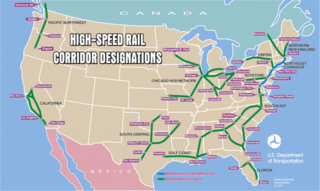
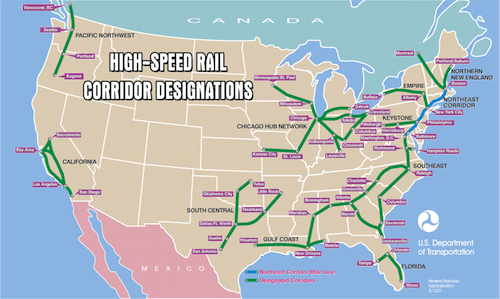
Moments ago, Obama was talking about his high-speed rail plan.
It's ambitious, and if approved, will provide lots of jobs. He is proposing a two-stage competitive grant process. In the first stage “applications will focus on projects that can be completed quickly and yield measurable, near-term job creation and other public benefits” and then there will be a “next round to include proposals for comprehensive high-speed programs covering entire corridors or sections of corridors.”
The question, of course, is where are these corridors?
—Northern New England Corridor (Boston, Montreal, Portland, Springfield, New Haven, Albany)
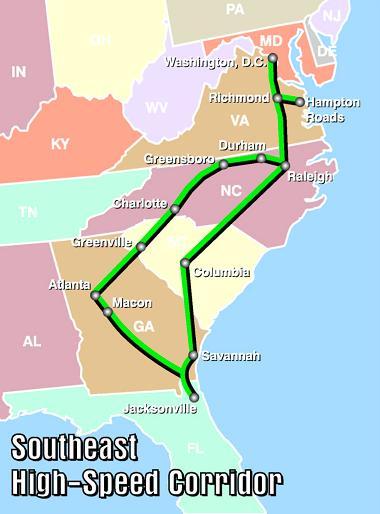
What does that mean locally (in the Southeast Corridor)? Here's a blowup from the US DOT website:
Now, that looks to me like Greensboro is incorporated in that route. But it also appears to me, based on this map, that Greensboro is about 80 miles north of its present location. I hope someone gets that worked out before they start laying the track.
Anyway, the DOT notes that the D.C.-Richmond-Charlotte segment has been the object of the "most intensive work" within the southeast corridor, so it may be online before, say, the Jacksonville-Raleigh part. The DOT also notes that, when completed, one should be able to travel (assuming speeds of 110 mph) from Charlotte to D.C. in about 6.5 hours. I would estimate that G'boro to D.C. would be in the neighborhood of 4 hours. Not too shabby.
The D.C.-NYC-Boston line, called the Northeast Corridor, isn't slated for high-speed rail. So if you want to take the train for G'boro to NYC, it'll be high speed until D.C. Then it's regular Amtrak.
It should be noted that the Southeast High-Speed Corridor was announced back in 1992. That's right, 1992. It's just that, until now, there wasn't the political will or capital to do more than devise plans for it. Under Obama, this might finally become a reality.
I can't believe that discontent is so high that there's secession talk.
What's startling is that this is coming from the usual suspects — armed "militia men" running around in the woods and hills of some back country state. It's coming from the Governor of Texas:
Texas Gov. Rick Perry isn't ruling out the possibility his state may one day secede from the nation.
Speaking to an energetic and angry tea party crowd in Austin Wednesday evening, the Lone Star State governor suggested secession may happen in the future should the federal government not change its fiscal polices.
"There's a lot of different scenarios," Perry told the rally, according to the Associated Press. "We've got a great union. There's absolutely no reason to dissolve it. But if Washington continues to thumb their nose at the American people, you know, who knows what might come out of that. But Texas is a very unique place, and we're a pretty independent lot to boot."
Perry also said: "Texas is a unique place. When we came into the Union in 1845, one of the issues was that we would be able to leave if we decided to do that." (Actually, that's not true and it's sad that the governor of Texas doesn't know his own history. Texas came into the union with the ability to divide into five states, not withdraw. And after seceding during the Civil War, Texas was allowed to re-enter the union after ratifying the 13th Amendment.)
Now, on the one hand, we all know what this is about. Perry is a politician and he was pandering to an anti-Washington crowd. Plus, Texas has always had that "don't mess with Texas" swagger, which I always find annoying. It's Perry's political rhetoric, and it doesn't stand scrutiny in light of Perry's political reality:
But still, secession talk is now on the table. And I, for one, am happy to let Texas go.
No more crazy Texas billionaires and politicians undermining America. The swift-boaters, much of the money to finance Reagan's contra war, Karl Rove, the Bushes…all Texas.
34 fewer Republican electoral votes, meaning either that no Republican would ever win a presidential election again… at least not unless he's extremely moderate.
Illegal Mexican immigrants sneaking over the border? Not our problem anymore. Texas will have to build that ridiculously expensive wall themselves.
Texas's monopoly on school textbooks will end. Most school textbooks in the USA are made in Texas, and the Texas legislature is always trying to mandate what goes in them (creationism, etc.)
It would be an economic boon to other states. NASA and Texas-based defense firms that contract with the United States could no longer be in Texas (a foreign country), so they would have to relocate to the upper 49. That's a huge jobs program.
America will no longer be obligated to play for social security, Medicare, etc. of Texans. Less for them, more for us.
Of course, for all the bluster and Texas swagger, I think Texans who choose to remain in a seceded Texas will soon find that they face the same problems they face now. Plus a host of new ones that the federal government would normally help with. (What's your intended social security system, oh, Republic of Texas?)
And they'll do fine for a while, sitting as they are on huge oil and gas reserves. But as America goes green and uses alternative energies more and more, Texas is going to find itself a veritable wasteland of useless resources. (Except, of course, the only things taht come out of Texas — steers and queers — as the saying goes).
Again, a lot of talk without having thought things through.
Besides, it's never going to happen.
UPDATE: For shits and grins, a foreign policy expert at Foreign Policy tells us what would happen to Texas if it seceded. Pay attention, haven't-thought-it-through crowd:
So what would Texas look like as a foreign country?
It would be the world's thirteenth largest economy — bigger than South Korea, Sweden, and Saudi Arabia. But its worth would crater precipitously, after NAFTA rejected it and the United States slapped it with an embargo that would make Cuba look like a free-trade zone. Indeed, Texas would quick become the next North Korea, relying on foreign aid due to its insistence on relying on itself.
On the foreign policy front, a seceded Texas would suffer for deserting the world superpower. Obama wouldn't look kindly on secessionists, and would send in the military to tamp down rebellion. If Texas miraculously managed to hold its borders, Obama would not establish relations with the country — though he might send a special rapporteur. (We nominate Kinky Friedman.)
So, Texas would need to court Mexico and Central American nations as a trading partners and protectors. Those very nations would also pose a host of problems for Texas. President Perry might find friends in anti-U.S. nations like Venezuela and Cuba, but their socialist politics would rankle the libertarian nation.
And Texas would become a conduit for drugs moving north to the United States from Mexico, maybe even becoming a narco-state. It would need to invest heavily in its own military and policing force to stop drug violence within its borders — taking away valuable resources from, oh, feeding its people, fending off U.S. border incursions, and improving its standing in the world.
In short: the state of Texas would rapidly become direly impoverished, would need to be heavily armed, and would be wracked with existential domestic and foreign policy threats. It would probably make our failed states list in short order. Probably better to pay the damn taxes.
Boyle said she was trying to take her new found fame in her stride.
"It's a challenge. Life is a challenge sometimes but this is different. And I like to test myself.
"If it all gets too much and they lock me up, I want a great big strait-jacket with spots on it. A pink one… and a big zip on the back so I can escape."
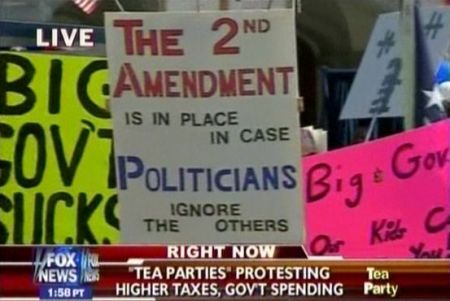
Imagine if that sign had been carried by a participant at a CAIR event?
UPDATE: Again, I'm sure this doesn't speak for a majority of the Tea bag protesters, but still, this type of "America-loving" speaks for some of them:
Another seemingly sedate protester, Brian Smith, a marketer from Greenville, S.C., who was in Washington on business and came by the rally, wandered equally off message. "I love my country and I don't like what's going on," Smith said. "Government — to be honest with you, and this will probably be misquoted, but on 9/11, I think they hit the wrong building. They should have gone into the Capitol building, hit out, knocked out both sides of the aisle, we'd start from scratch, we'd be better off today." I pointed out that "they" did try to hit the Capitol. "Yeah, I know, they missed," he said. "The wrong sequence. If someone had to go, it should have been the Capitol building. On that day I felt differently, but today that's the way I feel."
No one likes to pay taxes, so tax day typically attracts a range of right-wing Republicans, kooks, and demagogues, all of whom tell us how awful we have it. Herewith a short citizen's guide (that is, a citizen's guide that's short rather than a guide for short citizens) responding to the predictable charges:
1. "Americans pay too much in taxes." Wrong: The United States has the lowest taxes of all developed nations.
2. "The rich pay too much! The top ten percent of income earners pay over 72 percent of all income taxes!" Misleading: The main reason the rich pay such a large percent is they've become so much richer than the bottom 90 percent in recent years. If you look at what they pay as individuals — the percent of their incomes over and above the highest rate below them — you'll see a steady decline over the years. When Republican Dwight Eisenhower was president, the marginal rate on the highest earners was 91 percent (after deductions and tax credits, closer to 50 percent); by 1980 it was still up there, at 70 percent (an effective rate of closer to 45 percent); under Bill Clinton, it was 38 percent (an effective rate closer to 28 percent).
Look at the after-tax earnings of families and you'll see what's really going on. Between 1980 and 2000, the after-tax earnings of famlies at the top rose more than 150 percent, while the after-tax earnings of families in the middle rose about 10 percent. The Bush tax cuts of 2001 and 2003 raised the after-tax incomes of most Americans by a bit over 1 percent — but raised the after-tax incomes of millionaires by 4.4 percent.
3. "The bottom 60 percent pay only 3.3 percent of the taxes!" Misleading again. Most Americans are paying more in sales taxes than they ever have. Property taxes have also been rising at a steady clip. And Social Security taxes have also risen (thanks to the Greenspan Commission), while earnings over about $100,000 aren't subject to Social Security taxes. So-called "sin" taxes (mostly beer and cigarettes) have also skyrocketed. All of these taxes take a bigger bite out of the paychecks of people with lower incomes than they do people with higher incomes.
4. "Obama is raising your taxes!" Wrong. Obama is cutting taxes for 95 percent of Americans, by about $400 per person a year — not a whopping tax cut, to be sure, but not a tax increase by any stretch. Only the top 2 percent will have a tax increase, but even this tax increase is modest. Basically, they go back to the rates they were paying under Bill Clinton (their deductions will be limited to 28 percent, which is only fair). And they won't start paying this until 2011 anyway.
5. "The huge debts we're wracking up will cause your taxes to rise!" Wrong again. When it comes to the national debt, as I've said before, the relevant statistic is the ratio of debt to the gross domestic product. The only sure way to bring that debt down and make it manageable in future years is to get the economy growing again — which requires that, in the short term, the government spend a lot of money (because consumers and businesses won't). In the long term, the biggest source of concern is rising health-care costs. And that's something Obama and Congress are aiming to tackle.
6. "We have a patriotic duty to stand up against Washington taxes!" Just the opposite. We have a patriotic duty to pay taxes. As multi-billionaire Warrent Buffett put it, "If you stick me down in the middle of Bangladesh or Peru or someplace, you'll find out how much this talent is going to product in the wrong kind of soil. I will be struggling thirty years later." President Teddy Roosevelt made the case in 1906 when he argued in favor of continuing the inheritance tax. "The man of great wealth owes a particular obligation to the state because he derives special advantages from the mere existence of government."
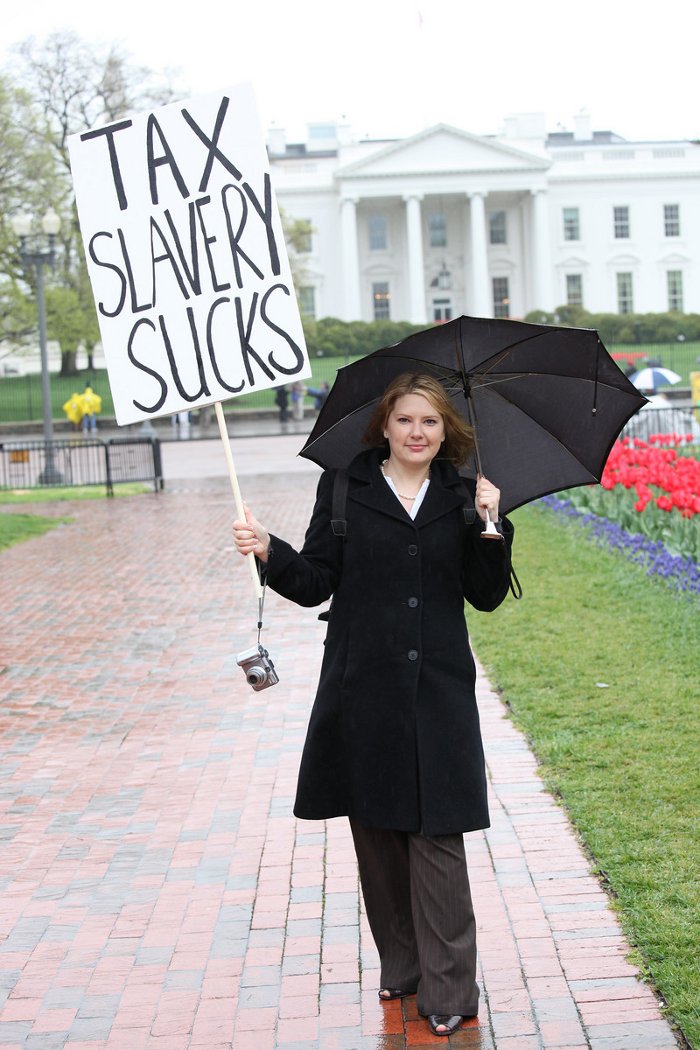
Michelle Poland, 33, a project manager from Southern Maryland who subcontracts map-making projects for the federal government, stood on the fringes of the rally with a large hand-painted sign that read, "Tax slavery sucks."
"I'm completely against the way my money is being spent," Ms. Poland said. "If we already have an extreme debt, we shouldn't spend more money."
Right. For starters, the government should cut out the middlemen who get paid with our tax dollars for subcontracting out map-making projects.
In Washington, D.C., protesters had planned to dump a million tea bags in Lafayette Square and even promised to put the bags on the tarps and clean up afterward. But their plans were thwarted after National Park Service officials said protesters didn't have the proper permit to dump the bags, NBC affiliate WRC TV reported.
"We have a million tea bags here, and we don't have a place to put them because it's not on our permit," said Rebecca Wales, lead organizer of D.C. Tea Party.
A D.C. think tank, the free market Competitive Enterprise Institute, said it would allow the dumping of the tea bags in its 12th floor conference room instead.
So the plan to dump the teabags in the park failed, meaning the protesters would have to dump the million-plus teabags…. in a conference room?….. of one of the protest organizers?
Yes, that'll show….them.
And then, someone got this bright idea:
At the Lafayette Square protest, someone reportedly threw a box of tea bags over a White House fence, forcing the Secret Service to briefly evacuate the North Lawn area.
This also forced the Secret Service to clear the protesters away while a robot device was called in to inspect the "suspicious package".
Good move.
Well, at least the D.C. teaparty went on as planned. Oh wait. It didn't?
A second D.C. rally that had been planned outside the Treasury Department also was foiled by the lack of a permit.
Did the patriots at the original Boston Tea Party have these problems?
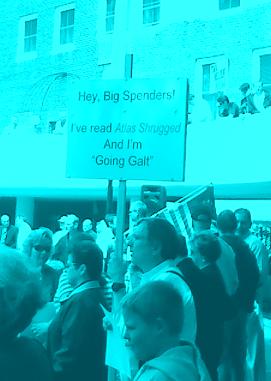
While I could only stay for the first hour or so of the 3 hour "protest", I can report the following:
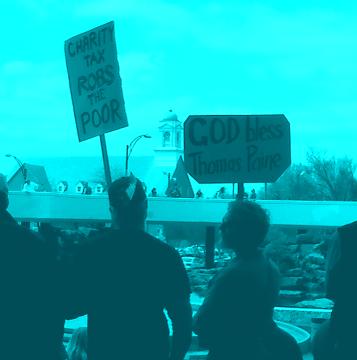
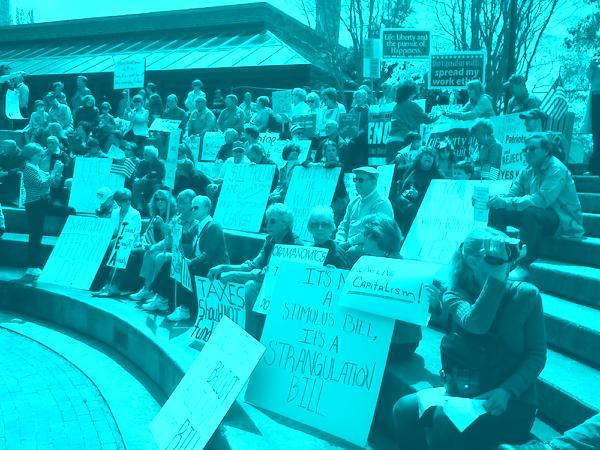
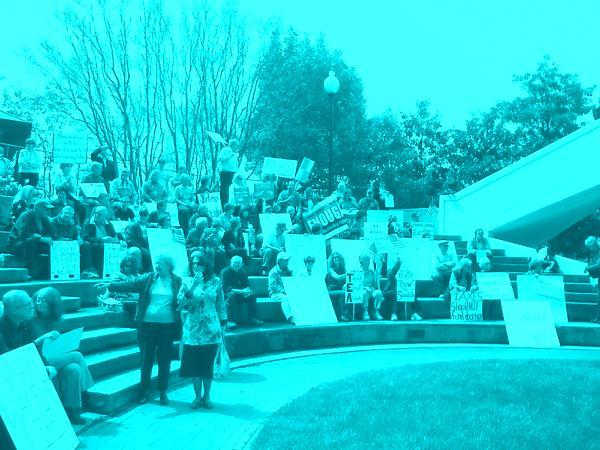
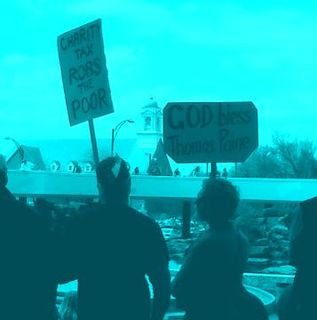
First of all, I take bad pictures, made even worse by the fact that I used a cell phone camera which was set to black/white (which actually seems to be blue/white). I'll pepper the most legible photos here. [UPDATE: BlueNC was there and took better photos].
The turnout was quite good. I would estimate about 800. Very few minorities (natch). Mostly the elderly (men and woman). The middle age was mostly women (to my surprise). And there were comparatively few under 30. There were a few families, and little girls were forced to carry signs that they didn't understand.
What exactly were they protesting?
Well, was like I posted a couple of days ago: it was basically "whatever you got", to paraphrase Jimmy Dean.
Going from the (handmade, yard-sale quality) signs, one clear thrust of the protest dealt with taxes, even though the Obama administration is cutting taxes for all except the very richest of Americans. Even then, the message wasn't clear.
A few signs said "No Taxes", but these were mostly held by kids (and presumably made by them as well). Most of the tax-related signage didn't go that far, but contained messages like "Taxed Enough Already" (the first letters forming "TEA") or "I already pay enough taxes". Apparently these people were protesting future tax increases.
One sign read "10% of the people pay 72% of the income taxes!! Is that fair??" I'm not sure what the signholder's intention was. The wealthiest 10% of Americans do pay the lion's share of income taxes — but that's because they receive the lion's share of income. That does strike me as fair. I would rather have the wealthiest 10% of income-earners pay 72% of the taxes rather than try to squeeze it out of the poorest 10% (or even the middle 10%), wouldn't you?
I didn't ask this sign carrier what he meant. It's probably not a good idea to, as this CNN reporter found out today:
[It's interesting for the teabagger in the above clip to invoke Lincoln in his anti-tax screed. Anyone want to guess the president who first mandated income taxes? Bueller? Bueller? And by the way, FOX aired this clip, cutting out the guy with the Obama-Hitler poster]
Of course, I'm trying to find logic where perhaps none exists. As publius writes:
The tea parties, however, don’t have much to do with logic.I’m sure our modern-day Samuel Adamses aren’t supporting big military spending cuts.I doubt they care that taxes are unchanged or lowered on 95% of families.I suspect they had almost nothing to say about the spending and executive overreach of the Bush years.Logical consistency, remember, isn’t the point.
The point is that tea parties give them an opportunity to reaffirm their own ideological self-image.In their own heads, they want to be “small government” people.In this sense, the tea parties are simply atonement – trying to “out out” the damned spot.
The other clear thrust of the protest dealt with the other end of the economic equation: government spending. Here, the message was even more disjointed. Many people objected, for example (again, going by the signs) to the bailouts. Others, to government "pork". And still others, to the stimulus. Many of the signs expressed concern about the deficit.
I personally don't have a problem with people expressing concerns about the government running up deficits. It should be a concern. But I was left to wonder where these people were when Bush was turning the huge surplus that Clinton gave him into a massive trillion dollar deficit.
One could argue, "well, Bush had to spend the massive amounts of money — we were attacked and that led to us fighting wars in Iraq and Afghanistan". Fair point, but we're still fighting those wars. And more importantly, what is the reasoning which leads one to condone deficit-spending in order to rebuild Iraq's infrastructure, but get upset about deficit-spending to rebuild our own infrastructure to combat an economic crisis?
But I digress.
Once the speakers took the stage, it got more interesting (for me). It was quite clear that their goal was to channel this mass discontent into pleas to join their organization, their think tank, their whatever.
The first speaker, an organizer from ncteaparty.com was refreshingly candid. He acknowledged that he knew diddly-squat about organizing protests, and suspected that most of the people there had never been to a protest.
The second speaker was a woman from the John Locke Foundation, and it was clear to me that she was either (1) stupid or (2) catering to the naivety of the crowd. It was remarkable. She said she was going to talk about "freedom". And then she proceeded to talk about excessive government spending.
It was never made clear to me what excessive government spending has to do with "freedom". I mean, here were hundreds of people exercising their freedom to assemble, their freedom to protest, etc. Even I, an opponent of everything said there, was moved by the "vox populi"ness of the tea party protest. I LOVE it when the people speak, even if I don't agree with them.
I apparently was the only one struck by the irony that these people were free to protest, and yet they had these speakers and signs that somehow suggested that the policies of the Obama government were infringing on freedoms. What freedoms they never said.
But every time this particular speaker used a phrase with the word "freedom" in it, people applauded. When she failed to use that buzzword (or other patriotic buzzwords), people sat on their hands. It was clear to me that many people in this crowd weren't really listening to, or not understanding, what was said so much as they were looking for an auditory cue to wave their flags (literally in some cases).
This same woman also talked about responsibility. She took on, for example, the car industry. They had the responsibility of running their own businesses. They could have, she said, not hired union workers. But they did. Now those auto manufacturers have to take responsibility for their actions, and not rely on government bailouts.
It was a cogent argument (one which I won't refute here), but as I listened to her, I wondered how her anti-union message would have been received at a tea party in Detroit or Flint.
This woman, as I said, was from the John Locke Foundation. She touted their alternative budget as being better than then the one presented by the NC legislature, which (she said) was full of tax increases and wasteful government spending.
She railed in particular against the NC government spending so much money on "social programs" (adding that such exhuberant spending limits "your freedom" although, again, I don't know what one has to do with the other).
I took a gander at the John Locke alternative budget to the one passed by the NC lesiglature. As expected, it lowers taxes drastically, and cuts government spending to "social programs", just as the speaker said it would. But at the rally, the speaker didn't bother to mention what some of these "social programs" were. I will:
Cultural programs ($26,509,810 less) — NC Arts Council, for example, gets over $8 million less
Blind and Deaf/Hard of Hearing Services ($1,247,231 less)
Public Health ($20,565,091 less) — includes $2,000,000 less for HIV prevention, $329,000 less for public health testing (includes elimination of jobs there), $2,000,000 less for the Breast and Cervical cancer program, elimination of UNC's OASIS program, etc.
Vocational rehabilitation programs ($3,591,938 less) — including merging the entire disability administration with the Blind and Deaf Services (which was gutted — see above)
Crime Control and Public Safety ($4,468,222 less) — including Flood Map planning, National Guard and rape assistance programs
Agriculture services ($23,160,175 less [more than half of that area's budget]) — including pesticide control, food testing
Clean Water Management Trust Fund (elimination in its entirety — all $100,000,000): John Locke Foundation would let industries self-police
Miscellaneous: Cut DMV Driver's License Division by $4.7 million by merging DMV offices (because they're not crowded enough)
The list goes on and on and on.
And then, this same woman, griped that the North Carolina government cut spending on transportation and prisons too much.
Now, why does government budget spending increases in any of the above programs "take away your freedoms", but a failure to increase spending in transportation/prison as high as John Locke's budget also "take away your freedoms"? This apparently was lost on the audience. But they booed and cheered appropriately, as long as whatever was said was being couched in jingoistic nationalistic terms (like "freedom").
By the way, I'm not saying that limiting government spending is bad. Some things are worth spending money on; others, maybe not so much. The point is: it's entirely subjective. I'm just saying that if she had bothered to provide a complete list of these eeeeevil social programs to the flag-waving audience, I have no doubt that most of them would have said (at some point): "Wait a second. That's a good program."
But to rail against ALL taxes as oppressive, or ALL government spending as "wasteful", is just plain oversimplified to the point of silliness.
And that brings me to MY main point.
These protesters were not stupid or evil. They just hadn't thought things through.
It's easy to be against "wasteful government spending" when you're never called upon to even think about what is supposedly "wasteful".
Protesting government spending is meaningless unless you say what you'd cut.
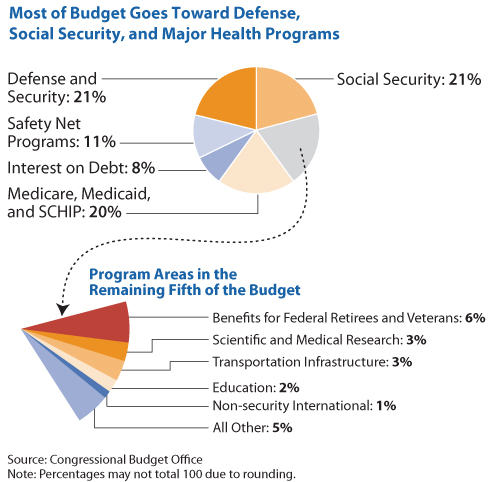
If you favor no bailouts, then say so. If you want to see the banking system collapse, then say so. If you think the recession demands no fiscal stimulus, then say so. If you favor big cuts in Medicare, Medicaid, social security and defense, then say so. I keep waiting for [tea party promotor Glenn] Reynolds to tell us what these protests are for; and he can only spin what they they are against.
All protests against spending that do not tell us how to reduce it are fatuous pieces of theater, not constructive acts of politics. And until the right is able to make a constructive and specific argument about how they intend to reduce spending and debt and borrowing, they deserve to be dismissed as performance artists in a desperate search for coherence in an age that has left them bewilderingly behind.]
It's easy to be against high taxes, if your brain isn't allowed to consider what that tax money will be spent on. It kind of reminded me of the rabble in this Simpsons episode, where the townspeople couldn't simply grasp the connection between taxes and social services:
The most striking thing about the whole protest was the constant reference to the government as "they". Apparently, the tea bag segment of the population loves America, but hates the American government. They love the Founding Fathers, but hate the government that the founding fathers formed. They profess to love the Constitution, but they hate the government created by that document. And I'm not talking about the "Obama government" — these people generally hate government as a concept. (They only complain about it, however, when a Democrat is at its head.)
The second speaker that I listened to was from the Civitas Institute. He again fired the masses by going for those jingoistic phrases. He was big on the symbolism of "Don't Tread On Me". The Civitas Institute had 7 or 8 Gadsden flags throughout the plaza, all bearing the iconic snake and bearing the words "Don't Tread On Me".
I won't get into this speaker too much, except to say that he was either stupid, or playing on the naivety of the crowd he was addressing. At one point, for example, he said this:
"…And whatever happened to the free market? I mean, these bailouts? Let me ask you: What would have happened if AIG had gone bankrupt? I'll tell you what: it would have gone bankrupt.But nooooo, we had to save it. It was 'too big to fail'." [boos, cheers, etc.]
This is just plain wrong, and there's not an economist — on the left or right — who would agree with this speaker's assessment of the AIG bailout. Look, AIG insures banks. Big banks. Big banks who made bad investments, and took out insurance on those bad investments. If AIG had failed, then those banks would be unable to collect that insurance, and THEY would have failed. And then other banks would freeze up, and there would have been no flow or credit to businesses large and small. Companies would fold, and the unemployment rate would be twice what it is now.
So the point of bailing out AIG wasn't to save AIG, its golden-parachuting senior management, or even its employees. The point was, ultimately, to save Main Street, and us. And anyone who doesn't recognize that shouldn't get in front of a microphone to talk about it. (That said, one can legitimately complain about the amount of the AIG bailout, or certainly the terms tied to the bailout, or any number of related issues. But to complain the necessity of it? Moronic.)
As I left the tea party to return to work (much to my sadness, because nationally-syndicated columnist and K'vegas resident Nathan Tabor was due to speak), the Civitas speaker was going on about government "takings", a legal reference to property. The Constitution does not allow the government to "take" your property without "just compensation". To this guy, that meant that the government cannot regulate your property, which, of course, is an entirely different thing.
The example he used was an "intermittent stream", which is a stream that forms when it rains a lot. North Carolina land use laws do not permit building on an areas that have intermittent streams — where there is a stream during the rainy season. Yes, that was his outrage, and he went on about it, invoking the flag, and freedom, and Thomas Paine.
Again, the audience sat on its hands (seriously, he's talking about streams???) until he said a sentence that included the word "freedom" or "God" or "America". Then, applause.
He then turned to the example of toilets, saying that because the government has so many regulations regarding toilets, the third-largest thing being smuggled in from Mexico (after drugs and people) is toilets. I don't know if that Mexico "fact" is true or not, but his point was that toilet smuggling is a consequence of "needless" government regulation. And the audience cheered. What he didn't the audience was that in the 1990's, the federal government essentially banned high-flow toilets because they wasted water. That creates a problem, especially in times of drought. Now, had he mentioned that to the crowd, I'm sure there would have been a handful of tobacco farmers who get hit hard whenever there is a drought or water shortage. And their take on that "needless" government regulation would have been quite different.
Again, that was my point. The people had legitimate concerns, but in the end, they hadn't thought things through.
Anyway, the toilet hissy-fit was my cue to leave.
I'll leave the coda to This Modern World's Greg Saunders:
In the grand scheme of things, getting people to complain about taxes on April 15th might be the easiest thing in the world. It’s right up there with “eating ice cream on a hot summer day” and “laughing whenever Glenn Beck cries”. Bitching about taxes is America’s true pastime. So when a few thousand people gather on tax day to whine about their taxes (after getting massive tax breaks, btw), it’s hardly the second coming of the American Revolution. Hell, I remember a time six years ago when millions of people took to the street to protest the government. We all saw how well that worked out.
When their rallying cry is “Grrrr…I hate you TAXES!”, there won’t be a whole lot left to keep the tea bagging movement together after April 15th. Manufactured-populism and a fractured-understanding of American history will only take you so far. The great-great-great-great grandchildren of liberty will have to find some other crusade to motivate them like birth certificate forgeries or investigating whether Bo Obama was really a rescue dog. Sure, some die-hards will stick around like the asshole who keeps flipping through your DVD’s at three in the morning oblivious to the fact that the party is over, but within a few weeks, the only people left to carry the “tea party” torch will be the GOP & Fox News personalities trying to recapture the “good times” with all the subtlety and humility of Chubby Checker trying to get everyone to do the twist.
I’m going to miss the “Tea Party” movement. I’m going to miss the powdered wigs and the lunatic ranting. I’m going to miss the ideological uncertainty and the unpragmatic futility (seriously, you’re mailing tea bags to the White House to demand lower taxes after you just got a tax cut?). Most of all, I’m going to miss the jokes. These last few weeks have been a golden age for juvenile humor that passes for insightful political commentary. It’s a rare movement that chooses to describe itself with terminology that also means “testicle slapping” and those of us who relish in the foolishness of conservative activism will be much worse off for it.
I'll resist the urge of many of my liberal co-bloggers (as well as members of the librel drive-by media) to make snickering sexual references about the hissy-fit-a-thon being thrown across the country. But I just wanted to remind you it is happening.
The gist of the rather nebulous complaints by these teabaggers is that the government taxes and spends too much, which is why these event are held on Tax Day. None of these people, mind you, have concrete example about where they want to cut federal spending.
Oh, sure, they'll tell you that the "pork" and "wasteful spending" needs to be cut out, and that's hard to disagree with. Unfortunately, they would be hard-pressed to tell you what the pork actually is. To cut federal spending as much as they want to, on the scale of ten to 40 percent, you would have to do a hell of a lot more than drop spending for bridges-to-nowhere. You would have to gut major major programs.
What, exactly, would they propose to cut?
Obama, I thought, did well, to explain the need for federal spending. It's buried in this clip for Olbermann last night.
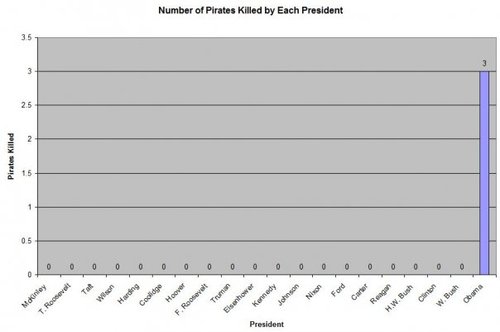
The USS Bainbridge, the Navy desroyer which rescued that captain from the Somali pirates, was diverted yesterday to intervene in another pirate attack on another U.S. vessel.
I mention this only to raise that ironic fact that the USS Bainbridge is named after Captain William Bainbridge, who fought against pirates in the First and Second Barbary Wars in the early 19th century, again off the coast of Africa. (Bainbridge himself was captured and held hostage by pirates at one point).



 I personally don't have a problem with people expressing concerns about the government running up deficits. It should be a concern. But I was left to wonder where these people were when Bush was turning the huge surplus that Clinton gave him into a massive trillion dollar deficit.