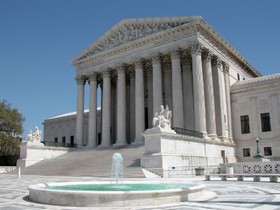
Stipulation

Ken AshfordWar on Terrorism/TortureLeave a Comment

Can we all at least agree that "torture" doesn't become "not torture" by virtue of the fact that the victim provides information?

President Bush got on the world stage and said, "We do not torture".  Now, it is beyond all doubt that we did conduct torture.  The response from Bush defenders (and Cheney himself) is that we got good information from it that saved lives.

Well, then what is their argument?  "We do torture, but it's okay (since we get something from it)"?  If that's their argument, they should say so, even if it exposes Bush as a liar.  Why can't those few still supporting the interrogation tactics just say that?

By the way…. last week, conservatives were complaining Obama was establishing a socialistic fascist dictatorship.

This week, conservatives are complaining Obama does not want to torture his opponents.

Go figure.

UPDATE:  Publius echoes my sentiments:

Via Andrew Sullivan, Steve Chapman raises a really good point – there’s simply no way that the effectiveness of torture can solely justify its use.  And I think he poses a difficult logical problem for torture supporters.

Chapman notes that if “effectiveness” is all we care about, any form of torture would necessarily be ok.  One could, for instance, drag in a detainee’s child and begin torturing him or her in front of the detainee.  I assume that even the most hardened torture advocates would draw a line there.  If they didn’t, that tells you pretty much all you need to know.

But if they do concede that certain methods go too far (i.e., that such things are relevant), then they’re stuck having to argue that the methods we used simply aren’t that bad.  In other words, if they concede a line exists, then they’re forced to argue that these methods don’t cross it.

And defending these methods seems very difficult, if not completely disingenuous.  I mean, it requires saying that heinous acts like slamming heads into walls, waterboarding, stress positions, striking faces, and locking people up in small boxes are all ok.  And remember – those are just the formally legalized tactics.  They exclude the grotesque acts that these tactics inevitably mutated into – things like murders and electrodes to testicles at Abu Ghraib.

All in all, it’s a fairly clarifying debate – one that will be remembered for some time.

At Long Last, A Good Use Of Twitter

Ken AshfordScience & TechnologyLeave a Comment

Celebrities tweet.  Politicians tweet.  News organizations tweet.  It seems that everyone (yes, me too) has something to tweet.

And that's fine by me.  Say what you want to say, and praise God that you must to do it in 140 charactors or less.

But I wouldn't argue that there is much social utility to Twitter.  It's just this… thing that's out there.  Use it, don't use it, follow tweets, don't follow tweets.  But why the obsessive media focus about Twitter? Seriously, who gives a damn?  Who gives a damn if Ashton Kuscher has more twitter followers than CNN?

That said, it was nice to read this story, because it actually made me think that Twitter does have limited social utility, for a limited set of people:

Adam Wilson posted two messages on Twitter on April 15. The first one, "GO BADGERS," might have been sent by any University of Wisconsin-Madison student cheering for the school team.

His second post, 20 minutes later, was a little more unusual: "SPELLING WITH MY BRAIN."

Wilson, a doctoral student in biomedical engineering, was confirming an announcement he had made two weeks earlier — his lab had developed a way to post messages on Twitter using electrical impulses generated by thought.

That's right, no keyboards, just a red cap fitted with electrodes that monitor brain activity, hooked up to a computer flashing letters on a screen. Wilson sent the messages by concentrating on the letters he wanted to "type," then focusing on the word "twit" at the bottom of the screen to post the message.

The development could be a lifeline for people with "locked-in syndrome" — whose brains function normally but who cannot speak or move because of injury or disease.

I just hope that this technological breakthrough will be permitted only for the handicapped.  The last thing I want is for people to tweet merely by thinking.

For Today Is “Talk Like Shakespeare” Day, Brothers…

Ken AshfordTheatre, YoutubeLeave a Comment

Shakespeare

… and he who sheds common parlance for that of the Stratford bard shall be my brother.

Thou recollects an army of good words are penned of habit upon the annual pirate's day.  And joy it doth bring to chroniclers of daily online musings.

But lo, the sheen of such a venture darkens upon the news of a forenight past, when made-and-true pirates from the dark continent boarded a vessel and hostaged her stalwart captain.  And tho the king's sharpshooters laid low the cold-hearted sea-heathens, piracy talk has lost its merriment.

But weep not, for a newish fad abounds.  'Tis "Talk Like Shakespeare" Day that we now herald.

Wouldst thou deign to be understood in such a task?  Then heed you these rules:

  1. Instead of you, say thou. Instead of y’all, say thee.
  2. Rhymed couplets are all the rage.
  3. Men are Sirrah, ladies are Mistress, and your friends are all called Cousin.
  4. Instead of cursing, try calling your tormenters jackanapes or canker-blossoms or poisonous bunch-back’d toads.
  5. Don’t waste time saying "it," just use the letter "t" (’tis, t’will, I’ll do’t).
  6. Verse for lovers, prose for ruffians, songs for clowns.
  7. When in doubt, add the letters "eth" to the end of verbs (he runneth, he trippeth, he falleth).
  8. To add weight to your opinions, try starting them with methinks, mayhaps, in sooth or wherefore.
  9. When wooing ladies: try comparing her to a summer’s day. If that fails, say "Get thee to a nunnery!"
  10. When wooing lads: try dressing up like a man. If that fails, throw him in the Tower, banish his friends and claim the throne.

Presently, thou may witness thine actors doing exceedingly fine homage to the Bard, excerpted from their satirical abridgement.  By way of the YouTube ThouTube (in offense of the king's copyright laws, methinks), the jesters speak folly thusly:


Earth Day

Ken AshfordEnvironment & Global Warming & EnergyLeave a Comment

P1060120-thumb-465x310 

Lake Mead, near Las Vegas, Nevada, taken last week. The “bathtub ring” records the water level less than a decade ago. Until recently, there was a “No Fishing” sign on the cantilevered pier. The road on the left was carved from what used to be lakebed. The triangle-shaped hill in the upper right is Pyramid Island, although it’s no longer an island. The protruding landform in the upper left is Saddle Island—also no longer an island. The water volume of the lake is down by more than half since 2000. The Southern Nevada Water Authority estimates that it will be significantly lower by July. The main reasons for this are declining snowmelt and increased water use for irrigated agriculture.

Any questions?

Corporal Punishment In NC Schools: If We Can Beat Mules, Why Not Kids?

Ken AshfordEducation1 Comment

North Carolina is one of the few states that permits educators to hit students.  Although the practice has been banned by some school districts in this state, 60 of the 115 school districts think that a teacher walloping a kid is a good way to maintain discipline.

That has prompted legislation about corporal punishment in schools.  A bill is now making its way through the General Assembly this year, havind passed a House committee yesterday.  The bill would not outright abolish the practice though.  It just adds more notification and parental consent safeguards when a child is spanked at school. That's all the supporters of the bill thought they could get passed this year.  It will help a little, but striking kids in school will continue as long as parents agree.

The bill banning corporal punishment outright was brought last session, but it failed.  Hence, the watered-down version this year. Last session, officials with the North Carolina Association of Educators, the UNC School of Social Work and the North Carolina PTA all supported a corporal punishment ban. They talked about the culture created by corporal punishment administered by authority figures, the bad example it provides for kids, and the research that shows it is not an effective way to discipline children.

But opponents of the bill loved to brag, it seemed, about how much they were hit when they were young.  Rep. Ronnie Sutton, for example, told his colleagues that when he was growing up, he was "beaten like a rented mule once or twice a week at school."

What Sutton apparently didn't realize is that in today's world, it would be illegal to beat a rented mule once or twice a week.  We have animal cruelty laws.

It's not hard, therefore, to expect the same treatment and protections being given to children in schools.

This session's bill (PDF) passed the committee and now goes to the House floor.  Opponents are already objecting on the grounds that the bill requires each school district to compile stats on the number of times corporal punishment was administered, and furnish that info to the State Board of Education.  Opponents are calling this a "bookkeeping nightmare".  Yikes — you mean it happens that often?

Movie Deaths

Ken AshfordPopular CultureLeave a Comment

Johnny Depp, Dustin Hoffman, Al Pacino, Brad Pitt, Robert DeNiro, Jack Nicholson, and Bruce Willis.

(1)  Four of these guys have died nine times (and no more) in the movies.  Name them.

(2)  One of these guys died nine and a half times in the movies (i.e., he died ten times, but his character was resurrected from the dead in a sequel).  Name him.

(3)  One of these guys died eleven times in the movies.  Name him.

(4)  One of these guys died fourteen times in the movies.  Name him.

[Answers]

We Have Ways Of Making You Bolster Our Untenable Position

Ken AshfordWar on Terrorism/TortureLeave a Comment

Bush/Rumsfeld/Cheney wanted to find links betweel al Qaeda and Iraq, so they could make their case to the American people that invading Iraq was a proper response to 9/11.  They didn't have any evidence of links, but they wanted their Iraq War, so they tried to get that "evidence" out of terrorist suspects….by torture:

A former senior U.S. intelligence official familiar with the interrogation issue said that Cheney and former Defense Secretary Donald H. Rumsfeld demanded that the interrogators find evidence of al Qaida-Iraq collaboration.

"There were two reasons why these interrogations were so persistent, and why extreme methods were used," the former senior intelligence official said on condition of anonymity because of the issue's sensitivity.

"The main one is that everyone was worried about some kind of follow-up attack (after 9/11). But for most of 2002 and into 2003, Cheney and Rumsfeld, especially, were also demanding proof of the links between al Qaida and Iraq that (former Iraqi exile leader Ahmed) Chalabi and others had told them were there."

It was during this period that CIA interrogators waterboarded two alleged top al Qaida detainees repeatedly — Abu Zubaydah at least 83 times in August 2002 and Khalid Sheik Muhammed 183 times in March 2003 — according to a newly released Justice Department document.

Torturing people to get the truth is repulsive.  But torturing people to get them to speak your vision of the truth is repulsive and fucked up.

Strip-Searching Students

Ken AshfordConstitution, Supreme CourtLeave a Comment

Ah, the days when I used to write in detail about Supreme Court cases in this blog are long in the past.  A shame, really.

But the Supremes did happen to hear a rather interesting Fourth Amendment case yesterday.

I should preface by saying that the nation's highest court hears a lot of Fourth Amendment cases: in the neighborhood of 4 or 5 every year.  You would think that, by now, the law of searches and seizures would be pretty much set in stone.

But no.  Seems that fact patterns arise in the real world that test that gray area where the right to privacy runs headlong into the government need to prevent crime.

Such was the case yesterday, Safford United School District v. Redding.

Here are the underlying facts:

Savana Redding, had been subjected to a strip search in 2003 by school officials in Safford, Ariz. She was 13 and in eighth grade at the time.

The officials were acting on a tip from another student and were looking for prescription-strength ibuprofen, a painkiller. They made Ms. Redding strip to her underwear, shake her bra and pull aside her panties. The officials, both female, found no pills.

Ms. Redding, a model student, had never been in trouble with the law and never been so much as called to the principal's office.  The other student who provided the "tip" to school officials was a former friend of Ms. Redding (the two had drifted apart — the friend had fallen in with the goth crowd, while Ms. Redding was one of the goody-two-shoes).

The strip search traumatized Ms. Redding to the point where she eventually changed schools (she is now a freshman in college).

The Fourth Amendment protects against "unreasonable searches and seizures".  It's that word "unreasonable" that is always the sticking point in these kind of cases. 

Is it "unreasonable" for the government (i.e., school officials) to search for drugs in the possession of students — students for whom the govenment is responsible (at least during school hours)?

No.  And locker searches, for example, have been routinely upheld as constitutional.

But strip searches, obviously, are more invasive of one's privacy when compared to a locker search.

On the other hand, students now know that their lockers are subject to random searches.  So where do they hide drugs?  In their underwear.

So yesterday, the Supremes wrestled with this balance, as the two sides made their arguments before the bench.  SCOTUSblog reports on yesterday's events:

It was common for members of the Court — and, especially, Justice Ruth Bader Ginsburg — to express discomfort with an Arizona prinicipal’s order for a close-to-naked search of a 13-year-old girl.  But that sentiment did not appear to be as strong as the concern that drugs may be so destructive for teenagers that some surer means of detecting them had to be acceptable under the Constitution.

No more telling illustration of the Court’s mood emerged than Justice David H. Souter — whose vote would almost have to be won for student privacy to prevail – expressing a preference for “a sliding scale of risk” that would add to search authority — including strip searching — based on how school officials assessed whether “sickness or death” was at stake.

“If the school official’s thought process,” Souter asked, “was ‘I’d rather have a kid embarrassed rather than some other kid dead,’ isn’t that reasonable under the Fourth Amendment?”  Stated in that stark way almost compelled agreement, without regard to whether a student singled out for a strip search was actually adding to such a risk, but was only the target of a classmate’s unverified tip.

Along with Souter, two other Justices whose votes might turn out to be crucial — Stephen G. Breyer and Anthony M. Kennedy — were plainly more concerned about the drug problem than with student privacy. Both of those Justices, in past cases involving students and suspected drug use, have suggested that students’ rights were not very sturdy.

The Washington Post adds:

Souter asked Wright [representing the school district] why the court should accept his "blanket assumption" that the search for any contraband, even an aspirin, allows a strip search. "I mean, at some point it gets silly," he said.

Redding's attorney, Adam Wolf of the American Civil Liberties Union, agreed that the type of drug does not matter if school officials do not have specific reason to believe it is hidden in a student's underwear.

Kennedy seemed to find that hard to buy. "The hypothetical is that there is a very dangerous drug, meth, that's going to be distributed and consumed that afternoon," he told Wolf.

The same rules apply, Wolf replied. "The Fourth Amendment does not . . . countenance the rummaging on or around a 13-year-old girl's naked body," he said. In one of the many memorable, if not exactly legalistic, phrases uttered in the courtroom yesterday, Wolf said there was a "certain ick factor" in the school officials' actions.

Justice Breyer also confessed that when he was in high school, he would (like all students) have to undress in the gym locker room, and things were often stuffed down "my underwear".  This led to a very un-judicial like laugh (especially from Clarence Thomas) — while Breyer tried to backtrack: "Uh… not my underwear".

It's hard to know where the Court will ultimately come down on this.  Clearly, they are not going to ban student strip searches altogether.  But then what?  What's the new constitutional guideline?

It's hard for me to think where I come down on this, too.  It seems to me that strip searches are (sadly) necessary and generally reasonable.  On the other hand, they really shouldn't be randomly conducted, like locker searches. 

There has to be, in my view, sufficient suspicion that a particular student is carrying drugs.  Is a "tip" from a fellow student enough?  Well, there it gets a little dicey.  Students will lie in order to "get" other students (this is precisely what happened to Ms. Redding).  I don't know.

Is there a less invasive way to search for drugs on the body of a student?  I suspect, for some drugs (remember, this case dealt with over-the-counter Ipuprofin) the obvious alternative — drug-sniffing dogs — won't work.

Tough call for the court.  It'll be interesting to see where they fall.

UPDATE:  Slate has a more colorful re-cap of yesterday's oral arguments, and also notes this:

On the courthouse steps after argument today, Redding is asked what she'd have wanted the school to do differently. "Call my mom first," she says.

Well, that seems perfectly reasonable.  I should have thought of that.

“Stop It Right Now Or I’ll Pull This Car Over And Let You Out”

Ken AshfordSex/Morality/Family ValuesLeave a Comment

Ah, the classic parental threat to the bickering kids in the back seat of the car.

One parent actually went through with the threat.  Result?  FAIL:

Madlyn Primoff, a 45-year-old Park Avenue lawyer, has been accused of doing just that Sunday evening in downtown White Plains, N.Y. Police say she ordered her two quarreling daughters from the car and drove away. One is 12, the other 10.

The 12-year-old ran after the car and was let in when she caught up. She and mom went home to Scarsdale, about 3 miles away.

The 10-year-old was left behind, crying. A passerby saw the girl, bought her ice cream and called the local police, who took her to the station.

The girl gave police her mother's name and their address, a $2 million house in well-to-do Scarsdale.

Soon after, Primoff called White Plains police to report her daughter missing. Police told her to come get her. Primoff was arrested when she showed up.

She pleaded not guilty yesterday to endangering the welfare of a child. A temporary order of protection was issued, barring her from contact with the girls.

Lesson to be learned for all you parents out there.

A Lie Can Get Halfway Around The World Before The Truth Can Get Its Boots On

Ken AshfordObama OppositionLeave a Comment

An interesting article by Michael Tomasky in The Guardian looks out how a conservative meme — one that is blatently false — gets started and circulated. 

Tomasky was reading an interview with Newt Gingrich in which Gringrich said:

"You have Obama nominating Judge Hamilton, who said in her ruling that saying the words Jesus Christ in a prayer is a sign of inappropriate behavior, but saying Allah would be OK. You'll find most Republican senators voting against a judge who is confused about whether you can say Jesus Christ in a prayer, particularly one who is pro-Muslim being able to say Allah."

Who is Judge Hamilton, and did she say that the words "Jesus Christ" in a prayer are inappropriate, but "Allah" would be okay?

No, of course Judge Hamilton (who is a guy) didn't.  It's a bald-faced, out-and-out lie.  But what prompted Gingrich to say that — to even think that?

Tomasky tracked the lie to its source (some hyperbolic rightwing site) and, of course, he found the judge's opinion.  Interesting read.  Tomasky concludes:

What kind of person can say or write such blatant lies? And I'd like to report that this is unusual, but this kind of slippery illogic is standard operating procedure on today's right. Find something that might inflame opinion and stoke prejudice, and pump it. Doesn't matter that it isn't really true. By the time the other side explains that it isn't true, we'll already have won. They know that no one's going to read page 49 of a legal opinion. As it happens this time someone did, but often, alas, they're right.

These are sick, sick people. May their Jesus consign them to history's ash heap.

Can Wingnuttery Be Cured?

Ken AshfordRepublicansLeave a Comment

I used to read Charles Johnson of the Little Green Footballs blog.  I stopped because he was, to my mind, just another batshit crazy conservative, and his commenters were often outright racist.  Blatently, unapologetically so.

But according to The Washington Independent, something has happened to Charles as of late:

But in the early days of Barack Obama’s presidency, LGF has become better known for the various fights it picks with many on the right — including conservative bloggers, critics of Islamic extremism, and critics of Islam in general who used to be Johnson’s fellow travelers.

Johnson has blasted Fox News host Glenn Beck, promoting a video from a Beck-inspired party that shows conservatives ranting about evolution and arguing that “this turn toward the extreme right on the part of Fox News is troubling, and will achieve nothing in the long run except further marginalization of the GOP.” In response to the news that the Department of Homeland Security was watching for increased right-wing extremism — something that most of the conservative blogosphere, like most Republicans, responded to with angry ridicule — Johnson pointed to the recent arrests of right-wing terrorists and criticized bloggers for buying into “distorted claims” about the DHS report. When Obama genuflected before King Abdullah of Saudi Arabia, Johnson found archival video of President Bush bowing to take a medal from the King and urged conservatives to turn down their “hyperventilating nonsense.”

This has the blogger’s peers asking themselves the same question, over and over: What the heck happened to Charles Johnson?

Either he's gone sane, or the right wing around him has gone so far afield that even Johnson can't help but take notice.

Interesting reading.