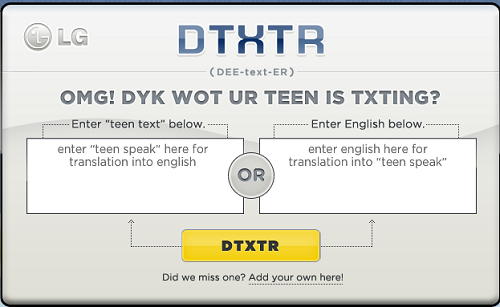
LG (maker of Voyager and other cell phones) has provided a web service called DTXTR (de-text-er) which translates teen txt shorthand to English, and vice versa.
That's because (according to LG), teens text an average of 1700 times per month (wow!); texting is more common than actual phone calls. (And 42% of teens report that they can txt with their eyes closed!)
As a result, a whole new shorthand lingo has developed. And we old farts (parents) need to keep up apparently.
Look for example, at LG's glossary of txt terms — this is for acronyms beginning with Y only.
Ten years ago, nobody knew what it was to "blog" or "text" or "tweet" or "IM".
So what new thingee will we be doing 2-3 years from now?
I predict that we'll be "waving", thanks to Google.
What is the "wave"? Well, it's hard to describe. Basically, the folks at Google were wondering why we communicate in different ways — email vs. chat, conversation vs. documents, etc. They decided to combine it all. The result they got? Google Wave.
Here's how it works: In Google Wave you create a wave and add people to it. Everyone on your wave can use richly formatted text, photos, gadgets, and even feeds from other sources on the web. They can insert a reply or edit the wave directly. It's concurrent rich-text editing, where you see on your screen nearly instantly what your fellow collaborators are typing in your wave. That means Google Wave is just as well suited for quick messages as for persistent content — it allows for both collaboration and communication. You can also use "playback" to rewind the wave and see how it evolved.
Here's a pic (click to embiggen):
Yeah, ok. Cool. But here's the $64,000 question: why? I guess it might be good if two or more people are collaborating on, say, a screenplay or something. In fact, that might be kind of fun. But what other uses might it have?
In the end, I suppose it doesn't matter. There's no "why" to Twitter or Facebook either, but people seem to gravitate to it.
So I'm going on the record as predicting that in 2011, we'll all be "waving". For better or for worse.
The test went like this: put a marshmallow on the table in front of a four-year-old; tell the child that he or she can either eat the marshmallow now, or leave it uneaten for a while (15-20 minutes) and receive a second marshmallow at the end of the test; have the researcher leave the room for the prescribed period of time; if the child sits alone with the marshmallow for the test period and does not eat the treat, the researcher returns and gives the child two marshmallows to eat. This a test of delayed gratification — the ability for a person to put off the instant thrill of one marshmallow for the promise of two marshmallows down the road. (The research also involved treats other than marshmallows — including small toys and other treats — presumably to control for kids who just don’t like marshmallows.)
Here’s a snippet (emphasis added):
Most of the children [struggled] to resist the treat and held out for an average of less than three minutes. “A few kids ate the marshmallow right away,” Walter Mischel, the Stanford professor of psychology in charge of the experiment, remembers. “They didn’t even bother ringing the bell. Other kids would stare directly at the marshmallow and then ring the bell thirty seconds later.” About thirty per cent of the children, however, were like Carolyn. They successfully delayed gratification until the researcher returned, some fifteen minutes later. These kids wrestled with temptation but found a way to resist.
… Once Mischel began analyzing the results, he noticed that low delayers, the children who rang the bell quickly, seemed more likely to have behavioral problems, both in school and at home. They got lower S.A.T. scores. They struggled in stressful situations, often had trouble paying attention, and found it difficult to maintain friendships. The child who could wait fifteen minutes had an S.A.T. score that was, on average, two hundred and ten points higher than that of the kid who could wait only thirty seconds.
Two hundred and ten SAT points? That's astounding!
Because science hates them. Here's the abstract from a recent issue of a scholarly journal called Intelligence, describing a study funded by the National Institute of Education:
Conservatism and cognitive ability are negatively correlated. The evidence is based on 1254 community college students and 1600 foreign students seeking entry to United States' universities. At the individual level of analysis, conservatism scores correlate negatively with SAT, Vocabulary, and Analogy test scores. At the national level of analysis, conservatism scores correlate negatively with measures of education (e.g., gross enrollment at primary, secondary, and tertiary levels) and performance on mathematics and reading assessments from the PISA (Programme for International Student Assessment) project. They also correlate with components of the Failed States Index and several other measures of economic and political development of nations. Conservatism scores have higher correlations with economic and political measures than estimated IQ scores.
Ouch. That's gonna leave a mark.
A conservative tries to spin the study, trying to make it NOT say that conservatives are stupid:
But there’s a more basic reason the conservatism-is-stupid argument does not actually follow from this research. As long as smarter people are more likely to be skeptical of tradition, then full-blown rejection of tradition will almost inevitably be associated with higher IQ, even if a majority of smart people still favor traditionalism.
Ummmmmm, what? Okay, whatever, but the study has nothing to do with acceptance or rejection of traditionalism. It has to do with cognitive ability. Conservatives have lower cognitive abilities and less education, period. That's what the study found.
On a related note, the people at the National Organization for Marriage (who provided that wonderful "The Gathering Storm" ad a couple of months ago), have a new ad. Pay particular attention to the final image (and if you need help), read below the fold.
The conservative Washington Times ran a headline yesterday that read, "Sotomayor reversed 60% by high court." The article quoted a right-wing activist saying, "Her high reversal rate alone should be enough for us to pause and take a good look at her record."
Rachel Maddow had a great segment on this GOP talking point last night, and it's worth keeping in mind as the debate over Sonia Sotomayor's nomination continues, not only because it's likely to be repeated quite a bit, but also because it points to a certain desperation in the judge's detractors.
Sotomayor has been on the appeals court federal bench for over a decade, and during her career, she's written 380 rulings for the 2nd Circuit's majority. Of those 380, five have been considered on appeal to the Supreme Court. And of those five, three have reversed the lower court's decision. That's how the right gets to a 60% reversal rating — three out of five, as opposed to three out of 380.
Of course, if that 60% figure were really scandalous, the right should have balked at the Alito nomination — he had two of his rulings considered by the high court, and both were overturned. (That's a 100% rating! He must have been a horrible judge!)
The irony is, Sotomayor's reversal numbers are actually better than the norm, not worse. Media Matters noted yesterday, "[A]ccording to data compiled by SCOTUSblog, Sotomayor's reported 60 percent reversal rate is lower than the overall Supreme Court reversal rate for all lower court decisions from the 2004 term through the present — both overall and for each individual Supreme Court term."
And yet, conservative media personalities nevertheless continue to tout this as evidence of a Sotomayor weakness, either unaware or unconcerned about how completely wrong the argument is.
OMG! OMG! She's a member of "La Raza" which means "The Race"! Scary foreign-sounding name, so it must be a scary radical terrorist group or something.
Seriously, that's the cry from the far right this afternoon:
As President Obama's Supreme Court nominee comes under heavy fire for allegedly being a "racist," Judge Sonia Sotomayor is listed as a member of the National Council of La Raza, a group that's promoted driver's licenses for illegal aliens, amnesty programs, and no immigration law enforcement by local and state police.
According the American Bar Association, Sotomayor is a member of the NCLR, which bills itself as the largest national Hispanic civil rights and advocacy organization in the U.S.
Meaning "the Race," La Raza also has connections to groups that advocate the separation of several southwestern states from the rest of America.
Love that language — "has connections to groups that advocate…". This from the right wing, which only weeks ago was all about seccession.
You can click through to La Raza yourself (they merely represent Latino interests in the areas of assets/investments, civil rights/immigration, education, employment and economic status, and health), but if you want a quick snapshot of just how radical it is, take a gander at some of its corporate sponsors. These are photo captures of La Raza's 2008 Annual Report…
GOSHEN — State police say a construction company owner shot his only employee on two different days this month with a BB gun and now faces felony assault and other charges.
Twice?
On two different days?
Why, oh why would the employee be anywhere near the company owner after being shot the first time?
The Republicans are going to go ballistic about this quote from the Supreme Court nominee:
"[W]hen a case comes before me involving, let's say, someone who is an immigrant — and we get an awful lot of immigration cases and naturalization cases — I can't help but think of my own ancestors, because it wasn't that long ago when they were in that position.
"And so it's my job to apply the law. It's not my job to change the law or to bend the law to achieve any result. But when I look at those cases, I have to say to myself, and I do say to myself, 'You know, this could be your grandfather, this could be your grandmother. They were not citizens at one time, and they were people who came to this country.' …
"When I get a case about discrimination, I have to think about people in my own family who suffered discrimination because of their ethnic background or because of religion or because of gender. And I do take that into account."
You see? She is going to take her heritage and background "into account"!
Except — gotcha! — that quote wasn't from Supreme Court nominee Sonia Sotomayor; it was from Supreme Court nominee Samuel Alito during his 2005 confirmation hearings.
Here's what Glenn Greenwald has to say regarding Justice Sam Alito on empathy and judging:
Anyone who is objecting now to Sotomayor's alleged "empathy" problem but who supported Sam Alito and never objected to this sort of thing ought to have their motives questioned (and the same is true for someone who claims that a person who overcame great odds to graduate at the top of their class at Princeton, graduate Yale Law School, and then spent time as a prosecutor, corporate lawyer, district court judge and appellate court judge must have been chosen due to "identity politics"). And the idea that her decision in Ricci demonstrates some sort of radicalism — when she was simply affirming the decision of a federal district judge, was part of a unanimous circuit panel in doing so, was supported by a majority of her fellow Circuit judges who refused to re-hear the case, and will, by all accounts, have at least several current Supreme Court Justices side with her — is frivolous on its face.
Yup. So these talking heads are going to have to explain why Sam Alito is NOT a racist:
And while I'm at it, what's this with calling Sotomayor a "reverse racist"? That's what Rush and others are saying, based on an out-of-context quote in which she expresses the hope that her life experiences as a minority and woman would make her a better jurist than a white man who didn't have those experiences.
Why is that reverse racism? If it's anything, it's racism (and it's not that). If racism is not liking someone of a different ethnic group, then "reverse racism" would be not liking someone of your own group, I would think.
Sure, I get the reasoning at work here: those who hate whites are reverse racists; whites who hate others are regular ol' racists. But isn't making that distinction itself racist?
UPDATE: Mark Krekorian over at NRO's The Corner has found yet another reason to dislike Sotomayor (pronounced Sot-oh-may-YORE):
Deferring to people's own pronunciation of their names should obviously be our first inclination, but there ought to be limits. Putting the emphasis on the final syllable of Sotomayor is unnatural in English (which is why the president stopped doing it after the first time at his press conference), unlike my correspondent's simple preference for a monophthong over a diphthong, and insisting on an unnatural pronunciation is something we shouldn't be giving in to.
To which I respond….
By the way, EVERYTHING about Sotomayor you read, see and hear over the next few months is just political theatre. She's going to be confirmed. That's so patently obvious that one wonders why anyone is bothering to object.
Ted Olson and David Boies in the same courtroom. Last time that happened it was in Bush (Olson) v. Gore (Boies). But now they have teamed up to fight Tuesday's decision by the California Supreme Court on Proposition 8:
A lawsuit filed in federal district court states that Proposition 8 — which eliminated the right of same sex couples to marry in California — creates a class of "second-class citizens" and thereby violates the U.S. Constitution. The suit also calls for an injunction against Proposition 8 until the case is resolved, which would immediately reinstate marriage rights to same sex couples. […]
The plaintiffs are represented by Theodore B. Olson and David Boies. Olson, a former U.S. Solicitor General, represented George W. Bush in 2000’s Bush v. Gore, which decided the presidential election. Boies represented Al Gore in that case. […]
"Yesterday, the California Supreme Court said that the California Constitution compels the State to discriminate against gay men and lesbians who have the temerity to wish to express their love and commitment to one another by getting married," Olson said. "These are our neighbors, co-workers, teachers, friends, and family, and, courtesy of Prop 8, California now prohibits them from exercising this basic, fundamental right of humanity. Whatever discrimination California law now might permit, I can assure you, the United States Constitution does not."
"Mr. Olson and I are from different ends of the political spectrum, but we are fighting this case together because Proposition 8 clearly and fundamentally violates the freedoms guaranteed to all of us by the Constitution," Boies said. "Every American has a right to full equality under the law. Same sex couples are entitled to the same marriage rights as straight couples. Any alternative is separate and unequal and relegates gays and lesbians to a second class status."
Their argument is that Proposition 8:
Violates the Due Process Clause by impinging on fundamental liberties,
Violates the Equal Protection Clause of the Fourteenth Amendment,
Singles out gays and lesbians for a disfavored legal status, thereby creating a category of "second-class citizens,"
Discriminates on the basis of gender, and,
Discriminates on the basis of sexual orientation.
It seems simple and unarguable, yet Proposition 8 was upheld. The question is, why?
Opponents of the proposition asked the court to overturn the ballot measure on the grounds that banning same-sex marriage changed the tenets of the state Constitution and therefore amounted to a revision, which can be placed on the ballot only by a two-thirds vote of the Legislature. Proposition 8 reached the ballot after a signature drive.
In Tuesday's ruling, the court said Proposition 8 "adds but a single, simple section to the Constitution" and therefore was a constitutional amendment and not a revision.
Of course, the California court only considered Prop 8 under the California Constitution. Olson and Boies are challenging Prop 8 based on federal Constitution grounds And if they win there, then all states must accept gay marriages (since federal law trumps state law).
I'm not optimistic for this to happen. But if any legal powerhouse can get this done, it's Olson-Boies.
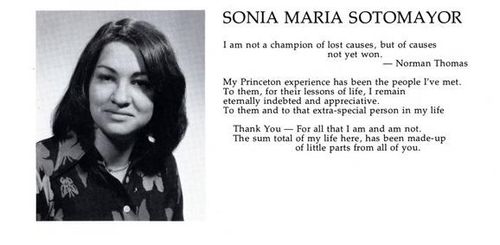
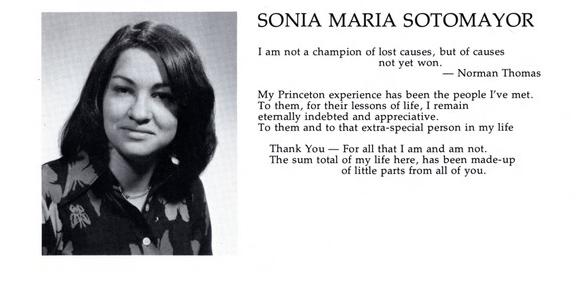
It's early yet, but I'll bet we're going to hear LOTS about Supreme Court nominee Sonia Sotomayor's 1976 Princeton yearbook photo.
Who is this "Norman Thomas" that she quotes? From Wikipedia:
Norman Mattoon Thomas (1884—1968) was a leading American socialist, pacifist, and six-time presidential candidate for the Socialist Party of America.
Oh, hell's bells.
UPDATE: And if you don't think the Sotomayor opposition isn't already being overly-silly, read this — and no, it's not from The Onion:
Sotomayor delivered the Judge Mario G. Olmos Memorial Lecture in 2001 at the University of California at Berkeley School of Law. The Berkeley La Raza Law Journal published the lecture the following year.
Conservative critics have latched onto the speech as evidence that Sotomayor is an “activist judge,” who will rule on the basis of her personal beliefs instead of facts and law.
“Personal experiences affect the facts that judges choose to see,” Sotomayor said. “My hope is that I will take the good from my experiences and extrapolate them further into areas with which I am unfamiliar. I simply do not know exactly what that difference will be in my judging. But I accept there will be some based on my gender and my Latina heritage.”
Sotomayor also claimed: “For me, a very special part of my being Latina is the mucho platos de arroz, gandoles y pernir — rice, beans and pork — that I have eaten at countless family holidays and special events.”
This has prompted some Republicans to muse privately about whether Sotomayor is suggesting that distinctive Puerto Rican cuisine such as patitas de cerdo con garbanzo — pigs’ feet with chickpeas — would somehow, in some small way influence her verdicts from the bench.
I called Bolton earlier today and asked him whether this was for real–whether any conservatives were genuinely raising this issue. He confirmed, saying, "a source I spoke to said people were discussing that her [speech] had brought attention…she intimates that what she eats somehow helps her decide cases better."
Bolton said the source was drawing, "a deductive link," between Sotomayor's thoughts on Puerto Rican food and her other statements. And I guess the chain goes something like this: 1). Sotomayor implied that her Latina identity informs her jurisprudence, 2). She also implied that Puerto Rican cuisine is a crucial part of her Latina identity, 3). Ergo, her gastronomical proclivities will be a non-negligible factor for her when she's considering cases before the Supreme Court.
AT&T, one of the biggest corporate sponsors of “American Idol,” might have influenced the outcome of this year’s competition by providing phones for free text-messaging services and lessons in casting blocks of votes at parties organized by fans of Kris Allen, the Arkansas singer who was the winner of the show last week.
Representatives of AT&T, whose mobile phone network is the only one that can be used to cast “American Idol” votes via text message, provided the free text-messaging services at two parties in Arkansas after the final performance episode of “American Idol” last week, according to the company and people at the events.
There appear to have been no similar efforts to provide free texting services to supporters of Adam Lambert, who finished as the runner-up to Mr. Allen.
The web is full of fancy search engines, some of which claim to not only search, but to give answers. For example, if you google "45 meters into yards", it will do that conversion.
But there's a new experiment out there called Wolfram/Alpha which is trying to "make all systematic knowledge immediately computable and accessible to everyone". In short, it is an answer engine, or, as they put it, "'a computational knowledge engine: it generates output by doing computations from its own internal knowledge base, instead of searching the web and returning links."
What does that mean? Well, click the link above and play around. At first it seemed rather limited to me, but as I experimented more, I realized it had pretty strong capabilities. For example, I wanted to know what the weather was on the day I was born (in Omaha, Nebraska). I simply typed "weather in omaha on september 27 1962" and learned not only that I was born on a Thursday, but that it was 56 degrees and partly cloudy. Google can't do that.
Find out the cast of obscure movies. And yes, if you type "woodchuck chuck", it will tell you how much wood a woodchuck would chuck.
And even though it is billed as an ongoing project, and its knowledge base is expected to grwo, it already knows the answer to the "meaning of life". Not bad.
The New York Times examines the (im)propriety of texting at the dinner table. Making a phone call at the table is an obvious faux pas, but what about the less intrusive texting?
As you might expect, working husbands and teenage daughters don't see it as a problem. But there are exceptions:
Brigid Wright, 17, from Needham, Mass., said that like many teenagers, she has honed the skill of eating with one hand and texting with the other. But, she said (and her family confirms), she does not text at the table at home.
“No teenager wants to look up from a glowing cellphone screen to see a disappointed parent frowning across the table,” she wrote in an e-mail message.
Ms. Boyd is 31. Sometimes she looks up from her glowing iPhone screen to see her husband, Gilad Lotan, a Microsoft designer, frowning at her across the table.
“If I’m sitting there privately responding to messages, Gilad might say, ‘Hey, I thought we were at dinner,’ ” she said. “I’ll be, like, ‘Hmm, sorry, just doing this quickly.’ ”
They both bring their iPhones to the table, she said, using them as conversational tools. If they’re debating a question, for instance, they might use their phones to look up the answer.
They try to avoid texting, she said, “if it’s a dinner where we’re trying to be engaged.” (As opposed to a dinner “where we both need food in our systems so we can both get back to work.”).
There is no texting or e-mailing at the dinner table in Lydia Shire’s home, in Weston, Mass. “My son would never dream of texting at the table,” said Ms. Shire, a chef and restaurant owner in Boston. “And he wouldn’t do it at anyone else’s table, either.”
As for me, I'm amazed that families still sit down to dinner together.