Myth Debunking

Ken AshfordHealth CareLeave a Comment

By the way, if you want a one-stop health care myth debunking place, bookmark this.  Here's the myths they debunk:

MYTH 1: There is no health care crisis
MYTH 2: Health care reform will impose rationing
MYTH 3: Health care reform provides for euthanasia, "death panel"
MYTH 4: Health care reform legislation will cover undocumented immigrants
MYTH 5: Health care reform will raise your taxes
MYTH 6: Health proposals would tax all small businesses
MYTH 7: Health care reform would add $1 trillion-plus to deficit
MYTH 8: House bill would ban private individual insurance
MYTH 9: Obama said he didn't read House bill
MYTH 10: Co-ops are an adequate substitute for a public option
MYTH 11: Obama is pushing a system like the U.K. and Canada
MYTH 12: Obama, Dems pushing "socialized medicine"
MYTH 13: Prominent opponents of health care reform are credible
MYTH 14: Government can't run a health care program

Our Local Senator Representative Is Entering Crazy Michele Bachmann Territory

Ken AshfordHealth Care, Local Interest1 Comment

In a telephone town hall yesterday, Senator Rep. Virginia Foxx (R-NC) said:

"The Constitution doesn’t grant a right to health care, and most of us are living as much by the Constitution as we can. It also doesn’t give the federal government the authority to deal with health care. As you may know, the 10th amendment, it says if it isn’t mentioned in the Constitution to be done by the federal government, it’s left to the states or the people. […]"

Okay, well I dealt with this before.  But, for a lark, let's play in her ballpark okay?

Call Virginia Foxx's office – (336) 778-0211 — and tell her you agree with her and we should therefore end Medicare and the Veteran's Administration.

Oh, yeah, she also said this:

"I think one of the problems we have in this country right now is the fact that the federal government is trying to do too much. We need to leave things to the states and the localities. … And unfortunately, we are distracting ourselves from looking after the defense of this nation because we are dealing with issues that should, by right, be the state and individual’s."

You can also tell Senator Rep. Foxx that you agree with her on that too.  Government shouldn't be meddling with medical issues that belong to individuals.  That's why you want her never ever to support bans on abortions.

P.S. Virginia Foxx is the one who called Matthew Shepard's murder an "unfortunate incident" which occurred during a robbery.

Obama’s Media Criticism

Ken AshfordObama & Administration, Right Wing and Inept MediaLeave a Comment

At a town hall forum at the DNC yesterday, Obama was asked where the lies about health care reform are coming from.  After laughing and making reference to "certain" news channels (he didn't mention them by name, but we all know which ones), this is what Obama supposedly said:

"…I have to say, part of the reason it spreads is the way reporting is done today. If somebody puts out misinformation, 'Obama's Creating Death Panels,' then the way the news report comes across is: 'Today such-and-such accused President Obama of putting forward death panels. The White House responded that that wasn't true.' And then they go on to the next story. And what they don't say is, 'In fact, it isn't true.'

"You know, it's fine to have a debate back and forth — he said, she said — except when somebody else is just not even telling remotely the truth. Then you should say in your reports, 'Oh, and by the way, that's just not true.'

"But that doesn't happen often enough."

This is a problem that has been noted by many, for many years.  Even when it is not propogating, the media, rather than reporting the facts, chooses instead to report what both sides say are the facts, as if both positions are equally valid.  It exaults fairness over accuracy

If Republicans said there were flying unicorns invading Oregon, and Democrats said there wasn't a single flying unicorn in Oregon or anywhere else, the media — even the better journalism outlets — would report "Republicans say there are flying unicorns in Oregon; Democrats deny this", rather than reporting "We've investigated it, and there a no flying unicorns in Oregon."

So what Obama said isn't new.  But it's new and interesting that he said it.

Stewart vs. The Originator of the “Euthanasia For Granny” Myth

Ken AshfordHealth CareLeave a Comment

Jon Stewart is best when he stops being a comedian and just talks reason.  Betsy McCaughey, the first who equated end-of-life planning with government-influenced euthanasia, went on the Daily Show to make her case.

Rather than trading barbs, the two of them actually discussed the house bill which supposedly supports the whole "death panel" meme.  (McCaughey never suggested, and in fact denies, that the bill creates "death panels", but her original concerns about the bill were morphed into "death panels" by Palin and the rightwing media).

It was as astounding as it was educational.  Two people, with the bill literally in front of them, reading from passage of the bill and discussing what it meant.

McCaughey made a big mistake by walking in carrying a big binder, which she said was only half of the House health care reform bill.  I guess she thought it gave her the air of authority.  The problem for her was, when she starting saying that the bill would lead to euthanasia, all Stewart had to say was "Show me where".  As she flipped through to find the section which supposedly supported her, she asked if Stewart had read the bill.  Stewart responded that he knew the section she was searching for, and yes, in fact, he had read it and there's no way it says what she says it says.  He later demonstrated his working knowledge of the bill, trumping her at every turn.

Watch it if you get a chance.

For what's its worth, she was no match for Stewart.

Texas Board of Education At It Again

Ken AshfordEducationLeave a Comment

These guys kill me:

The [Texas] State Board of Education has appointed “review committees” made up largely of active and retired school teachers to draft new social studies curriculum standards as well as six “expert reviewers” to help shape the final document.

The standards, which the board will decide next spring, will influence new history, civics and geography textbooks.

The first draft for proposed standards in United States History Studies Since Reconstruction says students should be expected “to identify significant conservative advocacy organizations and individuals, such as Newt Gingrich, Phyllis Schlafly and the Moral Majority.”

And liberals?  Nope.

One board member told the press that he wanted to:

add James Dobson's Focus on the Family, conservative talk show host Sean Hannity and former Arkansas Gov. Mike Huckabee to the list of conservatives. Others have proposed adding talk show host Rush Limbaugh and the National Rifle Association.

To be fair, that same board member wanted to add liberal organizations to serve as a contrast, but I don't think that's the point.

I think in some high school classes, politics will arise. Civics, current events — that sort of thing.  I don't understand what relevance Sean Hannity would have to a history class though.

But in those rare occasions where it comes up, can one construct meaningful guidelines in the first place on the issue of political ideology?  Most people and institutions don't fall conveniently into a conservative/liberal scheme easily.  The ACLU, for example, often tarnished as a librul commie organization, takes dozens of case defending churches against government intrusion and defending religious liberty in public shools (so long as the school doesn't mandate or endorse that religion).  That's conservative.  Mike Huckabee is liberal on some of his viewpoints, yet the proposed curriculum wants to teach otherwise.

The proposed curriculum — aside from being biased — is simply miseducation in that it reduces complex issues and ideologies into two distinct, convenient, but ultimately not-in-the-real-world ideologies.

Texas has among the the lowest SAT scores among all the states, usually it is ranked #45 or under.  Maybe the Texas board of education should focus on, you know, that.  Just sayin'.

Yahoo’s Novel Idea To Help Stop Email Spamming

Ken AshfordScience & Technology2 Comments

Here's the proposition:

Everybody pay one penny to send an outgoing email.

This will discourage spam, which consumes 33 terawatt hours of electricity every year.  A spam email sent to a million people would cost $10,000.

No, you say?  You don't want to pay to send email?

I hear you.  But what if it was voluntary?

But wait, you say.  If it's voluntary, then how will it discourage spammers?  They don't have to pay anything if it's voluntary.

True.  In fact, that's the POINT.  

If there's a code embedded in emails that are paid-for, then those emails will get a free pass through spam blocking software.  Then spam-blocking software can be adjusted to scan unpaid email, making it easier to catch actual spam.  In essence, paying one penny for an email creates a special class of email — "certified" email, if you want — which spam blocking software can ignore.  Then, spam blockers have a better change of identifying actual spam.

Wait, you say.  This sounds fishy.  This sounds like a way for Yahoo to make money.

Nope, says Yahoo.  The money collected will go to a charity.  Every penny.  A charity you choose.

So, instead of donating $100 to the animal sheltter, you essentially "buy" (prepay) $100 worth of one-cent certified emails (that's 10,000 emails).  You write and send an email as you normally would, but behind the scenes, a penny is deducted from that account, and the email becomes "certified". 

Sound better now?  You're not really out of pocket (assuming you were going to donate some money in the first place).

Yahoo is developing a system for this, called CentPay.  If enough volunteers do this, you can help stop spam AND you donate to charity.  But again, it is only effective if enough people voluntarily do this.

Do you think they will?

More info here.

Terror Politics

Ken AshfordBush & Co., Disasters, War on Terrorism/TortureLeave a Comment

I've largely refrained from posting about the Bush White House ever since Obama became president, but sometimes my self-imposed ban is hard to maintain.

Now that Bush is out of office, we're finding that the actual illegalities are just as bad, if not worse, than imagined.  The firings of the U.S. attorneys, for example, were politically motivated and were orchestrated from within the White House.  And today, we learned that Blackwater was contracted by the CIA to conduct overseas assassination, something which clearly violates U.S law.  And later this week, we're going to learn more about our torture practices.

And also today, we learn this about Tom Ridge, the very first head of the post-9/11 Department of Homeland Security [The source? Ridge himself, in a new book]:

  • He was never invited to sit in on National Security Council meetings;
  • He was "blindsided" by the FBI in morning Oval Office meetings because the agency withheld critical information from him;
  • He found his urgings to block Michael Brown from being named head of FEMA ignored; and
  • He was pushed to raise the security alert on the eve of President Bush's re-election, something he saw as politically motivated and worth resigning over.

For some reason, this last one gets to me.  It's a clear admission of GOP's use of scare tactics to influence politics, in this case, a national election.  We still see that tactic used effectively today.

Also, reflect on the meaning of that last item — it was more important to the Bush Administration to win re-election than to have an accurate Terrorist Alert Level.

That's patriotism?

UPDATE:  It should be noted that the request to heighten the terrorism allert level came from Ashcroft and Rumsfeld, while the DHS's security experts and Ridge argued against.  It should also be that Ridge won.  He now writes:

"I believe our strong interventions had pulled the 'go-up' advocates back from the brink… But I consider the episode to be not only a dramatic moment in Washington's recent history, but another illustration of the intersection of politics, fear, credibility and security."

Silliest “Serious” Objection To The House Health Reform Bill

Ken AshfordCongress, Health CareLeave a Comment

It still gets a lot of play, even among congresspersons:

"The health care reform bill is over 1,000 pages long!"

I'm not sure what that objection really means.

Are they suggesting that, because it's a huge bill, it must represent a massive government program?

If that's so, why don't they say it's a massve government program?

Or, are they complaining that the bill is so big, nobody can possibly read and understand it?  If that's so, then critics are merely exposing their ignorance or lack of education.

Let's make a comparison.  Atlas Shrugged is 1,200 pages.  People can read and understand that.

But here's the thing — Atlas Shrugged is printed in small type-face, single spaced.

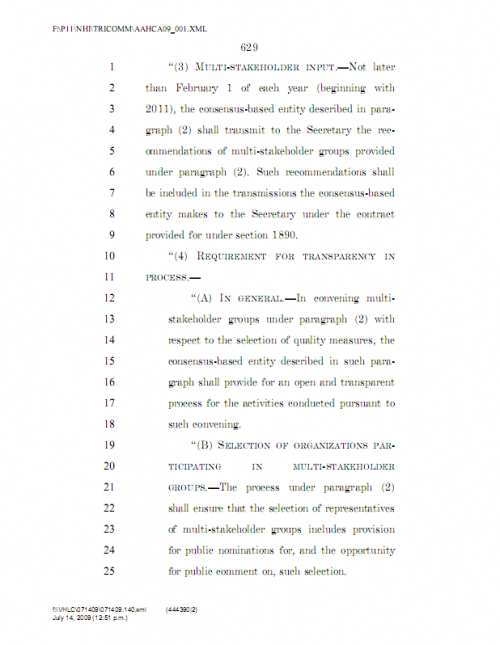
This is what a typical page from HR 3200 looks like.  This is a page from the actual bill:

Housebill

You see that?  Double spaced, huge font, and margins that are actually wider than the text itself.

A typical bill contains about 160 words per page — a typical book, like a Harry Potter, book — twice as many.

In other words, the House Health Care reform bill is about half a Harry Potter book.  And a teen can knock that one out in half a day.

Yes, you may say, but that's still too big for a bill.

Is it?  A bill to reform health care?  That's pretty broad subject.  Half a Harry Potter book sounds about right, considering the subject matter.  You not only have to make the actual changes themselves – to insurance practices, to administrative practices, to doctor-patient practices — but you have to address private insurance, Medicare, Medicaid, and Social Security — AND you have to set forth a way to monitor the reforms to make sure they actually are being implemented — AND establish procedures about enforcement for violators of the new policy, etc.  It IS a lot of ground to cover.

Yes, you may say, but the language of the bill is far more convoluted than a Harry Potter book.

And that's true.  But this is legislation — not quippy thirty second sound bites.  It's ALWAYS been written in legislative-ese. 

But it IS in English.  Don't understand what a particular term means?  There's an entire definition section (which occupies a few dozen pages of the bill). 

And a congressman with a paid staff of (one hopes) educated people can certainly figure this out.  After all, congressmen (through their paid staff) wrote it.

So the notion that the bill is really long and full of big words and doesn't have pictures is not only a specious criticism, but an embarassing one showing the ignorance or laziness of the person making the criticism.

How The Internet Sees You

Ken AshfordRandom Musings1 Comment

I don't quite understand this:

Personas is a component of the Metropath(ologies) exhibit, currently on display at the MIT Museum by the Sociable Media Group from the MIT Media Lab. It uses sophisticated natural language processing and the Internet to create a data portrait of one's aggregated online identity. In short, Personas shows you how the Internet sees you.
 
Enter your name, and Personas scours the web for information and attempts to characterize the person – to fit them to a predetermined set of categories that an algorithmic process created from a massive corpus of data. The computational process is visualized with each stage of the analysis, finally resulting in the presentation of a seemingly authoritative personal profile.

Ummmmm… rrrrright.

So I tried it, entering my name.

The problem is that when the Internet "sees" Ken Ashford, it sees me and two other dudes with the same name.  So my "profile" (shown below) is really a congomeration of the Internet identity of three different people named Ken Ashford.

Internetme  

Anyway, try it out yourself.

Five [Update: Six] Predictions About Gay Marriage

Ken AshfordSex/Morality/Family ValuesLeave a Comment

Over at NRO's The Corner, columnist Maggie Gallagher is compelled to present five predictions about the short term effects of same-sex marriage in those states which recognize it.  I'll address her predictions one at a time.

(1)  In gay-marriage states, a large minority people committed to traditional notions of marriage will feel afraid to speak up for their views, lest they be punished in some way.

Bizarre.  "Punished in some way"?  What way?  She doesn't say; I don't think even she knows.

In any event, looking at the health care debate, I don't see a lot of conservative people actually cowed lately from expressing (loudly) minority views.

(2)  Public schools will teach about gay marriage.

I read/hear this a lot from conservatives.  It comes up not only with gay marriages, but generally with homosexuality — these things will be "taught" in public schools.

Everytime I hear this concern, I try to envision what such a public school class would look like.  In what class would "gay marriage" be taught?  English?  And what would be said?

It seems to me that "gay marriage" might be taught in a high school civics or current affairs course.  But what's so bad about that?  Students would be taught that some states recognize gay marriage, and some don't.  Honestly — what more can be said on the subject?

What does Maggie Gallagher think will be taught?  How to have a "gay marriage"?  Praise for gay marriage?  Really?

(3)  Parents in public schools who object to gay marriage being taught to their children will be told with increasing public firmness that they don't belong in public schools and their views will not be accomodated in any way. 

Goes to my point above.  What will these parents be complaining about?

(4)  Religous institutions will face new legal threats (especially soft litigation threats) that will cause some to close, or modify their missions, to avoid clashing with the government's official views of marriage (which will include the view that opponents are akin to racists for failing to see same-sex couples as married).

This is just plain fear-mongering.  First of all, a couple of states that recognize same-sex marriages explcitly carve out exceptions for religious institutions — i.e., no church can be forced to perform gay marriages.  The states that don't explicitly have this provision are protected by the First Amendment.  The ACLU will even back the churches, should they ever be threatened with a lawsuit.  (And by the way, a lawsuit threat from who?)

By the way, you can't sue a person or a religious instutution for clashing with the government's view of marriage.  What makes Gallagher think you can sue someone for their opinions, much less their ideolofgical beliefs?  I mean, you can't sue a person for being racist, can you? 

(5)  Support for the idea "the ideal for a child is a married mother and father" will decline.

Well, this is probably true, although support for that has been in decline for decades.  And the decline has nothing to do with "gay marriages".  It has to do with the fact that the law doesn't criminalize (nor should it) single parent families.

***

When not being obscure or objectionable or just plain paranoid, Gallagher's predictions seem to be nothing more than merely saying "if SSM is acceptable, then more people will come to accept it."

Well, duh!

UPDATE

In a subsequent post, Maggie Gallagher adds a sixth prediction

I would like to offer a sixth prediction: Only a small minority of gay couples will seek gay marriages where they are available.

This is relevant to one of the core arguments now made for gay marriage: that it will help gay couples and their children achieve stability, monogamy, and (possibly) sexual fidelity.

I predict that after an initial burst of enthusiasm driven by its symbolic availability, relatively few gay couples will pursue marriage, because it makes so little sense for them.

How few? Oh, let's pull a standard out of our hats: After five to ten years (Steve can pick) after gay marriage, less than half of all gay couples in a given state will be married. I suspect it will be less than 25 percent. Let's find out.

This is probably the most offensive of Gallagher's predictions.

What she is saying is that gays won't marry because it "makes so little sense for them".  And why not?  Because gays, as we all know, have no interest in sexual fidelity.  They're just randy little whores.

A Pox On Both Houses?

Ken AshfordHealth Care, Obama & Administration, Right Wing Punditry/Idiocy1 Comment

Barney Frank took a protester to task after she refered to Obama's "Nazi" health care reform.  He asked the woman "on what planet" does she live, and said that trying to have a serious discussion with her about health care would be like talking to a dining room table.

Now, comes the tut-tut of the conservative media.  How both sides are engaging in uncivil discourse…

… as if there is no difference between (1) mobs of shouting angry conservatives, many of them playing the Nazi/facism card, some of them carrying guns and (2) the rare pushback against those mobs (like Barney Frank's response).

Sure, uncivility can be found on both sides, but how about a little perspective on the degree and frequency?

David Sedaris On Health Care

Ken AshfordHealth CareLeave a Comment

Not that he carries any weight, but I'm seeing his show in a month-and-a-half, and he got the question during a live chat, asking him to compare health care systems (he's lived in France for some time).  Here's his reponse:

Allow me to answer with kidney stones. I had my first one at the age of 34. At the time I was living in New York, and had no health insurance. Never in my life had I experienced such pain, but I couldn’t afford to go to the hospital, and so I passed it at home, not knowing until the end what it actually was. (I thought I was delivering Satan’s baby through my penis.)

I had my second kidney stone seven years later, in Paris. It was ten o’clock in the morning, and after looking at my options in the phone book, I took the metro to a hospital in the 15th. Two minutes after walking through the door, I was in a private room. Delicious, mind-numbing drugs were delivered to my blood stream by way of a tube and life was beautiful. I was in the hospital for four hours, and as I was leaving, I asked the receptionist how I was supposed to pay.

“Oh,” she said, “We’ll send you a statement.”
“But you never even asked me my name.”
“Really?”

A few weeks later I got a bill for the equivalent of seventy dollars, this because I’m not a French citizen, and am therefore not entitled to free care.

I got my third kidney stone a few months ago, while on a lecture tour of the United States. The hospital I went to was in Westchester county and the service was outstanding. Maybe I arrived at the slowest time, but, like in France, I was waited on immediately, and the doctor and nurses could not have been more pleasant. Again I was there for four hours, though this time the bill came to $5,800. Not including medicine.

I’m completely fascinated by the health care debate going on in the United States, especially by posters of Obama with a little mustache drawn on his upper lip. Is that what Hitler is really known for, his health care plan? To quote Bill Maher, “I haven’t seen this many pissed off old white people since they canceled, “Murder She Wrote.”

Now I live in England. I’ve just been granted Indefinite Leave To Remain, which allows me access to the NHS.

Health Care Without Republicans

Ken AshfordHealth CareLeave a Comment

It's becoming clear that trying to work out health care reform in a bi-partisan fashion ain't gonna happen.

The "public option" itself was a compromise.  Obama and most left-leaning people would prefer a "single payer" universal health care system like most advanced nations.  The single payer system would, effectively, do away with insurance companies and treat health care like we do our military – a single government program, rather than competing corporate programs.  Medicare is essentially a "single payer" health care system — except it is not available to everybody.

But "single payer" was clearly not going to pass muster with conservatives, so it was taken off the table right from the start.  So the "public option" became the administration's position.  The "public option" is analagous to the university education system — you have a public university run by the state (e.g., UNC) competing with private universities (e.g., Duke).  Just as people get to choose their own university, the "public option" provides a low-cost alternative (because, unlike the insurance companies, it is not trying to make a profit… and because, being the government, it can negotiate good deals — like cheaper drugs — from pharmaceuticals).

But no, Republicans didn't like the "public option" either.  Even THAT was too socialist.

And this past weekend, the Obama Administration floated the possibility of co-ops, which is where, instead of the "public option", you have a bunch of not-for-profit insurance companies (the "co-ops") compete with the for-profit mega-insurance companies, again to ostensibly keep down the price of health care.

But no, even that was met with GOP opposition.

So finally finally finally, the Obama Administration is realizing what some of us have already figured out: despite thei lip service to the need for health care, the Republican Party is in the pockets of the insurance companies and it doesn't want to see any kind of health care reform at all.

So why try to work with them?

Fortunately, the Democrats have a new plan.  Split the bill.

The White House and Senate Democratic leaders, seeing little chance of bipartisan support for their health-care overhaul, are considering a strategy shift that would break the legislation into two parts and pass the most expensive provisions solely with Democratic votes.

The idea is the latest effort by Democrats to escape the morass caused by delays in Congress, as well as voter discontent crystallized in angry town-hall meetings. Polls suggest the overhaul plans are losing public support, giving Republicans less incentive to go along.

Jonathan Cohn fleshed this out in more detail.

[The first bill] would include changes to Medicare and Medicaid, new taxes on individuals or employers, subsidies for people buying insurance, and (maybe) even a public plan. Because all of these affect federal outlays, positively or negatively, this bill could go through the reconciliation process, passing with just 50 votes.

The second bill would include the other elements — the insurance regulations, the requirement that everybody get coverage, and so on. These are the pieces of reform the parliamentarian likely wouldn't allow to go through reconciliation. As a result, it would still need 60 votes. But that's not so farfetched, since these happen to be the parts of reform on which there is the most wide-ranging consensus. Plenty of Republicans support these ideas, at least in principle.

All of this is theoretical, of course. Republicans might not support that second bill if it meant handing the Democrats a victory. At the very least, they'd fight Democrats on the details. Nor is it clear Democrats themselves have enough unity to get fifty votes for the controversial elements of reform. And all of that is assuming the parliamentarian lets those controversial elements go through reconciliation in the first place That's hardly a sure thing; it will really come down to his interpretation of the rules. But even the theoretical possibility of Democrats passing reform on their own would change the dynamics in Congress, by giving Republicans new incentives to negotiate in good faith — and giving Democrats a way to enact legislation in case the GOP remains as obstructionist as it is now.

Sounds like a plan.

I guess the main point is that Democrats aren't waiving the white flag yet.  And that's something to be thankful for.