From the B-roll, just chatting with the CNBC reporter before the "real" interview. Obama is kind of aware that he may have stepped in it, asking "Where the pool?" (meaning the press pool), but he laughs it off:

From the B-roll, just chatting with the CNBC reporter before the "real" interview. Obama is kind of aware that he may have stepped in it, asking "Where the pool?" (meaning the press pool), but he laughs it off:
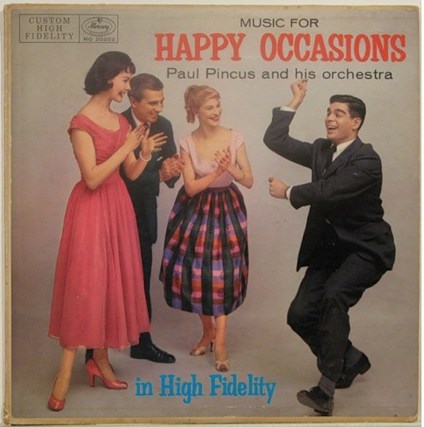

NOTE TO SELF: If I were to ever rename this blog, this should serve as the title ("Happy Occasions in High Fidelity") and the logo.
(H/T World O' Crap)
“In 2007 I finally made it to the Bush White House as a presidential speechwriter. But it was not at all what I envisioned. It was less like Aaron Sorkin’s The West Wing and more like The Office.”
This comes from Matt Latimer, who worked as one of Bush’s speechwriters during the president’s final twenty-two months in office. He’s got a book coming out, the thrust of which is that the Bush White House was just as dysfunctional and, well, stupid as we all imagined it was.
Here’s a significant excerpt about how Bush dealt with his $700 billion bailout proposal toward the end of his presidency, in the wake of the economic recession and Wall Street’s implosion:
We were faced with a dilemma: Should Bush still go out and address the nation, or should he cancel? And if he did go out, what should he say? Ed, typically, told us to write two drafts for the address to the nation—one outlining the proposal as originally announced and another that only discussed the “principles” the legislation needed to incorporate to win the administration’s support. Chris and I looked at each other warily. Two versions of a major prime-time address that may or may not be given hours from now? Sure, no problem. Ultimately, Ed decided to go with the second speech. But he clearly didn’t share his plan with the president. When the president came into the Family Theater to rehearse the speech in front of a teleprompter, he didn’t like the idea of just talking about principles. It sounded like the administration was backing away from its own plan (which it was).
“We can’t even defend our own proposal?” the president asked. “Why did we propose it, then?” This was not bold decision making. There were about a dozen people gathered in the theater to watch him rehearse, and all of us remained silent as the president looked at us for an answer.
The president walked over to sip some water from one of the bottles on the table near his lectern. “This speech is weak,” he said. He looked at me and Chris. “Frankly, I’m surprised, to be honest with you.”
There was more silence.
“Too late to cancel the speech?” the president asked into the air. He was joking…I think. Finally, Ed (who hadn’t exactly rushed to jump into the line of fire) explained that we had to make this change to the address because the proposal the president liked might not end up being the one he had to agree to. “Then why the hell did I support it if I didn’t believe it would pass?” he snapped. There was yet another uncomfortable silence.
Finally, the president directed us to try to put elements of his proposal back into the text. He wanted to explain what he was seeking and to defend it. He especially wanted Americans to know that his plan would likely see a return on the taxpayers’ investment. Under his proposal, he said, the federal government would buy troubled mortgages on the cheap and then resell them at a higher price when the market for them stabilized.
“We’re buying low and selling high,” he kept saying.
The problem was that his proposal didn’t work like that. One of the president’s staff members anxiously pulled a few of us aside. “The president is misunderstanding this proposal,” he warned. “He has the wrong idea in his head.” As it turned out, the plan wasn’t to buy low and sell high. In some cases, in fact, Secretary Paulson wanted to pay more than the securities were likely worth in order to put more money into the markets as soon as possible. This was not how the president’s proposal had been advertised to the public or the Congress. It wasn’t that the president didn’t understand what his administration wanted to do. It was that the treasury secretary didn’t seem to know, changed his mind, had misled the president, or some combination of the three.
As Chris and I were in our office in the EEOB trying to put in the latest of the president’s edits, there was a steady flow of people coming into the room. The economic team came in. Ed Gillespie, the president’s top communications adviser, came in. Tony Fratto, the deputy press secretary, was there. At one point there were twelve people crowded around our computer, trying to explain how the proposal worked. The economic advisers were disagreeing with each other.
There was total confusion. It was 5:30 p.m. The speech was in three and a half hours.
After finally getting the speech draft turned around and sent back to the teleprompter technicians, we trudged back to the Family Theater, where the president rehearsed. In the theater, the president was clearly confused about how the government would buy these securities. He repeated his belief that the government was going to “buy low and sell high,” and he still didn’t understand why we hadn’t put that into the speech like he’d asked us to. When it was explained to him that his concept of the bailout proposal wasn’t correct, the president was momentarily speechless. He threw up his hands in frustration.
“Why did I sign on to this proposal if I don’t understand what it does?” he asked.
Not the best and the brightest.
Here’s some more about the mindset of the Bush White House. It’s telling that the only person (apart from the author) who seemed to have a grasp of reality about Sarah Palin was, incredibly, George Bush himself.
The instantaneous reaction to Palin at the White House, however, was almost frenzied. I think what was really going on was that everyone secretly hated themselves for supporting McCain, so they latched onto Palin with over-the-top enthusiasm. Even the normally levelheaded Raul Yanes, the president’s staff secretary, was overtaken by Palin mania. He’d been slightly annoyed with me for not jumping on the McCain bandwagon and for saying aloud that I thought McCain would lose. Now, of course, I had to be enthusiastic about the ticket. “You still think we’re going to lose?” he asked me laughingly.
“Yep,” I replied.
Raul looked incredulous. “Well, you obviously don’t believe in facts!”
I was about to be engulfed by a tidal wave of Palin euphoria when someone—someone I didn’t expect—planted my feet back on the ground. After Palin’s selection was announced, the same people who demanded I acknowledge the brilliance of McCain’s choice expected the president to join them in their high-fiving tizzy. It was clear, though, that the president, ever the skilled politician, had concerns about the choice of Palin, which he called “interesting.” That was the equivalent of calling a fireworks display “satisfactory.”
“I’m trying to remember if I’ve met her before. I’m sure I must have.” His eyes twinkled, then he asked, “What is she, the governor of Guam?”
Everyone in the room seemed to look at him in horror, their mouths agape. When Ed told him that conservatives were greeting the choice enthusiastically, he replied, “Look, I’m a team player, I’m on board.” He thought about it for a minute. “She’s interesting,” he said again. “You know, just wait a few days until the bloom is off the rose.” Then he made a very smart assessment.
“This woman is being put into a position she is not even remotely prepared for,” he said. “She hasn’t spent one day on the national level. Neither has her family. Let’s wait and see how she looks five days out.” It was a rare dose of reality in a White House that liked to believe every decision was great, every Republican was a genius, and McCain was the hope of the world because, well, because he chose to be a member of our party.
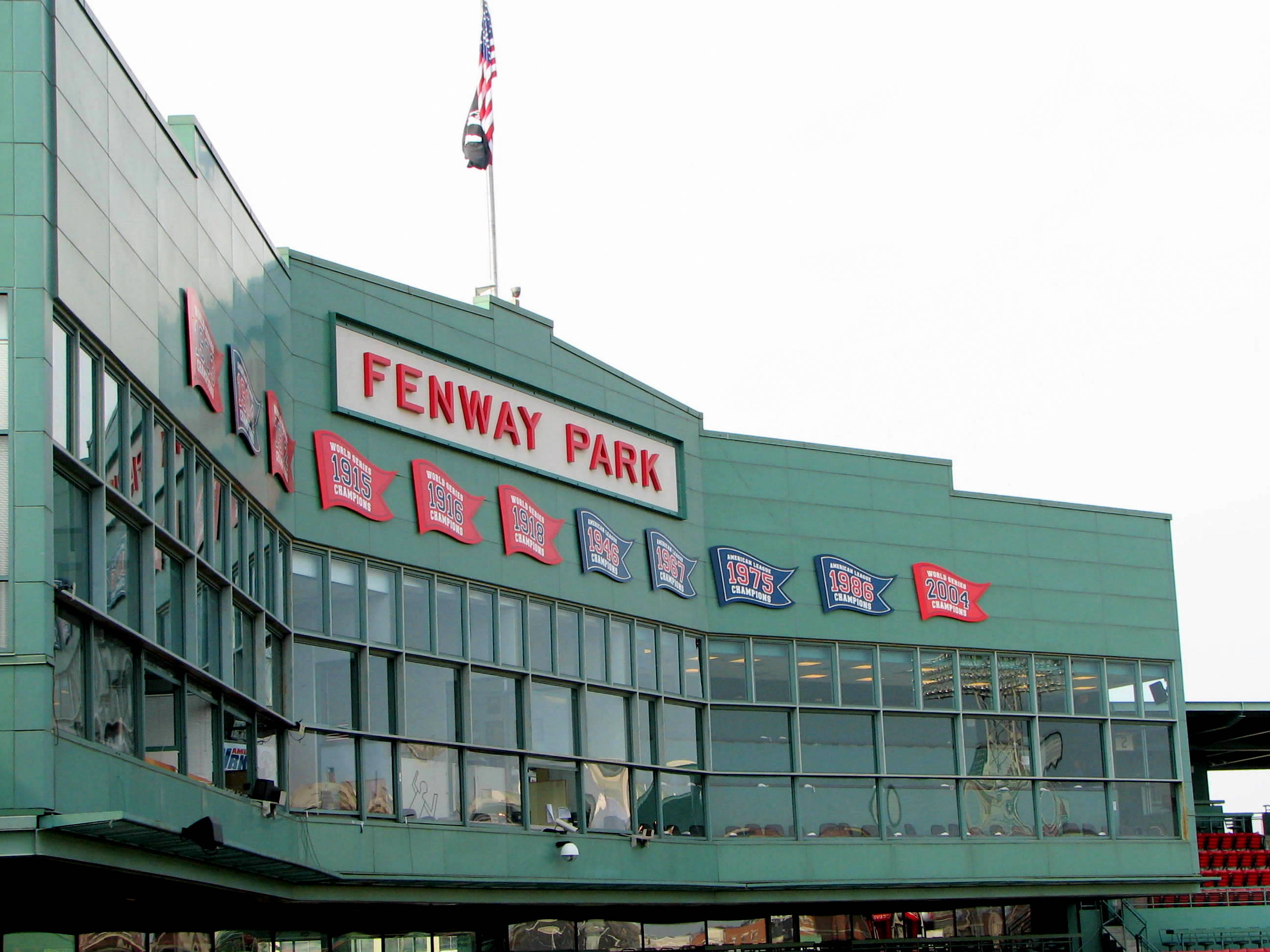
"Get your hats on… We're gonna score before the two-minute warning, get the ball back, then we're gonna score again and win this thing!''
– Patriots quarterback Tom Brady, moments before they scored before the two-minute warning, got the ball back, then scored again and won that thing.
If you don't want to see the whole thing, jump to the 6:00 minute mark. The young interviewer explains to Tea Party protesters what "czars" are (they are merely advisors and don't have executive power), and who appointed the first "czar" (Ronald Reagan). The reactions are priceless.
WASHINGTON — State and local tourism officials are being flooded by emails and calls from people across the country, saying they won't vacation in South Carolina because they're upset by GOP Rep. Joe Wilson's outburst at President Barack Obama.
The officials said that a number of the out-of-state e-mailers have said they've taken beach trips for years in Myrtle Beach, Hilton Head and other South Carolina resort areas, but don't plan to return.
***
South Carolina's $1 billion-plus tourism industry, centered around its beaches, had already been hit by the recession as Americans postpone vacations or cancel travel altogether. The state's 11.8 percent unemployment rate is among the highest in the country.
According to a press release by ColorOfChange.org (emphasis added):
The advertising boycott of Glenn Beck has cost the controversial host over half of his estimated advertising revenue since it was launched by ColorOfChange.org a month ago. This according to data analyzed from industry sources.
Estimated advertising revenue [the total amount of advertising money being spent during a block of commercial time for a program] was collected on a week-by-week basis for a period of two months. According to the data collected, the amount of money spent by national advertisers on Beck’s program per week was at its highest at approximately $1,060,000, for the week ending August 2, 2009. ColorOfChange.org launched their campaign at the end of that week and since then, 62 advertisers have distanced themselves from Beck. Data collected for the week ending September 6, 2009 shows Beck’s estimated ad revenue at $492,000, equal to a loss of $568,000.
FBI? You watching?
His penis must be REALLLLY small.
References to Ghost and "(I've Had The) Time of My Life" are not encouraged.
Succumbed after long battle with pancreatic cancer. He was 57.
Patrick Swayze, Lisa Niemi (Swayze's wife), George De La Pena in One Last Dance
Crystal Lee Sutton, formerly Crystal Lee Jordan, was fired from her job folding towels at the J.P. Stevens textile plant in her hometown of Roanoke Rapids, N.C. for trying to organize a union in the early 1970s. Her last action at the plant — writing the word "UNION" on a piece of cardboard and standing on her work table, leading her co-workers to turn off their machines in solidarity — was memorialized in the 1979 film by actress Sally Field. The police physically removed Sutton from the plant for her action.
She died yesterday from brain cancer.
Her death touches upon the contemporary hot topic involving health care reform. Several years ago, Sutton was diagnosed with meningioma, a type of cancer of the nervous system. While such cancers are typically slow-growing, Sutton's was not — and she went two months without potentially life-saving medication because her insurance wouldn't cover it initially. Sutton told the Burlington (N.C.) Times-News last year that the insurer's behavior was an example of abuse of the working poor:
"How in the world can it take so long to find out [whether they would cover the medicine or not] when it could be a matter of life or death," she said. "It is almost like, in a way, committing murder."
Though Sutton eventually received the medication, the cancer had already taken hold. She passed away on Friday, Sept. 11 in a Burlington, N.C. hospice.
We may be seeing the hint of a whiff of the first signs that our economic woes are taking a turn for the better, but what about the long term? What about the reforms that Obama promised to ensure that Wall Street greed and bungling don't get us into another mess 5, 10, or 20 years down the road?
For my money (literally), the best suggested reform was a consumer protection agency. Like the ones we have for food and drugs (FDA) and consumer products (CPSC), except that the focus is on financial products. Yeah, private ratings agencies (it was thought) should do that, but they dropped the ball as well.
So where is it?
Answer: it's coming. Wall Street will oppose it, and they'll line up the usual suspects to whip the ignorant mobs into a frenzy ("More government regulation! That's socialism!"). But it has to pass. It has to.

You know, I see these thing bubbling and I think, "Well, this is just another mindless rightwing rant that can't be taken seriously".
And then it does get taken seriously.
When will I learn?
The latest Beck-inspired frenzy to have gone mainstream is this whole "czar" business — specifically, that Obama has in his administration a bunch of "czars" who don't have titles and who aren't congressionally-approved, etc. The presence of these czars is now a major topic of conversation among GOP policymakers and their allies.
"Czars" are nothing new. Reagan, I recall, created a czar — a drug czar, I believe. It was understood to be simply a nickname for an actual post. It still is.
But Beck's rants have gone political mainstream. Yesterday Sen. Kay Bailey Hutchinson wrote an op-ed condemning czars in the Washington Post, which also ran an op-ed from House Minority Whip Eric Cantor (R-Va.) just six weeks ago on the exact same topic.
Both contain the same theme and the same lies:
Nearly 250 years [after the Constitution], these critical lines of separation are being obscured by a new class of federal officials. A few of them have formal titles, but most are simply known as "czars." They hold unknown levels of power over broad swaths of policy. Under the Obama administration, we have an unprecedented 32 czar posts (a few of which it has yet to fill), including a "car czar," a "pay czar" and an "information czar." There are also czars assigned to some of the broadest and most consequential topics in policy, including health care, terrorism, economics and key geographic regions.
Think Progress, among others, noted how very wrong this is.
In fact, ALL of these officials have formal titles. For example, Hutchison cites Van Jones, the "green jobs czar." But Jones had the title of Special Advisor for Green Jobs, Enterprise, and Innovation at the Council on Environmental Quality. The only person Obama has referred to as a czar is "drug czar" Gil Kerlikowske, whose official title is Director of the Office of National Drug Control Policy. (Additionally, "drug czar" was a term that existed long before the Obama administration.) […]
Hutchison does not list the 32 individuals whom she considers to be "czars." But if she's relying on the same list as Cantor — who also cited 32 people — then several of them are far from unaccountable; they've actually already been confirmed by the Senate.
The other thing that Cantor and Hutchinson do in relation to czars is fearmonger:
So what do these czars do? Do they advise the president? Or do they impose the administration's agenda on the heads of federal agencies and offices who have been vetted and confirmed by the Senate? Unfortunately — and in direct contravention of the Framers' intentions — virtually no one can say with certainty what these individuals do or what limits are placed on their authority.
They're advisors.
The president is allowed to have advisors, Kaye.
Joe Wilson, the "You Lie!" guy, went on Fox News Sunday to tell Chris Wallace that he ain't going to apologize for his outburst again, to anyone.
Wallace asked Wilson about Maureen Dowd's op-ed, in which she alleges that Wilson's disrespect for the president was motivated by racism. Wilson came back with a surprising and absurd defense:
I respect President Obama. Actually, there's a relationship in a way … his wife, ah, her family's from Georgetown [South Carolina], ah, my family's from next door, in McClellanville, so I, ah, have a great respect for the president.
Uhhhh…..
Yeah, Michelle Obama's great-great-great grandfather lived in Georgetown, SC…. where he was a slave.
So Wilson's best defense to the accusation that his Obama antagonism is motivated by racism… is that Obama's wife's ancestors grew up in slavery and segregation in the county next to Wilson's.
Chris Wallace didn't have follow up question.
I've run into a lot of people who claim tennis is boring.
I don't know what the hell they're talking about.
Here's how it went down:
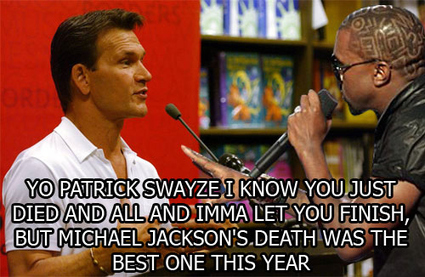
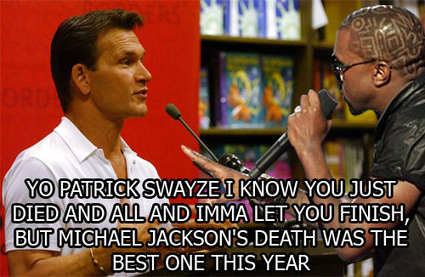
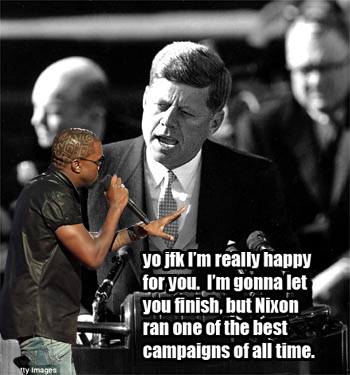
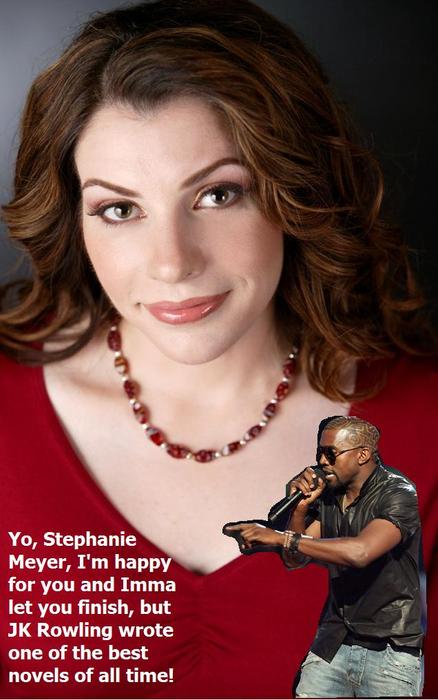
Okay, that's a spoof (the real video is embargoed).
UPDATE: Okay, here it is fo' riz-eal:
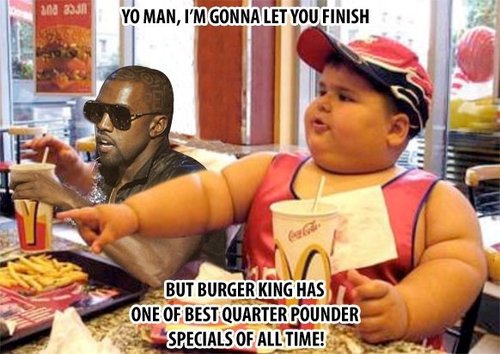
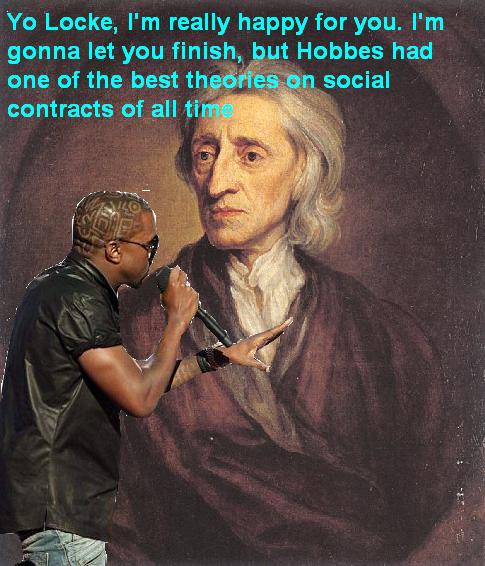
Here's some info from Dickopedia. Kanye aparrently has award show issues: