
A Treasury Department watchdog says the department acted properly when it denied a request from House Democrats for President Trump's tax returns https://t.co/RT2Dhojd1l pic.twitter.com/cc4VVFwVrF
— CNN Breaking News (@cnnbrk) April 10, 2020
COVID-19 Update: End Of Another Week
I took the day off from reporting yesterday, so these numbers are going to show a significant jump.
World:

US:


This week, Covid-19 passed heart disease and cancer as the leading cause of death per day in the United States. In this graph made by Dr. Maria Danilychev using data from Worldometer and the CDC, you can see that Covid-19 overtook heart disease sometime on Monday or Tuesday.
Forsyth County in NC had its third death yesterday.

The Trump administration is pushing to reopen much of the country next month, raising concerns among health experts and economists of a possible covid-19 resurgence if Americans return to their normal lives before the virus is truly stamped out.
Behind closed doors, President Trump — concerned with the sagging economy — has sought a strategy for resuming business activity by May 1, according to people familiar with the discussions.
In phone calls with outside advisers, Trump has even floated trying to reopen much of the country before the end of this month, when the current federal recommendations to avoid social gatherings and work from home expire, the people said. Trump regularly looks at unemployment and stock market numbers, complaining that they are hurting his presidency and reelection prospects, the people said.
Like others, they spoke on the condition of anonymity to reveal internal discussions.
Trump said at his daily briefing Thursday that the United States was at the “top of the hill” and added, “Hopefully, we’re going to be opening up — you could call it opening — very, very, very, very soon, I hope.”
Multiple Cabinet secretaries in recent days have publicly expressed hope that the various government orders directing residents to stay at home and forcing nonessential businesses to close could at least be partially eased next month.
Speaker of the House Nancy Pelosi, on the other hand, plans a more responsible course of action, and is urging Trump to do the same. “I would hope that the scientific community would weigh in and say, ‘You can’t do this, it is only going to make matters worse if you go out too soon,” Pelosi told Politico of the possibility of Trump pushing to reopen things.
Fortunately, Surgeon General Jerome Adams acknowledged today most Americans will not be able to resume their normal lives on May 1, when the Trump administration’s guidelines aimed at countering the spread of the coronavirus in the United States are set to expire.
In an interview on Fox News, Adams said the administration would be “data-driven” in determining when to reopen the country, and stressed that “now is the time for us to continue to lean into” the social-distancing recommendations first issued in mid-March and extended last week until the end of April.
“There are places around the country that have seen consistently low levels. And as we ramp up testing and can feel more confident that these places actually can do surveillance and can do public health follow-up, some places will be able to think about opening on May 1,” Adams said.
“Most of the country will not, to be honest with you, but some will,” he continued, “And that’s how we’ll reopen the country: place by place, bit by bit, based on the data.”
This WaPo analysis about Trump and criticism is spot on:
President Trump has lambasted governors whom he views as insufficiently appreciative. He has denigrated — and even dismissed — inspectors general who dared to criticize him or his administration. And he has excoriated reporters who posed questions he did not like.
The coronavirus pandemic has crystallized several long-standing undercurrents of the president’s governing ethos: a refusal to accept criticism, a seemingly insatiable need for praise — and an abiding mistrust of independent entities and individuals.
Those characteristics have had a pervasive effect on the administration’s handling of the crisis, from Trump’s suggestions that he might withhold aid from struggling state governments based on whether he is displeased with a governor to his repeated refusal to take responsibility for shortcomings in the laggard federal response.
John Feehery, a Republican strategist, said that he’s never worked with a politician who enjoys criticism, but what’s unusual about Trump “is that he’s willing to counterprogram. He’s willing to go on the offense on a continuous basis.”
“He’s saying the quiet part out loud,” Feehery said.
On Monday, for instance, Trump was asked about a new report by Christi Grimm, the top official in the Department of Health and Human Services’s Office of Inspector General, which found hospitals faced significant testing and medical supplies shortages. The president first demanded the inspector general’s name and when she was appointed. He hinted that perhaps “politics” entered into her findings — though the Office of Inspector General is an independent entity specifically designed to ferret out waste, fraud and abuse in government, with minimal partisanship.
Informed that Grimm was appointed to her current role in January but is a career bureaucrat who previously served in the Obama administration, Trump lashed out at ABC News’s Jonathan Karl, who had pressed him on the report’s damning findings.“You are a third-rate reporter and what you just said is a disgrace, okay?” Trump said, adding, “You will never make it.”
David Axelrod, a former senior adviser to President Barack Obama, said the president expects nearly everyone around him to do his personal bidding, a view both “childish” and “dangerous.” “Trump demands affirmation and does not tolerate oversight from the media, Congress, even inspectors general who he appointed,” Axelrod said. “He wants to impose his version of events and discredit and disable any arbiters of fact who might disrupt his self-aggrandizing story line. That has been his instinct in business and politics, and we see it on full display in this crisis.”
Throughout his term, Trump has frequently singled out other organizations and individuals whose goal is to be objective — from intelligence and federal law enforcement officials to public health experts and judges. His relationship with the Justice Department’s top law enforcement official is one example. He faulted his first attorney general, Jeff Sessions, for not sufficiently protecting him against special counsel Robert S. Mueller III’s Russia investigation, publicly tormenting him for months before finally firing him.
The media has also been an enduring target of Trump’s ire. At nearly every coronavirus news conference in recent days, the president has clashed with reporters — at times seemingly intentionally — dubbing the press “fake news” and criticizing the tone and content of their questions. Especially amid the deadly pandemic, Trump has upbraided reporters, not just for tough questions but for failing to flatter and publicly praise him.
During his Saturday news conference, for instance, Trump began his remarks by explaining that every decision his administration makes is intended “to save lives.” “It’s therefore critical that certain media outlets stop spreading false rumors and creating fear and even panic with the public,” he continued.
Without naming specific publications, Trump took umbrage with the cascade of stories that have documented his administration’s mishandling of crucial aspects of the coronavirus response. “It’s so bad for — for our country, so bad for the world,” Trump concluded. “You ought to put it together for a little while, get this over with, and then go back to your fake news.”
During the same news conference, he dismissed a question about when people should expect to receive their checks from the recently passed $2 trillion stimulus as being posed “in such a negative way” and described another as “always a nasty one from CNN.”
The day before, during Friday’s news conference, Trump also got into a testy back-and-forth when asked about comments in which his son-in-law and senior adviser, Jared Kushner, declared that the Strategic National Stockpile was for the federal government and not the states.
Trump called the question “a gotcha” before telling the reporter, “You ought to be ashamed.” “Don’t make it sound bad. Don’t make it sound bad,” the president continued, before concluding: “You just asked your question in a very nasty tone.”
It goes on and it’s well worth reading.
Trump seems to be more concerned about his “ratings” than anything else.
The Wall Street Journal always “forgets” to mention that the ratings for the White House Press Briefings are “through the roof” (Monday Night Football, Bachelor Finale, according to @nytimes) & is only way for me to escape the Fake News & get my views across. WSJ is Fake News!
— Donald J. Trump (@realDonaldTrump) April 9, 2020
In fact, the commander-in-chief has tweeted or retweeted 47 times as of this writing on Friday morning. His first tweet of the day was posted at 12:45 a.m.
Here’s his latest:
Wow, Approval Rating in the Republican Party – 96%. Thank you!
— Donald J. Trump (@realDonaldTrump) April 10, 2020
The content of the president’s Friday tweets give some insight into what’s on his mind as the coronavirus pandemic ravages much of the country, reaching its expected peak in hard-hit states like New York — which just saw its third straight day of record deaths.
The binge kicked off with the president extending a thank you to one of his campaign aides for touting his numbers in a fresh Fox News poll. The poll showed a high in his overall approval: 49 percent approved of his performance, while 49 percent disapproved.
Thank you Erin! https://t.co/m8HRlK6VCY
— Donald J. Trump (@realDonaldTrump) April 10, 2020
From there, he retweeted two posts from First Lady Melania Trump on mental health during the pandemic and CDC guidelines on face coverings; linked to reports on Attorney General William Barr’s criticism of the Russia investigation; chatted with Fox News analyst Gregg Jarrett about an airline bailout.
The president also reserved several tweets for bashing the media. He posted tweets criticizing CNN, the New York Times and ABC News.
Thank you Frank. It’s ABC Fake News. They knew they were wrong when they went with this Hoax of a story! https://t.co/FHkRaW3BTi
— Donald J. Trump (@realDonaldTrump) April 10, 2020
Meanwhile, he also retweeted posts citing CNN’s reporting, as well as several tweets from Wall Street Journal opinion writer Kimberly Strassel — just one day after calling her outlet “fake news.”
The president also carried on his feud with the director of the World Health Organization with several pointed retweets. Tedros Adhanom Ghebreyesus, the director-general of WHO, has been accused of spreading misinformation from China regarding the early outbreak and spread of the coronavirus. That has prompted a war of words between Trump and Ghebreyesus this week, and the president on Friday linked to an op-ed from the WSJ editorial board calling to “Reform or defund the World Health Organization.”
Trump’s focus was also apparently on the stock market. He celebrated this week’s market rally, casting it as a harbinger of a grander economic comeback once the country re-opens following the pandemic. He remains fixated on the anti-malaria drug hydrochloroquine, linking to a report that French President Emmanuel Macron is facing calls for wider use of the potential Covid-19 remedy.
This week, in only 4 days, we had the biggest Stock Market increase since 1974. We have a great chance for the really big bounce when the Invisible Enemy is gone!
— Donald J. Trump (@realDonaldTrump) April 10, 2020
Not to let his foes on the other side of the aisle get any rest, Trump packed in shots at House Speaker Nancy Pelosi and a series of shots at Joe Biden, the presumptive Democratic nominee who Trump will face in the 2020 general election.
A wild sample:
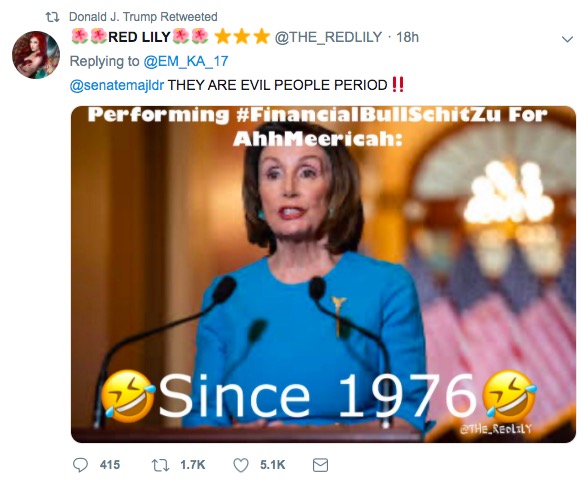
Because the T.V. Ratings for the White House News Conference’s are the highest, the Opposition Party (Lamestream Media), the Radical Left, Do Nothing Democrats &, of course, the few remaining RINO’S, are doing everything in their power to disparage & end them. The People’s Voice!
— Donald J. Trump (@realDonaldTrump) April 10, 2020
What a loon.
In other news, PM Boris Johnson is out of the ICU.
This drone footage captures NYC workers burying bodies in a mass grave on Hart Island, just off the coast of the Bronx. For over a century, the island has served as a potter’s field for deceased with no known next of kin or families unable to pay for funerals. pic.twitter.com/wBVIGlX6aK
— NowThis (@nowthisnews) April 9, 2020
Here’s an interesting phenomenon people have noticed — weird dreams:
The blog I Dream of Covid is a surrealist collection of dreams submitted by readers around the world in the midst of the coronavirus pandemic that, apparently, has had far-reaching effects into our collective subconscious. One San Francisco resident dreamed about walking around the city in Crocs and stepping on a needle contaminated with the coronavirus. Another person from Georgia recalled a dream where a doctor sprinkled salt on their thigh, tasted it with her fingers, and told them, “You are positive for Covid-19.”
As people around the world hunker down in quarantine or otherwise adjust to the disease, many have anecdotally reported having weirder, more vivid dreams than usual — some related to the coronavirus, some about mundane life in the pre-pandemic world, and some just plain strange and inexplicable. Some people have said they’re more restless, thereby getting less sleep than usual. (For those struggling to have a good night’s rest or grappling with nightmares, the National Sleep Foundation recommends sticking to a consistent sleep schedule, or taking a short 30-minute nap.) Meanwhile, others have reported sleeping more, and consistent deep sleepers (like myself) rarely recall the dreams they have.
For sleep researchers, it’s a ripe time to collect dream content for analysis. Some theorize that this onset of vivid imagery is a result of changing sleep schedules: Most people have vivid dreams during the REM (rapid eye movement) phase of sleep, and they tend to have longer and deeper REM cycles as the night progresses. If a person wakes up in the middle of a REM cycle, they’re more likely to remember their dream content and the details involved.
Others attribute this vividness to the emotional and physical chaos many of us are experiencing. In previous research, scientists have determined that the limbic system — parts of the brain involved in behavioral and emotional responses — are activated during dreams that are highly bizarre or emotional. I spoke with Dylan Selterman, a social psychologist who runs the Dreams, Relationships, Emotions, Attraction, and Morality (DREAM) Lab at the University of Maryland, on how something like the Covid-19 outbreak could be affecting our sleep and our dreams.
***
There is not a grand unified theory of dreams among researchers, but there are several different theories with some validity to them. You’ve probably heard of the continuity theory of dreams, which hypothesizes that people dream about the stuff they’re thinking about and doing while they’re awake. If we feel some degree of stress about the pandemic, or about work or family, then it’s normal for those types of themes to appear in our dream content.
Some researchers believe that dreams have a functional purpose to prepare us for difficult or challenging situations when we awake. Normally, what happens during a stress dream is that your mind appears to be working a problem out. There are also researchers who believe the inverse of that; for example, if you’re experiencing difficulties in your current life and dream about them, that can predict your future mental health.
***
The biggest variables that influence dream vividness have to do with your regular sleep habits. If it’s a very traumatic personal event, in clinical research, there’s evidence of people experiencing nightmares. It could be that people are changing their sleep schedules, and if they get more sleep, they’re likely to have more vivid dreams.
Another possibility is that people are thinking more about their dreams. Studies show that when you focus on your dreams more while you’re awake, you tend to remember them better. This has been shown in diary studies, for example. If a person starts a dream diary for even just a few days, they start to recall more imagery from their dreams.
The mathematical models are not the only way to make sense of the progress of the pandemic. Raw numbers can tell us a lot too. This is my favorite “how are we doing” set of charts. They can display active cases, confirmed cases, new cases/day, deaths, deaths/day, and recovered, for countries or US states and territories, in linear or log scale, raw or normalized for population. The data come from the Johns Hopkins coronavirus project.
The US is ahead of most countries in confirmed cases (noon, April 8),

while New Mexico is in the lower half of the pack. I’ve chosen a raw plot and a normalized plot, to show you what’s available.

Kevin Drum is posting numbers of deaths for seven European countries, the United States, and Canada. His source is the Johns Hopkins data. It’s another way to get a quick status report. Here is the April 8 report.

I should say here that all of the data are wrong. All have limitations, all are subject to their own types of error. It’s more important to look at trends than specific numbers.
Breaking News From CNN
Linda Tripp, whose taped conversations with Monica Lewinsky became a key part of President Clinton's impeachment, has died https://t.co/kB4iS9I9la pic.twitter.com/s5l9gJY3LZ
— CNN Breaking News (@cnnbrk) April 8, 2020
COVID-19 Update: The Very Beginnings Of Turning A Corner Maybe Perhaps
World:

US:
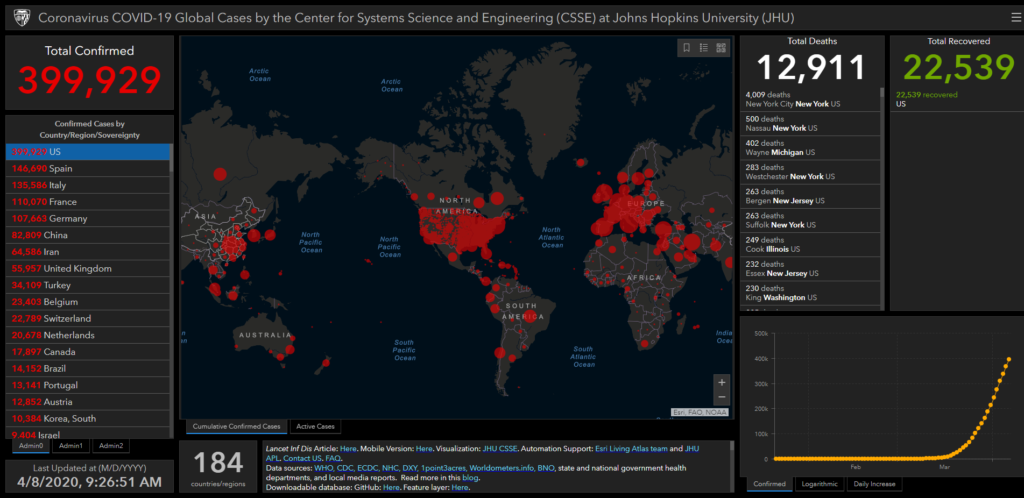
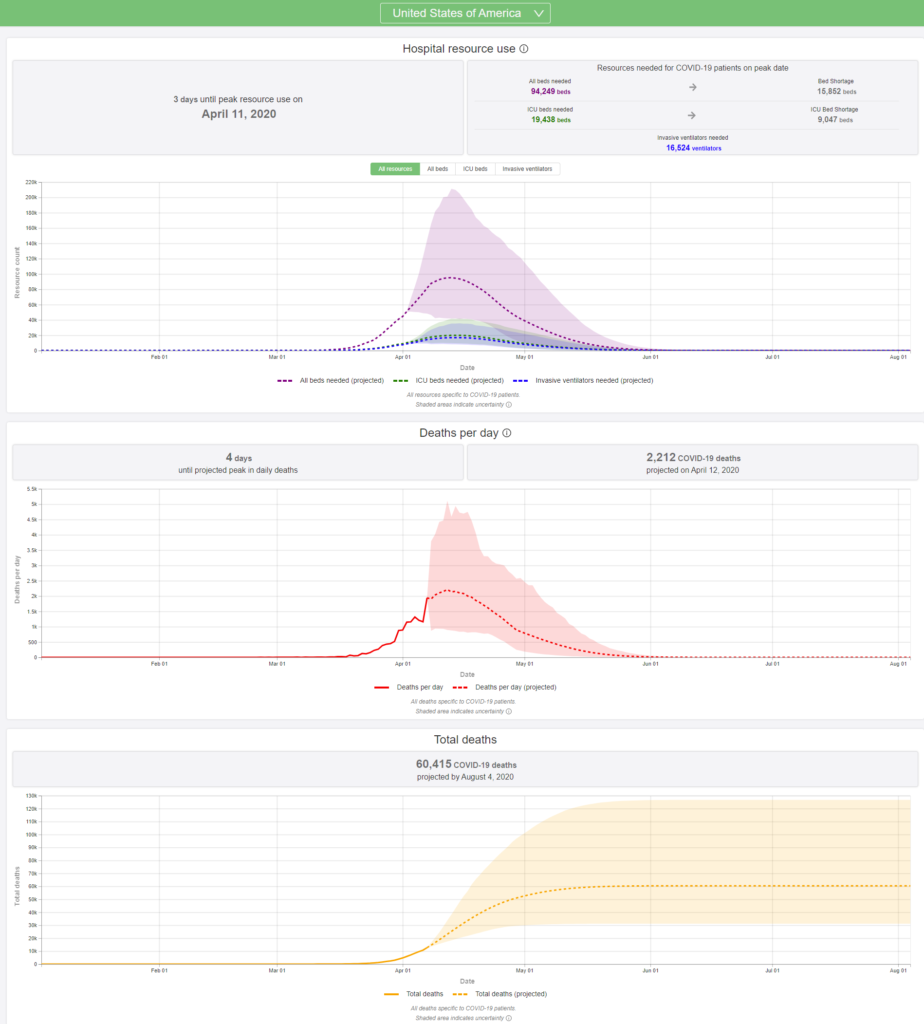
The good news here is that IMHE model, which assumes social distancing, now looks at a US death total of 60,415 — about 20,000 deaths fewer than predicted a few days ago.
NC:
North Carolina has at least 3,321 reported cases of coronavirus as of Wednesday morning, and 54 people have died, according to state and county health departments.
At least one case of the virus has been reported in 92 of the state’s 100 counties.
Health officials say the actual number of people in North Carolina with COVID-19 is likely higher, as some counties choose not to test everyone who is sick.
Nearly one-fourth of the state’s reported cases — 810 — are in Mecklenburg County, which has seen eight deaths.
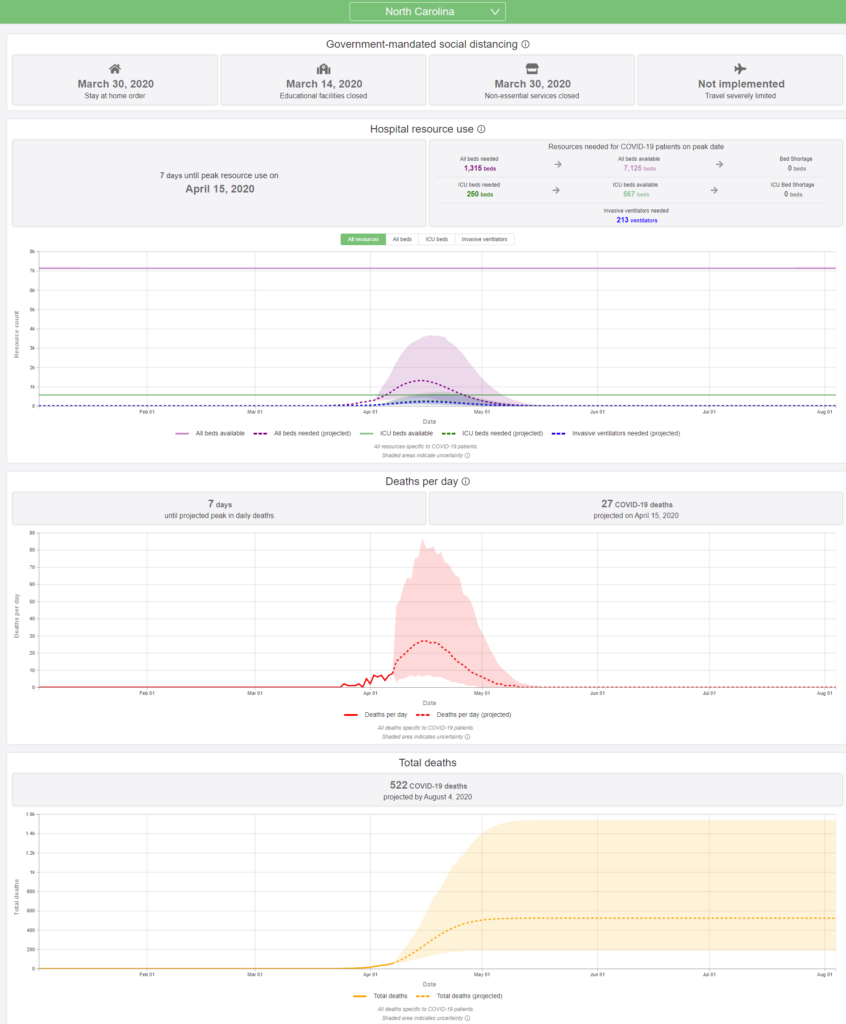
A piece of good news for NC — a study released yesterday showed we are not likely to have medical capacity exceeded.
In COVID news, the Centers for Disease Control and Prevention (CDC) quietly deleted large chunks of its guidelines on hydroxychloroquine and chloroquine, two anti-malaria drugs President Donald Trump has claimed to be potentially effective treatment for COVID-19.
Eli Lee, a research at the Citizens for Responsibility and Ethics in Washington (CREW) watchdog organization, flagged on Tuesday that the CDC’s advisory on coronavirus treatment no longer includes details of how “some U.S. clinicians have reported anecdotally different hydroxychloroquine dosing,” and that hydroxychloroquine and chloroquine are “reportedly well-tolerated in COVID-19 patients.”
The site also previously stated that the two drugs “are currently recommended for treatment of hospitalized COVID-19 patients in several countries.”
The section on hydroxychloroquine and chloroquine has now been whittled down to one paragraph explaining that they are merely “under investigation in clinical trials.”
Trump is doubling down on hydroxychloroquine though.
According to two sources who’ve heard him say it, Trump has repeatedly said how great it’ll be to “see the look on their faces” if it turns out the anti-malaria drug he’s been hyping as a coronavirus therapy ends up saving “many lives.” https://t.co/kBN3t9sePa
— Sam Stein (@samstein) April 8, 2020
NY may be getting over the hurdle:
We are flattening the curve, Cuomo says. New hospitalizations decreasing day over day, and that’s holding. Some hospitals releasing more patients than they are admitting. pic.twitter.com/ZHllii0GPm
— Charles Ornstein (@charlesornstein) April 8, 2020
Yesterday there was much talk about the disparate racial impact on COVID treatment. Black communities are being disproportionately affected by the public health crisis, according to the preliminary numbers we have available today. While comorbidities and environmental factors may certainly play a role, it’s also important to remember that on a structural level, black Americans face long-standing bias and discrimination when seeking medical care across the board.
First, let’s look at the numbers we have so far. As reported by Vox, in Louisiana, for example, black Americans make up 70% of coronavirus deaths. Louisiana Gov. John Bel Edwards described the numbers in his state as “disturbing,” and added it, “deserves more attention, and we’re going to have to dig into that and see what we can do to slow that trend down.”
In Chicago, 72% of COVID-19 related deaths are black Americans; which is close to six times the rate of white Chicago residents. Another haunting similarity to Louisiana? In both areas, only about 30% of the population is black. In Illinois as a whole, black Americans are 14% of the population—and 41% of coronavirus deaths.
“This new data offers a deeply concerning glimpse into the spread of COVID-19 and is a stark reminder of the deep-seated issues which have long created disparate health impacts in communities across Chicago,” said Chicago Mayor Lori Lightfoot.
In Michigan, a startling number of coronavirus cases are in Detroit, a majority-black city. Black Americans are less than 15% of Michigan’s entire population—but comprise close to 40% of coronavirus-related deaths and 35% of cases. ProPublica reports that in Milwaukee County, Wisconsin, 81% of people killed so far by the virus are black Americans.
These disturbing numbers lend to a major question: Why? As The New York Times suggests, some possible explanations are fairly obvious when we consider structural inequalities—black Americans may have higher rates of preexisting health conditions, such as asthma and high blood pressure, as well as less access to health insurance through an employer. Environmental pollution is a reasonable factor. Michigan state Rep. Tyrone Carter, for example, stated: “This pandemic just magnifies what we already knew: Access to health care, environmental issues in certain communities, air quality, water quality. We think about Flint and think about my district who has air issues, asthma.”
As NPR points out, however, bias may also be a factor. Black Americans, as it is, routinely experience discrimination and anti-black bias when seeking medical care. This systemic discrimination can impact black communities in everything from accessing pain medication to maternal survival rates. It’s not surprising—though it is horrifying—that this trend may continue in the face of a global pandemic. As NPR reports, according to recent billing data in a few states, physicians may be less likely to test black Americans who have cough and fever symptoms for the coronavirus.
Updates as the day continues:
POTUS officially announces new comms staffers: Kayleigh McEnany as White House Press Secretary; Alyssa Farah as Director of Strategic Communications; Ben Williamson as Senior Communications Advisor.
— Jake Tapper (@jaketapper) April 8, 2020
2,000 Americans died yesterday, but @realDonaldTrump will never lose focus on what’s important—his ratings and how they compare to The Bachelor. https://t.co/PdCNFQ0yIR
— Markos Moulitsas (@markos) April 8, 2020
ABC: “As far back as late November, U.S. intelligence officials were warning that a contagion was sweeping through China’s Wuhan region …”https://t.co/hnhObl6guH
— Aaron Blake (@AaronBlake) April 8, 2020
One of the most obnoxious talking points I’m seeing more and more from people on the right is this argument that the virus was overhyped because “we were told 2 million people in the US would die,” not noting that the number represented what would happen if we made zero changes.
Fox News in lockstep tonight: The war against coronavirus is over pic.twitter.com/npGxP7UVNu
— John Whitehouse (@existentialfish) April 8, 2020
UPDATE — Normally, this would be a post of its own, but it can’t be separated from the plague — BERNIE DROPS OUT.
“I congratulate Joe Biden, a very decent man who I will work with to move our progressive ideas forward … together, standing united, we will go forward to defeat Donald Trump, the most dangerous president in modern American history.” — Bernie Sanders pic.twitter.com/dA2FIEl6ME
— Aaron Rupar (@atrupar) April 8, 2020
Bernie Sanders is OUT! Thank you to Elizabeth Warren. If not for her, Bernie would have won almost every state on Super Tuesday! This ended just like the Democrats & the DNC wanted, same as the Crooked Hillary fiasco. The Bernie people should come to the Republican Party, TRADE!
— Donald J. Trump (@realDonaldTrump) April 8, 2020
Focus on the virus dipshit
— TeslaCharts (@TESLAcharts) April 8, 2020
Can’t see AOC plus 3 supporting Sleepy Joe!
— Donald J. Trump (@realDonaldTrump) April 8, 2020
I can see the ad now, “trumps mishandling of the pandemic cost thousands of lives.” https://t.co/SMmxku2XG1
— Molly Jong-Fast🏡 (@MollyJongFast) April 8, 2020
The hoax thing is back. From Brian Stelter’s newsletter:
Some of the biggest names in right-wing media are questioning the official Covid-19 death toll. Indeed, they’re suggesting the numbers might be inflated in an effort to paint President Trump and/or the crisis in the worst possible light. In recent days, a version of this theory has been floated by personalties such as Rush Limbaugh, Mark Levin, Tucker Carlson, Brit Hume, and “Diamond & Silk.”
Hume, who previously tweeted that New York’s “fatality numbers are inflated,” tweeted on Tuesday evening, “Well Dr. [Deborah] Birx just said it. Anyone in U.S. who dies with Covid-19, regardless of what else may be wrong, is now being recorded as a Covid-19 death.” (This is not quite what Birx said. She explained that if someone who goes into the hospital to be treated for the virus also “had a pre-existing condition” that eventually caused the individual to die, that would be counted as a Covid-19 death.)
Hume later appeared on Carlson’s show and offered the same message he did in his tweet. “There may be reasons people seek an inaccurate death count,” Carlson replied. The Fox News prime time host added, “When journalists work with numbers, there sometimes is an agenda.”
Hume and Carlson are not alone. Levin tweeted Tuesday evening that he has “suspected this for weeks.” And Limbaugh, who initially dismissed the coronavirus as the “common cold,” said recently, “It’s admittedly speculation, but … what if we are recording a bunch of deaths to coronavirus which really should not be chalked up to coronavirus?”
The death toll is likely *UNDERSTATED*
Right-wing media luminaries are advancing their theory in the face of reporting which indicates that the coronavirus death toll is being understated. An April 5 NYT story noted, “Across the United States, even as coronavirus deaths are being recorded in terrifying numbers — many hundreds each day — the true death toll is likely much higher.”
The NYT story cited hospital officials, doctors, public health experts and medical examiners who said the official death toll doesn’t account for many people: “The undercount is a result of inconsistent protocols, limited resources and a patchwork of decision making from one state or county to the next.”NYC Council health committee chair Mark Levine also said on Twitter the official NYC death toll “is certainly an undercount.” Levine explained, “Only people who die at home who are known to have a *positive coronavirus test* have the disease listed as the official cause on their death certificate. We know there are many others going uncounted.”
Trump was asked on Tuesday at the White House briefing about the accuracy of the death count, with a reporter suggesting it is a possible undercount because of the reasons outlined above. Trump pushed back, saying, “I think they’re pretty accurate on the death count. Somebody dies, I think the states have been pretty accurate.” Trump added, “No, the death counts, I think they are very, very accurate.” That said, given how the speculation about death counts being inflated are saturating right-wing media, it would not surprise me one bit if Trump later repeated the theory.
Of course he’s going to go with it. It may not be tomorrow or the next day. But he’ll get there.
And the fact that all those Fox News loonies are disseminating this crap to their millions of Trump cultists is simply horrifying. They are people without character or integrity who simply cannot ever, ever admit they are wrong. It’s one thing to engage in dirty politics. But this is next level.
They will say anything to keep Trump’s numbers down.
Ugh… the press briefing
Trump is again touting hydroxychloroquine, again citing the Michigan Democratic state legislator who believes it helped her recover. "She's in terrific shape, she looks fantastic, and she was very generous with her statements," he says. (She credited Trump on Fox and elsewhere.)
— Daniel Dale (@ddale8) April 8, 2020
Trump is recounting the story about how he was told up to 2.2 million Americans could've died if he did nothing, so if we can stay "substantially under the 100 (thousand)," "we all did a very good job" even though that's "a lot of people."
— Daniel Dale (@ddale8) April 8, 2020
Reminded that whole states vote by mail, and asked for any evidence for his claim that it's rife with fraud, Trump says, "I'll provide you with some…there's evidence being compiled." LOL
— Daniel Dale (@ddale8) April 8, 2020
Trump is falsely describing a California settlement over inactive voters on the rolls. The settlement was *not,* contrary to his claim, about people who voted even though they shouldn't have. He's said this before. My previous fact check: https://t.co/NawEtzkkmu
— Daniel Dale (@ddale8) April 8, 2020
Trump: "There's a lot of fraudulent voting…in this country." False. All evidence suggests voter fraud is extremely rare.
— Daniel Dale (@ddale8) April 8, 2020
Trump, making his pitch to Sanders voters while also boasting about himself, says he and Sanders agree on trade, except he, Trump, has done something about it.
— Daniel Dale (@ddale8) April 8, 2020
CNN’s ACOSTA: “Mr. President, do you have any investments in hydroxychloroquine?”
— Breaking911 (@Breaking911) April 8, 2020
PRES. TRUMP: “No I don't. Good question.”pic.twitter.com/NAKf2FQkq9
Breaking News From CNN
Trump removes acting Defense Department Inspector General Glenn Fine as chair of the committee overseeing $2 trillion in emergency coronavirus funding https://t.co/4CzZq7Y1j7 pic.twitter.com/ByJGb2IIxo
— CNN Breaking News (@cnnbrk) April 7, 2020
COVID-19 Update: US Death Toll Over 10,000
Almost 11,000 this morning as a matter of fact
World:

US:


North Carolina has at least 3,031 reported cases of the coronavirus as of this morning, and 48 people have died, according to state and county health departments.
The number of reported cases in North Carolina doubled in six days, hitting the 3,000 mark Monday evening. But the total number of cases is likely higher, experts say.

Reported US coronavirus cases via @CNN:
— Ryan Struyk (@ryanstruyk) April 7, 2020
Feb. 6: 12
Mar. 6: 332
April 6: 367,507
Reported US coronavirus deaths via @CNN:
— Ryan Struyk (@ryanstruyk) April 7, 2020
Feb. 6: 0
Mar. 6: 17
April 6: 10,908
Coronavirus cases per 100,000 by state via @CNN:
— Ryan Struyk (@ryanstruyk) April 7, 2020
678 – New York
463 – New Jersey
320 – Louisiana
201 – Massachusetts
194 – Connecticut
172 – Michigan
155 – Washington, D.C.
110 – Washington state
103 – Pennsylvania
102 – Rhode Island
97 – Illinois
90 – Colorado
87 – Vermont
We should keep in mind that the death toll here in the US is undercounted:
A coroner in Indiana wanted to know if the coronavirus had killed a man in early March, but said that her health department denied a test. Paramedics in New York City say that many patients who died at home were never tested for the coronavirus, even if they showed telltale signs of infection.
In Virginia, a funeral director prepared the remains of three people after health workers cautioned her that they each had tested positive for the coronavirus. But only one of the three had the virus noted on the death certificate.
Across the United States, even as coronavirus deaths are being recorded in terrifying numbers — many hundreds each day — the true death toll is likely much higher.
More than 9,400 people with the coronavirus have been reported to have died in this country as of this weekend, but hospital officials, doctors, public health experts and medical examiners say that official counts have failed to capture the true number of Americans dying in this pandemic. The undercount is a result of inconsistent protocols, limited resources and a patchwork of decision making from one state or county to the next.
In many rural areas, coroners say they don’t have the tests they need to detect the disease. Doctors now believe that some deaths in February and early March, before the coronavirus reached epidemic levels in the United States, were likely misidentified as influenza or only described as pneumonia.
With no uniform system for reporting coronavirus-related deaths in the United States, and a continued shortage of tests, some states and counties have improvised, obfuscated and, at times, backtracked in counting the dead.
Wisconsin, amazingly, is having primaries today. Yesterday was a day of maximal chaos in Wisconsin as two conservative courts insisted today’s election go forward and limited absentee voting, moves that threaten to prevent countless voters from participating and render the results illegitimate.
Yesterday afternoon, Democratic Gov. Tony Evers issued an executive order postponing the election—which includes a presidential primary and races for state and local office—to June 9. Republicans, however, have bitterly opposed such a delay and immediately challenged the order before the state Supreme Court. Hours later, the court’s four conservatives who heard the case blocked Evers’ order, with both liberal justices dissenting. As a result, the state was left with no choice but to proceed with in-person voting today, despite the serious risks to public health and a crippled elections infrastructure.
Not long thereafter, the U.S. Supreme Court overturned an order made last Thursday by a lower court, which said that voters could cast absentee ballots so long as election officials received them by April 13, regardless of when they were postmarked. In a 5-4 ruling—which, like the Wisconsin high court’s decision, fell along strictly ideological lines—the court’s conservatives ruled that all ballots must be postmarked by April 7.
This means that those who have the misfortune to receive their ballots late—a distinct possibility for many, given the huge surge in requests—now face an impossible choice, as Justice Ruth Bader Ginsburg noted in a dissent: They must either risk their health by voting in person today, or disenfranchise themselves by not voting at all. The same holds true for anyone who was unable to request a ballot, as well as the many groups of voters who cannot vote by mail, such as those who are without housing.
This video of Wisconsin Speaker Republican Robin Vos defending holding the election – while he is wearing full mandatory PPE and a face mask – is remarkable.
— andrew kaczynski🤔 (@KFILE) April 7, 2020
"It made no sense to cancel the election….you are incredibly safe to go out."https://t.co/PrDL6OBSTz pic.twitter.com/qEEmuk8Xk1
In other COVID news, Steak-umms nails it. Yes… Steak-umms.


/2
— West Wing Reports (edited by Paul Brandus) (@WestWingReport) April 8, 2020
Context:
1) U.S. deaths from #coronavirus – in just a few weeks – are about 1/5 of the nine-year Vietnam War
2) 1/3 of Korean War
3) nearly 2x as much as Iraq and Afghanistan combined
4) 2x the combined Union death tolls of Civil War battles of Antietam and Gettysburg
COVID-19 Update: This Is Getting Old


When certain folks all push the same angle — Trump, Giuliani, Solomon, et al — one may think immediately it’s a scam.
Like the Ukraine quid pro quo scam on which the very same players worked together, singing from the same hymnal.
The scam is more obvious because two of the people involved are promoting a pharmaceutical and they’re not medical doctors — they may be practicing medicine without a license by encouraging the use of a medication which isn’t approved for the use they advocate.
The drug is hydroxychloroquine, an antimalarial drug which has also been approved for a small number of autoimmune disorders like lupus.
Something is clearly not right when so many of the same players are pushing a drug using the power of the presidency to do so.
Of course you all know Trump wants and NEEDS to stay in office or he’s up the creek without a paddle. This scam isn’t about making money but instead about serving his need not to be investigated and prosecuted for all manner of tax, bank, wire fraud and more beginning ten months from now.
So…Team Trump picks a drug which when administered in safe dose, doesn’t do much constructively for anybody except people they don’t give a shit about like patients with lupus and autoimmune disorders.
Weak sauce studies on hydroxychloroquine to date suggest it’s a 50/50 crap shoot that the critically-ill patients qualifying for compassionate use and receiving this drug will recover. Somebody external to the White House, possibly external to the U.S., maybe even the drug company/ies which makes this, may have made have chosen this drug because they did this math. They have just enough iffy research by iffy researchers to encourage its use.
They end up with just enough people who’ll recover and claim it’s a miracle drug that saved their lives, and the other half are dead or disabled so they won’t appear on camera to say otherwise. Handpicked survivors become testimonials to Trump’s ‘Wile E. Coyote super genius‘ and his prospective worth as our two-term conman-in-chief.
Even Dr. Fauci has said there’s no proof this drug cocktail works; he’s been clearly frustrated with Trump’s handling of COVID-19.
Trump cut off attempts to ask Dr. Fauci more questions about this drug yesterday.
But Team Trump counters Fauci’s doubts by launching a character assassination attack in social media, calling Fauci part of the “deep state” out to get Trump.
At the same time there’s a continuous social media swarm pushing the drug.
Team Trump haven’t fired Fauci because they still need him to save Trump from making bigger mistakes and Fauci has much higher credibility ratings than any of the rest of Team Trump appearing before cameras.
But Trump’s current pandemic response failures are already projected to cost at least 100-240,000 American lives which Team Trump are now calling a goal, or success.
That’s part of the scam, too, the framing of what success will look like, long after Trump blew by the true benchmark of zero American deaths.
All this to boost his approval rating so he can use it for his re-election campaign. That’s the scam.
Just like the quid pro quo for which Trump was impeached — manipulate the situation so that false information boosts Trump’s approval with voters, abusing his power for his own personal gain.
What gave me pause wasn’t just the crappy research. Or the problematic French research with which this all began.
It was the fact that Rudy Giuliani, John Solomon, Charlie Kirk and a bunch of other right-wing support players were also doing their bit repeatedly to push this drug cocktail as well as a Russian doctor.
This is the Ukraine scam all over again, only this time the players are going to push a crappy drug and assassinate Dr. Fauci’s character, instead of pushing a false meme about Hunter Biden and assassinating Marie Yovanovitch’s character while she was ambassador to Ukraine.
Dr. Fauci has received death threats now because of this nonsense and his security detail has been increased because of it.
Michigan’s Governor Gretchen Whitmer has also been criticized by right-wingers about hydroxychloroquine. The state’s Department of Licensing and Regulatory Affairs throttled off-label prescriptions of the antimalarial drug because doctors and pharmacists were abusing their licenses by writing scripts for themselves and their families, hoarding the drug while depleting inventories.
But Dr. Fauci and Gov. Whitmer aren’t the only ones affected by this. There are so many stories about lupus and other autoimmune disorder patients who haven’t been able to fill their prescriptions because of a run on hydroxychloroquine because of Team Trump’s unlicensed practice of medicine at the podium — or unregistered lobbying for pharmaceutical company or companies.
Not to mention the strong possibility that although the Food and Drug Administration caved under pressure from Team Trump and now allows “compassionate use” of the drug for COVID-19, the drug could easily kill patients who are already under stress from SARS-CoV-2’s attack on their systems.
Hydroxychloroquine requires additional caution when used on females, geriatric patients, patients with diabetes — this describes a considerable number of COVID-19 patients in critical care! — thyroid disease, malnutrition, liver impairment, or those who drink alcohol to excess — for starters. The drug must be used with caution in persons with cardiac arrhythmias, congenital long QT syndrome, heart failure, bradycardia, myocardial infarction, hypertension, coronary artery disease, hypomagnesemia, hypokalemia, hypocalcemia, or in patients receiving medications known to prolong the QT interval or cause electrolyte imbalances.
This is only part a portion of the contraindications and precautions for hydroxychloroquine.
It may also cause permanent eye damage.
Imagine monitoring the patients receiving hydroxychloroquine even more closely when hospitals are overwhelmed and understaffed.
None of the research so far has been performed in vivo in a large, randomized trial. We really do not know what it will do except for what it has done for malaria patients and for autoimmune disorders — hardly the same things as patients in extremis from COVID-19.
Trump’s pushing drugs from the presidential podium must stop because Americans are being hurt for the sake of whatever scam Team Trump is pulling off this time.
We can see part of the potential reasoning Team Trump has used, but who else is benefiting from this? How do pharmaceutical companies fit into this, particularly Novartis which may be the sole source for the stockpile of hydroxychloroquine the federal government acquired. We don’t know the total amount the U.S. holds, how much might have been donated, and how much has been bought.
We don’t know whether this was part of conversations which may have happened at Davos around January 22, when pharmaceutical companies like Novartis were present and when business leaders were already concerned about COVID-19 outbreak in China.
We just don’t have all the facts yet to know every angle of this particular artless deal.
I can’t take it anymore. I’ve been to The Hague. I’m making a referral for crimes against humanity tomorrow. Today’s press conference was the last straw. I know the need for a prosecution referral when I see one. https://t.co/XQin24gqY4
— Rep. Tavia Galonski (@RepGalonski) April 6, 2020
Trump is playing optimist still this morning.
LIGHT AT THE END OF THE TUNNEL!
— Donald J. Trump (@realDonaldTrump) April 6, 2020
Lee Fierro, who played Mrs. Kintner in ‘Jaws’ has died at age 91 due to the coronavirus.
— Yashar Ali 🐘 (@yashar) April 5, 2020
In ‘Jaws,’ Fierro played a mom whose son was killed by a shark.
In this famous scene, she slaps Chief Brody for not taking the threat of a shark seriously. https://t.co/uzmZrhnL3F pic.twitter.com/Qr7UDxMjsV
A newly released report from the inspector general for the Department of Health and Human Services paints a devastating portrait of the Trump administration’s failures during the coronavirus pandemic.
NBC News reports that the HHS IG found that hospitals across the United States are lacking supplies as basic as thermometers, even as they’re being undercut by their own federal government in trying to acquire new supplies.
“Vendors have told us that they need to send whatever they have to the national stockpile,” said Ruthanne Sudderth, senior vice president for the Michigan Health & Hospital Association.
Additionally, the report found that supplies delivered to states by the federal government were either inadequate or defective.
“One hospital received two shipments from the Federal Emergency Management Agency with protective gear that had expired in 2010,” NBC News writes. “Another hospital system received 1,000 masks from federal and state governments, even though it expected a much larger delivery, and ‘500 of the masks were for children and therefore unusable for adult staff,’ the report said.”
The result of all this was to create “confusion, fear and distrust” throughout the health care system.
Ann Maxwell, assistant inspector general for HHS, tells NBC News that the failures outlined in the report are “unprecedented.”
“I think one moment that stands out for me is when I was talking to a hospital administrator and he told me that he had staff in the hospital out trying to procure masks and gloves from auto part shops, from home supply stores, from beauty salons, from art supply stores,” Maxwell said. “I was just taken aback.”
This has been reported in the media, of course, but now the government is agreeing (albeit not those within the Trump Administration).
One wonders how long the Inspector General for the HHS will have a job.
P.M. Updates:
Mark Levine, the chair of the New York City Council Committee on Health, claimed that officials are considering temporarily burying people who die from COVID-19 in local parks due to the number of increasing dead bodies and lack of space in freezers at Office of Chief Medical Examiner (OCME) facilities in the state.


In other news, British PM Boris Johnson was moved into intensive care this afternoon.
And here’s an odd story… Trump and 2020 Democratic frontrunner Joe Biden reportedly spoke via phone late this afternoon regarding the nation’s response to the coronavirus, per multiple reports.
That comes after Trump tweeted this tweet below, this morning:
Joe Biden wanted the date for the Democrat National Convention moved to a later time period. Now he wants a “Virtual” Convention, one where he doesn’t have to show up. Gee, I wonder why? Also, what ever happened to that phone call he told the Fake News he wanted to make to me?
— Donald J. Trump (@realDonaldTrump) April 6, 2020
And THIS…. is awesome:
Trump keeps saying the HHS deputy IG "came out of the Obama administration" and is politically biased against him.
— Marshall Cohen (@MarshallCohen) April 6, 2020
FACTS: Her name is Christi Grimm. She is a career official who has worked at HHS since 1999. She served during the Clinton, Bush, Obama and Trump administrations.
Trump is flinching under fire. He is unable to control himself and his emotions. He lacks command presence and any pretense of the moral authority required to call for national unity in a moment of national crisis. He is self pitying and dishonest; inaccurate and confusing.
— Steve Schmidt (@SteveSchmidtSES) April 6, 2020
Breaking News From CNN
The former intelligence community inspector general, who informed Congress of the whistleblower complaint that led to Trump's impeachment, says that he believes Trump fired him for doing his job https://t.co/ccFQr5Bwyu
— CNN Breaking News (@cnnbrk) April 6, 2020
Washington Post Delves Into All The Trump Administration Fuckups Of COVID-19
Max Boot calls Trump the worst president in all US history. Here’s why:
By the time Donald Trump proclaimed himself a wartime president — and the coronavirus the enemy — the United States was already on course to see more of its people die than in the wars of Korea, Vietnam, Afghanistan and Iraq combined.
The country has adopted an array of wartime measures never employed collectively in U.S. history — banning incoming travelers from two continents, bringing commerce to a near-halt, enlisting industry to make emergency medical gear, and confining 230 million Americans to their homes in a desperate bid to survive an attack by an unseen adversary.
Despite these and other extreme steps, the United States will likely go down as the country that was supposedly best prepared to fight a pandemic but ended up catastrophically overmatched by the novel coronavirus, sustaining heavier casualties than any other nation.
It did not have to happen this way. Though not perfectly prepared, the United States had more expertise, resources, plans and epidemiological experience than dozens of countries that ultimately fared far better in fending off the virus.
The failure has echoes of the period leading up to 9/11: Warnings were sounded, including at the highest levels of government, but the president was deaf to them until the enemy had already struck.
The Trump administration received its first formal notification of the outbreak of the coronavirus in China on Jan. 3. Within days, U.S. spy agencies were signaling the seriousness of the threat to Trump by including a warning about the coronavirus — the first of many — in the President’s Daily Brief.
And yet, it took 70 days from that initial notification for Trump to treat the coronavirus not as a distant threat or harmless flu strain well under control, but as a lethal force that had outflanked America’s defenses and was poised to kill tens of thousands of citizens. That more-than-two-month stretch now stands as critical time that was squandered.
Trump’s baseless assertions in those weeks, including his claim that it would all just “miraculously” go away, sowed significant public confusion and contradicted the urgent messages of public health experts.
“While the media would rather speculate about outrageous claims of palace intrigue, President Trump and this Administration remain completely focused on the health and safety of the American people with around the clock work to slow the spread of the virus, expand testing, and expedite vaccine development,” said Judd Deere, a spokesman for the president. “Because of the President’s leadership we will emerge from this challenge healthy, stronger, and with a prosperous and growing economy.”
The president’s behavior and combative statements were merely a visible layer on top of deeper levels of dysfunction.
The most consequential failure involved a breakdown in efforts to develop a diagnostic test that could be mass produced and distributed across the United States, enabling agencies to map early outbreaks of the disease, and impose quarantine measures to contain them. At one point, a Food and Drug Administration official tore into lab officials at the Centers for Disease Control and Prevention, telling them their lapses in protocol, including concerns that the lab did not meet the criteria for sterile conditions, were so serious that the FDA would “shut you down” if the CDC were a commercial, rather than government, entity.
Other failures cascaded through the system. The administration often seemed weeks behind the curve in reacting to the viral spread, closing doors that were already contaminated. Protracted arguments between the White House and public health agencies over funding, combined with a meager existing stockpile of emergency supplies, left vast stretches of the country’s health-care system without protective gear until the outbreak had become a pandemic. Infighting, turf wars and abrupt leadership changes hobbled the work of the coronavirus task force.
It may never be known how many thousands of deaths, or millions of infections, might have been prevented with a response that was more coherent, urgent and effective. But even now, there are many indications that the administration’s handling of the crisis had potentially devastating consequences.
Even the president’s base has begun to confront this reality. In mid-March, as Trump was rebranding himself a wartime president and belatedly urging the public to help slow the spread of the virus, Republican leaders were poring over grim polling data that suggested Trump was lulling his followers into a false sense of security in the face of a lethal threat.
The poll showed that far more Republicans than Democrats were being influenced by Trump’s dismissive depictions of the virus and the comparably scornful coverage on Fox News and other conservative networks. As a result, Republicans were in distressingly large numbers refusing to change travel plans, follow “social distancing” guidelines, stock up on supplies or otherwise take the coronavirus threat seriously.
“Denial is not likely to be a successful strategy for survival,” GOP pollster Neil Newhouse concluded in a document that was shared with GOP leaders on Capitol Hill and discussed widely at the White House. Trump’s most ardent supporters, it said, were “putting themselves and their loved ones in danger.”
Trump’s message was changing as the report swept through the GOP’s senior ranks. In recent days, Trump has bristled at reminders that he had once claimed the caseload would soon be “down to zero.”
More than 7,000 people have died of the coronavirus in the United States so far, with about 240,000 cases reported. But Trump has acknowledged that new models suggest that the eventual national death toll could be between 100,000 and 240,000.
Beyond the suffering in store for thousands of victims and their families, the outcome has altered the international standing of the United States, damaging and diminishing its reputation as a global leader in times of extraordinary adversity.
“This has been a real blow to the sense that America was competent,” said Gregory F. Treverton, a former chairman of the National Intelligence Council, the government’s senior-most provider of intelligence analysis. He stepped down from the NIC in January 2017 and now teaches at the University of Southern California. “That was part of our global role. Traditional friends and allies looked to us because they thought we could be competently called upon to work with them in a crisis. This has been the opposite of that.”
This article, which retraces the failures over the first 70 days of the coronavirus crisis, is based on 47 interviews with administration officials, public health experts, intelligence officers and others involved in fighting the pandemic. Many spoke on the condition of anonymity to discuss sensitive information and decisions.
Scanning the horizon
Public health authorities are part of a special breed of public servant — along with counterterrorism officials, military planners, aviation authorities and others — whose careers are consumed with contemplating worst-case scenarios.
The arsenal they wield against viral invaders is powerful, capable of smothering a new pathogen while scrambling for a cure, but easily overwhelmed if not mobilized in time. As a result, officials at the Department of Health and Human Services, the CDC and other agencies spend their days scanning the horizon for emerging dangers.
The CDC learned of a cluster of cases in China on Dec. 31 and began developing reports for HHS on Jan. 1. But the most unambiguous warning that U.S. officials received about the coronavirus came Jan. 3, when Robert Redfield, the CDC director, received a call from a counterpart in China. The official told Redfield that a mysterious respiratory illness was spreading in Wuhan, a congested commercial city of 11 million people in the communist country’s interior.
Redfield quickly relayed the disturbing news to Alex Azar, the secretary of HHS, the agency that oversees the CDC and other public health entities. Azar, in turn, ensured that the White House was notified, instructing his chief of staff to share the Chinese report with the National Security Council.
From that moment, the administration and the virus were locked in a race against a ticking clock, a competition for the upper hand between pathogen and prevention that would dictate the scale of the outbreak when it reached American shores, and determine how many would get sick or die.
The initial response was promising, but officials also immediately encountered obstacles.
On Jan. 6, Redfield sent a letter to the Chinese offering to send help, including a team of CDC scientists. China rebuffed the offer for weeks, turning away assistance and depriving U.S. authorities of an early chance to get a sample of the virus, critical for developing diagnostic tests and any potential vaccine.
China impeded the U.S. response in other ways, including by withholding accurate information about the outbreak. Beijing had a long track record of downplaying illnesses that emerged within its borders, an impulse that U.S. officials attribute to a desire by the country’s leaders to avoid embarrassment and accountability with China’s 1.3 billion people and other countries that find themselves in the pathogen’s path.
China stuck to this costly script in the case of the coronavirus, reporting Jan. 14 that it had seen “no clear evidence of human-to-human transmission.” U.S. officials treated the claim with skepticism that intensified when the first case surfaced outside China with a reported infection in Thailand.
A week earlier, senior officials at HHS had begun convening an intra-agency task force including Redfield, Azar and Anthony S. Fauci, director of the National Institute of Allergy and Infectious Diseases. The following week, there were also scattered meetings at the White House with officials from the National Security Council and State Department, focused mainly on when and whether to bring back government employees in China.
U.S. officials began taking preliminary steps to counter a potential outbreak. By mid-January, Robert Kadlec, an Air Force officer and physician who serves as assistant secretary for preparedness and response at HHS, had instructed subordinates to draw up contingency plans for enforcing the Defense Production Act, a measure that enables the government to compel private companies to produce equipment or devices critical to the country’s security. Aides were bitterly divided over whether to implement the act, and nothing happened for many weeks.
On Jan. 14, Kadlec scribbled a single word in a notebook he carries: “Coronavirus!!!”
Despite the flurry of activity at lower levels of his administration, Trump was not substantially briefed by health officials about the coronavirus until Jan.18, when, while spending the weekend at Mar-a-Lago, he took a call from Azar.
Even before the heath secretary could get a word in about the virus, Trump cut him off and began criticizing Azar for his handling of an aborted federal ban on vaping products, a matter that vexed the president.
At the time, Trump was in the throes of an impeachment battle over his alleged attempt to coerce political favors from the leader of Ukraine. Acquittal seemed certain by the GOP-controlled Senate, but Trump was preoccupied with the trial, calling lawmakers late at night to rant, and making lists of perceived enemies he would seek to punish when the case against him concluded.
In hindsight, officials said, Azar could have been more forceful in urging Trump to turn at least some of his attention to a threat that would soon pose an even graver test to his presidency, a crisis that would cost American lives and consume the final year of Trump’s first term.
But the secretary, who had a strained relationship with Trump and many others in the administration, assured the president that those responsible were working on and monitoring the issue. Azar told several associates that the president believed he was “alarmist” and Azar struggled to get Trump’s attention to focus on the issue, even asking one confidant for advice.
Within days, there were new causes for alarm.
On Jan. 21, a Seattle man who had recently traveled to Wuhan tested positive for the coronavirus, becoming the first known infection on U.S. soil. Then, two days later, Chinese authorities took the drastic step of shutting down Wuhan, turning the teeming metropolis into a ghost city of empty highways and shuttered skyscrapers, with millions of people marooned in their homes.
“That was like, whoa,” said a senior U.S. official involved in White House meetings on the crisis. “That was when the Richter scale hit 8.”
It was also when U.S. officials began to confront the failings of their own efforts to respond.
Azar, who had served in senior positions at HHS through crises including the 9/11 terrorist attacks and the outbreak of bird flu in 2005, was intimately familiar with the playbook for crisis management.
He instructed subordinates to move rapidly to establish a nationwide surveillance system to track the spread of the coronavirus — a stepped-up version of what the CDC does every year to monitor new strains of the ordinary flu.
But doing so would require assets that would elude U.S. officials for months — a diagnostic test that could accurately identify those infected with the new virus and be produced on a mass scale for rapid deployment across the United States, and money to implement the system.
Azar’s team also hit another obstacle. The Chinese were still refusing to share the viral samples they had collected and were using to develop their own tests. In frustration, U.S. officials looked for other possible routes.
A biocontainment lab at the University of Texas medical branch in Galveston had a research partnership with the Wuhan Institute of Virology.
Kadlec, who knew the Galveston lab director, hoped scientists could arrange a transaction on their own without government interference. At first, the lab in Wuhan agreed, but officials in Beijing intervened Jan. 24 and blocked any lab-to-lab transfer.
There is no indication that officials sought to escalate the matter or enlist Trump to intervene. In fact, Trump has consistently praised Chinese President Xi Jinping despite warnings from U.S. intelligence and health officials that Beijing was concealing the true scale of the outbreak and impeding cooperation on key fronts.
The CDC had issued its first public alert about the coronavirus Jan. 8, and by the 17th was monitoring major airports in Los Angeles, San Francisco and New York, where large numbers of passengers arrived each day from China.
In other ways, though, the situation was already spinning out of control, with multiplying cases in Seattle, intransigence by the Chinese, mounting questions from the public, and nothing in place to stop infected travelers from arriving from abroad.
Trump was out of the country for this critical stretch, taking part in the annual global economic forum in Davos, Switzerland. He was accompanied by a contingent of top officials including national security adviser Robert O’Brien, who took a trans-Atlantic call from an anxious Azar.
Azar told O’Brien that it was “mayhem” at the White House, with HHS officials being pressed to provide nearly identical briefings to three audiences on the same day.
Azar urged O’Brien to have the NSC assert control over a matter with potential implications for air travel, immigration authorities, the State Department and the Pentagon. O’Brien seemed to grasp the urgency, and put his deputy, Matthew Pottinger, who had worked in China as a journalist for the Wall Street Journal, in charge of coordinating the still-nascent U.S. response.
But the rising anxiety within the administration appeared not to register with the president. On Jan. 22, Trump received his first question about the coronavirus in an interview on CNBC while in Davos. Asked whether he was worried about a potential pandemic, Trump said, “No. Not at all. And we have it totally under control. It’s one person coming in from China. . . . It’s going to be just fine.”
Spreading uncontrollably
The move by the NSC to seize control of the response marked an opportunity to reorient U.S. strategy around containing the virus where possible and procuring resources that hospitals would need in any U.S. outbreak, including such basic equipment as protective masks and ventilators.
But instead of mobilizing for what was coming, U.S. officials seemed more preoccupied with logistical problems, including how to evacuate Americans from China.
In Washington, then-acting chief of staff Mick Mulvaney and Pottinger began convening meetings at the White House with senior officials from HHS, the CDC and the State Department.
The group, which included Azar, Pottinger and Fauci, as well as nine others across the administration, formed the core of what would become the administration’s coronavirus task force. But it primarily focused on efforts to keep infected people in China from traveling to the United States even while evacuating thousands of U.S. citizens. The meetings did not seriously focus on testing or supplies, which have since become the administration’s most challenging problems.
The task force was formally announced on Jan. 29.
“The genesis of this group was around border control and repatriation,” said a senior official involved in the meetings. “It wasn’t a comprehensive, whole-of-government group to run everything.”
The State Department agenda dominated those early discussions, according to participants. Officials began making plans to charter aircraft to evacuate 6,000 Americans stranded in Wuhan. They also debated language for travel advisories that State could issue to discourage other travel in and out of China.
On Jan. 29, Mulvaney chaired a meeting in the White House Situation Room in which officials debated moving travel restrictions to “Level 4,” meaning a “do not travel” advisory from the State Department. Then, the next day, China took the draconian step of locking down the entire Hubei province, which encompasses Wuhan.
That move by Beijing finally prompted a commensurate action by the Trump administration. On Jan. 31, Azar announced restrictions barring any non-U.S. citizen who had been in China during the preceding two weeks from entering the United States.
Trump has, with some justification, pointed to the China-related restriction as evidence that he had responded aggressively and early to the outbreak. It was among the few intervention options throughout the crisis that played to the instincts of the president, who often seems fixated on erecting borders and keeping foreigners out of the country.
But by that point, 300,000 people had come into the United States from China over the previous month. There were only 7,818 confirmed cases around the world at the end of January, according to figures released by the World Health Organization — but it is now clear that the virus was spreading uncontrollably.
Pottinger was by then pushing for another travel ban, this time restricting the flow of travelers from Italy and other nations in the European Union that were rapidly emerging as major new nodes of the outbreak. Pottinger’s proposal was endorsed by key health-care officials, including Fauci, who argued that it was critical to close off any path the virus might take into the country.
This time, the plan met with resistance from Treasury Secretary Steven Mnuchin and others who worried about the impact on the U.S. economy. It was an early sign of tension in an area that would split the administration, pitting those who prioritized public health against those determined to avoid any disruption in an election year to the run of expansion and employment growth.
Those backing the economy prevailed with the president. And it was more than a month before the administration issued a belated and confusing ban on flights into the United States from Europe. Hundreds of thousands of people crossed the Atlantic during that interval.
A wall of resistance
While fights over air travel played out in the White House, public health officials began to panic over a startling shortage of critical medical equipment including protective masks for doctors and nurses, as well as a rapidly shrinking pool of money needed to pay for such things.
By early February, the administration was quickly draining a $105 million congressional fund to respond to infectious disease outbreaks. The coronavirus threat to the United States still seemed distant if not entirely hypothetical to much of the public. But to health officials charged with stockpiling supplies for worst-case-scenarios, disaster appeared increasingly inevitable.
A national stockpile of N95 protective masks, gowns, gloves and other supplies was already woefully inadequate after years of underfunding. The prospects for replenishing that store were suddenly threatened by the unfolding crisis in China, which disrupted offshore supply chains.
Much of the manufacturing of such equipment had long since migrated to China, where factories were now shuttered because workers were on order to stay in their households. At the same time, China was buying up masks and other gear to gird for its own coronavirus outbreak, driving up costs and monopolizing supplies.
In late January and early February, leaders at HHS sent two letters to the White House Office of Management and Budget asking to use its transfer authority to shift $136 million of department funds into pools that could be tapped for combating the coronavirus. Azar and his aides also began raising the need for a multibillion-dollar supplemental budget request to send to Congress.
Yet White House budget hawks argued that appropriating too much money at once when there were only a few U.S. cases would be viewed as alarmist.
Joe Grogan, head of the Domestic Policy Council, clashed with health officials over preparedness. He mistrusted how the money would be used and questioned how health officials had used previous preparedness funds.
Azar then spoke to Russell Vought, the acting director of the White House Office of Management and Budget, during Trump’s State of the Union speech on Feb. 4. Vought seemed amenable, and told Azar to submit a proposal.
Azar did so the next day, drafting a supplemental request for more than $4 billion, a sum that OMB officials and others at the White House greeted as an outrage. Azar arrived at the White House that day for a tense meeting in the Situation Room that erupted in a shouting match, according to three people familiar with the incident.
A deputy in the budget office accused Azar of preemptively lobbying Congress for a gigantic sum that White House officials had no interest in granting. Azar bristled at the criticism and defended the need for an emergency infusion. But his standing with White House officials, already shaky before the coronavirus crisis began, was damaged further.
White House officials relented to a degree weeks later as the feared coronavirus surge in the United States began to materialize. The OMB team whittled Azar’s demands down to $2.5 billion, money that would be available only in the current fiscal year. Congress ignored that figure, approving an $8 billion supplemental bill that Trump signed into law March 6.
But again, delays proved costly. The disputes meant that the United States missed a narrow window to stockpile ventilators, masks and other protective gear before the administration was bidding against many other desperate nations, and state officials fed up with federal failures began scouring for supplies themselves.
In late March, the administration ordered 10,000 ventilators — far short of what public health officials and governors said was needed. And many will not arrive until the summer or fall, when models expect the pandemic to be receding.
“It’s actually kind of a joke,” said one administration official involved in deliberations about the belated purchase.
Inconclusive tests
Although viruses travel unseen, public health officials have developed elaborate ways of mapping and tracking their movements. Stemming an outbreak or slowing a pandemic in many ways comes down to the ability to quickly divide the population into those who are infected and those who are not.
Doing so, however, hinges on having an accurate test to diagnose patients and deploy it rapidly to labs across the country. The time it took to accomplish that in the United States may have been more costly to American efforts than any other failing.
“If you had the testing, you could say, ‘Oh my god, there’s circulating virus in Seattle, let’s jump on it. There’s circulating virus in Chicago, let’s jump on it,’ ” said a senior administration official involved in battling the outbreak. “We didn’t have that visibility.”
The first setback came when China refused to share samples of the virus, depriving U.S. researchers of supplies to bombard with drugs and therapies in a search for ways to defeat it. But even when samples had been procured, the U.S. effort was hampered by systemic problems and institutional hubris.
Among the costliest errors was a misplaced assessment by top health officials that the outbreak would probably be limited in scale inside the United States — as had been the case with every other infection for decades — and that the CDC could be trusted on its own to develop a coronavirus diagnostic test.
The CDC, launched in the 1940s to contain an outbreak of malaria in the southern United States, had taken the lead on the development of diagnostic tests in major outbreaks including Ebola, zika and H1N1. But the CDC was not built to mass-produce tests.
The CDC’s success had fostered an institutional arrogance, a sense that even in the face of a potential crisis there was no pressing need to involve private labs, academic institutions, hospitals and global health organizations also capable of developing tests.
Yet some were concerned that the CDC test would not be enough. Stephen Hahn, the FDA commissioner, sought authority in early February to begin calling private diagnostic and pharmaceutical companies to enlist their help.
FDA leaders were split on whether it would be bad optics for Hahn to be personally calling companies he regulated. When FDA officials consulted leaders at HHS, they understood it as a direction to stand down.
At that point, Azar, the HHS secretary, seemed committed to a plan he was pursuing that would keep his agency at the center of the response effort: securing a test from the CDC and then building a national coronavirus surveillance system by relying on an existing network of labs used to track the ordinary flu.
In task force meetings, Azar and Redfield pushed for $100 million to fund the plan, but were shot down because of the cost, according to a document outlining the testing strategy obtained by The Washington Post.
Relying so heavily on the CDC would have been problematic even if it had succeeded in quickly developing an effective test that could be distributed across the country. The scale of the epidemic, and the need for mass testing far beyond the capabilities of the flu network, would have overwhelmed the plan, which didn’t envision engaging commercial lab companies for up to six months.
The effort collapsed when the CDC failed its basic assignment to create a working test and the task force rejected Azar’s plan.
On Feb. 6, when the World Health Organization reported that it was shipping 250,000 test kits to labs around the world, the CDC began distributing 90 kits to a smattering of state-run health labs.
Almost immediately, the state facilities encountered problems. The results were inconclusive in trial runs at more than half the labs, meaning they couldn’t be relied upon to diagnose actual patients. The CDC issued a stopgap measure, instructing labs to send tests to its headquarters in Atlanta, a practice that would delay results for days.
The scarcity of effective tests led officials to impose constraints on when and how to use them, and delayed surveillance testing. Initial guidelines were so restrictive that states were discouraged from testing patients exhibiting symptoms unless they had traveled to China and come into contact with a confirmed case, when the pathogen had by that point almost certainly spread more broadly into the general population.
The limits left top officials largely blind to the true dimensions of the outbreak.
In a meeting in the Situation Room in mid-February, Fauci and Redfield told White House officials that there was no evidence yet of worrisome person-to-person transmission in the United States. In hindsight, it appears almost certain that the virus was taking hold in communities at that point. But even the country’s top experts had little meaningful data about the domestic dimensions of the threat. Fauci later conceded that as they learned more their views changed.
At the same time, as the president’s subordinates were growing increasingly alarmed, Trump continued to exhibit little concern. On Feb. 10, he held a political rally in New Hampshire attended by thousands where he declared that “by April, you know, in theory, when it gets a little warmer, it miraculously goes away.”
The New Hampshire rally was one of eight that Trump held after he had been told by Azar about the coronavirus, a period when he also went to his golf courses six times.
A day earlier, on Feb. 9, a group of governors in town for a black-tie gala at the White House secured a private meeting with Fauci and Redfield. The briefing rattled many of the governors, bearing little resemblance to the words of the president. “The doctors and the scientists, they were telling us then exactly what they are saying now,” Maryland Gov. Larry Hogan (R) said.
That month, federal medical and public health officials were emailing increasingly dire forecasts among themselves, with one Veterans Affairs medical adviser warning, ‘We are flying blind,’” according to emails obtained by the watchdog group American Oversight.
Later in February, U.S. officials discovered indications that the CDC laboratory was failing to meet basic quality-control standards. On a Feb. 27 conference call with a range of health officials, a senior FDA official lashed out at the CDC for its repeated lapses.
Jeffrey Shuren, the FDA’s director for devices and radiological health, told the CDC that if it were subjected to the same scrutiny as a privately run lab, “I would shut you down.”
On Feb. 29, a Washington state man became the first American to die of a coronavirus infection. That same day, the FDA released guidance, signaling that private labs were free to proceed in developing their own diagnostics.
Another four-week stretch had been squandered.
Life and death
One week later, on March 6, Trump toured the facilities at the CDC wearing a red “Keep America Great” hat. He boasted that the CDC tests were nearly perfect and that “anybody who wants a test will get a test,” a promise that nearly a month later remains unmet.
He also professed to have a keen medical mind. “I like this stuff. I really get it,” he said. “People here are surprised that I understand it. Every one of these doctors said, ‘How do you know so much about this?’ ”
In reality, many of the failures to stem the coronavirus outbreak in the United States were either a result of, or exacerbated by, his leadership.
For weeks, he had barely uttered a word about the crisis that didn’t downplay its severity or propagate demonstrably false information. He dismissed the warnings of intelligence officials and top public health officials in his administration.
At times, he voiced far more authentic concern about the trajectory of the stock market than the spread of the virus in the United States, railing at the chairman of the Federal Reserve and others with an intensity that he never seemed to exhibit about the possible human toll of the outbreak.
In March, as state after state imposed sweeping new restrictions on their citizens’ daily lives to protect them — triggering severe shudders in the economy — Trump second-guessed the lockdowns.
The common flu kills tens of thousands each year and “nothing is shut down, life & the economy go on,” he tweeted March 9. A day later, he pledged that the virus would “go away. Just stay calm.”
Two days later, Trump finally ordered the halt to incoming travel from Europe that his deputy national security adviser had been advocating for weeks. But Trump botched the Oval Office announcement so badly that White House officials spent days trying to correct erroneous statements that triggered a stampede by U.S. citizens overseas to get home.
“There was some coming to grips with the problem and the true nature of it — the 13th of March is when I saw him really turn the corner. It took a while to realize you’re at war,” Sen. Lindsey O. Graham (R-S.C.) said. “That’s when he took decisive action that set in motion some real payoffs.”
Trump spent many weeks shuffling responsibility for leading his administration’s response to the crisis, putting Azar in charge of the task force at first, relying on Pottinger, the deputy national security adviser, for brief periods, before finally putting Vice President Pence in the role toward the end of February.
Other officials have emerged during the crisis to help right the United States’ course, and at times, the statements of the president. But even as Fauci, Azar and others sought to assert themselves, Trump was behind the scenes turning to others with no credentials, experience or discernible insight in navigating a pandemic.
Foremost among them was his adviser and son-in-law, Jared Kushner. A team reporting to Kushner commandeered space on the seventh floor of the HHS building to pursue a series of inchoate initiatives.
One plan involved having Google create a website to direct those with symptoms to testing facilities that were supposed to spring up in Walmart parking lots across the country, but which never materialized. Another centered on an idea advanced by Oracle chairman Larry Ellison to use software to monitor the unproven use of anti-malaria drugs against the coronavirus pathogen.
So far, the plans have failed to come close to delivering on the promises made when they were touted in White House news conferences. The Kushner initiatives have, however, often interrupted the work of those under immense pressure to manage the U.S. response.
Current and former officials said that Kadlec, Fauci, Redfield and others have repeatedly had to divert their attentions from core operations to contend with ill-conceived requests from the White House they don’t believe they can ignore. And Azar, who once ran the response, has since been sidelined, with his agency disempowered in decision-making and his performance pilloried by a range of White House officials, including Kushner.
“Right now Fauci is trying to roll out the most ambitious clinical trial ever implemented” to hasten the development of a vaccine, said a former senior administration official in frequent touch with former colleagues. And yet, the nation’s top health officials “are getting calls from the White House or Jared’s team asking, ‘Wouldn’t it be nice to do this with Oracle?’ ”
If the coronavirus has exposed the country’s misplaced confidence in its ability to handle a crisis, it also has cast harsh light on the limits of Trump’s approach to the presidency — his disdain for facts, science and experience.
He has survived other challenges to his presidency — including the Russia investigation and impeachment — by fiercely contesting the facts arrayed against him and trying to control the public’s understanding of events with streams of falsehoods.
The coronavirus may be the first crisis Trump has faced in office where the facts — the thousands of mounting deaths and infections — are so devastatingly evident that they defy these tactics.
After months of dismissing the severity of the coronavirus, resisting calls for austere measures to contain it, and recasting himself as a wartime president, Trump seemed finally to succumb to the coronavirus reality. In a meeting with a Republican ally in the Oval Office last month, the president said his campaign no longer mattered because his reelection would hinge on his coronavirus response.
“It’s absolutely critical for the American people to follow the guidelines for the next 30 days,” he said at his March 31 news conference. “It’s a matter of life and death.”
The White House coronavirus task force had its biggest fight yet on Saturday, pitting economic adviser Peter Navarro against infectious disease expert Anthony Fauci.At issue: How enthusiastically should the White House tout the prospects of an antimalarial drug to fight COVID-19?
- This drama erupted into an epic Situation Room showdown.
Behind the scenes: Trump’s coronavirus task force gathered in the White House Situation Room on Saturday at about 1:30pm, according to four sources familiar with the conversation. Vice President Mike Pence sat at the head of the table.
- Numerous government officials were at the table, including Fauci, coronavirus response coordinator Deborah Birx, Jared Kushner, acting Homeland Security Secretary Chad Wolf, and FDA Commissioner Stephen Hahn.
- Behind them sat staff, including Peter Navarro, tapped by Trump to compel private companies to meet the government’s coronavirus needs under the Defense Production Act.
Toward the end of the meeting, Hahn began a discussion of the malaria drug hydroxychloroquine, which Trump believes could be a “game-changer” against the coronavirus.
- Hahn gave an update about the drug and what he was seeing in different trials and real-world results.
- Then Navarro got up. He brought over a stack of folders and dropped them on the table. People started passing them around.
- “And the first words out of his mouth are that the studies that he’s seen, I believe they’re mostly overseas, show ‘clear therapeutic efficacy,'” said a source familiar with the conversation. “Those are the exact words out of his mouth.”
Navarro’s comments set off a heated exchange about how the Trump administration and the president ought to talk about the malaria drug, which Fauci and other public health officials stress is unproven to combat COVID-19.
- Fauci pushed back against Navarro, saying that there was only anecdotal evidence that hydroxychloroquine works against the coronavirus.
- Researchers have said studies out of France and China are inadequate because they did not include control groups.
- Fauci and others have said much more data is needed to prove that hydroxychloroquine is effective against the coronavirus.
- As part of his role, Navarro has been trying to source hydroxychloroquine from around the world. He’s also been trying to ensure that there are enough domestic production capabilities inside the U.S.
Fauci’s mention of anecdotal evidence “just set Peter off,” said one of the sources. Navarro pointed to the pile of folders on the desk, which included printouts of studies on hydroxychloroquine from around the world.
- Navarro said to Fauci, “That’s science, not anecdote,” said another of the sources.
Navarro started raising his voice, and at one point accused Fauci of objecting to Trump’s travel restrictions, saying, “You were the one who early on objected to the travel restrictions with China,” saying that travel restrictions don’t work. (Navarro was one of the earliest to push the China travel ban.)
- Fauci looked confused, according to a source in the room. After Trump imposed the travel restrictions, Fauci has publicly praised the president’s restriction on travel from China.
- Pence was trying to moderate the heated discussion. “It was pretty clear that everyone was just trying to get Peter to sit down and stop being so confrontational,” said one of the sources.
- Eventually, Kushner turned to Navarro and said, “Peter, take yes for an answer,” because most everyone agreed, by that time, it was important to surge the supply of the drug to hot zones.
- The principals agreed that the administration’s public stance should be that the decision to use the drug is between doctors and patients.
- Trump ended up announcing at his press conference that he had 29 million doses of hydroxychloroquine in the Strategic National Stockpile.
Between the lines: “There has never been a confrontation in the task force meetings like the one yesterday,” said a source familiar with the argument. “People speak up and there’s robust debate, but there’s never been a confrontation. Yesterday was the first confrontation.”
- In response to a request for comment on Axios’ reporting, Katie Miller, a spokesperson for the vice president, said: “We don’t comment on meetings in the Situation Room.”
The bottom line: The way to discuss the drug’s potential has become a fraught issue within the Trump administration.
- Most members of the task force support a cautious approach to discussing the drug until it’s proven.
- Navarro, on the other hand, is convinced based on his reading that the drug works against the coronavirus and speaks about it enthusiastically.
- Some of Trump’s favorite TV hosts, including Fox’s Sean Hannity, and friends including Rudy Giuliani, have also been touting the malaria drug for the coronavirus. Trump has made no secret who he sides with.
- “What do you have to lose? Take it,” the president said in a White House briefing on Saturday. “I really think they should take it. But it’s their choice. And it’s their doctor’s choice or the doctors in the hospital. But hydroxychloroquine. Try it, if you’d like.”
Remember when the Republican party freaked out about Barack Obama and the US “leading from behind” abroad? Remember the howls that evoked from GOP leaders? Those days are gone. Welcome to what Martin O’Malley, a Democratic former governor of Maryland, calls the “Darwinian approach to federalism”.
Trump is telling NFL owners he wants the season to start on time. He is disregarding Centers for Disease Control and Prevention advice on wearing facemasks in public. And he is touting untested coronavirus cures live on national TV.
Think Trump University on steroids, only this time we all stand to be the victims.
When Dr Anthony Fauci says there is no evidence to back up Trump’s claims surrounding hydroxychloroquine, an anti-malaria drug, pay attention. The fact Jared Kushner is on the case is hardly reassuring. He’s the guy who thought firing James Comey was win-win politics and promised Middle East peace in our time.
While all this is going on, the Wisconsin Republican party is giving America a taste of the campaign to come in the fall. Right now, the Badger State GOP is fighting in the US supreme court efforts to extend mail-in voting for this Tuesday’s Democratic primary.
In other words, voters will be forced to choose between foregoing their rights and risking their lives. Democracy shouldn’t work that way.
Back in the day, Republicans looked upon absentee voting as a valuable adjunct, a key piece in the party’s election day arsenal. Not anymore. Instead it is a dreaded foe, a fact readily admitted by Trump on Fox & Friends this week. If the US were to adopt mail-in voting, said the president, “you’d never have a Republican elected in this country again”.
For good measure, Trump later declared from the White House: “I think a lot of people cheat with mail-in voting.”
For the record, Trump voted by mail in 2018. In March, the Palm Beach Post reported that he had requested a mail-in vote for the Florida Republican primary.
There is nothing like populism marinated in wholesale contempt for the populace. In case Trump and the Republicans forgot, “We the People” are the constitution’s first three words.
Sadly, once again we are reminded that Ridley Scott and Russell Crowe’s masterpiece, Gladiator, is the movie for this presidency and its tumultuous times. In one scene, a senator, Gracchus, attempts to confront Commodus, the emperor, about a plague spreading through Rome. The emperor declines, threatens the senator and muses about disbanding the Senate.
On Thursday, Trump forced the removal of Captain Brett Crozier from his command of the aircraft carrier USS Theodore Roosevelt, for having the temerity to plead his sailors’ case as more than 100 of them tested positive for coronavirus.
If you can leave your soldiers to suffer then no American is truly safe, no matter what Jeanine Pirro may say. Crozier left the ship to the cheers of the crew – then reportedly tested positive himself.
Hours after dismissing Crozier, Trump sacked Michael Atkinson, the intelligence community’s inspector general, for simply doing his job. Trump’s Ukraine call was never perfect, however many times he says it was.
Hail Caesar, indeed.
Whether Trump wins reelection is an open question. For now, the economy is cratering and the coronavirus death toll has exploded. Not a promising combination. Herbert Hoover faced a depression, not a plague. Trump may contend with both.
According to Chris Christie, a former New Jersey governor and the man who sent Charlie Kushner, Jared’s father, to prison, November will be a referendum on Trump. Joe Biden is nearly irrelevant.
For the moment, Trump holds a commanding lead among Republicans. Seven months from now, we will learn if party loyalty is enough to secure a second term.
Weekly List 177
This week coronavirus cases and deaths in the U.S. spiked, adding close to 200,000 reported cases, and by midweek, more than a thousand Americans were dying each day. Trump pivoted from denying the crisis and wanting to reopen the country, to suddenly acknowledging the gravity and claiming if 100,000 to 200,000 Americans die, he will have done a “very good job” — a remarkable claim! Only two times in American history, the Civil War and World War II, did more Americans die.
Trump continued to blame governors, the media, and this week accused hospital workers in New York City — as that city became the global epicenter of the pandemic — of stealing masks and selling them off for a profit. Trump made this accusation three times. As New York prepared for the apex of cases, Trump denied Gov. Andrew Cuomo’s request for more ventilators, and when asked by reporters Friday if New York had enough for the expected weekend surge, responded, “we’ll see.”
This week Jared Kushner was introduced at a task force briefing as leading much of the federal government response, despite his background as a real estate developer with no public health and scarce government experience. Kushner parroted Trump, saying the states are on their own and the national stockpile is not for them, and then when questioned by reporters on his misstatement on the stockpile, changed the associated language on the government’s website overnight. Reporting continued to reveal how poorly Trump has handled the pandemic response, including spending the first 70 days denying the problem existed and taking almost no action.
This was perhaps the most frightening time since Trump took office, as he appeared unmoved by the growing number of American deaths, and unwilling and unable to take any sort of action to improve matters, as the pandemic continued to ravage the U.S. By week’s end, the U.S. accounted for 1 in 4 worldwide cases, and 1 in 8 deaths.
Throughout the week, Trump tried throwing shiny coins to change the narrative: from launching a military counternarcotics operation, to bragging about a phone call with Saudi Crown Prince MBS on oil prices, to a blistering letter sent to Senate Minority Leader Chuck Schumer, to firing Intelligence Committee Inspector General Michael Atkinson late Friday night. But none of these acts distracted from the slew of American people dying.
- On Tuesday, the Trump regime rolled back an Obama-era fuel efficiency standard meant to limit automobile tailpipe pollution, virtually undoing the federal government’s biggest effort to combat climate change.
- The new rule written by Trump’s E.P.A. would allow cars in the U.S. to emit nearly a billion more tons of carbon dioxide over the lifetime of the vehicles than under the Obama standards.
- The Trump regime raced to complete the rule by the spring, even while focusing on the coronavirus. Trump was expected to extol the rule as a consequential rollback to counter the economic impact of the pandemic.
- On Thursday, Vox reported that the Trump regime had quietly revoked reservation status for the 321 acres of Mashpee Wampanoag tribe land in Massachusetts, which has been on the land for more than 12,000 years.
- The order, issued by Trump’s Interior Department, also removed the tribe’s ability to govern on its land. The process has only been done one other time since the Policy of Termination was put in place in the 1950s.
- On Saturday, New York Gov. Andrew Cuomo told CNN Trump has no authority to impose a quarantine on NY, New Jersey, and parts of Connecticut, saying “This would be a declaration of war on states.”
- Cuomo said he would sue the Trump regime if Trump did follow through, saying, “I’ve sued the federal government a number of times over the years. I do not believe it’s going to come to that on this.”
- Cuomo also said he spoke to Rhode Island Gov. Gina Raimondo about her executive order targeting New Yorkers, saying, “I don’t think the order was called for,” or “legal,” and called it “unconstitutional” and “reactionary.”
- Raimondo revised her order late Saturday, although she said it was prior and unrelated to her call with Cuomo, to “any person” coming to Rhode Island “for a non-work-related purpose must immediately self-quarantine for 14 days.”
- Late Saturday, Trump also backed off, tweeting: “On the recommendation of the White House CoronaVirus Task Force” and consulting with the three governors, “I have asked the @CDCgov to issue a strong Travel Advisory.”
- Shortly after, the CDC issued a memo, calling for the three states “to refrain from non-essential domestic travel for 14 days effective immediately.” All three states had already issued stay-at-home orders.
- On Saturday, Wendy Smith-Reeve, the Director of Arizona Department of Emergency Management, resigned after 24 years of service, saying her role was duplicative with the governor’ staff. It was unclear why she resigned.
- On Saturday, Illinois Gov. J. B. Pritzker announced that an infant who had tested positive for Covid-19 had died, marking the first recorded death of an infant in the U.S.
- On Saturday, a State Department press release and related tweets from early February announcing that the U.S. sent 17.8 tons of donated coronavirus medical supplies to China recirculated. The shipment was sent weeks after the first U.S. cases.
- On Saturday, WAPO reported that on February 5 a shouting match broke out between Health and Human Services Secretary Alex Azar and an Office of Management and Budget official about medical equipment and supplies.
- In the Situation Room, Azar asked for $2 billion to buy respirator masks and other supplies for the depleted federal stockpile. The OMB cut the request to $500 million when it was sent along to Congress.
- In late 2018, the Trump regime transferred authority for stockpiling from the CDC to HHS. For a year, HHS sparred with OMB to buy more supplies, asked in February for $11 billion over 10 years, but did not get the money.
- As the outbreak left states scrambling for medical supplies, the stockpile is plagued by underfunding, changing lines of authority, confusion over the allocation, and a lack of transparency.
- In mid-March when Trump declared a national emergency, the stockpile shifted again, from HHS to FEMA. It is unclear how FEMA has allocated requests, despite state and federal lawmakers demanding to know.
- Democratic-leaning Massachusetts received 17% of their requested items, Maine got 5%, and Colorado enough for just one day. Meanwhile, swing state Florida, led by a Trump ally, received their full order two times.
- Trump has warned states not to complain about what they receive, and on a call with governors, both he and Vice President Mike Pence urged states to buy on their own. State officials say this is unrealistic.
- On Saturday, in the evening, the U.S. passed the grim milestone of more than 2,000 deaths from the coronavirus, less than three days after reaching 1,000. The first death was reported at the end of February.
- There were 121,000 cases, with roughly 40% of cases and deaths in New York. New York City had 30,000 cases and 672 deaths, as its mayor warned that medical personnel and supplies will be overwhelmed in a week.
- On Saturday, Mexico’s President Andrés Manuel López Obrador urged people to stay home for one month to reduce coronavirus contagion, and warned of dire consequences. Mexico had 993 cases and 20 deaths so far.
- Late Saturday, Fox News host Jeanine Pirro’s show blamed technical difficulties for her not appearing at air time. When she did, Pirro appeared disheveled and stumbled over her words.
- On Sunday, the LA Times reported Skagit Valley Chorale in Washington decided to hold practice on March 6 despite nearby coronavirus cases. Three weeks later, 45 members are infected, three hospitalized and two are dead.
- On Sunday, Dr. Anthony Fauci told “State of the Union” that the U.S. could see “between 100,000 and 200,000” deaths before the pandemic is over and “millions of cases.”
- On Sunday, House Speaker Nancy Pelosi criticized Trump’s response to the pandemic on “State of the Union,” saying “his denial at the beginning was deadly” and that as he “fiddles, people are dying.”
- On Sunday, National Economic Council Director Larry Kudlow was asked on “This Week” about his saying “We have contained this” on February 25. Kudlow defended himself, saying, “I’m as good as the facts are.”
- Kudlow said, “At the time I made that statement, the facts were: contained … a lot of people agreed with me,” and “felt at the time that the flu was worse than the virus,” claiming he changed when the facts changed.
- On Sunday, Louisiana Gov. John Bel Edwards told “This Week” his state’s healthcare system could be overwhelmed. He ordered 12,000 ventilators from the national stockpile and private options, but has received just 192.
- On Sunday, governors of Texas, Oklahoma, and Delaware ordered 14 day quarantines for visitors from several states. Texas targeted New Orleans, Oklahoma six states including California, and Delaware any state.
- On Sunday, WSJ reported producers and distributors of medical supplies are raising red flags that they do not know where they should ship scarce supplies, and are not getting guidance from the federal government.
- Trump met with a half-dozen medical supplies executives on Sunday, but did not provide formal guidance about where to ship products with so many cities and states wanting more supplies.
- Peter Gaynor, the head of the Health Industry Distributors Association, asked FEMA in a letter for the zip codes, jurisdictions, and care facilities to prioritize last Thursday, but has not been given instruction.
- On Sunday, NYT reported the White House airlifted a shipment of N95 masks, face masks, gowns, gloves, and thermometers from China, landing in New York, the first of 22 flights to funnel much-needed goods to the U.S.
- The shipments are part of a private-public partnership with health care distribution companies, led by Jared Kushner. The U.S. will also be working with manufacturers from Thailand, Malaysia, Vietnam, Taiwan, and others.
- On Sunday, NYT reported while Trump has claimed to be the president of manufacturing, he did not take steps to gear up capacity as needs became identified and known.
- Two problems were clear. First, Trump recognized the problem too late, even as his advisors warned of a shortage of ventilators in late January. Second, Jared Kushner was put in charge, despite having little experience, and there was no organized response.
- While Trump evoked language of being a wartime president, he did not invoke the Defense Production Act. Trump welcomed volunteer efforts underway by companies, but there was no coordination by the regime.
- One official said Trump had not been briefed on the G.M.-Ventec deal, and was caught by surprise by the NYT story, leading him to be enraged and tweet about it, and command them to reopen a plant they sold last year.
- On Sunday, New York Gov. Cuomo said nonessential businesses must remain closed and gatherings will be banned until April 15. New York had more than 500 deaths since Friday, bringing the total to 1,100.
- New York had 59,513 cases, up 7,000 in one day. Cuomo said stay at home restrictions had helped slow the spread, including in the early cluster in Westchester. Cuomo postponed the presidential primary until June.
- On Sunday, in a series of tweets, as cases and deaths continued their exponential rise, Trump attacked the media. Trump tweeted, “The Lamestream Media wants us to fail. That will NEVER happen!”
- Trump added, “Polls are showing tremendous disapproval of Lamestream Media coverage of the Virus crisis. The Fake News just hasn’t figured that out,” referring to a CBS poll finding 13% of Republicans trust the media.
- Trump also bragged about his rating, tweeting, “Because the “Ratings” of my News Conferences etc. are so high, “Bachelor finale, Monday Night Football type numbers,”” adding, “the Lamestream Media is going CRAZY.”
- Trump added, quoting an article from the NYT, ““Trump is reaching too many people, we must stop him.” said one lunatic,” adding, “See you at 5:00 P.M.!” referring to his daily task force briefing.
- Trump continued, “President Trump is a ratings hit. Since reviving the daily White House briefing Mr. Trump and his coronavirus updates have attracted an average audience of 8.5 million on cable news.”
- Trump added, “Numbers are continuing to rise,” saying that “on Monday, Fox News alone attracted 6.2 million viewers…an astounding number for a 6 p.m. cable broadcast, more akin to the viewership for a popular prime-time sitcom.”
- While Fox News and CNN continued to broadcast Trump’s daily briefings live, other major networks like ABC, NBC, and CBS have started to return to showing their normal news programming at the early evening.
- On Sunday, at his daily task force briefing, Trump reversed from his plan to relax coronavirus guidelines in time for Easter, as he said repeatedly last week, saying he will extend the social distancing guidelines until April 30.
- Appearing in the Rose Garden, Trump appeared more somber, citing figures from his public health advisers, Dr. Deborah Birx and Fauci, that as many as 200,000 Americans could die, even with aggressive action.
- Trump said, “During this period, it’s very important that everyone strongly follow the guidelines,” adding, “We can expect that by June 1, we will be well on our way to recovery,” and “A lot of great things will be happening.”
- Trump cited predictions that up to 2.2 million Americans could die from the virus if nothing were done, noting “the viciousness” of the coronavirus virus — no longer comparing it to the flu as he had in the past.
- Trump added, “If we have between 100,000 and 200,000 we’ve all together done a very good job.” Notably, that number of deaths would be the third most in U.S. history, behind the Civil War and World War II.
- Trump said of changing course, “We had a lot of people who were saying, maybe we shouldn’t do anything. Just ride it….Ride that sucker right through…I thought about it, I said, maybe we should ride it through.”
- Fauci told reporters, “Dr. Birx and I spent a considerable amount of time going over all the data, why we felt this was a best choice for us, and the president accepted it.”
- Trump revealed a friend was in the hospital, saying, “he’s a tough person,” but “a day later he’s in a coma,” and expressed horror for what is happening at Elmhurst Hospital, in his former neighborhood in Queens.
- Trump added, “Body bags all over, in hallways. I’ve been watching them bring in trailer trucks — freezer trucks, they’re freezer trucks, because they can’t handle the bodies, there are so many of them.”
- Trump repeated complaints about Democratic governors, describing Gov. Jay Inslee as “a nasty person,” saying he got Pence to call him instead, “Because when they disrespect me, they’re disrespecting our government.”
- Trump also targeted New York, saying demand for masks had gone from between 10,00 and 20,000 per week to 300,000 a week now, saying “Something’s going on. And you ought to look into it as reporters.”
- Trump suggested, without evidence, that hospital staffers were taking masks and selling them, saying, “Where are the masks going — are they going out the back door?” even as hospitals have seen a surge in patients.
- Trump also lied, denying he had threatened to quarantine New York, saying, “I didn’t do that at all. Read the statement….Read what I said,” adding, “I said we’re going to look into possibly quarantine.”
- Fauci said there would be millions of U.S. cases, and the infection rate would begin increasing outside of New York soon. The U.S. had more than 142,000 cases of the 718,000 global cases.
- On Monday, the LA Times reported the reason Trump reversed on extending social distancing was because of advice from his reelection campaign advisors who warned, “You’re going to lose the election.”
- Advisors warned him the virus, which had mainly hit Democratic states on the coast, will soon hit rural areas deeply loyal to Trump. Prior, Trump’s inner circle thought he would open restaurants and bars by April 12.
- On Sunday, Politico reported the Food and Drug Administration issued an emergency use authorization for hydroxychloroquine and chloroquine, decades-old malaria drugs championed by Trump for the coronavirus.
- HHS announced Sandoz donated doses of hydroxychloroquine and Bayer donated doses of chloroquine to the Strategic National Stockpile, despite scant evidence either will be effective for treating the coronavirus.
- On Sunday, CNN reported the Justice Department has started an inquiry in coordination with the Securities and Exchange Commission of lawmakers’ stock trades after coronavirus briefings.
- The inquiry has included outreach from the FBI to at least one lawmaker, Senate Intelligence Chair Richard Burr. Congress passed the Stock Act in 2012, making it illegal for lawmakers to use inside information.
- On Sunday, NYT reported that after Jerry Falwell Jr., a staunch Trump ally and president of Liberty University, brought students back to campus from spring break, 11 students were sick with symptoms suggesting Covid-19.
- At least one of the three students sent to a local hospital in Lynchburg, Virginia tested positive. Eight students were told to self-isolate. Sunday, Falwell said any students returning should self-quarantine for 14 days.
- Falwell has echoed Trump’s talking points about the virus on Fox News. He has also sought to silence dissent on the school reopening, mocking a professor on social media and calling an upset parent a “dummy.”
- On Sunday, New York passed 1,000 deaths with more than 60,000 confirmed cases. New York City constructed an emergency field hospital in Central Park. There were more than 3,000 deaths in the U.S.
- On Monday, Trump called in to “Fox & Friends” for a 54-minute interview. As the death toll in New York passed 1,000, Trump said, “I think New York should be fine….They should have more than enough [ventilators].”
- Trump added, “I’m hearing stories that they’re not used,” saying, “anywhere from 2 to 4,000 that have been sent and aren’t used,” and adding, “after this is over they’ll be selling ventilators for a dollar a piece.”
- Asked about Cuomo, whose popularity has shot up, Trump said one of the reasons is because of the federal government, “We give him ships, we give him ventilators, we give him all the things that we’re giving him.”
- Asked why he suddenly changed his plans to reopen, Trump said, “I used to say, a lot of people said, could you just have kept it going? Like the flu, a bad case of the flu, a really bad case,” but Birx and Fauci showed him data.
- Trump lied, saying, “The federal government has done far more than if anybody else was president,” adding, “If Sleepy Joe was president, he wouldn’t even know what’s going on. You know that.”
- Trump closed, saying, “It’s like the old times,” referring to the 2016 race, and adding, “but this is a serious deal.” Trump then said he had to hang up to make other calls, including to Russian President Vladimir Putin.
- On Monday, Hungary’s parliament passed a bill declaring a state of emergency due to the coronavirus and giving Prime Minister Viktor Orban unlimited power. The bill was criticized by human rights watchdogs.
- The bill suspends elections and parliament, and has no end date. The bill allows punishment for journalists viewed as not accurate and severe punishment breaking the quarantine.
- On Monday, a new Sienna poll found 87% of New Yorkers approve of Cuomo’s handling of the coronavirus, 11% disapprove. Trump had the lowest approval in the poll, with 41% approving, and 56% disapproving.
- On Monday, Cuomo said the first child in New York had died from Covid-19. The state had nearly 9,000 new cases, bringing the total to 68,363 cases — about 40% in the U.S. — and 1,342 deaths, with the majority in NYC.
- Cuomo tried to deflect on Trump’s accusation that hospital workers were stealing masks saying, “I don’t know what he’s trying to say. If he wants to make an accusation then let him make an accusation.”
- On Monday, Virginia Gov. Ralph Northam and Maryland Gov. Larry Hogan ordered stay-at-home orders for their states, in Virginia until June 10. Virginia has more than 1,000 cases, and Maryland more than 1,400.
- On Monday, WAPO reported make-shift hospitals are being set up around the country on soccer fields, college gymnasiums, state parks, and convention centers ahead of the pandemic wave.
- The U.S. has 924,100 hospital beds, which are typically full. In a severe pandemic like the 1918 flu, 38 million people would require medical care, resulting in 9.6 million hospitalizations and 2.9 million ICU stays.
- On Monday, a study by Kinsa Health found stay-at-home orders are slowing the spread of coronavirus based on a national map of fever levels. 29 states have such orders. Trump refused to issue a national lockdown.
- On Monday, CNN chief Jeff Zucker said his network would continue to cover Trump’s daily task force briefings, despite considerable criticism. CNN added chyrons starting over the weekend to fact check Trump.
- On Monday, retailer Brooks Brothers announced it would repurpose its New York, North Carolina, and Massachusetts factories to produce 150,000 masks per day, as well as surgical gowns.
- On Monday, department store chain Macy’s announced it would furlough the majority of its 125,000 employee workforce because the coronavirus pandemic has forced the company to close all its stores.
- On Monday, NYT reported Trump has been without an acting chief of staff for three weeks during the crisis, having fired Mick Mulvaney. Mark Meadows waited three weeks to resign from his seat, and starts Tuesday.
- On Monday, at the task force daily briefing, Trump invited CEOs of companies who were doing their “patriotic duty” by donating medical equipment, including Honeywell and Proctor & Gamble, to make speeches.
- Trump also invited Mike Lindell, the CEO of MyPillow, who is a frequent advocate at Trump campaign rallies. Trump introduced him as a “friend,” saying, “Boy, do you sell those pillows, it’s unbelievable what you do.”
- Lindell then spoke as if at a rally, saying, “God gave us grace on November 8, 2016, to change the course we were on,” adding, “God had been taken out of our schools and lives, a nation had turned its back on God.”
- Lindell added, “I encourage you to use this time at home to get back in the word, read our Bibles and spend time with our families,” and the “president gave us so much hope…the best economy,” and so on.
- Trump shifted his tone from last week, saying, “The economy is No. 2 on my list,” adding, “First, I want to save a lot of lives,” bragging that if he had not taken steps more than two million could have died.
- Trump repeated his unfounded claim that New York hospital workers were stealing masks, saying, “How do you go from 10 to 20 to 300,000? 10 to 20,000 masks to 300,000?” adding, “something’s going on.”
- Trump continued to attack reporters. When CNN’s Jim Acosta asked Trump about his own statements weeks ago that the virus was “very much under control” and “will go away,” Trump said it “will go away.”
- Trump also praised his regime’s efforts, saying, “It’s almost a miracle the way it’s all come together, and instead of asking a nasty, snarky question like that, you should ask a real question.”
- Trump also again snapped at PBS reporter Yamiche Alcindor, saying, “You should be saying congratulations instead of asking a really snarky question.”
- Trump also lied, claiming governors had praised him on a call earlier in the day for providing ample testing, saying, “I think for the most part they were saying thank you for doing a great job.”
- According to audio provided to NYT, Trump had told governors, “We’ve tested more now than any nation in the world. We’ve got these great tests,” and claiming, “I haven’t heard about testing being a problem.”
- Trump repeated his false claim, “Over one million Americans have now been tested, more than any other country by far.” So far there have been 945,000 tests and the U.S. outbreak topped 160,000 cases.
- Later Monday, New York radio icon Mike Francesca, one of Trump’s biggest defenders, turned on him over the coronavirus response, saying on his show, “We’re watching people die, and now we know people who died.”
- Francesca added, “We’re seeing them die by the tens and twenties by the day,” adding police, firefighters, health care workers and other first responders “don’t have the supplies they need” to combat the pandemic.
- He said of Trump telling the media to investigate if NYC hospital workers are stealing supplies, “You go investigate that! You have your military, your FEMA investigate that! That’s your job!….There’s a disconnect.”
- He added, “So don’t give me the MyPillow guy doing a song-and-dance up here on a Monday afternoon when people are dying in Queens,” adding, “Get the stuff made” and “Treat this like the crisis it is!”
- On Tuesday, Trump tweeted that he watched “low rated (very) Morning Psycho (Joe) this Morning in order to see what Nancy Pelosi,” and “other than her usual complaining that I’m a terrible person, she wasn’t bad.”
- On Tuesday, in an op-ed, Bill Gates said the U.S. needs a national shutdown for at least 10 more weeks, saying, “The window for making important decisions hasn’t closed.” Trump has yet to order a national lockdown.
- On Tuesday, NPR reported Carnival cruise ship Zaandam, with four dead and nearly 200 infected, may be allowed to dock in Fort Lauderdale after 15 days at sea. The 1,400 passengers include 300 Americans.
- The ship has been turned away from Chile, Peru, and Argentina. Florida Gov. Ron DeSantis told Fox News on Monday, “We cannot afford to have people who are not even Floridians dumped into South Florida.”
- The Broward County Commission has had not decided as of Tuesday, and was waiting for clear and proper protocols for disembarkation by the cruise line. The ship was scheduled to arrive on Wednesday.
- On Tuesday, Dr. Robert Redfield, director of the CDC, said the agency was reviewing its guidelines of who should wear a mask, after evidence showed as many as 25% of people with the virus show no symptoms.
- One concern cited by Fauci on CNN is a shortage of masks, saying, “You don’t want to take masks away from the health care providers who are in a real and present danger of getting infected.”
- Redfield said the coronavirus is likely three times as infectious as the flu. The World Health Organization, which said citizens do not need to wear masks unless they are sick and coughing, is also reviewing its guidelines.
- On Tuesday, Politico reported Trump aides learned while calling the government of Thailand to ask for help with medical supplies that a U.S. shipment of the same supplies was already on the way to Bangkok.
- The discovery prompted Pence, as head of the coronavirus task force, to issue a moratorium of all USAID’s deliveries to countries requesting PPE, and send it to U.S. states instead.
- On Tuesday, the San Francisco Chronicle reported Capt. Brett Crozier, the captain of the U.S.S. Theodore Roosevelt, said in a letter sent Monday to the acting Navy Secretary that 100 sailors on his ship had coronavirus.
- In the letter, which was leaked to the media, Crozier asked for resources to allow isolation of his entire crew of more than 4,000, saying, “We are not at war. Sailors do not need to die.” The ship was docked in Guam.
- On Tuesday, Senate Majority Leader Mitch McConnell claimed in an interview that the impeachment trial had “diverted the attention of the government” from the coronavirus. The Senate acquitted on February 5.
- Notably, the CDC issued it first warning about the coronavirus on January 8, and Trump continued to hold campaign rallies (9) and play round of golf (6) during the months of January, February, and March.
- On Tuesday, WAPO reported staffers for House Intelligence Chair Adam Schiff have begun drafting legislation to set up an independent 9/11-style commission to examine why the U.S. was so unprepared for the pandemic.
- On Tuesday, WAPO reported the Post, NYT, and CNBC have stopped sending reporters to Trump’s daily briefings. The Times noted they stopped “both because of health considerations and the uncertain newsworthiness.”
- On Tuesday, at a two hour long daily briefing, a somber Trump called the pandemic “a great national trial, unlike any we have ever faced before,” adding, “This is going to be a very painful, very, very painful two weeks.”
- Birx and Fauci explained that with no mitigation efforts, 1.5 to 2 million Americans could die. Even with continuing social distancing, they estimated 100,000 to 240,000 Americans could die.
- The White House did not disclose the data behind their projections, which were shown on charts highlighted by Trump, Birx, and Fauci. During the presentation, the number of U.S. cases topped 200,000 cases.
- Birx added, “There’s no magic bullet. There’s no magic vaccine or therapy. It’s just behaviors,” and “Each of our behaviors translating into something that changes the course of this viral pandemic. Over the next 30 days.”
- Fauci said of the 100,000 number, “We don’t accept that number, that that’s what it’s going to be. We’re going to be doing everything we can to get it even significantly below that…We want to do much, much better.”
- Trump countered Fauci, saying, “When you see 100,000 people and that’s a minimum number,” and “it’s unlikely you’ll be able to attain that,” adding, “Think of what would have happened if we didn’t do anything.”
- Trump also reversed on comparing the coronavirus to the flu, which he claimed “people were saying.” Trump now said, “A lot of people have said, ‘Ride it out’ and ‘Think of it as the flu.’ But it’s not the flu — it’s vicious.”
- Asked if impeachment distracted him as McConnell suggested, Trump said, “I think I handled it very well, but I guess it probably did,” adding, “I think, you know, I certainly devoted a little time to thinking about it.”
- Trump added, “I think I’m getting A+’s for the way I handled myself during a phony impeachment, OK? … But certainly, I guess…I don’t think I would have done any better had I not been impeached, OK?”
- On Tuesday, more than 4,000 Americans had died of the coronavirus, surpassing 9/11, reaching 4,079, roughly 9% of the world’s 44,000 deaths. More than 800 died Tuesday and the U.S. had 189,600 cases.
- On Wednesday, Bloomberg News reported U.S. intelligence said in a leaked classified report that was delivered to the White House last week, China has concealed the extent of the coronavirus outbreak in its country.
- The report cited China reported incomplete data on the outbreak which started in the Hubei province in late 2019. China now claims 82,000 cases and 3,300 deaths, far less than the U.S.
- Shortly after the reporting, Pence told CNN, “The reality is that we could have been better off if China had been more forthcoming.” It is unclear what he meant, as the Trump regime had been briefed in December.
- Pence also lied, saying, “I don’t believe the president has ever belittled the threat of the coronavirus,” and saying Trump has “expressed gratitude and confidence in health care workers in this country.”
- On Wednesday, CNBC reported more than 1,000 New York City police officers, and 282 firefighters and EMTs are infected with the coronavirus. On Tuesday, 5,657 uniformed officers — roughly 15% — called in sick.
- A record 6,527 medical calls were placed to 911 on Monday, meaning low priority sick calls have to wait for ambulances. As of Tuesday, 43,119 people in New York City were infected and at least 1,096 had died.
- On Wednesday, facing mounting pressure, Gov. DeSantis issued a stay-at-home order for Florida for 30 days, after issuing a partial state closing days prior. There were more than 7,000 cases in the state and South Florida was an epicenter.
- Later Wednesday, governors of Georgia, Mississippi, and Nevada also issued stay-at-home orders. In all, 37 states, D.C. ,and Puerto Rico have issued state at home orders, impacting at least 294 million.
- Georgia Gov. Brian Kemp said of issuing a stay-at-home order, that it coincided with his learning people without symptoms could spread the virus, a fact that was already widely known since January.
- Shortly after, CNN reported that DeSantis’s stay-at-home order, which goes into effect Friday, will exempt religious services conducted in churches, synagogues, and houses of worship as “essential business.”
- On Wednesday, NBC News reported 15 people in New Jersey were charged and ordered to disperse by police after dozens gathered for a funeral. New Jersey has the second most infected at 26,000, with 537 deaths.
- On Wednesday, Trump used the daily briefing to unveil an unrelated new military counternarcotics operations mission, which he claimed would “protect the American people from the deadly scourge of illegal narcotics.”
- Trump said the operation would hurt Venezuelan leader Nicolas Maduro. The State Department launched a new effort to oust Maduro on Tuesday, citing oddly that Maduro had not prepared his country for the outbreak.
- In making the announcement, Trump was flanked by military officials, including Defense Secretary Mark Esper, NSA Robert O’Brian, and Attorney General William Barr. As he started, 800 Americans had died that day.
- Trump bragged, “Did you know I was number one on Facebook? I just found out I’m number one,” which was a lie. The day before, reporters were mocked for describing Trump as “grim-faced” and “somber.”
- As of Wednesday, including the sailors on the Theodore Roosevelt, 841 U.S. service members had tested positive, and one had died. Esper tried to draw a line between the pandemic and the counternarcotics operation.
- Asked about the Roosevelt, Esper claimed, without citing who, that some are calling for a military shutdown, saying, “There seems to be this narrative out there that we should just shut down…That’s not feasible.”
- On Wednesday, CNN reported according to a Trump adviser, before Trump shifted his approach, he “took a gamble” warmer weather would cause Covid-19 to dissipate, siding with aides over data and opinions of experts.
- On Wednesday, WSJ reported health experts now believe that as many as nearly one in three patients who are infected are getting a negative test result, although they cautioned the assessment is based on limited data.
- Late Wednesday, CNN reported a prestigious scientific panel told the White House that the coronavirus could be spread through talking and breathing, not just by sneezes or coughs.
- On Wednesday, more than 1,000 Americans died, the most in a single day from Covid-19, and double the deaths of America’s most deadly diseases, the flu and lung cancer. So far, 5,116 have died and 215,000 infected.
- On Wednesday, WAPO reported Fauci’s security has been stepped up, after he faced growing threats to his personal safety, including threats and unwelcome communications from fervent admirers.
- On Thursday, the Labor Department announced 6.6 million Americans filed initial jobless claims last week, a jump of 3,000%, bringing the total in the past two weeks to nearly 10 million.
- CNBC reported that nearly half the 24.8 million job gains since coming out of the financial crisis in 2010 have been lost. The 10 million job loss exceeded the 8.7 millions jobs lost during the Great Depression.
- On Thursday, the White House rejected calls to re-open registration for new sign-ups across the 38 Affordable Care Act marketplaces it controls despite the growing population left exposed the pandemic.
- On Thursday, NYT reported Trump’s companies are seeking to delay payments due to Deutsche Bank and Palm Beach County, Florida. American citizens were not granted such relief in the relief bills passed.
- On Thursday, Acting Navy Sec. Thomas Modly announced USS Theodore Roosevelt captain Crozier had been relieved for sending a letter over a “non-secure unclassified email” to a “broad array of people,” rather than up the chain.
- By Wednesday, 93 sailors had tested positive, and 1,000 more were taken off the carrier and placed into isolation on Guam. The firing was condemned by Democrats on the House Armed Services Committee.
- On Thursday, amid deaths climbing, Trump tweeted, “Just spoke to my friend MBS (Crown Prince) of Saudi Arabia, who spoke with President Putin of Russia,” and “hope that they will be cutting back” oil production.
- Trump added, “if it happens, will be GREAT for the oil & gas industry!” Crude oil prices surged by 25%. As has been reported, many Trump allies in the oil and gas business have called the White House asking for help.
- On Thursday, Pelosi announced she was forming a bipartisan House committee led by Whip Jim Clyburn to investigate the federal response to the pandemic and ensure that congressional funding is spent wisely.
- Pelosi said the panel will “weed out waste, fraud and abuse” and “protect against price gouging, profiteering and political favoritism,” and will ensure the federal response is based on science.
- Pelosi also said the panel will have subpoena power, and will do a retrospective review. Minority Leader Kevin McCarthy voiced opposition, saying Congress wrote oversight provisions into the latest package.
- On Thursday, Sen. Martha McSally told Fox Business she does not trust China, saying, “I’ve never trusted a communist,” adding their cover-up “has caused unnecessary deaths around America and around the world.”
- She also called on World Health Organization director Dr. Tedros Adhanom Ghebreyesus to resign, saying, “It’s just irresponsible, it’s unconscionable what they have done here while we have people dying.”
- On Thursday, after Minority Leader Chuck Schumer asked Trump to appoint a “military man,” not Kushner, to handle coronavirus supplies, Trump attacked Schumer and his home state of New York.
- Trump tweeted, “Somebody please explain to Cryin’ Chuck Schumer that we do have a military man in charge,” adding, “New York has gotten far more than any other State,” but “unfortunately got off to a late start.”
- Later Thursday, Trump sent a blistering letter on official White House stationery to Schumer, saying New York was “unprepared” for the coronavirus crisis because of the “impeachment hoax.”
- Trump added, “We have given New York many things, including hospitals, medical centers, medical supplies, record numbers of ventilators, and more. You should have had New York much better prepared than you did.”
- In an earlier letter, Schumer criticized the Trump regime’s response, saying, “the existing federal leadership void has left America with an ugly spectacle in which States and cities are literally fending for themselves.”
- Ealier, Pelosi said on McConnell’s claim that impeachment hobbled Trump’s response, “don’t blame impeachment… blame it on the fact that you didn’t want to face the reality, and that denial and that delay cost lives.”
- On Thursday, the number of worldwide coronavirus cases topped one million — doubling in the past week. The worldwide death toll passed 50,000. Roughly 1 in 4 reported cases were in the U.S.
- On Thursday, the LA Times reported Trump ended a $200-million pandemic early detection program aimed at training scientists in China and other countries, called PREDICT, in September.
- The project was launched by the U.S. Agency for International Development in 2009, and had identified 1,200 different viruses that had potential to turn into pandemics, including 160 novel coronaviruses.
- On Thursday, at the daily briefing, Pence introduced Jared Kushner who he said was taking a central role in the regime’s response to the pandemic, and working with FEMA to help oversee the distribution of supplies.
- Kushner, 39, accused, without evidence, some governors and U.S. senators of requesting supplies without knowing what they needed, saying states should find equipment on their own before asking the federal government.
- Kushner, who has no background in public health or government, said some are “better managers than others,” addings “Don’t ask us for things” when you don’t know what you have already, “just because you’re scared.”
- Kushner said he had been leading an active response for 13 days of dealing with the crisis: “We’ve done things that the federal government has never done before, quicker than they’ve ever done it before.”
- White House trade adviser Peter Navarro said, “We’ve had some issues making sure that all of the production that 3M does around the world, enough of it is coming back here to the right places.”
- Trump added that he had signed a Defense Production Act order for 3M to produce face masks, saying, “Hopefully they’ll be able to do what they are supposed to do.”
- Later Thursday, NYT reported that Kushner, Trump’s son-in-law, a real estate developer with no public health expertise or medical knowledge, has placed himself in the middle of Trump’s coronavirus response.
- Officials say Kushner has added another layer to an already fragmented response, and taken credit for changes already in progress. He views himself as an enabler of government agencies to overcome obstacles.
- Kushner has made promises for improvements that did not happen, including a nationwide screening website made by Google, and drive-through testing. He and Trump have overridden FEMA on delivery decisions.
- Officials anticipate Kushner’s role is likely to be a subject of the select House committee being set up by Pelosi. He started in mid-March and has worked to improve testing and obtain more medical equipment.
- Kushner has brought in dozens of friends and entrepreneurs as political appointees into critical spots like FEMA, causing a culture clash. One officials describe it as a “frat party” invading the federal government.
- On Thursday, WAPO reported since declaring a national emergency over the coronavirus three weeks ago, Trump delivered a series of rhetorical contortions, sowed confusion, and sought to blame others.
- In the past week, Trump has tried to remake his public image from a skeptic of the pandemic’s danger to a savior forestalling catastrophe, using the omnipresent daily press briefings to make edits and distort the truth.
- The briefings now sometimes last as long as two hours, and have become a daily battle of Trump trying to erase memories of two months of playing down the crisis, while scolding reporters who bring up past statements.
- While accepting none of the responsibility for mistakes, Trump has sought to blame China, Cuomo and other governors who ask for help procuring medical equipment, hospital workers, and the media.
- Trump spent his first three years dismantling and discrediting agencies of the federal government, and now finds himself in a moment where the American people need their government, leaving the country in confusion.
- On Thursday, NYT reported the 1,000 bed USNS Comfort Hospital Ship, docked in Manhattan with 1,200 crew members, has only 20 beds filled amid a tangle of military protocols and bureaucratic hurdles.
- On top of its strict rules not to treat coronavirus patients, the Navy is also refusing to treat a host of other conditions. One NY hospital official called it “a joke.” The USNS Mercy docked in Los Angeles has 15 patients.
- On Thursday, local WSFA-12 reported Montgomery County, Alabama received more than 5,880 medical procedure masks from the national stockpile that were rotted. The state has more than 1,100 cases.
- Late Thursday, Trump tweeted, “We hit 3M hard today after seeing what they were doing with their Masks. “P Act” all the way. Big surprise to many in government as to what they were doing — will have a big price to pay!”
- On Friday, NYT reported that 2,109 of 7,000 ventilators sent to states from in the federal stockpile were not operational, after the federal government let a contract to maintain them lapse last summer.
- On Friday, a new ABC News/Ipsos poll found Trump’s approval for handling the coronavirus has fallen to 47% approve, 52% disapprove (net +12) from 55% approve/43% disapprove (net -5) two weeks ago.
- The poll also found 91% of Americans said their routine had changed because of the virus, and 89% said they were concerned they or someone they know would get infected, up from 66% three weeks ago.
- On Friday, Trump invoked the Defense Production Act to ban “unscrupulous actors and profiteers” from exporting critical medical gear, telling reporters, “We’re not at all happy with 3M.”
- On Friday, 3M CEO Mike Roman called Trump’s tweet “absurd,” adding, “The idea that we’re not doing everything we can to maximize deliveries of respirators in our home country — nothing is further from the truth.”
- Roman added, “there are, however, significant humanitarian implications of ceasing respirator supplies” to health care workers in Canada and Latin America where 3M is a “critical supplier of respirators.”
- On Friday, Financial Times reported 3M protective medical equipment sent to Germany was allegedly “confiscated” in Bangkok and diverted to the U.S., leading a senior German official to accuse the U.S. of “modern piracy.”
- On Friday, Prime Minister Justin Trudeau blasted Trump’s move to block 3M products ordered by Canada, calling it a “mistake” and would backfire, noting Canadian doctors go to help Detroit every day.
- Canada had 3,255 confirmed cases and 67 deaths. Notably, Germany, which like South Korea did a national lockdown and mass testing, has a mortality rate of just over 1%, with 84,794 cases and 1,107 deaths.
- On Friday, as Capt. Crozier departed the USS Theodore Roosevelt, videos appeared on social media of sailors on the aircraft carrier erupting into applause and cheers. Crozier waved and saluted, then walked away alone.
- On Friday, Bloomberg News reported Sen. Kelly Loeffler sold $46,027 of shares in Booking Holdings, an online travel booking company on March 10 and 11, days before Trump announced a ban on air travel to European countries.
- Loeffler bought the shares on March 6 in an account jointly owned with her husband, Jeffrey Sprecher, Chair of the New York Stock Exchange. Trump announced the ban on the evening of March 11.
- On Friday, the HHS government website altered its description of the Strategic National Stockpile after journalists noted that it contradicted a claim Kushner made about the program at the Thursday briefing.
- Kushner had made a novel claim, saying that the federal stockpile was not for the states’ use, saying it is “supposed to be our stockpile,” adding, “It’s not supposed to be states’ stockpiles that they then use.”
- The old language said the stockpile is “the nation’s largest supply of life-saving pharmaceuticals and medical supplies for use in a public health emergency severe enough to cause local supplies to run out.”
- Old language also included, “When state, local, tribal, and territorial responders request federal assistance to support their response efforts… supplies get to those who need them most during an emergency.”
- The new language said the stockpile “is to supplement state and local supplies,” adding, “Many states have products stockpiled, as well,” and that the stockpile is “a short-term stopgap buffer.”
- On Friday, CNN host Brooke Baldwin announced she has tested positive for the coronavirus. Her news came days after CNN host Chris Cuomo, brother of New York Gov. Andrew, also said he tested positive.
- On Friday, the Times of San Diego reported a Washington state group is the first to sue Fox News for calling the coronavirus a “hoax.” The complaint asked the state court to keep Fox from airing false information.
- On Friday, the Trump Organization laid off 1,500 employees at hotels in the U.S. and Canada. Seventeen of Trump’s clubs and hotels have closed due to the pandemic.
- On Friday, ProPublica reported in cities like Milwaukee, Detroit, and New Orleans, and states including Illinois and North Carolina, African Americans are disproportionately contracting Covid-19 and dying from it.
- In Milwaukee, Black Americans make up 81% of the deaths, while being 26% of the population. In Michigan, where the state population is 14% black, African Americans make up 35% of cases and 40% of deaths.
- On Friday, the death toll rose above 7,000 Americans, including roughly 3,000 in New York state. The U.S. had more than 273,000 cases — one-quarter of all world cases.
- In New York City, 1,867 were dead, and 11,739 hospitalized. The city sent an emergency alert asking for 45,000 health care workers to volunteer. Mayor Bill de Blasio said, “People are dying,” and warned a surge is coming.
- On Friday, Cuomo thanked 21,000 out-of-state health professional volunteers for coming to help New York, as the state has become the global epicenter of the pandemic, saying, “New Yorkers will return the favor.”
- On Friday, at the daily briefing, Trump announced the CDC, in a reversal, is now advising Americans to wear non-medical masks in public. Trump called the directive “voluntary” and said he did not think he would do it.
- Trump repeated his false claims, blaming the Obama administration, saying, “The original test, the ones we inherited… were broken, they were obsolete, they were not good tests.” Covid-19 did not exist pre-Trump.
- Asked if New York has enough ventilators, Trump said we’ll “find out,” and blamed the state for any shortage, saying, “They should’ve had more ventilators [ready],” adding, “we have a lot of states.”
- After Birx warned about avoiding hot spots, Trump said, “the model shows hundreds of thousands of people are going to die. You know what I want to do? I want to come way under the model.”
- Trump added, “The professionals did the model. I was never involved in a model…this kind of model,” joking about his sexual exploits. Trump continued to make hundreds of thousands of deaths his benchmark.
- Asked if the national stockpile is for the states, Trump said, “Sure, but it is also needed for the federal government,” adding, “many of the states were totally unprepared for this,” and, “we’re not an ordering clerk.”
- Asked about mail-in voting for the November election, Trump said, without citing evidence, “No, because I think a lot of people cheat with mail-in voting.” Trump himself has voted by mail.
- Earlier in the week, Trump was asked about it on “Fox & Friends,” and mused, “if you ever agreed to, you would never have a Republican elected in this country again.” Democrats have called for more funding of mail-ins.
- Trump also said his regime had a plan to cover uninsured patients’ coronavirus treatment, saying, “This should alleviate any concern.” Trump blindsided HHS, which believed the concept was still under consideration.
- On Friday, the New York City Fire Department announced the death of Deputy Chief Inspector Syed Rahman due to the coronavirus. 1 in 4 New York City emergency medical services workers are out sick with the virus.
- On Friday, CNN host Erin Burnett broke down in tears while interviewing a widow who had to say goodbye to her husband over FaceTime. Stories came out all week about patients dying alone due to Covid-19’s contagion.
- On Friday, the Supreme Court canceled April arguments, leaving it unclear if the court will finish its term. Trump’s cases on turning over his financial records over to Congress and the Manhattan DA would be left in limbo.
- On Friday, Fox News host Tucker Carlson attacked Fauci, saying he has been “wrong repeatedly.” Host Sean Hannity attacked Cuomo, parroting a far-right conspiracy theory that he refused to stockpile ventilators.
- Late Friday, CNN reported Trump, in an act of retaliation, fired Intelligence Community Inspector General Michael Atkinson, who told Congress about the whistleblower complaint that led to the impeachment inquiry.
- Trump wrote, “As is the case with regard to other positions where I, as President, have the power of appointment…it is vital that I have the fullest confidence in the appointees…That is no longer the case” with the IG.
- The move, which came late Friday night amid the coronavirus pandemic, was condemned by the Democratic leaders of the House and Senate Intelligence Committees. Atkinson is a career, nonpartisan official.
- NBC News reported Trump informed Atkinson Friday night, circumventing a requirement that the House and Senate intelligence committees be notified by Trump 30 days before removal of the IG.
- On Saturday, Cuomo said New York coronavirus cases were up to 113,740, and said the apex is expected in roughly seven days. He added the 2,500 beds at Jacob Javits would be used for Covid-19 ahead of the expected surge.
- Cuomo said New York requested 17,000 ventilators from the government, but got none. He thanked Jack Ma for his help, saying China had donated 1,000, and thanked Oregon Gov. Kate Brown for sending 140 more.
- Cuomo said of reaching the apex, we are “not ready yet.” While cases continued to grow in New York, they did so at a lower rate than in other states — by week’s end, New York made up 35% of US cases.
- On Saturday, eight states with Republican governors had not declared stay-at-home orders, despite pleas by Fauci. Trump said Friday, “I leave it up to the governors…States that we are talking about are not in jeopardy.”
- On Saturday, the Coral Princess cruise ship was able to dock in Port Miami, after being turned away by Broward County. The captain said two passengers had died overnight. The Zaandam docked on Thursday.
- On Saturday, WAPO reported on the denial and dysfunction of the Trump regime’s response to the coronavirus. It took 70 days from his initial notification for Trump to take the threat seriously.
- The CDC first learned about a cluster of cases in China on December 31. The Trump regime received its first formal notification from China on January 3. The response was plagued with infighting and dysfunction.
- Polls showed that far more Republicans than Democrats were being influenced by Trump’s dismissive tone for months. A GOP pollster told GOP leaders, “Denial is not likely to be a successful strategy for survival.”
- The U.S. will be remembered as the country supposedly best prepared to fight the pandemic, but ended up unmatched with deaths likely to exceed the wars of Korea, Vietnam, Afghanistan, and Iraq combined.
- As the week came to a close, there were 1,159,953 worldwide cases and 62,399 dead from the coronavirus. The U.S. had 291,545 cases (1 in 4 worldwide) and 7,851 deaths (1 in 8) and a mortality rate of 2.7%.
Breaking News From CNN
President Trump has fired Michael Atkinson, the intelligence community watchdog who told Congress about the whistleblower complaint that led to impeachment https://t.co/01knNdbHn5 pic.twitter.com/PLIyJbbTys
— CNN Breaking News (@cnnbrk) April 4, 2020
Breaking News From CNN
President Trump has fired Michael Atkinson, the intelligence community watchdog who told Congress about the whistleblower complaint that led to impeachment https://t.co/01knNdbHn5 pic.twitter.com/PLIyJbbTys
— CNN Breaking News (@cnnbrk) April 4, 2020
Breaking News From CNN
President Trump announces the CDC recommendation that Americans voluntarily wear non-medical face masks in public after weeks of saying they shouldn't https://t.co/LeX7PXjdOg
— CNN Breaking News (@cnnbrk) April 3, 2020
Breaking News From CNN
The Supreme Court postpones remaining two weeks of oral arguments due to coronavirus, says Trump financials and other delayed cases may be rescheduled https://t.co/S1oxb07xQ4 pic.twitter.com/Y4mWycbQMB
— CNN Breaking News (@cnnbrk) April 3, 2020
COVID-19 Update: What is it, Friday?
I did not do an update yesterday: heavy fatigue. Yeah, I was concerned it was COVID-19 creeping up on me. But it was more likely a few nights of rough sleep.
But in essence, nothing changed. The rates of COVID19 cases in the world and the U.S. grew exponentially. Here’s where we are now.


Here’s some of the bullshit from the White House yesterday:
“The Strategic National Stockpile (SNS) helps prepare state, local, tribal, and territorial responders to react effectively during an emergency when stockpile items are deployed.” https://t.co/Tm2ItqPjEc https://t.co/eOxL12aY3Z
— Matt Watson (@BioAndBaseball) April 2, 2020
The President of The United States is 12 years old. https://t.co/5MmfNY4ZSS
— Bakari Sellers (@Bakari_Sellers) April 3, 2020
“If you spent less time on your ridiculous impeachment hoax, which went haplessly on forever and ended up going nowhere, and instead focused on helping the people of New York, then New York would not have been so completely unprepared…”
And so it goes….
Updates as needed.
Dr. Anthony Fauci responds to Dr. Oz’s advocacy for HCQ as a covid treatment: “That was not a very robust study.” Fauci also says some may “feel” HCQ is an effective treatment, and “there is a suggestion” it could be, but we can’t “make that majestic leap” to assume it’s a cure. pic.twitter.com/A623tHuPYC
— Bobby Lewis (@revrrlewis) April 3, 2020
Gardner’s letter was released shortly after Jared Kushner suggested the national stockpile wasn’t actually meant to be for states. https://t.co/Js7LzllWj3
— Aaron Blake (@AaronBlake) April 3, 2020

That map above shows where people ignored the mitigation guidelines for weeks. It’s pretty stunning.
And this man should be removed from office for malfeasance. Immediately:
After resisting a statewide stay-at-home order for days, Georgia Gov. Brian Kemp (R) succumbed to the pressure and issued one on Wednesday. Part of the reason, he said, was that he had just learned some new information.
Kemp said he was “finding out that this virus is now transmitting before people see signs.”
“Those individuals could have been infecting people before they ever felt bad, but we didn’t know that until the last 24 hours,” he said. He added that the state’s top doctor told him that “this is a game-changer.”
It may have been a game-changer, but it was a game-changer weeks or even months ago. That’s when health officials started emphasizing that asymptomatic people are transmitting the coronavirus. The idea that Kemp didn’t know this is striking. But he’s merely the latest top politician to indicate that he’s unfamiliar with the science even as he’s making life-or-death decisions for his constituents.
It’s unbelievable that he would attempt to excuse his irredemably bad judgment by admitting that he can’t even read the papers. But then he is a big Trump guy.
The Governors who refused to listen to the experts have bood on their hands. And it’s at least partly political. (It’s also that these people are, apparently, immoral and ignorant, which also explains their loyalty to Donald Trump.)
Kemp’s decision to shut down the state — and his unsettlingly late realization of a known fact about the virus — came on the same day that his neighbor to the south — Florida Gov. Ron DeSantis — also issued a shelter-in-place directive for his state.
DeSantis had faced heavy criticism for weeks for his unwillingness to take more charge of the situation; he deferred to local officials to make decisions about closures — which led to, among other things, scenes of spring breakers partying on Florida’s beaches even as the virus was beginning to rage across the country.
So, what changed DeSantis’ mind? “When you see the President up there and his demeanor the last couple of days, that’s not necessarily how he always is,” explained DeSantis on Wednesday.
Yes, really. The governor of Florida — a massively populated state with a huge elderly population — decided to, finally, issue a shelter-in-place order because he saw the President’s “demeanor” had changed this week. (Presumably, DeSantis watched Trump’s coronavirus press conference on Tuesday, when the President acknowledged the long-known reality that the death toll from coronavirus in the US was likely to be over 100,000.)
Kemp and DeSantis — and their decidedly questionable reasons for finally shutting down their states amid the coronavirus pandemic — are prime examples of what unquestioning adherence to the President produces, particularly when the President has been, until very recently, a fount of misinformation and underplaying of the threat posed by coronavirus.
“The fact that so many GOP big state governors — in TX, FL & GA — all tightened statewide restrictions immediately after Trump finally let his advisers frame the full risk from the WH podium underscores how much his earlier minimizing contributed to the critical delays in those states,” tweeted Ron Brownstein, a senior editor at The Atlantic and a CNN contributor. (On Thursday morning, Texas Gov. Greg Abbott joined DeSantis and Kemp as his shelter-in-place order went into effect.)
This is fanatical Trumpism at its most lethal. They will follow him over the cliff no matter what. And as it always the case with these fanatical cults, they drag a bunch of innocent people with them.
In a new survey from the Pew Research Center, 79 percent of Fox viewers say the media is exaggerating the risks of the coronavirus pandemic. And there’s more: 39 percent believe the virus was developed in a lab—presumably a Chinese bioweapons lab.
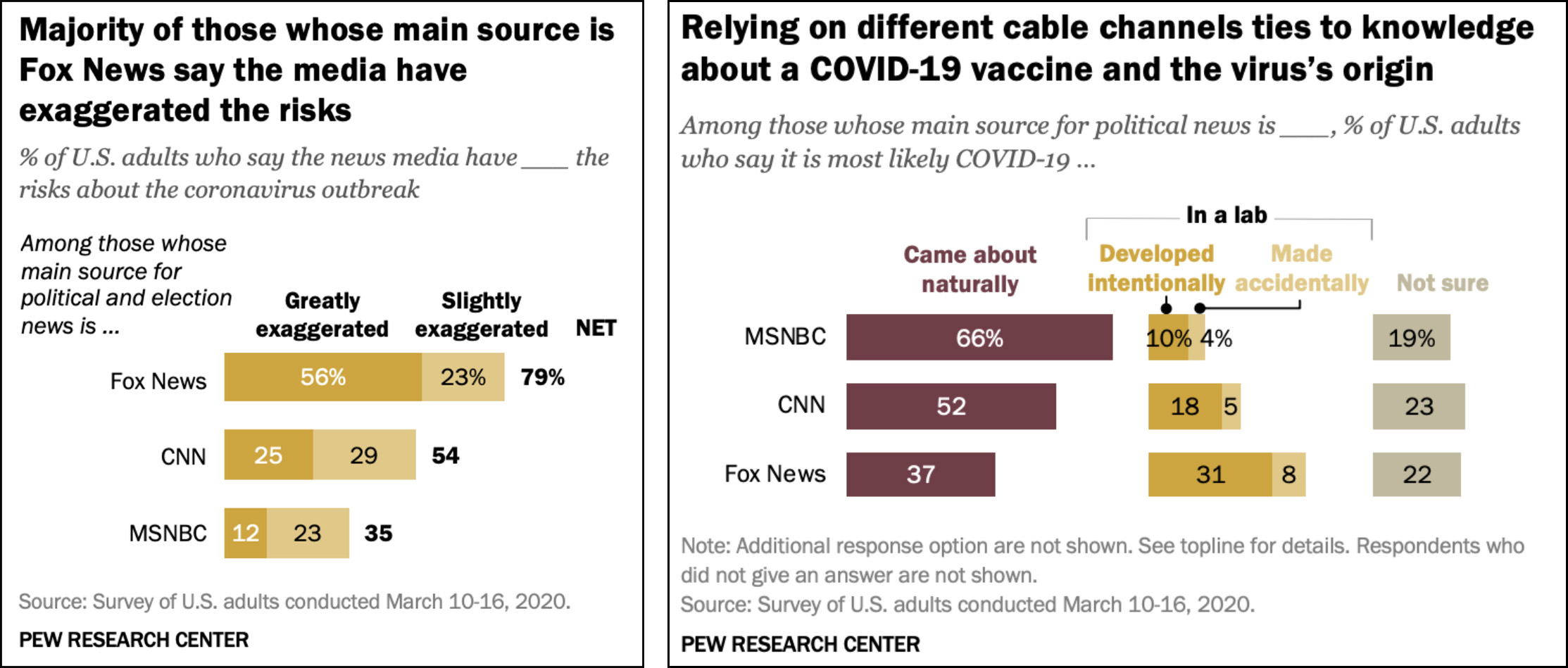
Fox viewers aren’t the only ones who are misinformed or prone to conspiracy theories, but they sure are the most likely. This is hardly a surprise from the network that brought you Benghazi and her emails, but it’s been astonishing to see just how far they’ll go to turn nearly anything into a partisan issue.
UPDATE: The federal Public Health Services website has been changed so that it jibes with what Kushner said yesterday. They thought nobody would notice.
Before:

After:

This is eye-opening. Jobless claims in historical perspective:
Huh. Look at this:
COVID-19 press briefing:
Trump conveys CDC that people where masks, but says he won’t wear one himself. Leader? No.
When asked about a national stay-home-from-work, Trump says he is leaving it to the governors because some states don[‘t have much of a problem. Fauci, who is not there, would disagree. Those states WILL have a problem.
remember this one https://t.co/SO4ZwbwaPB
— darth™ (@darth) April 3, 2020
Trump was asked about this story. Says he always knew about the threat of pandemics, says they were talking about “a threat of a pandemic” — but part of the point of the remarks was it could be something they’re not anticipating. https://t.co/teFjpxKViR
— andrew kaczynski🤔 (@KFILE) April 3, 2020
Trump is re-telling his story about governors who are grateful in private for his supplies-providing but then criticize him in public when Jim Acosta asks them about it, because it's political, even though "we have done a job like nobody's ever done a job."
— Daniel Dale (@ddale8) April 3, 2020
Asked what Kushner meant by "our stockpile," Trump says, "You know what our means: United States of America…our. Our. It means the United States of America…and then we take that our and we distribute it to the states…we need it for the federal government."
— Daniel Dale (@ddale8) April 3, 2020
The President makes an ass out of himself trying to defend Kushner’s stockpile statement from yesterday pic.twitter.com/fyMey49nFa
— Acyn Torabi (@Acyn) April 3, 2020
Reporter quotes Jared Kushner remark yesterday about how the federal stockpile was "our" stockpile. Trump calls it a "gotcha" question. "You try and make it sound so bad. You know what? You ought to be ashamed of yourself."
— Cathleen Decker (@cathleendecker) April 3, 2020
Trump tells a reporter she "oughtta be ashamed" of herself, and her "nasty tone," for asking for clarity about Kushner's comments about the stockpile, since it's so "simple."
— Daniel Dale (@ddale8) April 3, 2020
His answer did not clarify things and her tone was entirely normal.
I think when he says “federal government”, he means the federal government employees, because he said we have a lot of people. That was NOT what the strategic reserve was created for.
Here’s the law as it was written:
This is the dumbest thing. The federal government of the United States could step into and correct a haywire market where the states of the union are bidding against each other for life-giving goods, but it won't because it makes the president feel irrationally emasculated? https://t.co/RqypWjx642
— southpaw (@nycsouthpaw) April 3, 2020
Well, now he is saying “our” means “the states”, so what Jared said… makes no sense.
All of this makes perfect sense when you understand that
— Adam Serwer🍝 (@AdamSerwer) April 3, 2020
1. Trump does not understand how the federal government works
2. Trump thinks that because he is president, the federal government is a subsidiary of the Trump organization https://t.co/MMzAO6YkZd
I’m a federalist through and through, but the notion that states are responsible for gearing up and responding to a national (global) pandemic and the feds are bystanders or secondary is nuts. That said, thank God for some of these governors.
— Rory Cooper (@rorycooper) April 3, 2020
Reminded that he said the virus would go away in April, Trump falsely said, "I didn't say a date."
— Daniel Dale (@ddale8) April 3, 2020
February 10 rally: "Looks like by April, you know, in theory, when it gets a little warmer, it miraculously goes away. I hope that's true."
Watch this video of the send off of Captain Crozier, commander of the aircraft carrier USS Roosevelt who was fired yesterday for sounding the alarm to protect his sailors. Tells you everything you need to know about the type of #leader he is. pic.twitter.com/z9q3pTJpgZ
— Amber Smith (@AmberSmithUSA) April 3, 2020
"I am anchoring at this hour because our friend and colleague Brooke Baldwin, who normally anchors at this time, has herself been diagnosed with coronavirus," reports @jaketapper.
— The Lead CNN (@TheLeadCNN) April 3, 2020
"Brooke, we all love you… get well," Tapper adds.https://t.co/hkz2qNXcMG pic.twitter.com/VUL9jyEND0