I know I am harping on this a lot lately, but the rightwing fear of gay marriages is at once both hilarious and disturbing. To many of these wingers, the fact that some guy they don't know will marry some other guy they don't know represents an infringement on the freedom of the wingers. And the end of mankind. Take a look at this anti-gay-marriage ad, and its not-so-subtle "be afraid, be very afraid" undertones:
Some quotes:
"My freedom will be taken away from me". How, honey? Please tell us.
"I'm a California doctor who must choose between my faith and my job". Huh?? Does gay marriage mean you must medically treat people that you don't treat today? Oh, and about your job, doctor — aren't you ethically bound to treat whoever comes to you for treatment?
"I'm a Massachusetts attorney helplessly watching public schools teach my son that gay marriage is okay." No, the public schools in Massachusetts aren't teaching that. What course is that in? At best, they're teaching your son that gay marriage in Massachusetts is legal. Which, by the way, is fact.
"Those [gay marriage] advocates want to change the way I think." followed by "I will have no choice". Well, I'm not sure who these nameless advocates are (why can't these people ever name them?), but I think they've long given up on change the minds of bigots. And you "have no choice"? How exactly will the gay marriage advocates force you to change your mind? About anything? And, by the way, is changing your mind something to fear?
The ad is obviously tailored to send the message that gay marriage will impinge on the lives of those who do not support it. It fails, as these things are typically won to do, to explain how such a thing is even possible. In short, it's scaremongering.
[
UPDATE: See the post above].
Well, that's what the far right does.
But I wanted to address a more thoughtful rightwing response to gay marriage by the editors of the National Review. It's not blatant scaremongering like the ad above, but it is devoid of factual support and even common sense:
One of the great coups of the movement for same-sex marriage has been to plant the premise that it represents the inevitable future. This sense has inhibited even some who know perfectly well that marriage is by nature the union of a man and a woman. They fear that throwing themselves into the cause of opposing it is futile — worse, that it will call down the judgment of history that they were bigots.
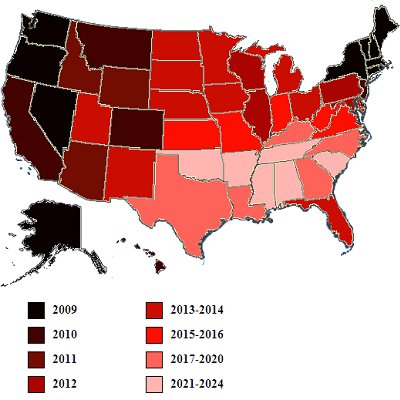
Well, compare today with 2004, where George Bush elevated the issue of gay marriage to a predominant campaign theme. Number of states recognizing gay marriage then? Zero. Now? Three, with more on the way. Objectively, doesn't the change at least suggest that gay marriage is inevitable?
I'm in no position to guess how the judgment of history will play out. I do suspect, however, that the editors are correct: those who oppose gay marriage now will likely be viewed by future generations — rightly or wrongly — as bigots. Too bad, so sad. But that's the price one pays for being on the losing side of history.
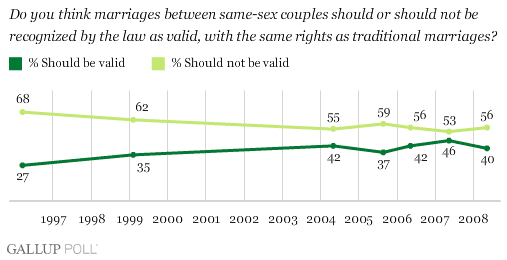
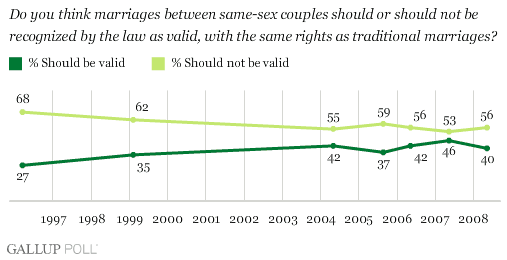
Contrary to common perception, however, the public is not becoming markedly more favorable toward same-sex marriage. Support for same-sex marriage rose during the 1990s but seems to have frozen in place (at least according to Gallup) since the high court of Massachusetts invented a right to same-sex marriage earlier this decade.
The high court of Massachusetts didn't "invent" the right. That's just snarkiness and stupidity rolled up in a big ball of inanity.
First, let's look at the data the editors refer to, i.e.,, the cherry-picked Gallup poll that state the proposition that support for same-sex marriage has frozen in place since the MA court recognized same-sex marriage (in 2004):
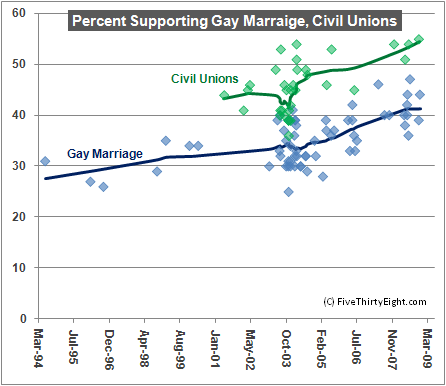
Meh. Maybe. But let's not just look at the trends of one poll. Let's look at all the polls, as Nate Silver does here where he pulls this combined poll graph from Pollster data). This chart includes an average of all surveys, except when the respondent was given a three-pronged choice between gay marriage, civil unions and nothing:
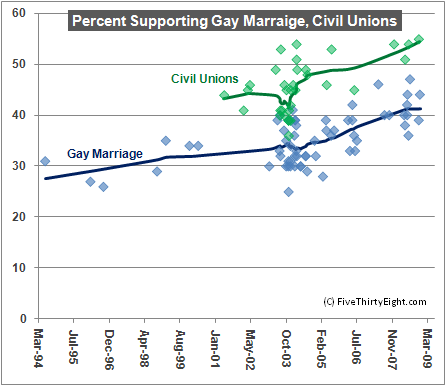
Looks like an rather continuous upward trend to me.
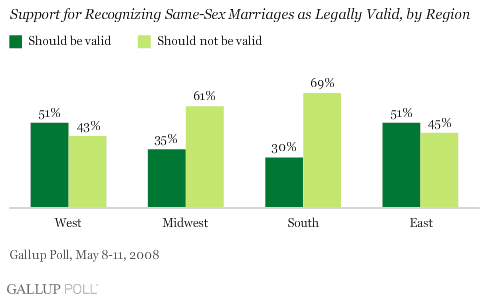
But of course, those are nationwide polls. When you look at the most recent polls broken down by region, a different story emerges:
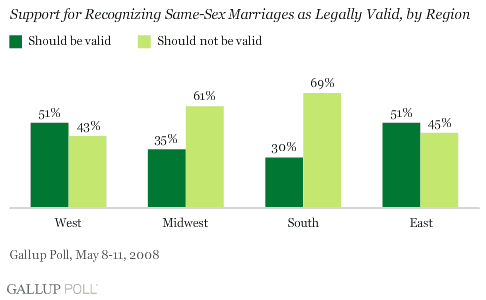
In the east and west, the majority supports gay marriage. And I don't think that was the case ten years ago.
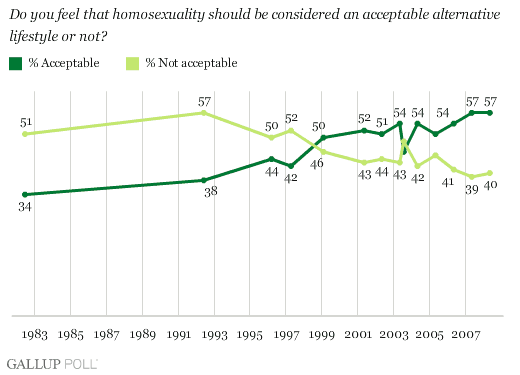
And you want to talk trends? Nationwide trends? Check this out, also from Gallup:
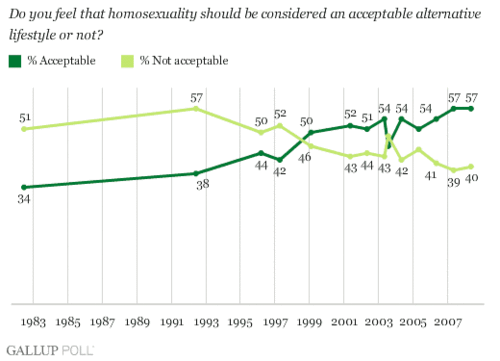
Now, this poll question doesn't ask specifically about same-sex marriage, but it certainly follows that as more and more people accept homosexuality as an acceptable alternative lifestyle, more and more (though not necessarily all) will eventually recognize the rightfulness of gay marriage. Eventually. There's just a bit of lag time.
By the way, let's look at some historical perspective. In 1967, when the U.S. Supreme Court recognized the right for interracial couples to marry, 72% were opposed to it. It wasn't until 1991 when the majority of Americans approved of interracial marriages.
72 percent. Nowhere on the charts above has opposition to gay marriage been that high.
But back to the editors:
Our guess is that if the federal judiciary does not intervene to impose same-sex marriage on the entire country, we are not going to see it triumph from coast to coast. Rather, we will for some time have a patchwork of laws. The division will not be so much between socially liberal and conservative states as between those states where voters can amend their state constitutions easily and those where they cannot. Thus same-sex marriage is likely to stay the law of the land in Massachusetts, Iowa, and Vermont, and perhaps also in New Hampshire.
In two of those states, at least, democratic procedure is now being respected. Vermont has chosen to recognize same-sex marriages legislatively, and New Hampshire may do so. Other states, such as Connecticut, have legislated recognition of civil unions for same-sex couples.
So far, so good. I don't necessarily agree with the way the editors think this will play out, but I'll pass on commenting.
Because now we get to the meat….
While free from the taint of lawlessness, these decisions seem to us unwise.
Ah. Here we go. "Unwise". Of course, what about "unjust"?
Few social goods will come from recognizing same-sex couples as married. Some practical benefits may accrue to the couples, but most of them could easily be realized without changing marriage laws.
The first sentence begs the question: "What social goods come from states recognizing opposite-sex couples as married?" I can think of many, but those same "goods" could apply to same-sex as well.
The second sentence bears close reading, i.e., "most of the practical benefits could easily be recognized without changing marriage laws".
Two points: first, the editors seem to be acknowledging that some of the practical benefits of marriage can't be easily inured to gay unions without "changing" marriage laws. That alone is enough reason for states to recognize gay marriage.
Secondly, the marriage laws aren't really "changing". They're just being applied to more people. It's no different than when the age of consent to marry is lowered (or raised) by a state. You're not changing the "practical benefits" of marriage; just expanding the number of people to whom those benefits can apply,
By the way, if you are not aware of the "practical benefits" of marriage are – the benefits that are denied to gay couples by virtue of the fact that they can't marry — here's a list(pdf) compiled by the U.S General Accounting Office in 1997. It's 75 pages long, and lists over 1,000 federal laws that would need to be changed in order to give the same practical benefits to gay couples. That doesn't include all the state laws. So this so-called "easy change" would require thousands of new pieces of legislation at the federal and state level.
Same-sex couples will also receive the symbolic affirmation of being treated by the state as equivalent to a traditional married couple — but this spurious equality is a cost of the new laws, not a benefit.
The editors would be hard-pressed to explain how a symbolic affirmation of equivalent treatment is a COST.
One still sometimes hears people make the allegedly “conservative” case for same-sex marriage that it will reduce promiscuity and encourage commitment among homosexuals. This prospect seems improbable, and in any case these do not strike us as important governmental goals.
Put another way: Marriage won't work with gays because we all know how promiscuous and uncommitted to relationships they are.
Oh, that's not bigotted?
It also flies in the face of the counterargument given in favor of recognizing traditional marriages. When asked, most conservatives will say that gay marriages should not be recognized because the point of present-day marriage laws is to encourage heterosexual marriage (as if the populace needs government encouragement to get married? It seems the most people don't need that incentive, as they are inclined to do so anyway).
So what is the "value" of traditional laws where the state recognizes opposite-sex (and only opposite-sex) marriages, according to the editors?
Both as a social institution and as a public policy, marriage exists to foster connections between heterosexual sex and the rearing of children within stable households.
With a (heterosexual) divorce rate at over 50%, with domestic violence (in heterosexual parented families) at an all-time high, and with deadbeat dads reaching an epidemic proportion, how's that "public policy" working out for ya?
It is a non-coercive way to channel (heterosexual) desire into civilized patterns of living.
Translated: Heterosexual sex outside of marriage is uncivilized, and so is gay sex whether in the confines of marriage or not.
And they wonder why they get tagged with the "bigot" label.
State recognition of the marital relationship does not imply devaluation of any other type of relationship, whether friendship or brotherhood. State recognition of those other types of relationships is unnecessary. So too is the governmental recognition of same-sex sexual relationships, committed or otherwise, in a deep sense pointless.
State recognition of straight marriages doesn't devalue the relationship of gay relationships?
What the editors fail to notice is failure of the state to recognize certain marital relationships and not others does devalue the marriages which are not recognized. It is, in essence, the state saying (to the gay union), "Look, we hold you on a par with a 'freindship' or a 'brotherhood'. Or a 'sexual hookup'. There is no way that you can make a commitment to each other in a way that government will recognize, we we do with straight couple marriages. In fact, doing so would be 'unnecessary' and 'pointless'."
Geez. How can passing laws NOT to recognize gay marriages be viewed as something other than an overt devaluation of gay marriages? State legislatures are going out of their way to make sure that gay marriages get stuck with a "less than" status.
No, we do not expect marriage rates to plummet and illegitimacy rates to skyrocket in these jurisdictions over the next decade. But to the extent same-sex marriage is normalized here, it will be harder for American culture and law to connect marriage and parenthood.
That was where I broke out laughing. There are lots of single parents who have and raise children. Sometimes intentionally. Sometimes not (Bristol Palin, I'm looking at you). If the editors were concerned about this, they would outlaw or fail to recognize or civilly fine the parent of bastard children.
But this is a red herring. If gays mararied, are we, as a people, going to somehow forget that it takes a man and a woman to procreate? That it is ideal for a child to be raised by married parents?
And by the way, parenthood is not the province of heterosexual couples. This is even less controversial than gay marriage, and most state permit gay couples to adopt children. That horse has already left the barn. So allowing gay adoptive parents to marry at this point won't damage the cultural connection of marriage and parenthood, it actually strengthens it.
That it has already gotten harder over the last few decades is no answer to this concern. In foisting same-sex marriage on Iowa, the state’s supreme court opined in a footnote that the idea that it is best for children to have mothers and fathers married to each other is merely based on “stereotype.”
No, that's not what the Iowa court said. First of all, it wasn't even addressing marriage of the mother and father at all. Secondly, it wasn't "merely based on stereotype", but on overwhelming scientific studies. Here's the full text of the footnote in question:
"The research appears to strongly support the conclusion that same-sex couples foster the same wholesome environment as opposite-sex couples and suggests that the traditional notion that children need a mother and a father to be raised into healthy, well-nurtured adults is based more on a stereotype than anything else."
So it's not based on "stereotype", but on research. The editors of National Review are simply lying here.
If worse comes to worst, and the federal courts sweep aside the marriage laws that most Americans still want, then decades from now traditionalists should be ready to brandish that footnote and explain to generations yet unborn: That is why we resisted.
The problem with this argument that "most Americans still want" the marriage laws as they are now… even if true… is that it neglects to consider precisely why we have a Constitution in the first place: to protect minorities against the tyrannies of the majority. "Tyranny of the majority" is an old phrase, and the concept was adopted by James Madison (you know, the founding father and author of the Constitution) in Federalist 10. (Why do the editors hate the founding fathers?)
Suppose, for example, that most people in the 1950's South wanted their segregation laws (I don't know if that is true or not, but let's assume so). And then a court comes along and says the Constitution — the equal protection clause — says that segregation laws are illegal, and the Southern state governments have to treat everybody equally and can't have separate public accommodations, seats on buses, etc. for blacks. Would the editors of the National Review argue this could not be done?
If they are not outright bigots, then they are woefully ignorant of the country that they purport to love. This is a constitutional democracy. It is not, and never has been, a pure democracy, where the majority rules (heck, a majority of the electorate doesn't even choose the president!).
I suspect that the editors of the National Review (the same people, mind you, who had no problem when a court, using constitutional principles, decided who the President in 2000 should be) are educated people and have been exposed to this point many many many times in their career. It is irrefutable. And yet, they simply pretend it doesn't exist. And why?
Well, if they're not stupid, perhaps they are bigots. No, not the sheet-wearing cross-burning kind. Perhaps they even have no problem with homosexuality in general (so long as it's kept hidden and doesn't have any public recognition or legal legitimacy). But bigotry is bigotry, even if it is soft. (And bigots rarely are self-aware of their bigotry).
On some level, the reason they oppose state recognition of gay marriage is because… they simply think homosexuality is something "less than" when compared to heterosexuality. That's at the root of their thinly-veiled arguments that there is "no point" to recognize gay marriage. No point for them, maybe. When you couple that reasoning with their other absurd arguments that adding gay marriage to society will take something away from what presently exists, you have a pile of nothing. Their "arguments" simply defy logic, fact and history (that's why they are so vulnerable to the "bigot" tag). But almost more offensively, their arguments defy or ignore the principles upon which this nation is based.