Washington Post’s Tom Shales says Obama “came across like Jimmy Stewart in ‘Mr. Smith Goes to Washington’: a bright-eyed young idealist up against entrenched power, old ideas and obstructionism. It was also a chance for Obama to go on national television and look presidential again, asserting himself in ways that helped make up for the past few months of perceived defensiveness, of appearing to kowtow to other powers, and of seeming to do more following than leading.”
More: “One heckler, Republican Rep. Joe Wilson of South Carolina, shouted out, ‘You lie!’ Again, the contrast worked to Obama's advantage; he looked and sounded calm and rational, though certainly assertive, while moblike voices railed defiantly against him.”
***
Democratic pollster Stan Greenberg conducted a focus group/dial test on President Obama's health-care speech with 50 independents in Denver, CO — half who voted for Obama last fall and half who voted for John McCain. In a conference call with reporters to discuss the findings, Greenberg said that before the speech, 23 of these independents supported Obama's call for reform, 23 opposed it, and four were undecided. After the speech, the number who said they supported reform jumped from 23 to 33.
***
Vice President Biden said Joe Wilson's outburst "demeaned the institution." He said he was "embarrassed for the chamber and a Congress I love."
Eric Cantor: "Obviously, the President of the United States is always welcome on Capitol Hill. He deserves respect and decorum. … I know that Congressman Wilson has issued an apology and made his thoughts known to the White House, which was the appropriate thing to do."
John McCain called the outburst "totally disrespectful." "There is no place for it in that setting, or any other, and he should apologize for it immediately," he said.
Rep. Joe Wilson's 2010 opponent has received more than $100,000 in contributions overnight
But while the majority of both parties' lawmakers behaved as adults, the insolence by House Republicans stole the show. There was derisive laughter on that side of the chamber when Obama noted that "there remain some significant details to be ironed out." They applauded as he spoke of "all the misinformation that's been spread over the past few months." They laughed again when he said that "many Americans have grown nervous about reform."
When Obama addressed the charge that he plans "panels of bureaucrats with the power to kill off senior citizens," someone on the GOP side shouted out "shame!" The president went on: "Such a charge would be laughable if it weren't so cynical." "Read the bill!" someone shouted back. Obama mentioned those who accuse him of a government takeover of health care. "It's true," someone shouted back.
***
Even as Obama delivered a tribute to the late senator Ted Kennedy, Rep. Tom Price (R-Ga), a leader of House conservatives, perused his BlackBerry. Shortly before the speech ended, Rep. Patrick McHenry (R-N.C.) walked out to beat the rush.
This morning, the conservosphere is lining up to demonstrate that Democrats booed and hissed Bush when he gave a State of the Union in 2005. Except what they were booing and hissing at wasn't Bush, but at what Bush was saying. Bush was warning that if something wasn't done, Social Security would fail. That prompted a boo — the spector of Social Security failing. It was not an attack on Bush, but an acknowledgement in agreement with Bush that losing Social Security would be bad.
But I suppose that;s a little to nuanced for conservatives to understand.
Two out of three Americans who watched President Barack Obama's health care reform speech Wednesday night favor his health care plans — a 14-point gain among speech-watchers, according to a CNN/Opinion Research Corporation national poll of people who tuned into Obama's address Wednesday night to a joint session of Congress.
Sixty-seven percent of people questioned in the survey say the support Obama's health care reform proposals that the president outlined in his address, with 29 percent opposed. Those figures are almost identical to a poll conducted immediately after Bill Clinton's health care speech before Congress in September, 1993.
The audience for the speech appears to be more Democratic than the U.S. population as a whole. Because of this, the results may favor Obama simply because more Democrats than Republicans tune into the speech. The poll surveyed the opinions of people who watched Wednesday night's speech, and does not reflect the views of all Americans.
I wanted to write a few final words to you to express my gratitude for your repeated personal kindnesses to me – and one last time, to salute your leadership in giving our country back its future and its truth.
On a personal level, you and Michelle reached out to Vicki, to our family and me in so many different ways. You helped to make these difficult months a happy time in my life.
You also made it a time of hope for me and for our country.
When I thought of all the years, all the battles, and all the memories of my long public life, I felt confident in these closing days that while I will not be there when it happens, you will be the President who at long last signs into law the health care reform that is the great unfinished business of our society. For me, this cause stretched across decades; it has been disappointed, but never finally defeated. It was the cause of my life. And in the past year, the prospect of victory sustained me-and the work of achieving it summoned my energy and determination.
There will be struggles – there always have been – and they are already underway again. But as we moved forward in these months, I learned that you will not yield to calls to retreat – that you will stay with the cause until it is won. I saw your conviction that the time is now and witnessed your unwavering commitment and understanding that health care is a decisive issue for our future prosperity. But you have also reminded all of us that it concerns more than material things; that what we face is above all a moral issue; that at stake are not just the details of policy, but fundamental principles of social justice and the character of our country.
And so because of your vision and resolve, I came to believe that soon, very soon, affordable health coverage will be available to all, in an America where the state of a family's health will never again depend on the amount of a family's wealth. And while I will not see the victory, I was able to look forward and know that we will – yes, we will – fulfill the promise of health care in America as a right and not a privilege.
In closing, let me say again how proud I was to be part of your campaign- and proud as well to play a part in the early months of a new era of high purpose and achievement. I entered public life with a young President who inspired a generation and the world. It gives me great hope that as I leave, another young President inspires another generation and once more on America's behalf inspires the entire world.
So, I wrote this to thank you one last time as a friend- and to stand with you one last time for change and the America we can become.
At the Denver Convention where you were nominated, I said the dream lives on.
And I finished this letter with unshakable faith that the dream will be fulfilled for this generation, and preserved and enlarged for generations to come.
He shot down the lies. He addressed all the BS about death panels, government coming between you and your doctor, illegal immigrants getting health insurance, etc. Not that rabid opponents will change their mind; they're entrenched in stupidity and or fearmongering. Key passage:
Some of people's concerns have grown out of bogus claims spread by those whose only agenda is to kill reform at any cost. The best example is the claim, made not just by radio and cable talk show hosts, but prominent politicians, that we plan to set up panels of bureaucrats with the power to kill off senior citizens. Such a charge would be laughable if it weren't so cynical and irresponsible. It is a lie, plain and simple.
There are also those who claim that our reform effort will insure illegal immigrants. This, too, is false – the reforms I’m proposing would not apply to those who are here illegally. And one more misunderstanding I want to clear up – under our plan, no federal dollars will be used to fund abortions, and federal conscience laws will remain in place.
He chastized the liars. He was presidential, looking down his nose (as one should) and the tone of the debate and the bickering. He called out those Republicans who worked against reform merely to score political points. Key passage:
But know this: I will not waste time with those who have made the calculation that it's better politics to kill this plan than improve it. I will not stand by while the special interests use the same old tactics to keep things exactly the way they are. If you misrepresent what's in the plan, we will call you out. And I will not accept the status quo as a solution. Not this time. Not now.
GOP hurt themselves by behaving like children. Republicans hurt themselves by having a bill in their hands, twittering, and — in the case of Jim Wilson (R-SC) — calling the president a "liar" (what he actually shouted out was "You lie!" — a serious childish breach of ethics; not even during the Iraq War did a Democrat do that). Here's the video — check out Pelosi's stare:
But there was something clarifying about a Southern good ol' boy yelling "Liar" at the president over illegal immigration. That's what the GOP now is: the worst aspects of the old Democratic party combined with a nihilism that is only eclipsed by its catastrophic governance for the past eight years. Defeating these morons and actually creating a discourse for reform is what we elected Obama to do.
But they still insist on doing it to themselves, don't they? That's the silver lining.
Those southern Repubs behaved like children, only reinforcing the point that Obama was making.
"This evening I let my emotions get the best of me when listening to the President’s remarks regarding the coverage of illegal immigrants in the health care bill. While I disagree with the President’s statement, my comments were inappropriate and regrettable. I extend sincere apologies to the President for this lack of civility."
UPDATE UPDATE (11:35 pm): Even though the speech ended 2 hours ago, the Democratic opponent of Wilson has raised $40,000 in campaign donations as a result of Wilson's behavior.
He outlined what the plan should be. He made the (rather obvious) point that the public option is, you know, an option. It's not government-mandated. He pointed out that there must be cost-savings. For those concerned about government health care options running up the deficit, Obama pointed out that health care costs are the deficit, and if we don't do something now, we're going to find ourselves in a much much worse situation down the road. Required mandatory health care. The other big thing: making denial of coverage for pre-existing conditions "illegal".
On then public option, he didn't make it a line in the sand, but he did say (in effect): "You got a better idea?!?"
He made health care the moral imperative. The best part of the speech was the end, where he quoted from a letter he received Ted Kennedy before the latter's death, and went into the importance of health care. It's not, Obama said, government for the sake of government. It is a moral imperative which speaks to the charactor of our nation — i.e., that we help each other, that we take care of our own…. literally. Republicans sat on their hands. Key passage:
That large-heartedness – that concern and regard for the plight of others – is not a partisan feeling. It is not a Republican or a Democratic feeling. It, too, is part of the American character. Our ability to stand in other people's shoes. A recognition that we are all in this together; that when fortune turns against one of us, others are there to lend a helping hand. A belief that in this country, hard work and responsibility should be rewarded by some measure of security and fair play; and an acknowledgement that sometimes government has to step in to help deliver on that promise.
The GOP response, by the way, was abyssmal. It was given by Rep. Charles Boustany (R-LA), a conformed birther, who is not only a congressman from Louisiana, but a doctor. Gives the only Republican idea on health care reform, which is malpractive reform (making it harder to sue doctors). Interestingly, Rep. Dr. Charles Boustany has been sued three times for malpractice. Anyway, Boustany's message was basically "It's time to start over". Don't believe it. They just want to kill reform.
Obama, by the way, for all his chastizing of Republicans, mentioned tort reform as a viable idea — the GOP loved that. He also mentioned other points of the plan — one of which was McCain's (and he gave McCain credit).
It was a great speech, the most effective and moving speech Obama has given.as President.
Will it do the job? Will it produce a bill?
Yes, it will. But not because he won over the Republicans. The ridiculous Eric Cantor was typical of his GOP colleagues. He sat up there, right in front of the President of the United States, tweeting on his Blackberry. He at least looked like a living adolescent. Most of his colleagues looked like the jury at the Salem witch trials, with an occasional madman screaming epithets at the President whose very countenance offends so many rightwingers.
But this speech worked because it will galvanize Democratic support. The President's passion — the first time we've seen it in a year — will bring straying Democrats back. And the Republicans now know that there will be a bill with them or without them. The implied threat of going the reconciliation route was just below the surface.
That is why the Republicans looked so miserable. They either work with Obama to produce a bill or Democrats pass a bill without them.
Nate Silver says it wasn't a home run, but a stand-up triple:
As Marc Ambinder outlined this afternoon, this was a difficult speech because it was going for a bit of a two-fer. On the one hand, Obama needed to appeal to liberals — both the 60 or so members of the House who have threatened to vote against a watered-down bill, and the much broader, activist community who has grown wary of what they perceive as a Clintonian president who is too willing to compromise. On the other hand, he needed to appeal to independent voters and their brethren, among whom Obama's approval ratings and sentiment toward his health care package have fallen significantly. He could afford to skip over the broad mainstream of the Democratic Party, who are going to be happy with more or less anything the that he does on health care, and the quarter or so of country who disapproved of Obama from Day One and won't care for what he has to say no matter what.
I think Obama accomplished both of those things — with some margin to spare. On the one hand, there was no absence of red meat for the liberals. Lies were called out as lies. The Republicans, who seemed to lack an understanding of the theatrics in the room, were at several points made to look petty and stupid. And Obama made the moral case for health care reform, something many liberals — including yours truly — have been urging him to do for a long time.
On the other hand, there was a lot of the "bipartisan" pivoting of the sort that made Obama very popular during his 2004 DNC convention speech. He made himself look like the reasonable party in the room. He got a smile out of John McCain, and a golf clap out of John Boehner. At the end of the day, he probably acknowledged the sacrifice of the "robust" public option (although a version with a trigger remains possible, and perhaps even likely). But he got some mileage out of it: using it as the left goalpost by which he'd confidently kick the field goal through.
I called the speech a triple, because I think it was about 10 minutes too long. Andrew Sullivan's readers call it a home run. FOX News, I'm sure, will call it a long fly-out to the warning track. The bottom line: it was a well-delivered speech, and a very, very smart speech. It will remind people of what they liked about Obama. It won't do miracles. But it will increase, perhaps substantially, the odds of meaningful health care reform passing.
RELATED: A message from MoveOn and REM:
UPDATE: For 30 seconds, I turned to Fox News' post-speech coverage. It was Hannity talking to Frank Luntz. And Hannity said (this is pretty close to verbatim): "I couldn't believe that Obama called out insurance company executives — calling them 'bad people'".
Then he played the clip. And of course, Obama didn't say that. He said the opposite. Here's what Obama actually said:
My guiding principle is, and always has been, that consumers do better when there is choice and competition. Unfortunately, in 34 states, 75% of the insurance market is controlled by five or fewer companies. In Alabama, almost 90% is controlled by just one company. Without competition, the price of insurance goes up and the quality goes down. And it makes it easier for insurance companies to treat their customers badly – by cherry-picking the healthiest individuals and trying to drop the sickest; by overcharging small businesses who have no leverage; and by jacking up rates.
Insurance executives don’t do this because they are bad people. They do it because it’s profitable.
Did Hannity correct himself? Did he even know or care that he misrepresented Obama's speech?
Jarbas Agnelli saw a photo in the newspaper of birds sitting on electric wires and decided to set it to music. Twist: The score was built around a musical theme using the birds as notes.
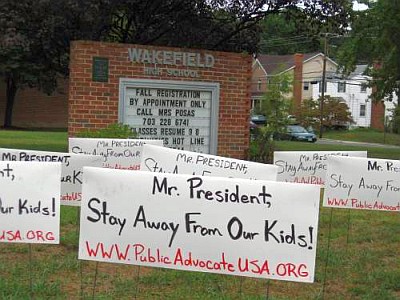
My child is home today. She will not be forced to endure Obama's speech, given by Obama. I read it, printed it off, and I will discuss it with her. Then as we discuss it, I'll tell her the reasons I did not want Obama or the school district deciding that we HAD to hear it. I'll tell her that at first, he tried to dictate what lesson plans the teachers would use with the speech, but changed it after criticism. I'll explain the fact that Obama is a liar. That he promised to debate health care reform on C-Span, and did not, and that in fact, he had Congress craft a piece of crap with questionable motives, and tried to have it passed before it was read. I''ll explain that he's still trying to pass this bill, despite the fact that the majority do not want it, and that he and his minions would ultimately like to end the insurance that we have, and is paying very well for our health care needs, so that he can cover people who DON'T work as hard as her parents do. I'll explain that he has no credibility, and no leadership skills. That his administration is filled with the kind of people who do not inspire trust, and are very poor leaders. We'll consider the speech, and remark that he's going to give this speech to kids in kindergarten as well as older kids? How many of them are going to understand this drivel? This ultimately boring claptrap coming from a boor? Then I'll tell her that when he says "ask questions", apparently he doesn't mean it, because if you do, you're considered a nut, a terrorist, made fun of, or ostracized. That his administration is full of condescending tools who call the American people names. Then we'll laugh at him. All in all, it's going to be a good day.
One day, God willing, this child-turned-adult will leave her parents, think back on this and say to herself, "MAN, my parents were idiots!"
Not really been attuned to the health care debate? That's fine. You're busy.
Fortunately, you can increase your knowledge about the central sticking point — the public option – in 150 seconds, just by watching this dwarf former Secretary of Labor, former boyfriend of Hilary Rodham, author, father of the Family and Medical Leave Act, Rhodes scholar and NPR commentator Robert Reich explain what "the public option" is. It's not complicated.
That's when The Beatles: Rock Band is released. Now kids all over the world can ruin masterpieces… right at home!
On the other hand, the remastered recordings of the entire Beatles catalogue are out tommorrow, too.
UPDATE: Well, not the entire catalogue. For instance, did you know that, impossible as it may sound there are still Beatles songs unreleased? True – the most notable ones being Carnival of Light (an experimental piece recorded on 5 January 1967 for The Million Volt Light and Sound Rave) and a 27-minute jam of Helter Skelter. A John Lennon composition the three surviving Beatles worked on in the early ’90s prior to the Anthology release called Grow Old with Me also remains unreleased.
The town hall meetings are over. Congress is back in session. If the White House is changing its tone for the upcoming health care debate, and this is indicative of that tone, I think we might see some good things coming. As the Washington Postnoted, "In abandoning the cool, patient tone he adopted at health-care town hall meetings over the summer, Obama signaled that he is ready to take a hard-line approach on Wednesday."
Wednesday is when Obama gives his health care speech before Congress. His style will obviously be a little different than it was with the AFL-CIO yesterday. But, I hope, not too different.
The best write-up on this non-issue comes from Forbes writer Tunku Caradarajan in an article aptly titled "Too Many Kooks":
The Silly Season ceases to be "silly" when what passes for political debate in America turns not merely stupid or witless, but certifiably demented.
I write of the kooky reaction of many conservatives–politicians, citizens and commentators in the media–to the plan by President Obama to address the nation's schoolchildren tomorrow. (And I write, please note, as a nonlefty libertarian who did not support Barack Obama in the presidential election.)
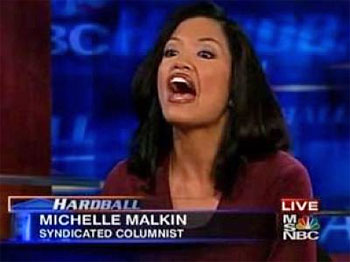
Obama will, as we all know, address our kids–plenty of whom need a lesson or two on the subject, since they clearly don't get it from their parents–on the virtues of study, education and hard work. According to a White House spokesman, the aim of the speech is "to challenge students to work hard in school, to not drop out and to meet short-term goals like behaving in class, [and] doing their homework …" If anyone thinks that's unpalatable, subversive, Commie and un-American, I'd like to meet for a duel at dawn by the skating rink at New York's Central Park. (Pick your weapon, Michelle Malkin and Glenn Beck …)
All those links are to other Malkin screeds. I don't if those are really the "subtext" of Obama's speech (which I've printed in full below the fold). Maybe she means "context".
So basically, Malkin is now claiming that she doesn't have a problem with the actual speech; but it serves as a platform to go on a tangent of rants about other nonsensical things.
And that is why you should keep your kids out of school today… um…. yeah… I guess.
Malkin closes by asked "Now, who are you calling 'kook'?"
Rescission — the technical term for canceling coverage on grounds that the company was misled — is often considered among the most offensive practices in an insurance industry that already suffers from a distinct lack of popularity among the American public. Tales of cancellations have fueled outrage among regulators, analysts, doctors and, not least, plaintiffs' lawyers, who describe insurers as too eager to shed patients to widen profits.
What typically happens is that someone gets sick, and not only does the insurer deny the coverage, but they cancel the policy on that person because (the insurer says) that person failed to disclose a pre-existing condition.
Now, let me weigh in on my experience, because, yes, for a year or two, I was a lawyer representing a major insurance company. I handled cases where people were denied disability coverage and sometimes their policies were rescinded for failing to disclose a pre-existing condition.
Okay. Here's how insurance companies defend their practice of rescission:
Insurance company officials say they need to be able to cancel policies to control fraud, which by some estimates reaches $100 billion annually.
Trust me. I'm no shill for insurance companies and I can't speak to the big-picture estimates of $100 billion annually, but yes, Virginia, many people do try to defraud the insurance company. I've seen it. There are people who claim to be unable to work because they can't move their back and lo and behold, there's videotape of them doing brickwork on their patio or gardening or something, all while collecting disability benefits. (You don't think insurance compannies check these things out?)
And who pays for this? We do. Our premiums are higher because some people are playing the system.
But what about the other side of the coin? Are insurance companies engaging in rescission of policies on the slightest pretext? The Washington Post story provides this anecdotal evidence:
The untimely disappearance of Sally Marrari's medical coverage goes a long way toward explaining why insurance companies are cast as the villain in the health-care reform drama.
"They said I never mentioned I had a back problem," said Marrari, 52, whose coverage with Blue Cross was abruptly canceled in 2006 after a thyroid disorder, fluid in the heart and lupus were diagnosed. That left the Los Angeles woman with $25,000 in medical bills and the stigma of the company's claim that she had committed fraud by not listing on a health questionnaire "preexisting conditions" Marrari said she did not know she had.
By the time she filed a lawsuit in 2008, she also got a diagnosis of pancreatic cancer and her debts had swelled beyond $200,000.
And this:
In a pending case, Blue Shield searched in vain for an inconsistency in the health records of the wife of a dairy farmer after she filed a claim for emergency gallbladder surgery, according to attorneys for the family. Turning to her husband's questionnaire, the company discovered he had not mentioned his high cholesterol and dropped them both. Blue Shield officials said they would not comment on a pending case.
In other words, failure to mention some medical condition on your application form – any medical condition — serves as grounds for insurance companies to deny you coverage and take away your policy altogether. An egregious example often told includes a woman in Texas was diagnosed with aggressive breast cancer. Soon after, her insurer dropped her — the company found an instance in which she visited a dermatologist for acne, and didn't tell the insurer about it.
It happens, and yes, it's rather unsavory. It's one thing when people fail to disclose major illnesses on their insurance application; that certainly indicates fraud on the insurance company. But if I had a stiff back for a few days four years ago, and I forgot to mention it to the insurance company (because I had forgotten about it myself), should I get dinged with denial-of-coverage and rescission if, ten years later, I develop some back problem?
The problem is that when people apply for insurance, they don't want to disclose every tiny illness, even assuming they do remember. And why? Because they know that they risk being denied coverage for a pre-existing condition.
I don't have any personal insight into the zealousness that insurers employ to deny coverage. There certainly seem to be indications that insurance companies use the "fighting fraud" excuse to, let's be blunt, raise their profit margin. Three months ago, the House Subcommittee on Oversight and Investigation held a hearing on this with executives from three of the nation's largest health insurers, WellPoint Inc., UnitedHealth Group, and Assurant Inc. At one point, late in the discussion, Rep. Bart Stupak (D-Mich.) asked each of the execs whether they would at least commit to stopping rescissions except where they could show "intentional fraud." All three responded with the same answer: "No." They liked the money-saving tactic and planned to keep using it.
As the article points out, the rescission issue is getting better if only because the government (usually at the state level) is cracking down on overt practices by the insurance companies to deny coverage or rescind policies.
My only point here is that we need to crack down not only on overt insurance practices, but also on the actual fraud committed against insurance consumers. Any reform which makes it easier for people to play the insurance racket isn't going to help us in the long run, since that leads to an increase in health care coverage costs for all.