Justice Scalia Wants Dumber Lawyers?

Ken AshfordCourts/Law, Supreme Court1 Comment

As reported in the Wall Street Journal law blog, Justice Scalia has some interesting opinions when it comes to the quality of counsel that appears before him in the U.S. Supreme Court:

Well, you know, two chiefs ago, Chief Justice Burger, used to complain about the low quality of counsel. I used to have just the opposite reaction. I used to be disappointed that so many of the best minds in the country were being devoted to this enterprise.

I mean there’d be a, you know, a defense or public defender from Podunk, you know, and this woman is really brilliant, you know. Why isn’t she out inventing the automobile or, you know, doing something productive for this society?

I mean lawyers, after all, don’t produce anything. They enable other people to produce and to go on with their lives efficiently and in an atmosphere of freedom. That’s important, but it doesn’t put food on the table and there have to be other people who are doing that. And I worry that we are devoting too many of our very best minds to this enterprise.

And they appear here in the Court, I mean, even the ones who will only argue here once and will never come again. I’m usually impressed with how good they are. Sometimes you get one who’s not so good. But, no, by and large I don’t have any complaint about the quality of counsel, except maybe we’re wasting some of our best minds.

So…. from his perspective on the Supreme Court bench, Scalia thinks that, generally speaking, the quality of lawyers in today's bar is high.

But… according to Scalia, that's bad thing.

Say what?

Look, lawyers get a bad rap.  Sometimes deservedly so.  But to suggest that smart lawyers are wasting their time practicing law seems… well… dumb.

No, lawyers don't produce anything in society (neither do judges for that matter) but neither do, say, surgeons.  Does that mean a smart and accomplished surgeon is wasting his time?  That society would be better off if he had chosen a different vocation? 

Being a good "smart" lawyer does not mean that one can become a good engineer and "invent the automobile" (which, last time I checked, was already invented).  They are entirely different skill sets.  I know lawyers — brilliant lawyers — who can't program a VCR.

So what the hell is Scalia saying?
Judicial Activism

Ken AshfordSupreme CourtLeave a Comment

Number of questions asked by new Justice Sonia Sotomayor to litigants during her first hour on the Supreme Court bench: 36

Number of questions asked by Justice Clarence Thomas to litigants over the past three year: zero

Headlines That Give Us Pause

Ken AshfordHistoryLeave a Comment

Cruise to trace Titanic's route on centennial of ship's sinking

A memorial cruise is scheduled to set sail 100 years after the sinking of the Titanic, following the same trans-Atlantic route as the ill-fated ship, according to organizers.

The Titanic Memorial Cruise is to set sail in April 2012, departing from Southampton, England, on April 8, just as the Titanic did.

CNN

Okay, but at some point, they're going to abandon tracing Titanic's route, right?  And arrive in the States?  Because if they follow Titanic's route all the way, that's going to be pretty sucky.

P.S.  I wonder how many on the Titanic Memorial Cruise are going to go to the ship's bow and do the I'm-King-Of-The-World thing.  It'll probably become annoying after a while.

Then and Now

Ken AshfordBush & Co.Leave a Comment

February, 2004:

Elizabeth Blackburn, an outspoken advocate of human embryonic stem cell research and therapeutic cloning is fired by the Bush administration from the President's Council on Bioethics because of her dissenting views.

This week:

Elizabeth Blackburn wins the Nobel Prize for Medicine for her pioneering work on cancer and aging.

2012

Ken AshfordPopular CultureLeave a Comment

Critics are already panning the disaster epic "2012", coming out in November as "over the top" and "laughably over the top" and "ridiculously over the top".  Here's a trailer and an extended scene:

Yeah, I can't imagine why it might be called "over the top".

Still, with Oliver Platt, it has at least one redeeming quality.

Quote Of The Day

Ken AshfordRepublicansLeave a Comment

On Saturday, Rep. Thaddeus McCotter (R-MI) discussed the direction of the GOP in an address to the Republican Northeast Conference in Newport, RI. McCotter, who serves as the chairman of the Republican Policy Committee in the House, chided conservative “ideologues” for controlling the party. McCotter explained that these individuals want to “purge” opponents “all the time…because they’re nuts.” He then clarified that his remarks were directed at radical conservatives like Sen. Jim DeMint (R-SC):

MCCOTTER: If the Republican Party wants to become its own antithesis, which is an ideological party, we’re going to continue to have these problems. Remember, ideologues, there’s a reason why they purge all the time — it’s because they’re nuts. Hope the ideologues weren’t listening. If, however, as I said before, we understand that we represent constituencies and America is a vast country full of a variety of opinions and peoples, way of life, then we will get where we need to go. As for the attitude of the Senator from South Carolina that it is better to have fewer friends than more, that’s easier to say in South Carolina than Detroit.

I have a funny feeling the wrath of the right will soon befall this man…

Wellpoint Exhibits Contempt, Greed, and Bad Timing

Ken AshfordHealth CareLeave a Comment

Seriously?  Watch this story about Anthem Blue Cross & Blue Shield of Maine, a subsidiary of WellPoint.  They are suing the State of Maine, because Maine is not letting them jack up their health insurance premiums 18.5%.

That's a pretty ballsy lawsuit, especially with the health care debate raging.

Dday at Hullabaloo gives the background:

This story shows how silly it would be to solely rely on regulation to rein in insurance industry practices.

Like many other states, Anthem Health Plans hold a monopoly on the individual insurance market in Maine, controlling 79% of all the plans. Also like many other states, they are licensed to sell insurance through the Department of Insurance, who must clear all rate increases prior to implementation. Originally, Anthem Health Plans were a nonprofit Blue Cross and Blue Shield corporation licensed to practice in Maine since 1939. In 1999, Anthem bought the business and began to operate it as a for-profit company. Since that point, Anthem has raised premium rates 10 times, and 8 of those times have been double-digit rate increases.

Jan-99: 20.4%
Nov-99: 15.7%
Jan-01: 23.5%
Feb-02: 12.7%
Jan-03: 3.4%
Mar-05: 14.5%
Mar-06: 16.3%
Jan-07: 16.7%
Jul-07: 1.3%
Jan-08: 12.5%

The average individual Maine rate-payer is paying four times as much for insurance than they did ten years ago.

But this isn't good enough for Anthem Health Plans. They first proposed a 14.5% rate increase for its individual insurance products, then they revised it up to 18.1% and finally 18.5%. This is an average increase. Some plans would see increase of 24.5%, some 38.4%, and for its Preventive Care and Supplemental Care Accident rider, which is part of 1/3 of all their policies, Anthem proposed a rate increase of 58.2%. This amounts to Maine consumers paying $12 million more in annual premium dollars for the exact same level of benefits.

Anthem isn't hurting for profit. Their Maine operations have generated an average annual return of $70 million dollars over the last five years. Anthem paid dividends to their parent company, WellPoint, of $75 million dollars last year alone, and $152 million since 2006. Their nine highest-paid employees totaled over $4.3 million in compensation. The individual market, while a smaller portion of their overall business, still generated $5.4 million in profit over the last two years.

The reason Anthem desires these rate raises is because their actuarial charts show they can guarantee a 3% profit through this increase. That's an estimate, however, and in 8 of the last 10 years the profit margin achieved has actually been higher. The Maine Superintendent of Insurance ruled in May 2009 that the 3% profit and risk margin sought was "excessive and unfairly discriminatory," as per the laws of the state, and instead approved a rate increase of 10.9% for Anthem. Given the recession, the financial health of the company, and the years of large rate increases, there was no way she could approve anything higher.

So Anthem sued the state….

This is a very revealing case. Those arguing against a public option claim that insurance regulations alone will be sufficient to provide an affordable product for everyone. Here's a case where Maine is attempting to regulate the industry, and the industry sues the state in an effort to grab more profit. While claiming to be on the side of reform, they will fight tooth and nail, and can be expected to do so for every regulation in the national health care bill, right down the line.

The Other New FTC Rule

Ken AshfordCorporate GreedLeave a Comment

Earlier today, I mentioned a new FTC rule which, rather unusually, applied to bloggers: if you endorse or recommend something in exchange for payment (or a free sample), you must disclose the fact that your review was paid for.  While I tend to frown on the regulation of bloggers (and the Internet in general), this regulation struck me as reasonable.

The FTC issued another regulation — a "guideline" actually – which applies to advertisers running testimonial ads, and I really like this one:

Under the revised Guides, advertisements that feature a consumer and convey his or her experience with a product or service as typical when that is not the case will be required to clearly disclose the results that consumers can generally expect. In contrast to the 1980 version of the Guides – which allowed advertisers to describe unusual results in a testimonial as long as they included a disclaimer such as "results not typical" – the revised Guides no longer contain this safe harbor.

So if the new weight-loss pill ad feature a woman from Bumblefuck, Kentucky who lost 50 in three weeks, look for the part of the ad (whether it is on TV, on the radio, in print, or on the web) that says "Results not typical".

FTC Establishes Rule Governing Bloggers

Ken AshfordBloggingLeave a Comment

I don't think bloggers should (or necessarily can) be regulated, but this strikes me as a good idea:

The Federal Trade Commission will require bloggers to clearly disclose any freebies or payments they get from companies for reviewing their products.

It is the first time since 1980 that the commission has revised its guidelines on endorsements and testimonials, and the first time the rules have covered bloggers.

But the commission stopped short Monday of specifying how bloggers must disclose any conflicts of interest.

The FTC said its commissioners voted 4-0 to approve the final guidelines, which had been expected. Penalties include up to $11,000 in fines per violation.

The rules take effect Dec. 1

Oyez! Oyez!

Ken AshfordConstitution, Supreme CourtLeave a Comment

It's the first Monday in October, so the U.S. Supreme Court is now in session.

I've already outlined the big cases this term (as I see them) here.  This week on the docket, the Court will hear arguments for two First Amendment cases — one about speech; one about religion.

The speech one I find particularly interesting.  The case is on United States v. Stevens (08-769), which deals with a federal law that criminalizes selling depictions of animal cruelty. The question is, quite simply, whether the law runs contrary to the First Amendment, i.e., are depictions of animal cruelty "free speech"?  It will be argued on Tuesday.

The Solicitor General will defend the law as “designed to prevent people from profiting from the unlawful torture and killing of animals,” while opponents will frame the question as one of “whether the government can send an individual to jail for up to five years just for making films — films that are not obscene, pornographic, inflammatory, defamatory or even untruthful.”

At issue are so-called "crush videos" — videos on the Internet which involve women — usually in high heels — stepping on animals (small kittens, etc.) and killing them (yes, it is a sick world).  They have been outlawed here in the United States, but now the constitutional question arises as to whether they can be constitutionally outlawed.

The First Amendment protects speech.  Exceptions have been carved for (as the quote above suggests) speech that is obscene, pornographic, inflammatory, defamatory, or untruthful.  The problem (arguably) with the law is that it is so broad that it could conceivably cover hunting videos and fishing videos.  In fact, Stevens (the defendant in the case) was arrested for seilling dog-fighting videos which, while bad, aren't "obscene" to the level of women skull-crushing kittens.

These cases are tough, because one's inclination is to say "Well, if the speech harms society, it should be banned", but of course, how far down that slope is one prepared to go?  And who gets to decide what kind of speech harms society?  Banning child porn and kitten-skull-crushing videos is one thing, but hunting/fishing?  Probably not.  The thing is… where does the court draw the line?  It gets tricky. 

It is always hard to predict speech case outcomes.  Scalia, for example, opposed the ban on flag-burning, noting that the First Amendment has to stand for allowing speech that offends some; otherwise it means nothing.  In another free speech case, Justice Kennedy, who is more moderate, also opposed bans on flag-burning, but on the other hand, he supported the suspension of a student who displayed a banner saying "Bong Hits for Jesus".

So which way will this one come out?  I'm leaning toward them overturning the law.

Tearjerker Monday

Ken AshfordRandom MusingsLeave a Comment

CNN:

Sunflower On the morning of last year's annual Sunflower Fair in La Porte, Indiana, a family, appearing a little lost, walked up and down a crowded street, looking in vain for the table to sign up their entry. They carried a large sunflower with them.

If no one noticed the exhausted, grieving look in the family's eyes, that was understandable. The Sunflower Fair is a place of happy noise: rides and music and food booths. It is La Porte's fall festival, and people from across northwest Indiana come to spend a Saturday in the midst of the milling, chattering crowds.

The family silently bearing the large sunflower had never been to the fair before.

But this was important.

They finally located the entry table, and asked for a form. They carefully filled it out. Their flower was entered in the seed head category — the one that judges the largest seed head, which is the circular area in the middle of a sunflower.

They wrote down the name of the person who had grown the sunflower:

Wyatt Wilke.

He was their 7-year-old son. He had died earlier that same day, at a few minutes after midnight.

Now, less than 10 hours later, here they were, with Wyatt's flower.

There's more.

“Hold That Line! Hold That Line!” (Luke 3:7)

Ken AshfordConstitution, Godstuff, Red Sox & Other SportsLeave a Comment

I don't have all the facts, just this:

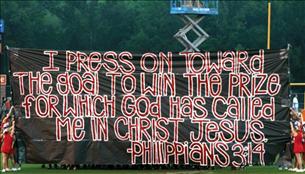
Cheerleaders at a north Georgia high school will have to fall back on school spirit alone to inspire the football team tonight against a longtime rival because the school district will no longer allow them to hold up signs bearing Bible verses.

The Catoosa school district banned the signs over concerns they were unconstitutional and could provoke a lawsuit, the Associated Press reports.

That has angered a number of people in this deeply religious community near Lakeview-Fort Oglethorpe High School and many held a rally last night to protest the ban.

For tonight's game against Ridgeland High School, an area outside the stadium has been designated for displaying the signs. Football fans will be allowed to take their Bible-verse signs into the stands as long as they're hand held, the Chattanooga Times Free Press reports.

A sign at a recent game read: "Commit to the Lord, whatever you do, and your plans will succeed."

School superintendent Denia Reese says she invoked the ban after getting a call from a Ringgold, Ga., resident, Donna Jackson, who allegedly said the signs could provoke a lawsuit. The school's attorney agreed.

Reese also said that Jackson filed an open records request for financial documents on the purchases of supplies used to make the banners, the Times Free Press reports.

Jackson denies the allegations, calling them "absolutely false."

I'm not sure it is unconstitutional, to be honest.  The U.S. Supreme Court has already ruled that students can pray at football games (or pre-games), so long as the prayer is not school-sponsored or school-funded or broadcast over school equipment.  That's the bright line, and there's nothing (yet) to suggest that the religious banners and signs were bought and paid for by the school district.  In fact, the Chattanooga Times Free Press says "the cheerleaders said they raised all the money to make the banners".  If that's true, I think they're okay.

The larger question for me is: What the hell does God have to do with high school football?

1002_WEB_A1_LFO_signs2_t305

Score a touchdown for Jesus?  Oh, come on.  And what happens if the other team scores a touchdown?  Who is that for?  Satan?

I'm no biblical scholar, but I don't think "goal" as used in Phillippians 3:14 was intended to mean the goal line in a football game.  And in fact, in the Kings James Version of the Bible, that passage reads: "I press toward the mark for the prize of the high calling of God in Christ Jesus."

Generally, speaking, the Bible doesn't serve well as a football playbook (ignoring the fact that the Bible predates football by about seventeen centuries).  Take Joel 2:8, for example:

They do not jostle each other; each marches straight ahead. They plunge through defenses without breaking ranks.

Well, that might work for short running plays where your team is inches from the goal line, but you've got to put the ball in the air once in a while, right?

Another one that won't work, Genesis 4:8:

"Let's go out to the field." And while they were in the field, Cain attacked his brother Abel and killed him.

That's probably an egregious foul.  Just guessing.

And why no Galatians 3:3 banners?

Are you so foolish? After beginning with the Spirit, are you now trying to attain your goal by human effort?

Yeah, I guess that banner wouldn't go over too big.

Of course, I think the most problematic verse for football players is Deuteronomy 14:8:

The pig is also unclean; although it has a split hoof, it does not chew the cud. You are not to eat their meat or touch their carcasses.

Not sure how you can score a goal if you are forbidden to touch pigskin.