
The White House cancels a presidential visit to the Centers for Disease Control and Prevention in Atlanta, citing the interference a trip may cause as the coronavirus outbreak grows https://t.co/OgIs1Crn0K pic.twitter.com/i90d3cDYBz
— CNN Breaking News (@cnnbrk) March 6, 2020
Trump Continues To Mislead On COVID-19; Markets Continue To Plummet
REPORTER: What was this Obama-era rule that you are blaming for the coronavirus testing problems?
— Aaron Rupar (@atrupar) March 4, 2020
PENCE: “The last administration asserted FDA jurisdiction over testing, and the development of tests like this. The president changed that on Saturday.” pic.twitter.com/S3EOycBS6B
Um, does this sounds like Trump has moved testing oversight to an agency with less expertise but will be “faster”?
Anyway, it’s not true. The FDA can issue an EUA (emergency use authority) notice allowing labs to proceed with in-vitro testing. They did it under Obama, for Zika, Ebola, and several other health emergencies. Trump made them issue a policy document because they dropped the ball on an EUA.
Good contextual tweet. https://t.co/qhp6WiMvFH
— Soledad O'Brien (@soledadobrien) March 5, 2020
And lest we forget…
Is he talking about how we refused the WHO tests? pic.twitter.com/zWJKBfqHLT
— Emmerbetic (@Emmerbetic) March 4, 2020
Yesterday, on the same day that the World Health Organization (WHO) pegged the global death rate of the novel coronavirus at 3.4 percent — a figure higher than earlier estimates — Trump went on Sean Hannity’s Fox News show and insisted it’s actually not that bad.
As cases spread across the United States (in part because of expanding testing) and states declare public health emergencies, Trump cited a “hunch” to make a case that the mortality rate is actually “a fraction of 1 percent.” He recklessly dismissed the WHO mortality rate as “really a false number,” used bogus numbers to compare the coronavirus to the much less deadly seasonal flu, and didn’t discourage people with Covid-19 (the disease caused by coronavirus) from going to work.
In this clip, Trump:
— Aaron Rupar (@atrupar) March 5, 2020
1. Denies WHO’s coronavirus death rate based on “hunch”
2. Calls coronavirus “corona flu”
3. Suggests it’s fine for people w/ Covid-19 to go to work
4. Compares coronavirus to “the regular flu,” indicating he doesn’t get the difference pic.twitter.com/uC9c03zX31
I’m not a doctor nor am I an expert in public health but I am extremely neurotic. I have been talking to some very smart doctors and experts in public health and they all agree this administration is slow walking testing and emergency preparedness for #COVID19.
— Molly Jong-Fast (@MollyJongFast) March 5, 2020
When the Trump administration was struggling to resolve problems with coronavirus testing kits a couple weeks ago, the Food and Drug Administration sent one of its top scientists to help out.
The FDA’s director of the Office of In Vitro Diagnostics and Radiological Health, Timothy Stenzel, flew to CDC headquarters in Atlanta on the weekend of Feb. 22, but he was immediately forced to wait overnight as health department officials lobbied the CDC to give him access to the agency’s campus, according to Politico. Stenzel was there specifically to work out issues with the CDC’s coronavirus test that had already hobbled more expansive screening for weeks.
The CDC told Politico Stenzel’s wait was simply a function of the fact that he arrived a day earlier than the agency had expected. “Due to CDC security requirements, he was not allowed on campus that night,” the spokesperson said.
Gee, maybe a little urgency might have helped as the minutes ticked away on preventing the spread of a virus that’s now beginning to bud nationwide. Naturally, once he gained access, Stenzel found issues such as evidence of lab contamination that may have played a role in tainting the test kits and delaying their delivery.
Ultimately, the delays resulted in a failure to administer the tests quickly to a wider group of people in order to promote early detection of the virus and perhaps prevent its spread. “CDC initially limited testing to people who had recently traveled to China or had close contact with a confirmed case and were also symptomatic,” writes Politico.
Meanwhile, it keeps rolling along.

The stock market made a sharp recovery from Tuesday’s post-rate-cut selloff. Both the S&P 500 and Dow Jones Industrial Average jumped over 4% on Wednesday, boosted by big victory of former Vice President Joe Biden coming out of Super Tuesday primaries, as well as Congress’s latest $8.3 billion funding package to tackle coronavirus.
The Dow Jones Industrial Average surged 1,173.45 points, or 4.53%, to close at 27,090.86. The S&P 500 gained 126.75 points, or 4.22%, to end at 3,130.12 and the Nasdaq Composite rose 334.00 points, or 3.85%, to close at 9,018.09.
That was its second largest points gain in history
But today, we’ve seen it drop 650 points.
[UPDATE: As of 2:30 pm, down 1000] [UPDATE: Another last 10 minute surge and it closes down 969]This chart shows very succinctly why delaying domestic readiness measures is more damaging the longer you wait: simultaneously accelerates relative spread while delaying expansion of health system capacity. https://t.co/F3R6tzJiiN
— Jeremy WASH YOUR DAMN HANDS Konyndyk (@JeremyKonyndyk) March 5, 2020
The state of NY is being far more transparent and pro-active than the federal government is right now. https://t.co/t9pwriPBvU
— Chris Hayes (@chrislhayes) March 5, 2020
UPDATE: He won’t shut up…
With approximately 100,000 CoronaVirus cases worldwide, and 3,280 deaths, the United States, because of quick action on closing our borders, has, as of now, only 129 cases (40 Americans brought in) and 11 deaths. We are working very hard to keep these numbers as low as possible!
— Donald J. Trump (@realDonaldTrump) March 5, 2020
He closed the borders? To a virus? How did he do that?
#Coronavirus Via Bloomberg (@business):
— Bad Fox Graphics (@BadFoxGraphics) March 5, 2020
-Global cases reach 94,534
-Global death toll surpasses 3,000
-Japan quarantines people arriving from China, S. Korea
-S. Korea to ban export of masks 3/6/20
-Multinational firms HSBC, UBS, Nestle curb business travel
President Trump: https://t.co/lMxCumQ6WQ
Meanwhile, Azar is being benched from public appearances, or so it seems:
Taking the stage with Pence instead yesterday — four of Azar’s deputies, and Ben Carson.
— Dan Diamond (@ddiamond) March 5, 2020
There will be no Azar at Pence’s presser later today, too. https://t.co/V3mjICUrru https://t.co/lqlh6CN2UJ
BREAKING: By a 20-point margin, Americans say Trump’s handling of the Coronavirus makes them less likely to vote for him.https://t.co/TCyz7frXKx
— Andy Slavitt (@ASlavitt) March 5, 2020
This is what leadership looks like. This is why leadership matters. This is why transparency matters. This is why honesty matters. @MollyJongFast https://t.co/vYmCqUwXBx
— (((Howard Forman))) (@thehowie) March 5, 2020
Rand Paul the lone senator to vote against $8.3 billion package to fund the Coronavirus response. Paul had an amendment that failed to offset the costs of the package. The vote was 96-1, and will now be sent to Trump for his signature
— Manu Raju (@mkraju) March 5, 2020
What Do You Know? It’s Uncle Joe
The dominant question going into Super Tuesday was: Did Joe Biden’s sweeping victory in South Carolina come just in time, or was it too late?
The answer is now clear. Biden all-but-swept Super Tuesday states, propelled by a tsunami of late-deciding voters.
Last night’s lessons, in order of how clear they are:
- Mike Bloomberg has provided us a salutory lesson: you can’t just buy a presidential election no matter how much money you have. He flamed out utterly tonight and needs to drop out immediately if he’s serious about defeating Donald Trump being his real and singular goal. Continuing to run would accomplish nothing except to embarrass him even further.
- Elizabeth Warren has been slipping in the polls and will slip even more after being blown out tonight. She should drop out.
- Joe Biden is also proving that money isn’t everything: not only is he winning solidly tonight, but he’s doing it on a shoestring. However, he should attract a lot more money after his performance tonight, and this will allow him to prove that money’s not nothing, either. He’s now in a virtuous circle, with victory bringing in more money and more money helping him win more states, rinse and repeat.
- Bernie Sanders 2020 sure looks a lot like Bernie Sanders 2016. He has his fans, obviously, but he tops out at 30-40 percent of the vote. Like it or not, there’s just not stronger support out there for a revolution, and Bernie isn’t willing to moderate his message to win over more supporters. That’s admirable, in its own way, but it’s not how you win a nationwide election.
- It’s obviously Bernie vs. Joe from here on out. Like 2016, I expect that Bernie will stay in until the bitter end no matter how unlikely an eventual victory becomes. I hope he proves me wrong.
A week ago, prognosticators speculated that Bernie Sanders could emerge from Super Tuesday’s contests with an insurmountable delegate lead of more than 300 delegates. After that, since Democrats allocate delegates proportionally, they said even if a Sanders challenger won a state 55% to 45%, Sanders’ delegate lead would narrow only marginally.
Instead, Biden’s powerful showing on Super Tuesday saw him easily break the “threshold” level – the 15% of votes cast required to collect delegates – virtually everywhere. He carried Elizabeth Warren’s home state of Massachusetts, outperformed projections in Sanders’ own Vermont and won Minnesota against all expectations. Biden prevailed in the southern states, including the mega-prize of Texas.
In fact, at this point, it’s Biden, not Sanders, who leads in delegates.
Michael Bloomberg has dropped out and endorsed Biden. His money is limitless, but his rationale for getting in – preventing a Sanders nomination as Biden faltered – collapsed.
Bloomberg will now become Biden’s wing-man, potentially committing his vast resources and deep organization to the Biden cause.
Warren, after her poor showing and her humiliating loss in Massachusetts, is “reassessing.” Her only rationale for continuing – that she can bring the Sanders and the non-Sanders coalitions together – hardly seems plausible. It would mean the Democratic Party nominating someone who consistently finishes third or worse in most primaries.
As ballots were cast on Super Tuesday, Nate Silver of fivethirtyeight.com estimated that Joe Biden would enter the convention with over 1,700 delegates, while Bernie Sanders would claim over 1,300.
To win outright, a candidate needs 1,991 delegates. The Bloomberg, Buttigieg and Klobuchar delegates seem mostly destined to move to Biden. Hundreds of superdelegates are also available to vote for the former vice president on a second ballot if the convention needs it. All that makes Biden now the prohibitive favorite to be the nominee. His resurrection was swift, almost unbelievable and simply unprecedented in the modern history of Democratic presidential primaries.
Bernie Sanders’ campaign was predicated on taking 30% of the delegates into the convention, then demanding the nomination. “Sanders aides believe, he’ll easily win enough delegates to put him into contention at the convention,” The Atlantic reported in April 2019. “They say they don’t need him to get more than 30 percent to make that happen.” (My emphasis.)
So they built a campaign that demanded little of Sanders : no change in message, no effort to broaden the coalition. Like his utter lack of interest in legislating, his campaign had zero interest in building actual majority support. Everything else flowed from there, from his failure to grow Black support (the very same voters who defeated him in 2016) to his tolerance of toxic surrogates and online supporters. It’s easy to make enemies of your detractors if you don’t have to worry about winning their support. But what’s amazing about Super Tuesday results isn’t just that Sanders lost, it’s that he did so by actually shrinking his base compared to 2016. Youth turnout was abysmal. His raw vote totals are significantly down. And where we did see record turnout, it was predominantly in the states that Biden won!
None of this, sadly, is deterring Sanders supporters, who seemed to have amped up the ugliness.
After Super Tuesday, the Democratic nomination has essentially been whittled down to a two-man race between Sanders and former Vice President Joe Biden, and it’s going to get really, really nasty, threatening a return to the conditions that contributed to a Democratic Party meltdown in 2016.
“I like Joe. Joe is a decent guy, and I do not want this campaign to degenerate into a Trump-type effort where we’re attacking each other, where it’s personal attacks,” Sanders said Wednesday. “That is the last thing this country wants.”
But that’s exactly what the country is going to get, if not from Sanders himself, then from aggrieved surrogates already going nuclear. It didn’t take long for some of them to start passing around a video of Biden’s many stumbles at debates and on the campaign trail and calling him mentally unfit for the presidency, an attack that will no doubt be re-upped if the two men meet one-on-one on the next debate stage.
Breaking News From CNN
Former national security adviser John Bolton's book about his time working for President Trump has been delayed until May due to the White House's review of the manuscript https://t.co/zGuZwdu52r pic.twitter.com/shPTYlFYqC
— CNN Breaking News (@cnnbrk) March 3, 2020
It’s Super-Duper-Tuesday!
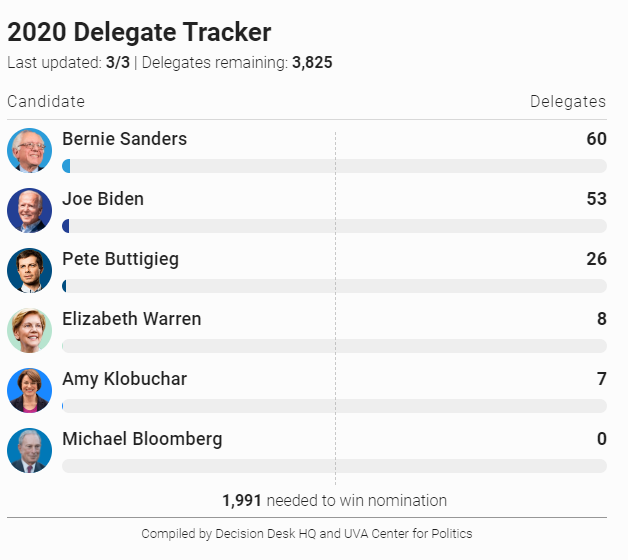
A third of all pledged delegates in the Democratic presidential race will be doled out on Tuesday across 14 states — from California to Maine — in the single biggest day of the 2020 contest.So, what’s going to happen?
California and Texas are the two biggest states voting today, and obviously, much focus is on them. Here in North Carolina, I already voted — for likely non-nominee Elizabeth Warren. In both California and Texas, which have the most delegates up for grabs and, therefore, matter most today, Warren is running a solid third behind Sen. Bernie Sanders and Joe Biden. And, more importantly, she is above the 15% threshold to win delegates in each. If Warren can stay above that 15% number in both of those states, Tuesday will be a very good day for her campaign, no matter what else happens.
Sanders is expected to do well in the west and northeast. FiveThirtyEight lists him as a significant favorite in California, Utah, Colorado, Massachusetts, Maine and his home state of Vermont. He’s also favored in Minnesota.
Biden is expected to do better in the south, a less liberal region and one with a larger share of African-American voters. A good night for Biden would see him winning Alabama, Arkansas, North Carolina, Oklahoma, Tennessee and Virginia. On a very good night, he would also win Texas, where the polling suggests a close race. “The Amy/Pete coalition for Biden is big. But, in order to succeed on Super Tuesday, he still needs Bloomberg to collapse,” Amy Walter of The Cook Political Report writes.
Former Vice President Joe Biden has gotten a lot of good news over the past few days. A huge, almost 30-point win in South Carolina. A series of impressive endorsements. Other candidates in the moderate lane — namely, former South Bend, Indiana, Mayor Pete Buttigieg and Sen. Amy Klobuchar, who were among those endorsers — dropping out.
But one thing we haven’t had a lot of since South Carolina was hard data. That changed late last night with a flurry of new polls — we now have at least two polls conducted since South Carolina in every single Super Tuesday state. So the picture heading into Super Tuesday is a lot clearer, and overall, things look good for Biden.
Biden is now about twice as likely as Sanders to win a delegate plurality, according to our primary model, which gives him a 65 percent chance of doing so compared with a 34 percent chance for Sanders. This represents the culmination of a trend that has been underway in the model for about a week; it started to shift toward Biden once polls showed the potential for him to win big in South Carolina — and it anticipated a polling bounce in the Super Tuesday states if he did win big there. Still, even after South Carolina, Biden’s plurality chances had risen only to 32 percent, compared with 64 percent for Sanders. That means the polling bounce from the events of the past few days has been bigger than the model anticipated.
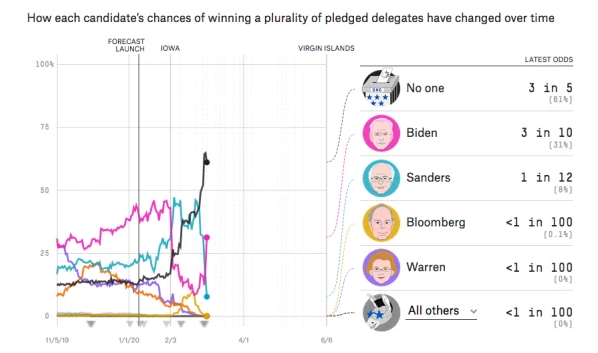
The real fight at the moment is not to beat Sanders in delegates collected on Super Tuesday — even the most pessimistic projections for the Vermont senator assume he wins the most — but rather to be the person who takes the second most delegates, and, by extension, can make the case as the Bernie alternative.That fight is between Biden, Warren (due to her strength in California, largely) and Bloomberg, and the former vice president would appear to have a leg up at the moment as he comes into Tuesday with momentum from his larger-than-expected win in South Carolina over the weekend and a slew of endorsements — including from Klobuchar and Buttigieg — announced on Monday.For Biden to slot in behind only Sanders in delegates, he need a few things to happen: a) get over 15% in California b) win or come close in Texas and c) run up the margins in southern states — Virginia, Tennessee, Alabama — where the Democratic electorate will have a major African American tilt.
Sanders should do quite well in New England (Maine, Massachusetts, Vermont) as well as in Minnesota and Colorado. But it’s California where Sanders’ day will be made (or not). There’s virtually no question that Sanders will win the state but the key is whether or not Biden, Warren or Bloomberg can get to 15% or more.If no one other than Sanders gets to 15% statewide, he will get almost 60% of all of the delegates, according to calculations made by the Cook Political Report’s David Wasserman. If, on the other hand, two non-Sanders candidates got 15.1% of the vote each, Sanders would win just 38% of California’s delegates. So, BIG difference.
Then there is the Bloomberg question. The last 72 hours have been former New York City Mayor Michael Bloomberg’s worst-case scenario: Biden crushes in South Carolina’s primary and a rapid lining-up of centrist former candidates behind him occurs. The entire premise of Bloomberg’s candidacy is that Biden is too weak to win the nomination. And now, on the day Bloomberg’s campaign has focused all its efforts (and money) since he began running for president, he finds Biden with all the momentum.Given the amount of money Bloomberg has spent on ads, staff and, well, everything else on Super Tuesday states (well more than $500 million), it has to be considered a major disappointment if he doesn’t make the 15% threshold for delegates in California and Texas. Polling in both states suggests Bloomberg is slightly below the cut-off line in each state; if he doesn’t make viability statewide in either one, it’s very, very likely that Bloomberg has a bad night — regardless of what happens elsewhere in the country.
COVID-19 Is Immune To Trump’s Lies And Bullying
So how does Trump handle the combination of the virus and the economic fallout from it? He can’t blame it on a political conspiracy, though he has flirted with the notion—suggesting at one point that the whole thing was a new Democratic “hoax” before denying he had said that. And there’s no enemy here to finger as the villain either. There’s no Robert Mueller, Peter Strzok, or Adam Schiff against whom to rail.
Denial isn’t going to work, as the Chinese Communist Party learned when it tried to cover up the virus early on in the outbreak. Trump has tried to minimize the likely impact on the United States, talking about how few cases there have been and what a good job his administration has done on containing the spread. But now that cases have shown up in California, Washington State, Rhode Island, Florida, and New York, and the first deaths are beginning to occur, his self-congratulation is starting to look naive. If the spread of the virus continues, this look-on-the-bright-side approach will appear altogether ineffective—particularly bad for Trump, who has marketed himself as the guy who comes in and makes magic happen. And while Trump has insisted that the current weakness of the stock market is nothing but a blip that will reverse shortly, he has essentially no leverage to make good on that prediction.
The president can, of course, protest that the spread of the virus and the resulting economic damage are not his fault. He may even be right about that—not in the sense that his handling of the matter has been competent, but in the sense that this particular virus may have been beyond the power of even competent management to contain. But presidents rarely get spared political blame for economic shocks beyond their control. And a president who ties his political fate so energetically to the state of the economy and the market—who declares that voters should ignore apparent illegality, corruption, and serial failures of decency because their retirement accounts are faring well and their job prospects are good—may prove particularly vulnerable to conditions that undermine the premise of his argument. The fact that he has long claimed to control the economy with the force of his will makes his inability to do so a particular liability.
The point here is not to predict, much less to hope, that the virus will do what Mueller and Schiff could not. The Fox and Friends host Pete Hegseth claimed that “the Democrats” and “the media” are “rooting for coronavirus to spread.” Acting Chief of Staff Mick Mulvaney, similarly, told an audience at the Conservative Political Action Conference that the press thinks “this will bring down the president, that’s what this is all about.”
Everyone should be hoping that Trump handles this matter brilliantly—even if that means that he reaps political benefit from it. Situations like this are among the reasons the country needs a functioning executive branch, and all Americans are invested in the presidency’s success in managing the disease’s spread.
The risks of considering the likely political impact of the virus and its economic fallout are already visible in the deranged response to it by some of the president’s political supporters, who—clearly fearing some of the very effects we are describing here—are busy putting out information that may well get people killed. The talk-radio host Rush Limbaugh’s insistence that COVID-19 is nothing more than “the common cold,” and statements by Fox News hosts that frightening news coverage of the virus is aimed only at taking down the president, would be irresponsible in any context. But comments minimizing the harms of the epidemic are particularly dangerous, given that listeners to Limbaugh and viewers of Fox News tend to be older, and elderly people are dramatically more likely to die if they contract the virus.
Our point, rather, is that the challenge President Trump now faces is one he cannot obviously meet with the usual toolkit he has relied on during previous crises. He can meet it only by actually doing the job of president of the United States, which is—in a fundamental sense—a management position that supervises a raft of executive agencies with immense resources to address a wide range of issues. This is exactly the part of the job Trump has never shown the slightest interest in or capacity for. It is the part of the job that he actively disdains.
It is also, alas, the part of the job that implicates the name of the branch of government he heads. The solution to this problem involves faithful—and skillful—execution of the powers of the government. But that solution will require Trump to begin to value the role played by a more traditional president. It is not an exaggeration to say that many lives may depend on his undergoing that transformation.
Coronavirus Cases by State:
— PM Breaking News (@PMBreakingNews) March 3, 2020
California: 20
Washington: 18
Illinois: 4
Oregon: 3
Florida: 3
Rhode Island: 2
New York: 2
Georgia: 2
Massachusetts: 2
New Hampshire: 1
Wisconsin: 1
Arizona: 1
Note: Repetriated cases from Diamond Princess ship not included
Dow down another 500 points AFTER the Fed makes a VERY rare half percentage point cut between regularly scheduled meetings. Normally, a cut like this suggests the Fed has a grip on the economy. This looks like the Fed caved to Trump’s market-obsessed pressure
— Ali Velshi (@AliVelshi) March 3, 2020
Rep. Mark Pocan has condemned the CDC for its "inexplicable" decision to stop publicly disclosing the number of Americans who have been tested for the novel coronavirus. Their site apparently no longer discloses the number of tests or the number of deaths. https://t.co/oyczK5o3qG
— Kyle Griffin (@kylegriffin1) March 3, 2020
BREAKING: Washington state reports seventh death from coronavirus – AP
— Breaking911 (@Breaking911) March 3, 2020
Senate Ds emerge from Pence briefing saying US not prepared for Coronavirus
— Manu Raju (@mkraju) March 3, 2020
“No,” Tester said when asked if US is prepared, arguing Trump “dropped the ball early” and there are “not enough test kits
Reed: “I think there’s an attempt to minimize – not to be realistic“
The Dow went up 1200 points yesterday, after a disastrous previous week when it lost 3000. And even though then Fed cut half a point on the interest rate, Dow is down 900 on the day.
Steyer Out Saturday; Buttigieg Out Last Night; Klobachar Out Just Now
Basically, the day before Super Tuesday, we’re down Biden, Sanders, Bloomber and Warren.
But the knockout of Pete Buttigieg means perhaps the most. And this just in…
Breaking: Pete Buttigieg plans to endorse Joe Biden
— Political Polls (@PpollingNumbers) March 2, 2020
People complain about the incompetence of the Democratic party, but at least they managed to thin the field when it still mattered.
— emptywheel (@emptywheel) March 2, 2020
What does this mean?
Well, before Kobuchar got out, 538 speculated that Buttigieg leaving was bad news for Sanders, as it made it HARDER for him to get a majority, and maybe even a plurality.
Now, Nate Silver of 538 says this:
I'm not sure if our model will say that, but **it's getting pretty close to saying that** and the factors it isn't considering (i.e. that Biden could pick up a disproportionate share of Klobuchar and Buttigieg voters) would likely push it in that direction.
— Nate Silver (@NateSilver538) March 2, 2020
Jonathan Bernstein, Bloomberg Opinion: “As for Michael Bloomberg … it’s been true from the start and continues to be true that the most likely effect of his campaign is to split the mainstream liberal vote and make Sanders the nominee.”
Nate Cohn, The Times’s polling expert, sees Buttigieg’s exit as good news for Biden: “Many stronger Buttigieg states [like Maine, Colorado and Utah, all of which vote Tuesday] were also states where Biden was in jeopardy of not hitting 15% [and thus winning no delegates]. Even if his support breaks evenly, good for Biden — and it might not be even. Elsewhere, Buttigieg support is concentrated in affluent areas, where it’ll break Biden.”
Megan McArdle: “I might be too pessimistic about Biden’s chances. It all feels just too close to the emotional roller coaster we #NeverTrumpers rode back in 2016, when we spun elaborate fantasies about the field narrowing and a champion emerging to take down the Orange Menace.”
Jonathan Chait: “Biden was not my first, or second, or third choice. He is endlessly exasperating. But he has a quality many of the media elites have failed to see. His meandering delivery — marred with a stutter that seems to have returned in his old age after he mastered it as a young man — nonetheless manages to convey a sincerity and a decency.”
Perry Bacon Jr., FiveThirtyEight: Buttigieg “might genuinely think that Sanders would be a terrible nominee for the Democratic Party. But there is a potential upside for Buttigieg in making this decision too. At his age, Buttigieg has four decades to try to become president. In leaving the race now, he builds goodwill with Democratic Party officials broadly and Biden in particular.”
Coronavirus, In Pictures And Graphics

Yup, prayer.
Donald Trump Jr., the president’s son, told Fox News that Democrats “seemingly hope that it comes here, and kills millions of people so that they could end Donald Trump’s streak of winning.”
No elected official, Democratic or otherwise, have said any such thing. Some Democrats — and some Republicans — have, however, been critical of the Trump administration’s response to the coronavirus. Republican Sen. Richard Shelby and Democrat Senate Minority Leader Chuck Schumer have both called on the administration to spend more to combat the virus, for example.
Despite this, on Sunday, Vice President Mike Pence — who is in charge of the White House’s efforts to deal with the outbreak — defended the president’s son’s remarks as “understandable.”
And when you have a president who says things like this…
Here’s Trump at his rally tonight in South Carolina dismissing worries about the coronavirus as the “new hoax” pic.twitter.com/Q58d7dI1cb
— Aaron Rupar (@atrupar) February 29, 2020
… Democats NEED to push back.
Seriously people- STOP BUYING MASKS!
— U.S. Surgeon General (@Surgeon_General) February 29, 2020
They are NOT effective in preventing general public from catching #Coronavirus, but if healthcare providers can’t get them to care for sick patients, it puts them and our communities at risk!
https://t.co/UxZRwxxKL9
Here’s some silver lining for China. As manufacturing plummets….

… so is the pollution

You can add New York state and Florida (presumptive positives) to this list. New cases coming in fast. we can expect more U.S. states and countries to announce new cases in the coming days. https://t.co/cPI2Wd2F9q
— Josh Michaud (@joshmich) March 2, 2020
• First coronavirus case in sub-Saharan Africa confirmed in Nigeria
— Al Jazeera English (@AJEnglish) March 2, 2020
• Highest number of deaths outside China is Iran, at 54
• Over 89,000 cases worldwide pic.twitter.com/YvvRRXNcE8
Significant #COVID19 activity in Europe:
— Isaac Bogoch (@BogochIsaac) March 1, 2020
-France and Switzerland are banning large gatherings
-The Louvre is closed, conferences cancelled
-Over 1100 reported cases in Italy with 29 deaths
-Spain, UK, Germany, others with more caseshttps://t.co/dTwC5NP3b2
Second US #COVID19 death: a Seattle-area man in his 70s https://t.co/ouQCpKIOOW
— Dr. Tara C. Smith (@aetiology) March 2, 2020
Why working out the #coronavirus death rate is “PHD-level hard” – by the BBC’s head of stats @robertcuffe https://t.co/nE1IAuszDV
— BBC Reality Check (@BBCRealityCheck) March 2, 2020
BREAKING: France confirms 61 new cases of coronavirus and 1 new death, raising total to 191 cases and 3 deaths https://t.co/eUoE2b20hL
— BNO Newsroom (@BNODesk) March 2, 2020
And what is this all about?
The fact that there is nowhere to see how many cases the US has tested and that the @CDCgov has suddenly hidden this number without explanation is infuriating and inexcusable https://t.co/Z9a5djoX3o
— Steve Lookner (@lookner) March 2, 2020
King County, Washington is also setting up modular housing for coronavirus patients to be isolated & recover https://t.co/PJMfsHwwbY
— Steve Lookner (@lookner) March 2, 2020
Columbia University virologist Angela Rasmussen on the estimate that two percent of the people who are infected with the coronavirus will die:
That could certainly change. The China CDC published a report in which they looked at like 45,000 patients and calculated that case fatality rate based on that. Prior to that, the fatality rate was being estimated at around 2 or 3 percent. So that is one of the numbers that has remained fairly consistent. My personal opinion, though, is that the case fatality rate could actually be much lower if there’s a bunch of mild cases that we’re not being able to test for.
….We know that once we get past about age 50 or 60, that case fatality rate starts increasing. It’s 0.1 percent or 0.2 percent for people, I think, through age 49. And then ages 50 through 59 goes up to 1 percent. Then it goes up to like 3 percent [for patients in their 60s and 70s] and then it goes, age 80-plus, to like 14 percent case-fatality rate. It really depends on the population that the virus is affecting. Also people with preexisting conditions also have a higher case fatality rate. So that would be like heart disease, diabetes, and asthma.
On what to do if you start to feel sick:
It’s still flu season. I would treat this same way we would treat the flu. Don’t freak out….And if you really do need care, then you should definitely seek it out. You shouldn’t wait until you’re, like, dying of pneumonia before going to the doctor.
….The good news is that because in the majority of patients it’s mild, what we should be telling people is that if you are in a low risk group, you don’t have to rush the hospital. You should stay home and recover. So that the hospitals are not going to be overburdened with, with otherwise healthy people, when they need to be using their resources for treating the people who are likely to have more severe illness….The virus, I’m not as worried about. I’m much more worried about what people’s reaction is going to be — and how our public health system is going to be handling them.
On previous pandemics:
I don’t remember people being this crazy during the 2009 flu pandemic. That had a much higher case fatality rate in some communities — from four up to almost 20 percent. So in that sense, this virus isn’t that different from other pandemic viruses that we’ve dealt with before.
The best thing you can do is wash your hands frequently. Soap breaks down the lipid membrane that surrounds the coronavirus and kills it. Hand sanitizers also work as long as they’re 60 percent alcohol or higher.
We’re up to…5 now?
BREAKING: Washington state health officials announce 3 new coronavirus deaths
— Breaking911 (@Breaking911) March 2, 2020
2. These #Covide19 deaths are tragic, but sadly not surprising. The virus got into a long-term care facility there. The cases from yesterday are mainly of an age & health status that makes them very vulnerable. pic.twitter.com/VkXcbE57da
— Helen Branswell (@HelenBranswell) March 2, 2020
Correction it is SIX. 5 in King County and 1 in Snohomish.
— Naveed Jamali (@NaveedAJamali) March 2, 2020
RIP Freeman Dyson
The father of a friend of mine — a seminal thinker for the ages.
In 1979, Freeman Dyson came up with a plan to live forever.
There was no fanciful elixir. It was not a matter of theological speculation. Mr. Dyson was, for all his eccentric, maverick tendencies, a theoretical physicist — one of the most brilliant and insightful of his age.
In a mathematically rigorous manuscript, sprinkled with commentary and philosophical quotations, he wrote the formulas by which some advanced consciousness could encode itself into a form of matter that would persist indefinitely into the cosmic future, after the last star is snuffed out in the darkness.
He postulated that this eternal machine might be an amorphous cloud of particles, passing electromagnetic signals back and forth to emulate human thought. He made sure to spend a few paragraphs outlining a detailed plan for unlimited memory storage, since “it seems hardly worthwhile to be immortal if one must ultimately erase all trace of one’s origins in order to make room for new experience.”
It was this paper, “Time Without End: Physics and Biology in an Open Universe,” that brought me to Mr. Dyson’s office at the Institute for Advanced Study in Princeton last May, four decades after its publication. I was working on a book about the end of the universe and seeking his expertise. How will it happen? How can we know? Should we hold on to anything like hope?
By this time, Mr. Dyson was a legend, known as much for his intellectual breadth as for his groundbreaking work in physics and mathematics.
At the age of only 24, he had an insight that proved the equivalency between two seemingly disparate theories of particle physics that would lead three of his colleagues to a Nobel Prize.
To the public, he’s more famous for giving science fiction the “Dyson Sphere,” a hypothetical structure a future civilization could build to harness the entire power of its sun. As a professor at the institute in 1965, he won the prestigious Dannie Heinemann Prize for Mathematical Physics for his work in quantum field theory, just a few years after taking leave to try to develop an interplanetary spacecraft powered by nuclear explosions.
He worked with such luminaries as Richard Feynman and Wolfgang Pauli, and wrote books speculating about religion, biology, and the future of human society. His early achievements landed him an offer of a professorship before he even finished his Ph.D., so he never bothered to complete it — he felt that being a perpetual student gave him license to explore more freely.
Of course, being a genius and visionary helped with that, too. By the time he was pondering eternal life, he had already firmly established his scientific legacy, so he could risk working on topics he knew would be considered frivolous. In the introduction of his 1979 paper, he pushed back against the idea that eschatology, the study of end times, should be avoided by serious scientists: “If our analysis of the long-range future leads us to raise questions related to the ultimate meaning and purpose of life, then let us examine these questions boldly and without embarrassment.”
At our meeting last year, I asked if he still felt that these topics were considered “disreputable” in physics.
“Yes, of course,” he replied. Proof, he said, was “the fact that everything I wrote was wrong.”
I should be clear here that there was no mistake with his calculations, given the knowledge of the cosmos at the time. Mr. Dyson was betrayed by the universe.
By the 1970s, it was firmly established that the universe was expanding, so the next big question was whether the cosmos was fated to recollapse, destroying us all in a Big Crunch, or to simply expand forever.
The latter possibility might sound more appealing — Mr. Dyson himself wrote that the concept of a recollapsing universe was “a rather dismal story” — but it seemed that it would still doom us to a bleak future cosmos of gradual cooling in which all sources of light and heat would fade away by degrees.
When Mr. Dyson turned his attention to an eternally growing cosmos, though, he found hope. He calculated that a machine built to gradually slow its computations, periodically entering states of hibernation, could persist, subjectively, forever.
The discovery in the late 1990s that the universe is not just expanding, but accelerating in its expansion, ruined everything. If this acceleration continues, even a carefully engineered calculation machine will eventually come apart.
“The universe just disperses into disconnected volumes, which are essentially empty,” Mr. Dyson told me. “Essentially nothing happens after a finite time.”
This seems to be where we’re headed. The current scientific consensus is that far in the future, long after our own sun dies, whether or not we have evolved from fragile biological humanity to spacefaring, self-replicating machines, we will all eventually succumb. The distant galaxies will be pulled beyond the limits of our sight; stars will die; all light will fade. We will end our cosmic existence alone, in the dark.
“It would be disappointing,” Mr. Dyson said. “I mean, you have to accept what nature provides. But it’s like the fact that we have finite lifetimes. It’s not so tragic. In many, many ways it makes the universe more interesting. It’s always evolving to something different. But having a finite lifetime for the whole thing …” His voice trailed off.
“Maybe that’s our fate. But certainly, I would prefer to have evolution going on forever.”
Whether or not the accelerated expansion will continue is not a settled question. It may never be one. As a theoretical cosmologist myself, I’m searching for answers, but I have to concede we may never figure them out. Maybe it’s the journey that will be worthwhile; maybe we’ll learn something useful along the way.
At the end of our discussion, I asked Mr. Dyson whether he thinks we’ll someday say with certainty where we’re all going, how it’s all going to end.
“It’ll be more interesting if it turns out to be unanswerable,” he said. “Nature always has more imagination than we have. So, I think it’s quite likely.”
Freeman Dyson passed away last week, at the age of 96. He knew no one could have all the answers, but I got the impression that he liked it that way.
“The beauty of science is that all the important things are unpredictable,” he told me. “The optimistic view in me is that nature is designed to make the universe as interesting as possible.”
Breaking News From CNN
President Trump is expected to visit the CDC headquarters this week. It's unclear if Vice President Pence, who is in charge of the administration's response to the coronavirus outbreak, will join him https://t.co/ZqWftG9GD4 pic.twitter.com/EoMqzyBdTL
— CNN Breaking News (@cnnbrk) March 1, 2020
Weekly List 172
This week the coronavirus consumed the country and the world, as it spread from continent to continent. Trump’s strategy in recent weeks of ignoring and minimizing the virus’ import became untenable as his precious stock market plummeted, and country by country news spread of deaths and disruptions. The global stock markets have lost $6 trillion in value from the outbreak, while the Dow Jones Industrial Average and Standard & Poor’s 500 lost 12% and 11% this week alone, the worst fall since the recession of 2008.
Trump held an impromptu news conference Wednesday, where he openly contradicted the experts by his side. He spent the week blaming the market’s plunge on the media, the Democrats, and even the Federal Reserve. Trump’s firing of the U.S. pandemic response team, and cuts to the Centers for Disease Control and Prevention’s budget and focus, left the country flat-footed and ill-prepared.
As the week came to a close, the first American died from the coronavirus, and shortly after the news was publicly reported, Trump held his second news conference on Saturday afternoon, appearing somber and disoriented. Negative global economic news continued to come up, suggesting the stock market’s turmoil was far from over — and Trump, who has centered his re-election around the stock market price, started to see polling suggesting trouble.
- On Saturday, the LA Times reported Trump has effectively flipped the 9th Circuit Court of Appeals in San Francisco. Trump frequently vented about decisions by the 9th Circuit in his first years in office.
- Trump has named 10 judges to lifetime appointments on the 9th Circuit, almost a third of the 29 on the Circuit. Obama named just seven in eight years in office. Experts say the full impact of the shift will be felt starting in 2021.
- On Thursday, Gallup reported Americans’ satisfaction with the U.S. position in the world rose to its highest level in 17 years since 2003, rising to 53%.
- The increase was driven largely by Republicans: since 2016, Republicans who are satisfied rose from 19% to 85%, Independents from 36% to 48%, and Democrats declined from 52% to 19%.
- However, just 37% believe Trump is respected by world leaders, with Republicans (74%) much more likely than independents (27%) and Democrats (6%) to think Trump is respected.
- On Saturday, Russian President Vladimir Putin told state-media outlet TASS that Russia could regain its status as “a global rival” for Western powers through some degree of “integration” with Ukraine.
- On Saturday, MSNBC host Chris Matthews compared Bernie Sanders winning the Nevada primary to France falling to Nazi Germany in 1940, after a guest likened it to crossing the Maginot Line. He later apologized.
- On Saturday, NYT reported Trump’s efforts to remove disloyal employees was set to heat up ahead of the election , unlike past leaders who were focused on having a stable team for their re-election. The moves are causing unease in the regime.
- Trump has removed senior career officials including Alexander Vindman, John Hood, Jessie Liu, Victoria Coates, and Andrew Hallman. An expert called it the biggest assault on the nation’s civil service system since 1883.
- Trump is also clearing officials from the Office of Director of National Intelligence, Justice Department, National Security Council and more. Not only career officials, but also Republican appointees are being targeted.
- At a time of global tumult, and concern about spread of the coronavirus, Democrats raised concerns that the global health security expert position on the NSC has been left vacant by Trump for two years.
- Allies have convinced him he is surrounded by a deep state. He has been frustrated by the decision-making process that slowed his agenda. By surrounding himself with loyalists he will avoid open debate and dissent.
- On Sunday, speaking to reporters before heading to India to meet Prime Minister Narendra Modi for a two day visit, Trump bragged about a crowd-size estimate, “We’re going to have millions and millions of people.”
- Trump also again tried to insert himself in the Democratic primary, saying, “I think Democrats have been treated Bernie very unfairly. And it sounds like me like a leak from Adam Schiff, because they don’t want Bernie.”
- Trump also claimed he had not been briefed, saying, “I read where Russia is helping Bernie Sanders….What they try and do is — certain people like certain people to have information. No different than it’s been.”
- Trump also blamed Schiff and said he should be investigated, “They leaked it. Adam Schiff and his group — they leaked it to the papers and — as usual. They ought to investigate Adam Schiff for leaking that information.”
- Trump also said of the Roger Stone trial, “You have a juror that’s obviously tainted. She was an activist against Trump…and said bad things about Stone. She somehow weaseled her way onto the jury,” calling it “tainted.”
- On Sunday, Mark Short, an aide to Vice President Mike Pence, told “Fox News Sunday” that foreign governments have tried “to sow chaos” for years, but there is no intelligence that Russia is trying to help Trump.
- On Sunday, White House national security adviser Robert O’Brien told “Face the Nation” that he had not received a briefing that “Putin is doing anything to try and influence the elections in favor of President Trump.”
- O’Brien added, “If it’s out there, I haven’t seen it. I’d be surprised if I haven’t seen it.” He also claimed Joe Maguire “wasn’t pushed out,” but that he was an acting director and his term was over in two weeks.
- O’Brien also echoed Trump’s statements, saying, “Schiff’s committee continues to leak selective information,” and claiming the briefing Trump got from intelligence “has not told us that Russia is trying to reelect” him.
- On Sunday, O’Brien also told “This Week” that “the Russians and the Chinese and others like to sow disruption in the American electorate,” but “that doesn’t mean because they prefer a particular candidate.”
- O’Brien added if Russia is interfering it would make sense they “would like Bernie Sanders to win the Democratic nomination,” adding, “because he wants to spend money on social programs” and “out of the military.”
- On Sunday, 2020 candidate Joe Biden told “Face the Nation” that Facebook alerted his staff about Russian bots targeting his campaign, saying, “the Russians don’t want me to be the nominee.”
- On Sunday, Judge Amy Berman Jackson rejected Stone’s motion to disqualify her in a strongly worded order, arguing the motion to have her recuse herself lacked “any factual or legal support.”
- Jackson added, “the pleading appears to be nothing more than an attempt to use the Court’s docket to disseminate a statement for public consumption that has the words ‘judge’ and ‘biased’ in it.”
- On Saturday, WIRED reported after resignations and firings last week in the ODNI, almost all the roles created after 9/11 to prevent it from happening again will either be vacant or lack permanent appointees.
- On Sunday, Axios reported that over the past 18 months, Trump’s White House and allies have put together a list of disloyal career government officials to oust, and Trump loyalists to replace them with.
- A well-connected network of conservative activists, including Ginni Thomas, the wife of Supreme Court Justice Clarence Thomas, have quietly worked to develop “Never Trump” and pro-Trump lists.
- The right-wing strategy group “Groundswell” has funneled names who should be fired to Thomas. Former employees like Jessie Liu and H.R. McMaster were targets of the group.
- Since his impeachment acquittal, aides said Trump’s distrust of the so-called “deep state” has intensified, believing the government, from the DOJ to Department of Homeland Security, is filled with snakes.
- On Sunday, the Guardian reported former NSA McMaster plans to publish “Battlegrounds: The Fight to Defend the Free World” on April 28. The book was not expected to be a tell-all about the Trump regime.
- On Tuesday, Politico reported the White House has hired James Bacon, a 23 year-old college senior to be the right-hand man for Presidential Personnel Office director John McEntee.
- On Monday, BBC News reported Trump spoke to a crowd of roughly 100,000 in India. As he walked on to the stage, the Village People song “Macho Man” rang out over loudspeakers.
- Trump mispronounced several Indian words, and said of PM Modi, “Everybody loves him but I will tell you this, he is very tough.” The crowd began leaving midway through Trump’s speech, which came after Modi’s.
- On Monday, Trump promoted a conservative author’s book, tweeting, “Great new book just out…by Gianni Caldwell,” giving the incorrect name of the book and the author, Gianno Caldwell.
- On Sunday, CNN reported police cleared the Jewish Community Center in Albany, New York after it received a bomb threat. The threat was emailed to JCCs across the country. The FBI was notified.
- Gov. Andrew Cuomo tweeted, “Bomb threats were made by email today against multiple Jewish Community Centers across NY.” Cuomo said there have been 42 anti-Semitic attacks in New York so far in 2020.
- On Monday, the Supreme Court said it would hear a case over whether a Philadelphia religious organization has the right to discriminate against same-sex couples in placing foster children in homes.
- On Tuesday, speaking to reporters in India, Trump said Harvey Weinstein’s conviction was a “great victory” for women, adding, “I knew him a little bit ― not very well,” and said Weinstein gave a lot of money to Democrats.
- When asked what message he would sent to women on sharing their stories, he said, “I haven’t seen too much because I’ve been in India.” More than 20 women have accused Trump of sexual harassment or assault.
- On Wednesday, Louisiana judge Jessie LeBlanc, who called a black sheriff’s deputy and a black law clerk the N-word in text messages, apologized but refused to resign. She will run for reelection in December.
- On Wednesday, the DOJ established a new office, the Denaturalization Section, in its immigration office to strip citizenship rights from naturalized immigrants.
- The section will assist Trump’s broader efforts to remove immigrants who have committed crimes. A DOJ spokesperson added the section will “ensure that they are held accountable for their fraudulent conduct.”
- In establishing the office, Trump signaled that naturalized citizens have fewer rights than those born in the U.S., and that immigrants who have been naturalized should not assume that they cannot be deported.
- The new section will replace a team of immigration lawyers who have been asked to instead focus on cases that revoke citizenship for terrorism, war crimes, human rights violations, and sex offenses.
- On Wednesday, a U.S. appeals court ruled the Trump regime can withhold law enforcement funds from so-called sanctuary states and cities that refuse to cooperate with federal immigration authorities.
- The unanimous decision by a three-judge panel was a victory for the regime in its years-long battle. Three other federal appeals courts have upheld the injunction. The case may be appealed to the Supreme Court.
- On Tuesday, Trump escalated his battle with the judicial branch, demanding that liberal Supreme Court justices Sonia Sotomayor and Ruth Bader Ginsberg recuse themselves from cases involving him.
- Trump quoted Fox New host Laura Ingraham, tweeting, “‘Sotomayor accuses GOP appointed Justices of being biased in favor of Trump,’” adding, “This is a terrible thing to say.”
- Trump added, “Trying to “shame” some into voting her way?” and, “She never criticized Justice Ginsberg when she called me a “faker”. Both should recuse themselves on all Trump, or Trump related, matters!”
- Trump again invoked fairness, tweeting, “While “elections have consequences”, I only ask for fairness, especially when it comes to decisions made by the United States Supreme Court!”
- Shortly after, Trump told reporters of Justice Sotomayor, “Her statement was so inappropriate,” and “it’s almost what she’s trying is take the people who do feel a different way and get them to vote the way that she would like.”
- When pressed by reporters, Trump was unaware of Justice Sotomayor actually wrote, or that other justices have written similar things in dissent opinions. When asked what he found inappropriate, he said, “you know what the statement was.”
- Trump also accused House Intelligence Chair Adam Schiff of leaking information about intelligence assessment on Russia, and claimed he had not been briefed on Russia’s intention to help him and Sanders.
- Trump also claimed, “I want no help from any country, and I haven’t been given any help from any country,” although in 2019 Trump asked for help from foreign governments in public and in his July 25 call with Ukraine.
- Trump also chided CNN correspondent Jim Acosta, asking did CNN apologize for saying “certain things that weren’t true?” Acosta responded CNN’s “record on delivering the truth is a lot better than yours sometimes.”
- While Trump was having lunch with India Prime Minister Modi, violence broke out on the streets of New Delhi as gangs of Hindus and Muslims battled over India’s new citizenship law, viewed as anti-Muslim.
- Modi choreographed Trump’s visit as a sign of India’s rising stature on the world stage. Photos emerged of a group of Hindu men beating a Muslim man, saying Muslims do not belong in India. Trump did not comment.
- On Tuesday, Judge Amy Berman Jackson convened a hearing on Tuesday to consider a sealed motion from Stone’s attorney, who cited alleged jury misconduct, and expressed concern about the safety of the jurors.
- Traveling back from India, Trump tweeted, “There has rarely been a juror so tainted as the forewoman” in Stone’s case, citing she “never revealed” her hatred of Trump and Stone, and “was totally biased, as is the judge.”
- Jackson read Trump’s tweet, along with commentary from InfoWars’ Alex Jones and Fox News host Tucker Carlson to her courtroom, saying making jurors’ identities public “would put them at substantial risk of harm.”
- Jackson said the commentary is part of a campaign of intimidation and harassment of jurors in Stone’s case, adding, “While judges may have volunteered…jurors are no volunteers,” and they deserve public respect.
- Trump’s tweet came during a hearing on whether to hear testimony from Stone’s jurors in a closed courtroom. Trump also quoted a tweet citing bias by the judge in Stone’s case, adding, “a total miscarriage of justice!”
- Eleven jurors came to the hearing. The two jurors who testified said that the forewoman was fair and encouraged them to carefully consider all the evidence.
- The forewoman Tomeka Hart also testified, and said she did not read news accounts or social media posts about the trial while serving on the case, nor delete posts as alleged, and was “honest” on her questionnaire.
- On Wednesday, Vanity Fair reported Trump is fighting with acting chief of staff Mick Mulvaney, White House counsel Pat Cipollone, and Jared Kushner over his desire to pardon Stone.
- The three have cautioned against a possible election year scandal, and warned it could result in Attorney General William Barr resigning. Trump is being pushed by Fox News host Tucker Carlson.
- On Tuesday, in a closed-door lunch with AG Barr for a briefing on the government’s expiring surveillance authorities, Senate Republicans told Barr they strongly back him despite recent news and conflicts with Trump.
- Senate Majority Leader Mitch McConnell told reporters Barr “enjoys overwhelming support” from Senate Republicans. The lunch took place as Trump was tweeting about the Stone case.
- On Tuesday, in an open letter, 70 former U.S. senators wrote, “Congress is not fulfilling its constitutional duties,” and advocated for “the creation of a bipartisan caucus of incumbent senators.”
- The letter noted, “the legislative process is no longer working,” saying, “Senate committees have lost responsibility for writing legislation,” and “filibusters are now threatened as a matter of course.”
- On Tuesday, Turkey’s state-owned Halkbank agreed to enter a formal plea of not guilty to criminal charges, backing off from its previous refusal to respond to allegations saying U.S. courts did not have jurisdiction.
- On Wednesday, WAPO reported ABC News suspended David Wright, one of its veteran correspondents, after conservative group Project Veritas caught him complaining about media bias in an undercover sting.
- Wright said, “I don’t think we’re terribly interested in voters,” and, “Commercial imperative is incompatible with news.” He said of Trump ,“we don’t hold him to account,” or “give him credit for what things he does do.”
- WAPO reported Wright was suspended before the video was even released. The move was widely condemned in journalistic circles for ABC News “caving” to a “scam,” and rewarding “surveillance anarchy.”
- On Wednesday, Trump’s re-election campaign filed a libel lawsuit against the NYT over a 2019 op-ed on the topic of Russian involvement in the 2016 election, saying the newspaper purposely published a false story.
- The piece by Max Frankel, the former executive editor of the Times, titled “The Real Trump-Russia Quid Pro Quo” argued there was an agreement between Russia and Trump’s campaign to help him get elected.
- The eight-page complaint also accused NYT of harboring “extreme bias against and animosity toward” Trump’s campaign and sought to sway the 2020 election by publishing content “with reckless disregard for the truth.”
- An NYT spokesperson said, “The Trump Campaign has turned to the courts to try to punish an opinion writer for having an opinion,” adding, “the law protects the right” to express “judgments and conclusions.”
- On Wednesday, the Fresno Bee reported a nonpartisan watchdog group filed an ethics complaint against Rep. Devin Nunes, seeking information on who is funding his lawsuits against media companies and critics.
- On Thursday, just after 1 a.m., Trump quoted a tweet by Rep. Jim Jordan on James Comey and FISA courts, adding, “They spied on my campaign!” — suggesting he would break from AG Barr over the FISA reauthorization.
- On Monday, conservative radio host Rush Limbaugh claimed the coronavirus was “being weaponized as yet another element to bring down” Trump, falsely claiming the “overhyped” virus is like the common cold.
- On Monday, the Centers for Disease Control and Prevention raised their travel warning to Level Three, the highest level, and advised U.S. citizens to avoid all non-essential travel to South Korea.
- The CDC also announced that 18 more cases of coronavirus had been diagnosed in the U.S., bringing the total to 53.
- On Monday, the Dow Jones Industrial Average fell more than 1,000 points, or roughly 3.4%, as did the S&P 500, on fears the coronavirus was spreading, and the outbreak could spread further into Asia and Europe.
- On Monday, just after the stock market closed, and at 3 a.m. in India, Trump tweeted, “The Coronavirus is very much under control in the USA,” adding, “Stock Market starting to look very good to me!”
- On Tuesday, Dr. Nancy Messonnier, director of the CDC’s National Center for Immunization and Respiratory Diseases, warned that the coronavirus will likely spread to the U.S., saying it was not a question of if, but when.
- She also advised that hospitals, businesses, and schools should begin making preparations, saying, “We are asking the American public to work with us to prepare, in the expectation that this could be bad.”
- For the first time since the outbreak, more new cases were reported outside China than inside, including in Italy in Europe, Iran in the Middle East, and a traveler in Italy bringing it back to Brazil in Latin America.
- On Tuesday, at his news conference in India, Trump told reporters, “we’re very close to a vaccine.” The White House later clarified that on Trump’s very close comments: “He was talking about the Ebola vaccine.”
- On Tuesday, Larry Kudlow, director of the National Economic Council, told CNBC the virus had been “contained,” and it would not do serious harm to the economy, saying, “I won’t say [it’s] airtight, but it’s pretty close to airtight.”
- On Tuesday, the stock market slid again over concerns about the coronavirus, losing almost 900 more points on the Dow Jones and closing down another 3%. The selloff escalated after Messonnier’s briefing.
- On Tuesday, the mayor of San Francisco declared a state of emergency, joining Santa Clara and San Diego, citing the city is an international travel hub, and noting, “This declaration of emergency is all about preparedness.”
- On Tuesday, WAPO reported Trump is furious about the plunging stock market and the regime’s messaging. Kudlow told the Post late Monday that investors should be “buying these dips,” saying it was a one-day slump.
- While traveling in India, Trump watched the stock market intensely, and believed the CDC’s extreme warning had spooked investors, which precipitated his tweets in an attempt to assure investors.
- Trump had also been unhappy with how Health and Human Services Secretary Alex Azar has handled things. Azar held a press conference Tuesday after the CDC warning striking a markedly less concerned tone, but did not stop the market plunge.
- On Wednesday, Trump tweeted he would hold a press conference at 6 p.m., blaming the media “MSDNC & @CNN” for making things look as bad as possible, while misspelling the coronavirus as “the Caronavirus.”
- Trump also blamed the media and “their incompetent Do Nothing Democrat comrades” for panicking the stock market, and said Democrats “are all talk, no action” on the coronavirus.
- On Wednesday, WPVI News reported 83 people in Nassau County, New York who may have been exposed to coronavirus are being asked to undergo a voluntary quarantine for 14 days from their time in China.
- On Wednesday, Limbaugh said on his show that Sanders poses a “greater threat” to the U.S. than the coronavirus, arguing the mortality rate of the coronavirus is 2% but that socialism “kills every country.”
- Limbaugh also targeted Dr. Messonnier, noting her brother is former deputy AG Rod Rosenstein so she is being alarmist, saying, “that town is establishment oriented or rooted, which means they despise Trump.”
- On Wednesday, Snopes fact-checked claims that Trump had fired the U.S. pandemic response team in 2018 as part of cost cuts, and found the claim to be true.
- Trump also eliminated a dedicated position on the NSC to coordinate pandemic response in 2018, and narrowed the CDC’s epidemic work from 49 countries to 10. Trump’s 2020 budget would cut CDC funding by 16%.
- On Wednesday, asked about Trump saying the coronavirus was under control, while visiting San Francisco’s Chinatown, House Speaker Nancy Pelosi said, “I don’t think the president knows what he’s talking about.”
- On Wednesday, Trump held a White House news conference, after bipartisan criticism that the regime’s coronavirus response has been insufficient. The virus has infected 81,000 and killed nearly 3,000.
- Trump named Vice President Mike Pence to lead the coronavirus response, saying, “Mike has been very good…Anybody that knows anything about health care.” As governor of Indiana, Pence bungled a response to an HIV outbreak.
- Trump’s rhetoric on the crisis contradicted top health care experts standing beside him during the news conference. Trump said, “The risk to the American people remains very low.”
- Dr. Anne Schuchat, the principal deputy director of the CDC, said, “we do expect more cases,” adding, “The trajectory of what we’re looking at over the weeks and months ahead is very uncertain.”
- Trump contradicted her, giving false assurances, saying, “I don’t think it’s inevitable,” adding, “We’re testing everybody that we need to test,” and “we’re finding very little problem, very little problem.”
- Trump, a well-known germaphobe, held up a Johns Hopkins University study saying the U.S. was the most prepared in the world, and compared it to the flu, advising Americans to cover their coughs and wash their hands.
- Trump downplayed the significance of the outbreak, and said he had learned data about the flu: “Over the last 10 years we’ve lost 360,000…from what we call the flu. ‘Hey, did you get you get your flu shot.’”
- Trump also falsely claimed a coronavirus vaccine was close, saying, “We’re rapidly developing a vaccine and they can speak to you. … The vaccine is coming along well.” The actual expected time is a year and a half.
- Trump blamed the stock market fall on the Democrats’ debate: “I think they look at the people that you watched debating last night, and they say, if there’s even a possibility that can happen.”
- Trump ripped Pelosi for her criticism of his response: “I think Speaker Pelosi is incompetent. I think she’s not thinking about the country,” adding, “I’ve been beating her routinely at everything.”
- Trump also said he thinks the Democrats will lose control of the House, and that Pelosi “should go back to her district and clean it up,” adding, “We should all be working together.”
- Trump also attacked Minority Leader Chuck Schumer, who had urged Trump to take $8.5 billion from Congress, not the $2.5 billion Trump requested, to fight the outbreak, referring to him as “Crying’ Chuck Schumer.”
- Shortly after Sec. Azar said “the degree of risk has the potential to change quickly,” Trump contradicted him, saying, “When you have 15, and the 15 within a couple of days is going to be down to close to zero.”
- Trump, who has been concerned about the stock market and his re-election, has been reluctant to give an “alarmist” view, comparing the coronavirus to the flu and saying it will wane in warmer weather.
- Shortly after, NYT reported the CDC confirmed the first coronavirus transmission by a person in California who had not traveled to any of the countries with outbreaks, or been exposed to anyone infected.
- On Wednesday, Fox News host Laura Ingraham said, “Democrats and their media cronies have decided to weaponize fear” on the coronavirus, adding they “actually consider this virus a political godsend.”
- On Thursday, Pence selected Dr. Deborah Birx, director of the U.S. effort to combat HIV and AIDS, to serve as the coronavirus response coordinator, making her the third person designated as the regime’s primary official.
- On Thursday, NYT reported the White House directed all messaging by government health officials and scientists on the coronavirus, including statements and public appearances, will be controlled by Pence.
- Pence’s desire to control messaging seemed aimed at preventing the conflicting statements coming out of the regime. Typically, an administration does make health officials and scientists available.
- In a meeting Thursday with Pence, Dr. Anthony Fauci, an NIH official and one of the country’s leading experts on viruses, said, “this virus has adapted extremely well to human species…We are dealing with a serious virus.”
- Dr. Fauci also said at the meeting that the coronavirus appeared to have a higher mortality rate than the flu. He told associates the White House told him not to speak publicly without clearance.
- Around the time of that meeting, Trump met with the playwright behind FBI Lovebirds: Undercovers, a play based on text messages between Peter Strzok and Lisa Page. Daily Beast reported the meeting last 45 minutes.
- On Thursday, at her weekly news conference, Pelosi called the market sell-off “disturbing,” and said, “We want to instill confidence” and work on prevention in the U.S. “without panicking people about this.”
- Pelosi also responded to Trump blaming Democrats on Wednesday, saying, “Lives are at stake,” and adding, “This is not a time for name-calling or playing politics.”
- Pelosi said on Pence taking the lead, we have “always had a very candid relationship,” and “I expressed to him the concern that I had of his being in this position,” given his mishandling of the HIV outbreak in Indiana.
- On Thursday, CNN reported Mulvaney sent a brief, government-wide email saying all coronavirus-related communications must go through Katie Miller, Pence’s press secretary, who recently married Stephen Miller.
- Later Thursday, California Gov. Gavin Newsom announced 33 people in the state have been tested positive for coronavirus, and that officials are monitoring 8,400 people for the virus.
- On Thursday, the Dow Jones tumbled almost 1,200 points, its biggest one day loss in history. The S&P 500 was down 4.4% on the day, bringing its total decline to more than 10%.
- Later Thursday, Trump convened a meeting of Trump-friendly African-American leaders and media personalities to celebrate Black History Month at a round table open to the media.
- Among the guests were social media personalities Candace Owens and Diamond and Silk. Several leaders said Trump was the best president since Abraham Lincoln, and one called him the “first black president.”
- Trump also contradicted Dr. Fauci’s remarks earlier in the day, saying the coronavirus could “get worse before it gets better,” but adding it could “maybe go away. We’ll see what happens. Nobody really knows.”
- Trump also said, without evidence, after the week’s historic Wall Street sell-off, “It’s going to disappear. One day it’s like a miracle, it will disappear.”
- On Thursday, a Department of Health and Human Services whistleblower alleged in a complaint federal employees were sent to work at coronavirus quarantine locations in California without adequate safety protocols.
- The whistleblower also alleged the workers were then flown back home on commercial airlines. She is seeking federal protection, alleging she was unfairly and improperly reassigned after raising concerns.
- The whistleblower, who received two HHS department awards from Azar last year and the highest performance evaluations, has decades of experience. The complaint was filed with the Office of the Special Counsel.
- The complaint said the deployments took place in late January and early February, for airplanes carrying about 200 Americans repatriated from Wuhan who returned to two Air Force bases in California.
- The complaint said 27 Administration for Children and Families officials were sent and “appropriate steps were not taken to quarantine, monitor, or test [workers] during their deployment and upon their return home.”
- On Thursday, Japanese Prime Minister Shinzo Abe announced that all schools in the country will close on Monday until spring break due to coronavirus. Tokyo Disneyland will be closed starting from Saturday.
- On Friday, South Korea reported 256 additional cases, raising the total to over 2,000. Thirteen people have died. The U.S. and South Korea military postponed annual military exercises due to the outbreak.
- On Friday, Iran cancelled Friday prayers after the number of infected people rose to 245, with 26 dead, the highest number outside of China. The government also closed universities, cinemas, events, and conferences.
- Seven Iranian government officials, including Vice President Masoumeh Ebtekar, have contracted coronavirus, the highest number of any country. Iran’s former ambassador to the Vatican, Hadi Khosroshahi, died.
- On Thursday, Trump quoted Fox News, tweeting, “CNN is infected with Trump Derangement Syndrome. I’m calling out CNN for irresponsibly politicizing what should be a unifying battle against a virus.”
- Trump also quoted Fox News, tweeting, “CNN doing whatever it can to stoke a national Coronavirus panic. The far left Network pretty much ignoring anyone who they interview who doesn’t blame President Trump.”
- On Friday, just after midnight, Trump complained “the Do Nothing Democrats,” are blaming him for the coronavirus, even though he “closed our border, and ended flights, VERY EARLY.”
- Trump added the Democrats “were busy wasting time on the Immigration Hoax, & anything else they could do to make the Republican Party look bad, while I was busy calling early BORDER & FLIGHT closings.”
- Trump said his moves put us “way ahead in our battle with Coronavirus.” The tweet mirrored one he sent earlier Thursday night and deleted, saying Democrats are “wasting their time on the Impeachment Hoax.”
- Shortly after 1 a.m., Trump quoted Fox News, tweeting, “Federal Court Deals Major Blow To Sanctuary Cities,” adding, “This is BIG NEWS! Funds will be cut off immediately. MAKE AMERICA GREAT AGAIN!”
- On Friday, Donald Jr. told “Fox & Friends” Democrats are trying “to take a pandemic and seemingly hope that it comes here, and kills millions of people so that they could end Donald Trump’s streak of winning.”
- On Friday, speaking at the Conservative Political Action Conference, Mulvaney said the regime took “extraordinary steps four or five weeks ago” to prevent the spread of the virus.
- Mulvaney complained back then the media only covered impeachment, and “the reason you’re seeing so much attention to it today is that they think this is going to be the thing that brings down the president.”
- Mulvaney also brushed off concerns about the virus, saying, “The flu kills people,” and adding, “What I might do to calm the markets is turn the television off for 24 hours. This is not Ebola. It’s not SARS. It’s not MERS.”
- Mulvaney criticized the media for not covering Trump’s relationship with his son Barron, saying the press wants to portray him as a “terrible monster,” despite First Lady Melania saying she wants to keep Barron’s life private.
- On Friday, two surveys found that 38% of Americans would not buy Corona beer “under any circumstances” because the name of the beer sounds like the name of the outbreak.
- On Friday, NBC News reported the Congressional Asian Pacific American Caucus issued a letter to colleagues urging members to help stop the spread of coronavirus-fueled xenophobia against Asian Americans.
- On Friday, in an interview with Fox Business, Larry Kudlow said investors should not “rule out more optimistic options,” saying there is no guarantee cases of the disease will “skyrocket,” adding, “Stocks looks pretty cheap to me.”
- On Friday, Kudlow also spoke at CPAC, saying Sanders, not the virus, could hurt the economy: “The virus is not going to sink the American economy. What is or could sink the American economy is the socialism.”
- Kudlow again urged people to buy stocks, saying, “if you’re the long term investor — which you all should be since…the country is in good, safe hands right now — you might think about buying the dip.”
- Eric Trump also tweeted advising his followers to buy stocks, saying, “In my opinion, it’s a great time to buy stocks or into your 401K,” adding, “I would be all in… let’s see if I’m right…”
- On Friday, after a Fox News poll showed him losing to every Democrat, Trump tweeted, “Worst Polls, just like in 2016 when they were so far off the mark…Why doesn’t Fox finally get a competent Polling Company?”
- Trump also retweeted a Thursday tweet, saying, “52% in the new Rasmussen Poll.” However, Trump’s Rasmussen approval had fallen 10 net points from 52/47 to 47/52 in one day.
- On Friday, speaking to reporters, Trump also blamed the Fed for the market sell-off, saying, “I hope the Fed gets involved,” and adding, “Our Fed sits there, doesn’t do what they’re supposed to do.”
- Trump also said, “I think we’re going to do very well in the election,” saying people will be inspired to vote out of dislike of the Democrats, and adding, “After we win, you’ll see a rise in the stock market like you haven’t seen before.”
- On Friday, Federal Reserve Chair Jerome Powell issued a rare statement to calm the markets, saying the Fed would use its tools “act as appropriate to support the economy.” The market trimmed its losses after.
- The statement came as the market fell for the seventh day. Ironically, because of Trump’s bullying of the Fed, and previous rate cuts at questionable times, the Fed’s ability to cut further was limited.
- On Friday, WAPO reported the Trump regime was considering emergency economic responses to the coronavirus as the stock market continued to fall. Among the measures being considered is a targeted tax cut.
- The measures were not designed to stop the spread of the virus, but rather to halt economic fears that are causing the stock market to fall. Pence’s office was also involved in the discussions.
- Asked by the Post about the reporting, Kudlow said, “I just don’t think anybody ought to panic right now. We’re going to stay the course on our policies.” The White House refused to comment further.
- On Friday, the Dow Jones and S&P 500 dropped again, putting the losses at 12% and 11% for the week. Global stock markets lost $6 trillion in value in six days over the coronavirus outbreak.
- On Friday, Trump inserted himself in the Democratic primary on behalf of Sanders, saying, “The Dems are working hard to take the prized nomination away from Bernie,” calling it “Back room politics.”
- Later Friday, Trump told reporters Democrats and the media are trying to scare Americans about the coronavirus, saying, “They’re doing everything they can to instill fear in people, and I think it’s ridiculous.”
- Trump added, “We haven’t lost anybody yet, and hopefully we can keep that intact,” adding, “A lot of that’s attributable to the fact that we closed the border very early. Otherwise it could be a very different story.”
- Trump also said, “Some people are giving us credit for that and some people aren’t,” for his handling of the coronavirus, and adding, “But the only ones who aren’t, they don’t mean it. It’s political. It’s politics.”
- On Friday, Rep. John Garamendi told MSNBC that NIH official Fauci was scheduled to do all five major Sunday talk shows, but the interviews were canceled after Pence’s office “took over” coordinating messaging.
- On Friday, WAPO reported major U.S. companies like Facebook and Amazon have started to cancel conferences and travel plans within the U.S., which could impact results of hotels, airlines, and convention centers.
- International travel, particularly to Asia, has been the hardest hit. U.S. companies like Facebook have also canceled major conferences that involve an international audience.
- On Friday, WAPO reported a DHS employee returning from China was told by her superior to return to work in early February, in violation of the 14-day quarantine, according to complaints filed by a union of her co-workers.
- The employee worked for U.S. Citizenship and Immigration Services in Newark. The incident raised concerns about agencies following CDC guidance for employees returning from China and other areas.
- On Friday, according to a statement by the government of Hong Kong, the pet dog of a coronavirus patient tested “weak” positive for the virus, and was put in quarantine.
- On Friday, the Trump regime abruptly postponed a special summit of Asian leaders — ASEAN, Association of Southeast Asian Nations — in Las Vegas scheduled for March 14, amid growing alarm over the coronavirus.
- On Friday, the CDC announced 11 confirmed cases of the virus in San Antonio, Texas. The first case was also reported in Oregon, resulting in the closure of the 430-student school where the person worked.
- On Friday, Trump held a campaign rally in North Charleston, South Carolina, the night before the Democratic primary in South Carolina. Trump said, “the Democrats are politicizing the coronavirus, you know that right?”
- Trump attacked Democrats, saying, “nervous Nancy [Pelosi], Crying Chuck Schumer, Cryin’ Chuck. Bunch of losers,” and disparaged the 2020 Democrats with his various nicknames and rhetoric.
- Trump called coronavirus the Democrats’ “new hoax,” saying they tried “‘Russia, Russia, Russia.’ That didn’t work out too well. They couldn’t do it. They tried the impeachment hoax.That was on a perfect conversation.”
- Trump claimed, “we have the best professionals in the world…we are so ready,” and, “I initiated the first federally mandated quarantine in over 50 years,” adding, “They weren’t happy. They weren’t happy about it.”
- Trump also attacked the media, saying, “Comcast, which owns NBC…we call it MS-DNC, right?…But NBC I think is worse than CNN,” adding, “I’ll do everything possible to destroy their image because they are…terrible.”
- Trump added, “they paid a fortune for years for ‘The Apprentice,’…14 seasons, think of that,” and saying after he left, “They got a big movie star…But the show went down the tubes very quickly after they had Trump.”
- Sen. Lindsey Graham, who accompanied Trump, thanked Trump in front of the crowd, saying, “more than anything else, for putting up with the never-ending bullshit you have to go through.”
- After the crowd started chanting, “10 more years,” Trump said, “We’ll set the term limit at 25 years,” and added Graham will get it passed.
- On Friday, in a letter to AG Barr, the House Judiciary Committee sought to interview 15 current and former prosecutors, including the four who quit the Stone case after DOJ leaders intervened to impose a lighter sentence.
- The panel also demanded that AG Barr turn over any communications showing “improper political interference,” including any messages Trump sent about Stone’s sentencing.
- On Friday, a U.S. Court of Appeals ruled 2–1 in favor of Trump, overturning a lower court decision and finding former White House counsel Don McGahn can defy a congressional subpoena for his testimony.
- Late Friday, Trump announced in a tweet he would nominate Rep. John Ratcliffe as his director of national intelligence. Trump considered Ratcliffe for the position last summer, but he was not confirmable in the Senate.
- Ratcliffe, who is a highly-partisan, staunch defender of Trump on the House Intelligence Committee, would replace Richard Grenell. The DNI position has been vacant since August 15 when Dan Coats stepped down.
- On Friday, Bloomberg News reported Elliott Management has taken a “sizable stake” in Twitter, and plans to push for the removal of its CEO, Jack Dorsey. Founder Paul Singer is a Trump donor.
- On Thursday, NYT reported 33 Turkish soldiers were killed and 30 wounded after a Russian airstrike in northwest Syria, raising concerns of a direct conflict between Russia and Turkey, a NATO member.
- On Saturday, the U.S. and Taliban signed a peace deal that calls for the full withdrawal of U.S. troops from Afghanistan within 14 months, and marked a turning point in the 18 year war.
- On Saturday, CVS announced shortages of masks and hand sanitizer. The U.S. Surgeon General tweeted, “STOP BUYING MASKS!” saying they are not effective in stopping the virus and healthcare professionals need them.
- On Saturday, China’s official Purchasing Managers’ Index (PMI) fell from 50.0 in January to 35.7 in February, a record low, highlighting the damage to the second-largest economy from the coronavirus.
- On Saturday, the first American died of the coronavirus near Seattle, Washington. The death came as new unexplained cases in Washington, Oregon, and California suggest local, person-to-person spread of the virus.
- On Saturday, Reuters reported DHS is considering imposing entry restrictions at the U.S.-Mexico border to control the spread of the coronavirus. There are just 3 known cases of the virus in Mexico.
- On Saturday, Trump announced on Twitter, “I will be having a 1:30 P.M. Press Conference at the White House to discuss the latest CoronaVirus developments” — shortly before the first U.S. death was reported.
- Trump spoke in unusually subdued and somber tones, saying, “There’s no need to panic,” and adding, “This is something that’s being handled professionally” standing next to Pence, Azar, and Fauci.
- Trump addressed the first death, saying the patient was a “wonderful woman” who was “a medically high risk patient in her mid-50s,” adding the virus will be survivable for the vast majority who contract it.
- Shortly after, Jeffrey Duchin, chief health officer for Seattle and King County, said the deceased patient was a man in his 50s with underlying conditions.
- Trump called for calm, saying, “our country is prepared for any circumstance,” adding, “We are having very good initial feedback” about a vaccine” and he will meet with pharmaceutical companies Monday.
- Trump said, “We would respectfully ask the media and politicians and everybody else involved not do anything to incite a panic,” saying there is “no reason to panic” and that this “is being handled professionally.”
- Trump said, “The markets will all come back. The markets are very strong,” blaming the Fed for not acting quickly enough, and saying he plans to propose a tax-cut later this year that will benefit middle-class households.
- Pence spoke next, saying the risk to most Americans remains low. He also announced additional travel restrictions on Iran, and said the State Department advises not to travel to Italy and South Korea.
- Pence said the government had 40 million surgical masks stockpiled and was planning to buy 35 million more per month, and added, “the average American does not need to go out and buy a mask.”
- When asked about calling the virus a “hoax” at his rally on Friday, Trump replied, “No no no. ‘Hoax’ referring to the action [Dems] take to try and pin this on somebody, because we’ve done such a good job.”
- When asked about NYT reporting that Pence is coordinating messaging, and Fauci is being muzzled and does not have the opportunity to tell the truth, Trump said, “Well, that’s a very dishonest question.”
- Fauci then responded, “I’ve never been muzzled and I’ve been doing this since Reagan,” adding, “That was a real misrepresentation of what happened.”
- On Saturday, WAPO reported an unreleased State Department report found roughly 2 million tweets peddling conspiracy theories about the coronavirus in the three weeks since the outbreak in China became public.
Breaking News From CNN
President Trump, in a tweet, announces people will be screened for coronavirus upon arriving in the US if they are traveling from high-risk countries. Follow live updates: https://t.co/ucYWfQUxhs pic.twitter.com/fx7ynUxCWw
— CNN Breaking News (@cnnbrk) March 1, 2020
Breaking News From CNN
The Trump administration announces new travel restrictions for Iran, Italy and South Korea in response to the spread of coronavirus https://t.co/XLVX1zW9bI pic.twitter.com/AymSYnUx4Z
— CNN Breaking News (@cnnbrk) February 29, 2020
Breaking News From CNN
President Trump says he will nominate Rep. John Ratcliffe to be director of national intelligence https://t.co/oCMo7mBZMm pic.twitter.com/jIqX0ZkERU
— CNN Breaking News (@cnnbrk) February 28, 2020
Breaking News From CNN
In a major victory for President Trump, an appeals court ruled that former White House counsel Don McGahn doesn't have to testify before the House https://t.co/NcFrkZZtYF pic.twitter.com/DCR2bObaIW
— CNN Breaking News (@cnnbrk) February 28, 2020