
The Trump administration is targeting top Venezuelan officials with criminal charges, sources say.
An earlier tweet incorrectly said the administration also planned to designate Venezuela as a state sponsor of terrorism and has been deleted https://t.co/dd03O2f1V5 pic.twitter.com/qfGUk3kMvP
— CNN Breaking News (@cnnbrk) March 26, 2020
COVID-19: Relief Package Passes Senate As Jobless Claims Break All Records
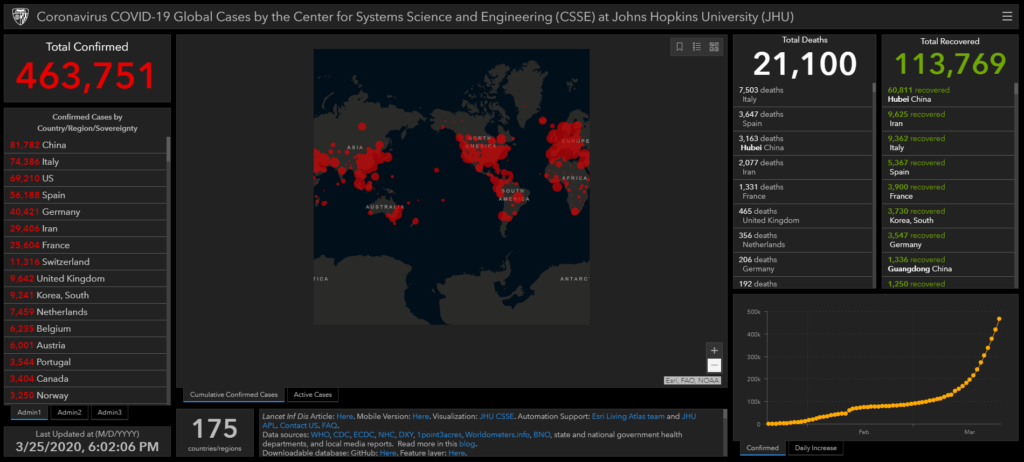
636: Number of confirmed cases in the state of North Carolina
12,910: Number of coronavirus tests conducted in the state
2: Number of deaths related to the coronavirus in North Carolina
17: Cases in Forsyth County; zero deaths
Winston-Salem will go into “stay at home” order beginning at 5 p.m. Friday. A full list of essential businesses, along with the full stay-at-home order can be found here. Mayor Allen Joines has ordered all residents to stay at home because of “a significant and increasing number of suspected cases of community transmission and likely further significant increases in transmission” of COVID-19. The stay-at-home order will last until April 16, or until modified.
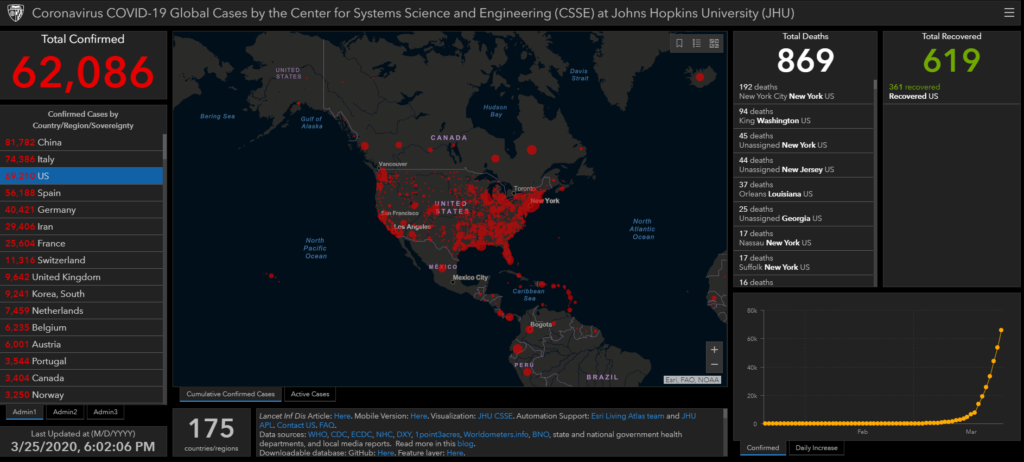
The US death toll is actually a little higher than reflected here (which is current only to last night.
Over the past 24 hours, the U.S. reported 14,024 new cases of coronavirus and 265 new deaths, raising the total to 68,347 cases and 1,037 dead.
This is the highest number of new cases reported by a single country in one day since the coronavirus pandemic began.
Anyone who thinks we’re going to be over this in a couple more weeks is insane.
After a week of Congress members and the Trump administration proposing various plans to get cash into the hands of Americans to help them weather the coronavirus crisis, the Senate has unanimously passed a plan.
The “phase three” coronavirus bill, includes, as of now, cash measures totaling $290 billion per the Center for a Responsible Federal Budget.
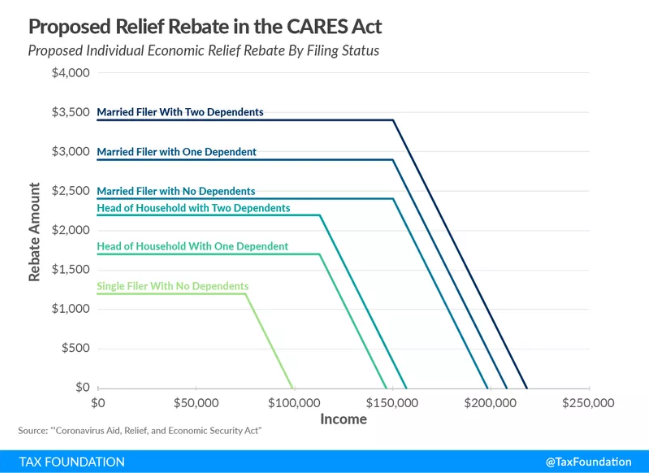
The plan’s provisions are very simple. Adults would get $1,200 each and children $500 each. At higher incomes, the checks would get smaller: The benefit would start decreasing at a rate of $5 for every additional $100 in income. The phaseout starts at $75,000 in adjusted gross income for singles, $112,500 for heads of household, and $150,000 for married couples filing jointly; it would phase out entirely by $99,000 for singles and $198,000 for couples (with no children).
For example, a single childless person with an AGI of $85,000 would get $700 because $500 of the benefit was phased out by their higher income.
Unlike some early Senate Republican proposals, there is no minimum income (which would’ve excluded very poor people), and the check amounts don’t “phase in,” so the middle class doesn’t get more than the poor.
Here is how that policy looks in graph form:
Other factors of the relief:
A $500 billion loan program for businesses: The biggest sticking point between Democrats and Republicans throughout the negotiations was $500 billion in emergency loans both for large businesses and municipalities grappling with the coronavirus outbreak. For instance, $50 billion of that money was allotted to passenger airlines, according to the Washington Post.
Rather than trying to negotiate that figure down, Democrats instead negotiated to have strings attached to it. Instead of giving the Trump administration broad discretion to make the loans, Schumer and Pelosi said there will likely be a new inspector general in the Treasury Department specifically to oversee these funds, as well as a congressional oversight panel to examine how the money is being used. Schumer’s office also announced they secured a provision that will “prohibit businesses controlled by the President, Vice President, Members of Congress, and heads of Executive Departments from receiving loans or investments from Treasury programs.” The children, spouses or in-laws of lawmakers and executive officials also cannot receive these loans.
Some additional conditions, championed by progressives and supported by the public, including a requirement for companies to implement a $15 minimum wage, have not made it into the final legislation.
“Unemployment insurance on steroids”: Schumer announced Monday afternoon that unemployment insurance will be expanded to grapple with a new surge in claims, calling it “unemployment insurance on steroids.” The new bill will increase unemployment insurance by $600 per week for four months. This money is in addition to what states pay as a base unemployment salary. This benefit would extend to gig economy workers, freelancers, and furloughed workers who are still getting health insurance from their employers, but are not receiving a paycheck.
Expanded funds for hospitals, medical equipment, and health care worker protections: The bill contains $150 billion to boost the health care system, according to Schumer. Of that money, $100 billion will go to hospitals, $1 billion will go to the Indian Health Service, and the remainder will be used to increase medical equipment capacity.
Increased aid to state and local governments: Schumer also said about $150 billion of federal money would be allocated for state and local governments who are dealing with the impacts of the crisis in their local communities, including $8 billion for tribal governments.
Direct payments to adults below a certain income threshold: The legislation includes a one-time $1,200 check that would be sent to most adults making $75,000 or less annually, according to past tax returns. A $500 payment would also be sent to cover every child in qualifying households. The final policy marks a significant change from the direct payments initially proposed by Republicans, which would have given less to many individuals who do not have taxable income. It now includes the majority of adults who are under the $75,000 threshold and phases the payment out as people’s incomes increase.
Loans to small businesses: There is $367 billion in the bill aimed at providing loans for small businesses, according to the Washington Post.
The US Department of Labor registered nearly 3.3 million initial unemployment insurance claims last week, according to data newly reported this morning.
That shatters the previous record, which was about 700,000 in seasonally adjusted terms, or a million in raw terms, way back in 1982. Just a few days ago, a Goldman Sachs analysis predicting 2.25 million initial claims was seen as an alarming forecast. The real figure was much higher — pretty much literally off the charts.

Here’s the NC graph:
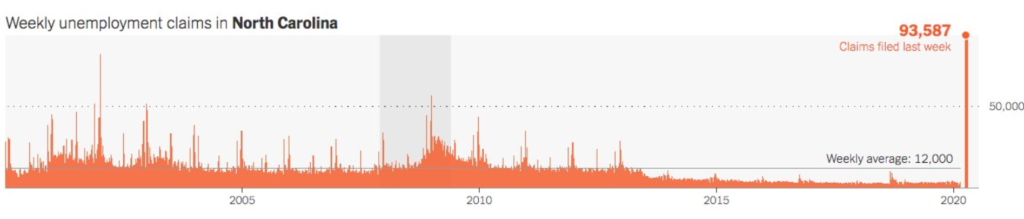
And the news, to be clear, is in many ways even worse than that sounds. This is data released on the morning of March 26, but it covers the period that ended on March 21. Total or partial shutdowns of non-essential business activity have spread considerably since five days ago, so we should expect next week’s report to feature further devastation. And that’s to say nothing of the secondary consequences of people losing jobs and incomes to Covid-19 and thus being forced to curtail spending.
The medical news grows grimmer everyday, especially at the front lines.
The NY Times and CNN’s Brynn Gingras both delivered reports on Elmhurst Hospital Center in Queens, which has transferred non-coronavirus patients to other facilities in order to become one of the city’s main crisis centers. Medical officials have spoken of an “apocalyptic” scene inside the hospital, describing how they’re forced to work with increasingly strained resources as patients are dying while in wait at the emergency room.
“We’re busting at the seams essentially. Every bed is basically filled,” Gingras said, quoting a hospital worker. “The hospital is already having to take measures transferring patients to other hospitals because they can’t keep up with the demand. They’re having to bring in more doctors and nurses, more equipment daily just to keep up with this demand. It’s not sustainable, quite frankly, is what we’re hearing.”
Between treating patients and dealing with crowds of people who are sick or looking to be tested, reports also highlighted how refrigerated trucks have been brought in to serve as makeshift morgues for the bodies of deceased patients. CNN’s report also alluded to how the situation is compelling medical professionals to have new conversations to decide on who they can try to save.
“The fact that we’re having this conversation about people’s [do not resuscitate] decisions is staggering,” said Dr. Jeanne Marrazzo. “If it’s not a wake-up call to people, I don’t know what else can be.”
Trump is still hoping to have the economy roaring back by Easter. But at yeseterday’s briefing (after Trump left the stage), coronavirus task force member Dr. Anthony Fauci warned that the coronavirus “very well might” become a seasonal cycle. “It will be inevitable that we need to be prepared that we will get a cycle around,” Fauci said. Fauci is the director of the National Institute of Allergy and Infectious Diseases.
Fauci explained that the possibility of the coronavirus coming back in “cycles” means that “it emphasizes the need to do what we are doing,” referring to the administration’s efforts in developing a vaccine as quickly as possible so that it will be available “for that next cycle.”
On CNN he told Chris Cuomo: “You’ve got to be realistic and you’ve got to understand that you don’t make the timeline. The virus makes the timeline.”
Other bits:
Trump on delaying the Olympics: "It's probably the first time maybe ever or certainly in a long time that it was on an odd year. It's always on an even year, they tell me."
— Kyle Griffin (@kylegriffin1) March 25, 2020
NBC and CNN producers say they’re through airing Trump’s virus pressers. “We might take it from the top and then cut away after the first lie, and return when the lies stop.”
Here is the playbook which Trump ignored:
Breaking News From CNN
The US will designate Venezuela as a state sponsor of terrorism and charge President Maduro, sources say, a move that enables more crippling sanctions https://t.co/dd03O2f1V5 pic.twitter.com/C9IxwWb4aK
— CNN Breaking News (@cnnbrk) March 26, 2020
Breaking News From CNN
Joe Arpaio, who was pardoned by Trump over two years ago, says he has officially filed election papers in a bid to win back his former position as sheriff of Maricopa County in Arizona https://t.co/8OjmT5c6c8 pic.twitter.com/yNVtLHSat0
— CNN Breaking News (@cnnbrk) March 26, 2020
COVID-19: Cake Or Death?
World as of 10 am:

Spain’s coronavirus death toll overtook that of China on Wednesday, rising to 3,434 after 738 people died over the past 24 hours, the government said. The spiraling number of deaths came as Spain entered the 11th day of an unprecedented lockdown to try and rein in the COVID-19 epidemic that has now infected 47,610 people.
Prince Charles has been tested ppositive.
Playwright Terrence McNally died from COVID-19 yesterday.
The 2020 Summer Olympics in Tokyo were postponed to 2021.

Here’s how to read the charts above: Let’s use France as an example. For them, Day 0 was March 5, when they surpassed one death per 10 million by recording their sixth death. They are currently at Day 19; total deaths are at 184x their initial level; and they have recorded a total of 16.4 deaths per million so far. As the chart shows, this is slightly below where Italy was on their Day 19.
US as of 10 am:

This morning, we crossed 800 deaths in the U.S. Other milestones:
— Charles Ornstein (@charlesornstein) March 25, 2020
100 deaths: March 17
200 deaths: March 20
300 deaths: Saturday
400 deaths: Sunday
500 deaths: Monday
600 deaths: Tuesday
700 deaths: Tuesday
(h/t to @ryanstruyk for compiling early numbers.)
Obviously, the US is in a dire situtation with NYC being the epicenter.
New Orleans is also looking especially bad, which makes the decision to have Mardi Gras seem a little stupid in retrospect.
The United States keeps reacting too late to the coronavirus, prolonging its economic pain and multiplying its toll on Americans’ health.
Why it matters: The spread and impact of the coronavirus may be unfathomable, but it’s not unpredictable. And yet the U.S. has failed to respond accordingly over and over again.
First, it happened with testing — a delay that allowed the virus to spread undetected.
- Then we were caught flat-footed by the surge in demand for medical supplies in emerging hotspots.
- And the Trump administration declined to issue a national shelter-in-place order. The resulting patchwork across the country left enough economic hubs closed to crash the economy, but enough places up and running to allow the virus to continue to spread rampantly.
Between the lines: Proactive containment and mitigation steps would have required extraordinary political and economic capital, especially if they had come early in the process, when many Americans didn’t grasp the full weight of this challenge.
- But making decisions based on today’s information — without an understanding of how much worse tomorrow will be — is also politically and economically risky, and carries the extra cost of more deaths.
What they’re saying: A senior Health and Human Services official told me that if they could do it all over again, they would have engaged the private sector to ramp up medical manufacturing in mid-January — about two months earlier than ended up happening.
- “By waiting to fully appreciate and acknowledge this as a once-in-a-lifetime crisis, this was a colossal missed opportunity,” the official said.
- Now, even as testing and hospital capacity remain limited, President Trump is eager for an economic recovery — even though, by all estimates, the outbreak is only going to get worse.
- Removing social distancing measures is “a catastrophically bad idea. The human cost would be devastating, and the economic toll from that devastation might be even steeper than what we’re seeing right now,” Indiana University’s Aaron Caroll and Harvard’s Ashish Jha wrote earlier this week in The Atlantic.
Case in point: The Trump administration squashed rumors more than a week ago that it was considering a national shelter-in-place policy. But it might have done some good at that point.
- “The economic impact is severe in scope, but limited in duration,” Raymond James wrote in a research note dated March 15.
- But just a week later, the firm published a new note: “The government has likely missed its window … The failure to establish a nationwide lockdown and instead allow individual states to make those decisions is likely going to result in the spread continuing.”
The bottom line: When I asked the HHS official how all of this keeps happening, the official said it’s at least partially due to disconnects — between Trump and his administration; between the government and the private sector, and between the U.S. and the rest of the world.
- “At the end of the day, the virus has slipped through all those cracks that exist between all of these entities,” the official said.
The big issue remains… MEDICAL SUPPLIES.
A mad scramble for masks, gowns and ventilators is pitting states against each other and driving up prices. Some hard-hit parts of the country are receiving fresh supplies of N95 masks, but others are still out of stock. Hospitals are requesting donations of masks and gloves from construction companies, nail salons and tattoo parlors, and considering using ventilators designed for large animals because they cannot find the kind made for people.
The market for medical supplies has descended into chaos, according to state officials and health-care leaders. They are begging the federal government to use a wartime law to bring order and ensure the United States has the gear it needs to battle the coronavirus. So far, the Trump administration has declined.
“I can’t find any more equipment. It’s not a question of money,” said New York Gov. Andrew M. Cuomo, whose state is battling the nation’s worst outbreak. “We need the federal help and we need the federal help now.”
At best, Cuomo said, his team has secured enough protective gear for health workers to last a few weeks. It’s been unable to buy most of the 30,000 ventilators it estimates it will need to keep hospitalized patients breathing at the peak of the crisis, he said.
His pleas are echoed by others, including the American Medical Association, Illinois Gov. JB Pritzker and Democratic presidential candidates Sen. Bernie Sanders (I-Vt.) and Joe Biden, who have called on the Trump administration to use the Defense Production Act to order companies to mass produce medical supplies. The law, enacted during the Korean War, allows the government to require companies to manufacture certain goods and to pay them for it.
Although governors and hospital leaders welcome the many U.S. companies stepping forward to make masks and ventilators, they fear the voluntary efforts will be too scattershot without federal coordination.
“When we went to war, we didn’t say, any company out there want to build a battleship? Who wants to build a battleship?” Cuomo said.
President Trump and his trade adviser, Peter Navarro, have repeatedly said they don’t need to force companies to produce under the Defense Production Act because so many manufacturers are volunteering to make medical supplies. Trump seemed to acknowledge the chaos on Tuesday, however, calling the world market for masks and ventilators “crazy” in a tweet, adding that it was “not easy” to acquire them.
But he also tweeted that he hasn’t had to use the Defense Production Act “because no one has said NO! Millions of masks coming as back up to States.” In a briefing Tuesday evening, Trump added: “Companies are heeding our call to produce medical equipment and supplies because they know that we will not hesitate to invoke the DPA in order to get them to do what they have to do. It’s called leverage.”
Early Tuesday, Peter Gaynor, the head of the Federal Emergency Management Agency, told CNN the government planned to use the DPA to acquire 60,000 coronavirus test kits. But later, FEMA Press Secretary Lizzie Litzow said the agency “at the last minute” had been “able to procure the test kits from the private market without evoking the DPA.”
In the meantime, states and hospitals are describing extraordinary efforts to secure equipment. In a briefing this week, Pritzker said he had a team of people working the phones seven days a week trying to buy medical supplies all over the globe. He asked nail salons, tattoo parlors and elective surgery centers to donate their stockpiles of masks and gloves while they are closed for business.
Pritzker said his team has made progress, including a big purchase of 2.5 million N95 masks, the government-certified masks that can screen out small particles and that are favored by health-care workers dealing with the virus. But he said his team is “running up against obstacles that shouldn’t exist,” including orders by other states and the federal government.
Senators and the Trump administration officials reached an agreement early today on a sweeping, roughly $2 trillion stimulus measure to send direct payments and jobless benefits to individuals as well as money to states and businesses devastated by the coronavirus pandemic.
The legislation, which is expected to be enacted within days, is the biggest fiscal stimulus package in modern American history, aimed at delivering critical financial support to businesses forced to shut their doors and relief to American families and hospitals.
Struck after midnight, the deal was the product of a marathon set of negotiations among Senate Republicans, Democrats and President Trump’s team that nearly fell apart as Democrats insisted on stronger worker protections and oversight over a new $500 billion fund to bail out distressed businesses.
The deal was completed after a furious final round of haggling between Steven Mnuchin, the Treasury secretary, and Senator Chuck Schumer, Democrat of New York and the minority leader, after Democrats twice blocked action on the measure as they insisted on concessions.
The sheer size and scope of the package would have been unthinkable only a couple of weeks ago. Administration officials said they hoped that its effect on a battered economy would be exponentially greater than its $2 trillion cost, generating as much as $4 trillion in economic activity.
Businesses controlled by President Trump and his children would be prohibited from receiving loans or investments from Treasury Department programs included in a $2 trillion stimulus plan agreed to early Wednesday by White House and Senate leaders in response to the coronavirus crisis.
The provision, which was touted by Senate Minority Leader Charles E. Schumer (D-N.Y.) in an early-morning letter to colleagues, would also apply to Vice President Pence, members of Congress and heads of federal departments, as well as their children, spouses and in-laws.
During a television interview Wednesday morning, Schumer stressed that the provision applies not only to Trump but to “any major figure in government.”
“That makes sense. Those of us who write the law shouldn’t benefit from the law,” Schumer said on CNN.
This bipartisan deal is a raw deal for the people. It does far too little for those who need the most help, while providing hundreds of billions in corporate welfare, massively growing government, inhibiting economic adaptation, and widening the gap between the rich and the poor.
— Justin Amash (@justinamash) March 25, 2020
But the confidence of closing the deal led the markets to huge gains. The Dow burst 11.4% higher, while the more closely followed S&P 500 index leaped 9.4% as a wave of buying around the world interrupted what has been a brutal month of nearly nonstop selling. It was the biggest one day gain since 1933.
What else? Well, on a broader note, everyone is talking about Dan Patrick’s on-air death plea.
Patrick, the lieutenant governor of Texas, touched off an outpouring of anger when he declared to Tucker Carlson that people like him — grandparents in their twilight years — should risk death so people can stop social distancing to avert economic calamity.
Why has this touched such a chord on social media?
I submit it’s because it captures something essential about President Trump, his response to coronavirus, and the vision of our responsibilities to one another underlying it — or, more accurately, the lack of any such vision.
President Donald Trump seems determined to end social distancing efforts by Easter (April 12), reiterating his plan at Tuesday’s press briefing to relax his administration’s guidelines in the next few weeks — even as experts continue to warn that efforts against the coronavirus could require months.
Trump: There is tremendous hope as “we begin to see the light at the end of the tunnel”
— Kathryn Watson (@kathrynw5) March 24, 2020
Johns Hopkins data: pic.twitter.com/XSMhE5yXED
Patrick, a Republican, noted that it’s time to “get back to work,” adding that seniors such as him should be willing to be “sacrificed” if necessary, so our children don’t “lose our whole country” to an “economic collapse”:
No one reached out to me and said, “As a senior citizen, are you willing to take a chance on your survival in exchange for keeping the America that all America loves for your children and grandchildren?” And if that’s the exchange, I’m all in.
This is driving all the attention. But a crucial aspect of Patrick’s plea continues to elude us: He was offering his best argument in defense of Trump’s evolving position on what his government, and our society, should do in response to coronavirus.
Right now, Trump is actively considering relaxing federal recommendations on social distancing. As Trump put it, “we cannot let the cure be worse than the problem itself.”
Health experts are screaming warnings. As Tom Inglesbe, the director of Johns Hopkins Center for Health Security, powerfully argues, the failure to test has dramatically undercounted the true numbers of those infected. This, plus a looming exponential surge in cases, almost certainly means that, if we don’t continue major social distancing, our health system will soon be overwhelmed.
Indeed, the World Health Organization is now warning that a major acceleration could turn the United States into the next coronavirus global epicenter.
But Trump plainly wants to ward off the coming economic downturn — no matter the cost — because he fears for his reelection. As the New York Times reports:Mr. Trump has watched as a record economic expansion and booming stock market that served as the basis of his re-election campaign evaporated in a matter of weeks. The president became engaged with the discussion on Sunday evening, after watching television reports and hearing from various business officials and outside advisers who were agitating for an end to the shutdown.
Indeed, as Matt Gertz documents, Trump may have adopted the idea that “the cure is worse than the disease” almost verbatim from a segment on Fox News, which has pushed this line relentlessly.
Patrick’s plea to Carlson was inspired by Trump himself. As Patrick noted, his “heart is lifted” by Trump’s suggestion that it might be time to go back to work.
“We’ve got a choice here,” Patrick said. “We’re going to be in a total collapse in our society if this goes on another several months. There won’t be any jobs to come back to.”
“As the president said, the mortality rate is so low,” Patrick concluded. “Do we have to shut down the country?”
Trump has not said the elderly should be prepared to sacrifice their lives, as Patrick did. But Trump’s framing of the broader choice at hand is very much like Patrick’s: We must get back to work, because he sees the risks posed to our economy by social distancing as more intolerable than the risks of relaxing it.
But the virus is the underlying cause of the threat to the economy. Indeed, it’s worse than this: As Will Wilkinson argues, the current Trump/Patrick line is that we should risk millions more dying, even though we’d only be guessing that relaxing social distancing would help the economy, when in fact the mounting deaths would take their own economic toll.
But, in a way, the very indeterminate nature of this guesswork — by Patrick and Trump alike — is what captures an essential truth about Trump’s handling of this whole disaster.
What Trump is really proposing here — and what Patrick is justifying — is a further washing-of-hands of responsibility for this whole affair.
We don’t have to choose between unbearably high mass death totals and an economic collapse that dooms the American experiment. The government can send people money in sufficient sums and fortify the welfare state to save them from personal economic calamity, while bailing out small and large businesses with tight conditions that sagely protect taxpayers and working people.
As it happens, Trump and both parties appear close to a deal doing this. But Democrats had to drag Trump toward conditions on bailouts, and drag Republicans toward spending enough on protecting individuals.
Those things might not stave off a recession. But they will mitigate the effects, and surely the result will be worth living through to avert countless additional deaths. We could do more to mitigate those effects, if Trump and Republicans (and to a lesser extent, Democrats) were willing.
The federal government could have done this while also offering a robust response to the crisis from the outset that itself would have minimized deaths. But Trump didn’t do this, because he feared taking the novel coronavirus seriously would rattle the markets and imperil his reelection.
Indeed, Trump’s failure to take the coronavirus seriously continues right now: He still won’t use the federal government in the manner he should to get private companies to supply equipment. It’s in that context that we should view Trump’s directive for people to get back to work.
That directive becomes exponentially more irresponsible and dangerous, because Trump is advocating a course of action that will result in many more cases while also refusing to do everything possible to marshal the needed supplies for dealing with that coming tidal wave.
Patrick is telling us we should simply accept horrifying levels of sickness and death, on the indeterminate claim that it will somehow mitigate economic pain that we could mitigate through determined government action, if only the leadership were there to do so.
Trump would not put it quite this way. But this, at bottom, is what he’s asking us to accept. And we don’t have to.
Still, this has led the far-right’s most zealous Trump supporters have set their sights on Dr. Anthony Fauci.
To the vast majority of Republicans, the entire medical community and the country at large, Fauci is the government’s leading infectious disease expert, respected for providing Americans with consistent, factual information about the coronavirus pandemic — even if it means contradicting President Donald Trump while he hovers feet away.
But to a vocal minority of ring-wing blogs and pro-Trump pundits, Fauci is the embodiment of the establishment forces that have been arrayed against the president since he came to Washington. And those voices are getting louder amid rumblings about Fauci’s standing with Trump as the president itches to get the economy restarted in the coming weeks.
“A Deep-State Hillary Clinton-loving stooge,” read a Saturday headline on the American Thinker, a far-right website, latching on to a WikiLeaks-released email that showed Fauci praising Clinton for her Benghazi testimony as secretary of State.
“Guy was a Hillary mole,” pro-Trump podcaster Bill Mitchell tweeted on Monday.
“Disrespectful,” read a Monday headline on the right-wing Gateway Pundit, comparing Fauci to ousted general Stanley McChrystal.
The narrative has even started to migrate to Fox News, a key source of information for the president.
“He’ll still have a job at the end of this, whatever happens,” Fox News host Steve Hilton argued during his Sunday night monologue on “The Next Revolution.” “Our ruling class and their TV mouthpieces whipping up fear over this virus, they can afford an indefinite shutdown.”
Fauci’s portrayal in conservative media circles could play a crucial role in the coming days as the country comes to the end of a 15-day period of social distancing and business closures intended to slow the coronavirus outbreak. While public health officials like Fauci have cautioned that the country will likely have to extend that period, Trump and his team are signaling that they want to get people back to work soon, by mid-April if possible. The cues from right-wing media, as split as they are, could influence how much Trump listens to Fauci.
“He obviously has the backing of the president right now, but a lot of people on the right in the grass roots are extremely skeptical of this entire coronavirus thing,’” said Lee Stranahan, the host of “Fault Lines” on Sputnik Radio, a Russian government-backed media outlet. The coronavirus has killed hundreds in the United States and almost 20,000 worldwide, according to researchers and government officials, overwhelming hospitals and straining global medical supplies. Cases and deaths are expected to keep rising in the coming days.
For the moment, Fauci — director of the National Institute Of Allergy and Infectious Diseases since 1984 — still has the respect of large swathes of Trump’s supporters, reflecting the unique fissures that have emerged in the MAGA movement during the coronavirus. Trump supporters who praise Fauci also tend to believe the president should employ swift, severe measures — and keep the economy shuttered — as long as necessary to keep coronavirus under control.
In past, non-pandemic times, the right would have likely unified in rallying against a government official publicly quibbling with the president. But this time, reliable Trump boosters like Breitbart and the majority of the Fox News stable are leaving him alone.
“I think he’s obviously excellent at his job, and I think he’s aware that he’s on that stage to offer detail and help finesse language, and he seems cool with it,” said Raheem Kassam, the former editor of Breitbart London and host of the podcast “War Room.”
Fauci’s criticism of palace intrigue reporting on his relationship with Trump has endeared even more to this crowd.
“Mainstream media and several journalists, especially as it pertains to the White House press corps, are purposely trying to get Fauci to contradict Trump for a juicy conflict in the middle of a pandemic,” said Stephen Miller, a conservative media columnist who contributes to The Spectator USA, the American division of the long-time conservative British outlet.
The New York Times published an article Monday suggesting the president was losing patience with Fauci’s willingness to oppose him in public and in interviews, even as the NIAID director has gone out of his way to praise Trump to more conservative outlets.
Miller noted Fauci had implicitly rebuked reporters for asking questions that Fauci said were “pitting one against the other,” calling it “just not helpful” in the middle of the pandemic.
Fauci, Miller said, “doesn’t appear to want to take the bait.”
Instead, it’s the right-wing fringe that has been going after Fauci, largely due to the fact that he tamps down Trump’s excitement over quick-fix solutions, such as the antimalarial drug hydroxychloroquine, his desire for stringent restrictions on gatherings and his publicly dire predictions about the potential death toll that are at odds with Trump’s more optimistic outlook.
These figures have been latched on to Fauci for weeks, even if their comments weren’t initially gaining much traction.
“The guy has been around for 50 years yet never thought to prepare for something like this?” griped John Cardillo, a pundit for the Trump-friendly Newsmax, in a March 13 tweet. “Every time he speaks he makes things worse. Maybe he is the problem, not the solution.”
“I think a lot of people at this point are looking for an explanation for the very confusing, unprecedented events going on in the world,” said Stranahan, who vehemently opposed attacking Fauci.
Trump on Tuesday tried to quell any rumors of dissatisfaction with Fauci, who was noticeably absent at Monday’s White House coronavirus briefing and a Tuesday afternoon virtual town hall on Fox News.
But then Fauci was there again, at the president’s side, Tuesday night during the latest coronavirus briefing. And Trump praised Fauci early in the day, calling his performance as “very good,” and even appearing to make light on Twitter of a much-shared meme showing Fauci facepalm as the president jokingly used the term “deep State Department.”
Regardless, Trump does have a history of sidelining administration officials who disagree with him, from former White House counsel Don McGahn to ex-Secretary of State Rex Tillerson.
In this case, however, much of the conservative world, including many Trump supporters, would prefer to keep Fauci in his role.
“What I would say to the president is that we’re all in this thing together and people have come to recognize Fauci alongside Trump as a solid team up there, so why change it?” Kassam argued.
That won’t stop the hardcore MAGA fanbase from going after Fauci. Hours before Trump praised Fauci on Tuesday, Mitchell, the Trump-friendly podcaster, tweeted a fresh Fauci-bashing article from the far-right site Big League Politics.
“Dr. Fauci Wants America to Become a Police State Like China in Order to Stop Coronavirus.”
Other developments of the day:

u can not in good conscience report on trump bragging about how many tests the US is doing today without including the clip of him saying he did not want the cruise ship to dock because he liked the numbers being where they are
— darth™ (@darth) March 25, 2020
Whom do you trust for #coronavirus info:
— Ali Velshi (@AliVelshi) March 25, 2020
Dems:
CDC 87%
Your governor 75%
National media 72%
Friends/family 72%
Religious leaders 44%
Trump 14%
Republicans:
Trump 90%
CDC 84%
Friends/family 81%
Religious leaders 71%
You governor 65%
National media 13%
-CBS/YouGov
About 65 people attended a disco themed birthday party at @realdonaldtrump’s birthday party March 8. Nobody looked sick. But coronavirus was in the room. Now 17 guests are ill.https://t.co/Ja3sLKX3Sx
— David Fahrenthold (@Fahrenthold) March 25, 2020
The Federalist (@FDRLST) is advocating “chicken-pox parties for the ‘wuhan virus'”–where people voluntarily infect themselves with Covid. Another “cost/benefit” article asks: Is America ‘Better Off’ Letting People Die? It’s a cult. pic.twitter.com/1rkmWrKfZB
— Darinstrauss (@Darinstrauss) March 25, 2020
Part of my research is about the ways in which political ideology shapes how people process data.
— Don Moynihan (@donmoyn) March 24, 2020
This, where Coulter presents data that show the exact opposite of what she claims, is the most amazing thing I’ve ever seen. https://t.co/i9mfUjyiF1
Breaking News From CNN
Trump says he wants the US “opened up and just raring to go by Easter,” a date few experts believe will be sufficient to contains coronavirus' spread https://t.co/iNXSFqmg5T pic.twitter.com/SrvJxOKxiZ
— CNN Breaking News (@cnnbrk) March 24, 2020
COVID-19: The Second Week
World as of 8:25 am:

US as of 8:25 am:
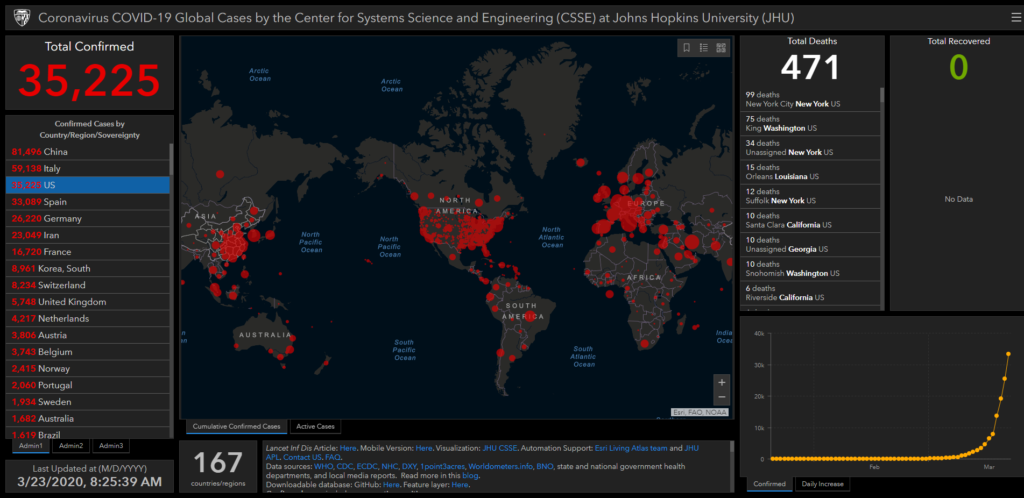
Sadly, the numbers now suggest the U.S. is poised to take the lead in #coronavirus cases. It’s reasonable to plan for the US to top the list of countries with the most cases in approximately 1 week. This does NOT make social intervention futile. It makes it imperative!
— Thomas P. Bossert (@TomBossert) March 23, 2020
Locally:
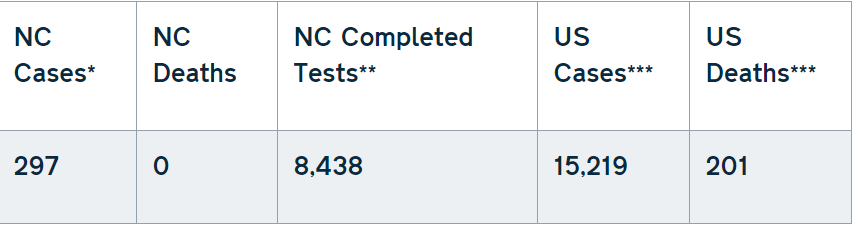
County numbers, according to county health departments:
- Alamance County has three positive coronavirus cases
- Davie County has one positive coronavirus case
- Davidson County has two positive coronavirus cases
- Forsyth County has 12 positive coronavirus cases
- Two are identified as community-spread
- Guilford County has 11 positive coronavirus cases
- Montgomery County has one positive coronavirus case
- Randolph County has one positive coronavirus case
Stay safe out there! “Hands… washing hands..” 🎶 pic.twitter.com/QaRB1qZshp
— Neil Diamond (@NeilDiamond) March 22, 2020
Trump announced that he is activating the National Guard in California, New York and Washington state in an effort to combat the coronavirus outbreak during a briefing at the White House Sunday evening.
A vote to advance the massive coronavirus stimulus bill failed last night in the Senate as negotiations had yet to produce a deal on the more than $1 trillion aid package. A second vote has now been scheduled for Monday shortly after 12:00 p.m. ET.
Republicans, who needed 60 votes to move forward on the bill, weren’t able to win over any Democrats to proceed, meaning no aid will flow to the economy — including checks to individuals, help for small businesses and bailouts for big corporations — until an agreement is reached.
Democrats said that they were dissatisfied with worker protections in the bill, which was written by Republicans, and that the rules on corporate bailouts are too lax.
It is remarkably difficult to get precise details about the coronavirus rescue bill that’s currently stalled in the Senate. But here are the main pieces:
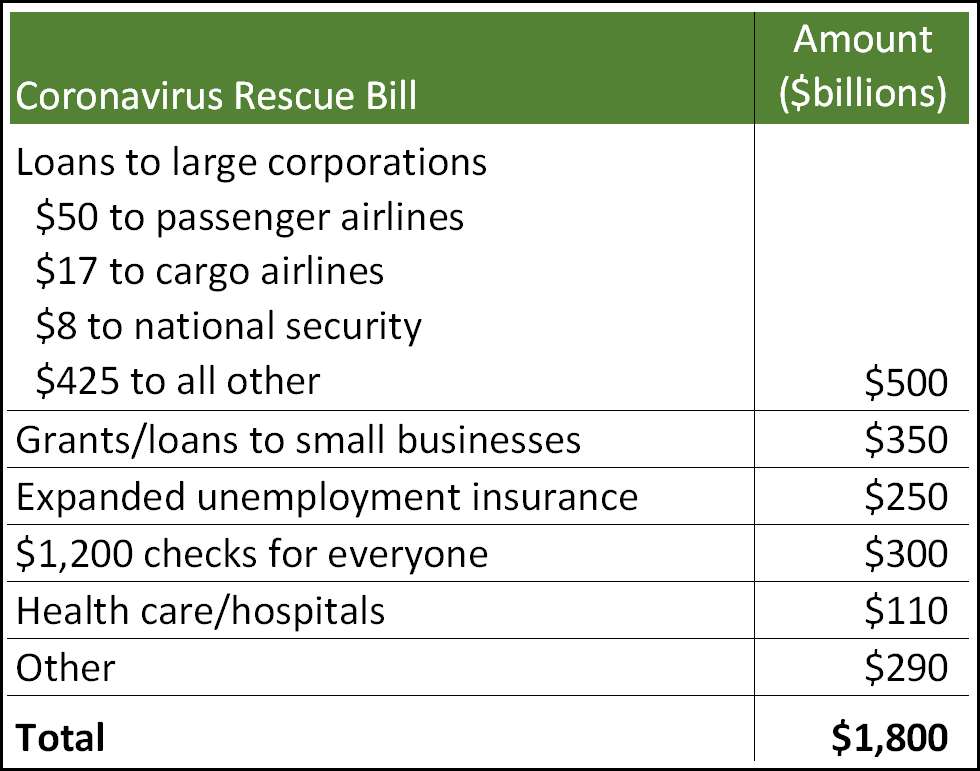
The negotiations over this bill have been almost a parody of modern American political polarization. Republicans cared only about the loans to businesses and the flashy $1,200 checks for all Americans. Democrats insisted on unemployment insurance replacing 100 percent of income; money for hospitals; and making the $1,200 checks equal for everyone.
Republicans mostly caved in on the Democratic demands, but their price was an increase from $200 billion to $500 billion in the loans for big corporations. You might wonder why there was a price for this. Why did Republicans have to be talked into it in the first place? There was some muttering about not trusting the states to disburse the money or something, but in the end it was just because they’re Republicans. Putting corporations first is in their DNA or something.
Oh, and the $500 billion loan pool would be under the control of the Secretary of the Treasury and would have virtually no strings attached. It’s just a giant slush fund that the Trump administration can do anything with. Does anyone think for a second that Trump wouldn’t use this as leverage to help his friends and punish his enemies? Of course he would.
This was the straw that broke the camel’s back.
UPDATE — still no bill today:
49-46, Senate again fails to advance the coronavirus package. Democrats block it, like yesterday, complaining that the Senate Republican bill is not good enough yet. Negotiations are continuing.
— Sahil Kapur (@sahilkapur) March 23, 2020
In other news, Trump is reportedly growing irritated that Dr. Anthony Fauci, director of the National Institute of Allergy and Infectious Diseases, keeps publicly correcting his misstatements about the coronavirus pandemic.
Sources tell the New York Times that “Trump has become frustrated with Dr. Fauci’s blunt approach at the briefing lectern, which often contradicts things the president has just said.”
The president has given Fauci more leeway to contradict him than he has with most other officials, however, because he “knows that Dr. Fauci is seen as credible with a large swath of the public and with journalists.”
The Times also reports that Trump’s frustration with Fauci is part of a broader frustration with medical experts in the White House who have pushed for social distancing as a way to contain the disease.
“There has been a growing sentiment that medical experts were allowed to set policy that has hurt the economy, and there has been a push to find ways to let people start returning to work,” the Times reports. “Some Republican lawmakers have also pleaded with the White House to find ways to restart the economy, as financial markets continue to slide and job losses for April could be in the millions.”
WaPo has a story confirming something that has long been implicit (based on Trump’s treatment, for a period, of COVID-19 briefings as classified). The intelligence community was tracking and briefing on the COVID-19 outbreak long before it rose to public attention.
U.S. intelligence agencies were issuing ominous, classified warnings in January and February about the global danger posed by the coronavirus while President Trump and lawmakers played down the threat and failed to take action that might have slowed the spread of the pathogen, according to U.S. officials familiar with spy agency reporting.
***
Intelligence agencies “have been warning on this since January,” said a U.S. official who had access to intelligence reporting that was disseminated to members of Congress and their staffs as well as to officials in the Trump administration, and who, along with others, spoke on the condition of anonymity to describe sensitive information.
***
The warnings from U.S. intelligence agencies increased in volume toward the end of January and into early February, said officials familiar with the reports. By then, a majority of the intelligence reporting included in daily briefing papers and digests from the Office of the Director of National Intelligence and the CIA was about covid-19, said officials who have read the reports.
The money line repeats one the CIA used to describe how George Bush ignored warnings about 9/11: the system was blinking red.
“Donald Trump may not have been expecting this, but a lot of other people in the government were — they just couldn’t get him to do anything about it,” this official said. “The system was blinking red.”
What’s key though (and, because of editing decisions, doesn’t get a lot of focus in the story) is one reason why Trump didn’t heed the warnings of his briefers: because he believed Xi Jingpeng more than he believed the US intelligence community.
The intelligence reports didn’t predict when the virus might land on U.S. shores or recommend particular steps that public health officials should take, issues outside the purview of the intelligence agencies. But they did track the spread of the virus in China, and later in other countries, and warned that Chinese officials appeared to be minimizing the severity of the outbreak.
***
Robert Kadlec, the assistant secretary for preparedness and response — who was joined by intelligence officials, including from the CIA — told committee members that the virus posed a “serious” threat, one of those officials said.
Kadlec didn’t provide specific recommendations, but he said that to get ahead of the virus and blunt its effects, Americans would need to take actions that could disrupt their daily lives, the official said. “It was very alarming.”
Trump’s insistence on the contrary seemed to rest in his relationship with China’s President Xi Jingping, whom Trump believed was providing him with reliable information about how the virus was spreading in China, despite reports from intelligence agencies that Chinese officials were not being candid about the true scale of the crisis.
We all pay for Robert Kadlec to make sure policymakers get warnings about such things. And yet, Trump refused to believe those warnings because someone he trusted more — Xi — told him differently.
Trump has been permitted to believe his authoritarian buddies over the intelligence community on all manner of things. It derives from two things: first, his own innate fondness for authoritarians. But also, his need to believe Vladimir Putin’s assurances that Russia didn’t help him get elected.
The enabling of Trump’s fondness for dictators will end up being very costly for the United States.

Trump’s tweeting today suggests that he doesn’t understand how viruses work:
THIS IS WHY WE NEED BORDERS!
— Donald J. Trump (@realDonaldTrump) March 23, 2020
And he seems to be anxious about the social distancing and isolation:
WE CANNOT LET THE CURE BE WORSE THAN THE PROBLEM ITSELF. AT THE END OF THE 15 DAY PERIOD, WE WILL MAKE A DECISION AS TO WHICH WAY WE WANT TO GO!
— Donald J. Trump (@realDonaldTrump) March 23, 2020
Biden says he’ll do his first “presentation” from his new home TV studio (built in what had been a rec room, he says) today around 11:30 a.m. ET.
As for isolation and self-distancing:
Everyone is coping in their own way.
Some of us need humor, from the dumb and punny to the satirical and dark.
Some of us need all the news and updates and details possible.
Some of us need to limit what we take into our brains.
Some of us need the distraction of normalcy. Just because we’re not posting about the news doesn’t mean we’re ignoring it.
Some of us need to leave the house every day and breathe the air and move our bodies. You may even find us standing in the rain.
Some of us are frozen with fear in our homes.
Some of us can work from home.
Some of us still drive to work every day and spend that day sanitizing everything instead of working as much as usual.
Some of us wish that working from home were an option, so we’d still have income.
Some of us go into creative mode, trying new crafts and finishing old ones and tackling those long-planned home improvement projects.
Some of us sit and read or or watch TV or play on our phones for hours.
Some of us are introverts, but we still need human interaction.
Some of us are extroverts, and the energy depletion from lack of socializing is real.
Some of us are clinging to our online friendships like a lifeline.
Some of us are clinging inward to our own family units.
Everyone copes in their own way. We’re just not used to coping en masse
Economy continues to tank. It is at 18,926 as of 10:05 am, down about 244 for the day, most likely on the belief that the unemployment levels will show an unemployment rate something close to what it was during the Great Depression.
Breaking News From CNN
Health officials in Nigeria have issued a warning over chloroquine after they said three people in the country overdosed on the drug, in the wake of President Trump's comments about using it to treat coronavirus https://t.co/wNqSs9qaea
— CNN Breaking News (@cnnbrk) March 23, 2020
Breaking News From CNN
Health officials in Nigeria have issued a warning over chloroquine after they said three people in the country overdosed on the drug, in the wake of President Trump's comments about using it to treat coronavirus https://t.co/wNqSs9qaea
— CNN Breaking News (@cnnbrk) March 23, 2020
Weekly List 175
This week the United States had the highest spread rate of the coronavirus of countries reporting, starting the week with roughly 2,500 cases, and ending the week fourth in the world with more than 22,000. Countries that had early testing available like South Korea saw their daily adds ebb to below 100, while daily growth in U.S. cases was close to 50%. Despite Trump’s promises last Friday for 1.4 million tests this week, a new Google testing website and drive-thru testing at retailers — none of it happened. Trump continued this week to hold daily press briefings in which he lied, spread disinformation, and attacked the media, while self-aggrandizing — resembling and replacing Trump’s campaign rallies.
The Dow Jones Industrial Average traded down another 17%, the worst week since October 2008, and hitting levels below where the market traded when Trump took office. Goldman Sachs estimated 2.25 million Americans filed for initial unemployment this week — a record — while the Trump regime asked states not to report their data, lest the stock market, 30% off its highs, would trade further down. Several banks said the U.S. economy was already in a recession, and projected the second quarter gross domestic product would fall double digits, some estimating a fall of more than 20%. The Senate reconvened this week, but finalized little as businesses small and large shut down, and the nation came to a standstill.
Amid fear and panic, Trump assured the country all was well and he had matters in control — blaming China for the “Chinese virus,” while blustering we are at war with an “invisible enemy” that he will defeat. Fox News sharply shifted its tone on the virus, but much of the country, which has not been impacted, viewed it as a problem for three blue states. Hospitals around the country — especially New York and California — sounded alarms about lack of masks and other surgical gear, as well as ventilators and ICU beds. Trump shifted his tone from promising states help to telling governors, “We’re not a shipping clerk” — you’re on your own.
- On Saturday, the White House physician announced in an evening statement that Trump tested negative for the coronavirus. The statement did not say if he will be retested.
- On Sunday, an NBC News/WSJ poll conducted last Wednesday through Friday found 99% heard about the coronavirus, and 60% think the worst is yet to come, while 31% say it is not a big problem — split along party lines.
- On Tuesday, a new NPR/PBS NewsHour/Marist poll found 60% of Americans say they had not very much or no trust at all in what Trump is saying, while 37% have a good amount or a great deal of trust.
- Just 40% of Republicans view the coronavirus as a real threat, while 54% believe it is blown out of proportion. For Democrats 76% believe it is, 20% do not, and for Independents 50% believe it is, 41% do not.
- On Tuesday, a Pew Research survey looking back at impeachment found 46% say Trump did something wrong that warranted his removal, 28% say he did but not enough to warrant removal, 25% say he did nothing wrong.
- On Saturday, Spain followed Italy, imposing strict limits and telling citizens to stay inside with few exceptions. In France, cafes and restaurants were ordered to close, along with nonessential businesses.
- On Sunday, Begona Gomez, the wife of Spanish Prime minister Pedro Sanchez, tested positive for the coronavirus. The country had 6,391 infections and 191 deaths, second only to Italy in Europe.
- On Sunday, AFP reported at least five Brazilian officials who traveled with President Jair Bolsonaro on his U.S. visit have tested positive for the coronavirus, including lawyer Karina Kufa, and Senator Nelsinho Trad.
- On Saturday, in the evening, Chicago O’Hare airport had people waiting in packed crowds for hours for enhanced screening as Americans, including students, returned from Europe after Trump’s Oval Office speech edict.
- Both Illinois Gov. J.B. Pritzker and Chicago Mayor Lori Lightfoot sharply criticized the federal government for having hundreds of people crammed together. Large crowds were also seen at Dallas-Fort Worth Airport.
- On Saturday, in the late evening, Mayor Ravi Bhalla of Hoboken, New Jersey imposed strict nightly curfews from 10 p.m. until 5 a.m., and directed all bars and restaurants to allow for delivery and take-out only.
- On Sunday, a former senior health systems analyst returning to the U.S. at Dulles Airport said in an op-ed it was “a case study in how not to handle a pandemic,” saying she spent three hours in a jammed immigration hall.
- On Sunday, WAPO reported with Trump’s fumbled coronavirus response, Americans have had no guidance, and have been left to figure out their own strategy using advice from public experts and other sources.
- Trump’s speeches and news conferences last week did not offer any clear directives. People have turned to neighbors, clergy, and parenting groups to decide whether to cancel events.
- A group of pastors in Arkansas met to decide on Sunday services. One said “half of his church is ready to lick the floor, to prove there’s no actual virus.” They did end up holding services, with some precautions.
- On Sunday, Dr. Anthony Fauci told “Meet the Press” that Americans are “going to have to hunker down significantly more than we as a country are doing” to flatten the curve and fight the outbreak of Covid-19.
- Ask if we should consider a 14 day shutdown like Europe, Fauci said, “I would prefer as much as we possibly could,” adding, “If you let the curve get up there, then the entire society is going to be hit.”
- On Sunday, Norway’s renowned University of Science and Technology issued a warning, telling students to return from “poor developed” countries amid the coronavirus, and singled out the U.S.
- On Sunday, CNBC reported Senate Majority Leader Mitch McConnell has not yet scheduled a vote on the coronavirus relief bill passed in the House late Friday. McConnell said he “will need to carefully review” the bill.
- On Sunday, Oklahoma governor Kevin Stitt, after facing a backlash Saturday for tweeting a photo of himself and his kids at a crowded restaurant and encouraging people to go out, declared a state of emergency.
- On Sunday, defying all health experts, Rep. Devin Nunes told Fox Business, “If you’re healthy, you and your family, it’s a great time to go out and go to a local restaurant…Let’s not hurt the working people in this country.”
- Trump also encouraged people to go out in crowds, quoting a tweet showing an image of a large gathering at the White House, and adding, “This took place in the Rose Garden, just coming out of a cold Winter!”
- Trump also complained about the “Fake News” not covering the ceremony. He also tweeted, “TODAY IS A NATIONAL DAY OF PRAYER. GOD BLESS EVERYONE!”
- Trump also quoted a tweet from Judicial Watch about Hillary Clinton’s emails and Benghazi, and added, “Great Job by Judicial Watch. Potentially a treasure trove. Too bad you are not given more help.”
- Hours later, after criticism for packed crowds at airports, Trump tweeted, “We are doing very precise Medical Screenings at our airports. Pardon the interruptions and delays,” adding, “We must get it right. Safety first!”
- Trump also tweeted his false claim, “The USA was never set up for this, just look at the catastrophe of the H1N1 Swine Flu (Biden in charge..”, adding, “Great decision” to close our border to China, “Saved many lives!”
- Trump also tweeted about a 5 p.m. news conference, and added, “We are working closely with the Governors …which are a very big factor. They are working hard, along with us, to get the job properly done.”
- Notably, in an op-ed, New York Gov. Andrew Cuomo called on Trump to mobilize the military to help by increasing hospital bed capacity, adding, “the time is growing short and fewer options are available.”
- Trump also tweeted, “Can’t believe they are not going after Schumer for the threats he made to our cherished United States Supreme Court,” adding, “If a Republican did that, there would be an endless price to pay.” Notably, Trump did do that.
- Trump also said he was considering a pardon for Michael Flynn, tweeting, “after destroying his life & the life of his wonderful family” the FBI has “lost” Flynn’s records, adding, “I am strongly considering a Full Pardon!”
- On Sunday, Nike announced it would close all its U.S. stores for two weeks. Numerous other retailers joined, including Patagonia, Warby Parker, Urban Outfitters, and more.
- On Sunday, Ohio Gov. Mike DeWine announced the state would close all restaurants and bars starting at 9 p.m. New York City and Los Angeles also announced schools will close as of Monday.
- On Sunday, the governors of Massachusetts and Nevada also announced they would close all K-12 schools starting Monday. By day’s end 33 states had announced schools would close for a varying number of weeks.
- On Sunday, MGM temporarily closed its Las Vegas properties starting Tuesday. On Tuesday, Nevada Gov. Steve Sisolak closed all nonessential businesses, including casinos, for 30 days.
- On Sunday, Treasury Secretary Steven Mnuchin told “This Week” that despite forecasts of a slowdown, he does not think there will be a recession, adding that the market goes up and down.
- When asked about Trump’s error-laden Oval Office speech, Mnuchin said, “I don’t think he got things wrong at all,” adding, “people misinterpreted” Trump’s comment on cargo, which the White House later corrected.
- When asked about the Federal Reserve’s response and Trump’s tweets calling it “pathetic,” Mnuchin said, “I speak to Jay Powell now almost every single day,” so it would not be appropriate for him to comment.
- Later Sunday, the Federal Reserve announced it is dropping its benchmark interest rate to zero, and launched a massive $700 billion quantitative easing program to shelter the economy from the effect of the coronavirus.
- Minutes later, Trump held a White House press conference. He started off saying, “It makes me very happy and I want to congratulate the Federal Reserve,” and “I think that people in the market should be very thrilled.”
- Trump said he spoke to CEOs of grocery store chains, as shelves have been emptied, and said to Americans, “You don’t have to buy so much,” adding, “Take it easy. Relax.” So far there were 3,300 cases and 61 deaths in the U.S.
- Trump also claimed, “Young people, people of good health, and groups of people, just are not strongly affected.” Earlier today, Dr. Fauci said to young people, “You are not immune or safe from getting seriously ill.”
- As Trump spoke and after, the Dow Jones futures fell more than 600 points, at one point down as much as 800 points, triggering the “limit down” trigger to halt trading.
- Shortly after, acting Department of Homeland Secretary Chad Wolf said the regime is considering all options, including a domestic air travel ban — the first time since 9/11 — amid complaints about crowds in airports.
- Later Sunday, the CDC announced new guidelines, saying gatherings of 50 or more people should be postponed or canceled for the next eight weeks in order to curb the spread of the coronavirus.
- On Monday, the International Monetary Fund announced it “stands ready” to use its $1 trillion lending capacity to help countries struggling with the humanitarian and economic impact of the coronavirus.
- On Monday, Ursula von der Leyen, president of the European Commission, said she was proposing a temporary shutdown of all nonessential travel into the bloc for 30 days.
- On Monday, NYT reported amid the coronavirus crisis, the culture fostered by Trump has led to a regime that is plagued by turf wars and infighting. Trump has been racked by indecision and is quick to blame others.
- Trump sees the public health crisis through the lens of the media coverage and the stock market performance. Trump views each crisis as a public relations problems, and views each day as an episode on a television show.
- Trump dismissed repeated warnings to bring in more experts, or to give less power to Jared Kushner. Without a pandemic team on the National Security Council, responsibility fell on Health and Human Services Secretary Alex Azar, a former drug executive.
- Kushner was deeply involved in Trump’s error-ridden Oval Office speech and selling Trump on saying Google had developed a website that did not exist. Trump was reportedly raging by Sunday night over media coverage.
- On Monday, Vanity Fair reported over the weekend, with the markets in free fall and positive tests for people at Mar-a-Lago, Trump finally awoke to the dangers of the outbreak, and the magnitude of what is going on.
- Trump was also concerned that the National Football League might preemptively follow the NBA and NHL and cancel its season. Trump called the NFL owners and begged them not to cancel.
- Reportedly the principal target of Trump’s anger is Kushner, who advised him to treat the emergency as a public relations problem, while others like Fauci were calling for aggressive action.
- On Monday, NYT reported according to a recording obtained, Trump told governors on a Monday morning call that they are on their own, saying, “Respirators, ventilators, all of the equipment — try getting it yourselves.”
- On Monday, major cities including New York, Los Angeles, Chicago, and San Francisco ordered restaurants, bars, and cinemas to close to the public. Restaurants were permitted to do takeout business.
- On Monday, citing “a lack of federal direction,” the governors of New York, New Jersey, and Connecticut closed movie theaters, gyms, and other places of gathering of 50 or more. Restaurants can only do take out or delivery.
- Shortly after, Trump tweeted “had a very good tele-conference” with governors and added, “Cuomo of New York has to “do more”.” Cuomo responded, “No — YOU have to do something! You’re supposed to be the President.”
- On Monday, 33 states closed K-12 schools — an unprecedented number — impacting millions of kids, in a move educators said is likely to have major and long-lasting implications for the country’s K-12 education system.
- On Monday, the federal government directed its 2.1 million employees to work from home, after a week of confusion as some were told to report to work even as public health officials implored people to work from home.
- On Monday, at a press briefing, Trump issued new guidelines, calling for closing schools and avoiding groups of more than 10 people, discretionary travel, bars, restaurants, and food courts for 15 days.
- Trump said, “It seems to me if we do a really good job, we’ll not only hold the death down to a level that’s much lower than the other way had we not done a good job,” adding, “people are talking about July, August.”
- Trump added, “If everyone makes this change or these critical changes and sacrifices now we will rally together as one nation and we will defeat the virus and we’re going to have a big celebration all together.”
- When asked about the Google website, Trump said, “They’re working hand in hand,” and “I think they’re doing really a great job.” Asked to rank his performance during the crisis a rating he said, “I’d rate it a 10.”
- On Monday, WAPO reported on a sharp shift in tone by Fox News personalities, after weeks of downplaying the threat of the coronavirus and casting it as a conspiracy against Trump.
- There was a massive paradigm shift over the weekend. Personalities like Sean Hannity, Laura Ingraham, Jeanine Pirro, and “Fox & Friends” co-hosts suddenly are calling the virus a “crisis” and telling people to stay home.
- On Monday, NYT reported that McConnell and other GOP senators are reaching out to Republican-nominated federal judges who are eligible to retire, and asking them to quit so Republicans can pick their replacement.
- On Monday, the Supreme Court postponed arguments due to the coronavirus. The court was set to hear the case over whether the Manhattan DA and the House can subpoena Trump’s financial records.
- On Monday, the Justice Department dropped charges against two Russian firms, Concord Management and Concord Consulting, that were indicted in the Mueller probe of financing schemes to interfere in the 2016 election.
- The DOJ rationale was that the companies were exploiting the case to gain access to delicate information that Russia could weaponize. The trial was set to start next month. The court granted the motion to dismiss.
- On Monday, in a highly-choreographed display of political theater, Russia’s highest court approved constitutional changes which will allow President Vladimir Putin to stay in power until 2036.
- On Sunday, the Welt am Sonntag German newspaper reported Trump tried to lure a German firm, CureVac, which is developing a coronavirus vaccine, to relocate to the U.S. and produce exclusively for the U.S.
- CureVac’s main investor Dietmar Hopp responded, saying he was not selling and wanted the firm to develop a vaccine to “help people not just regionally but in solidarity across the world.”
- On Monday, WAPO reported a Berlin-based company shipped 1.4 million coronavirus tests to the World Health Organization by the end of February. The WHO shipped 250,000 by Feb 3. Trump declined the offer to take any.
- From mid-January to February 28, the Centers for Disease Control produced 160,000 tests but fewer than 4,000 were used. The government did not reach out to academia or private companies during this time.
- The CDC has not explained the nature of the manufacturing problem. Germany has had just 17 deaths from more than 7,200 case (a 0.23% mortality rate), the U.S. had 85 deaths and over 4,600 cases (1.82%).
- On Monday, Amazon announced it would hire an additional new 100,000 employees in order to meet the demand for shipments. On Tuesday, the company suspended shipments of nonessential items in order to keep up.
- On Monday, the Dow Jones dropped 3,000 points, or 12.9%, despite the rate cut, suffering its worst day since the “Black Monday” market crash in 1987, and its third-worst day ever. The S&P 500 dropped 12%.
- On Tuesday, the Federal Reserve announced another $500 billion operation for overnight repo to help fund the markets. The move comes on top of $1.5 trillion announced last week.
- On Tuesday, New York announced cases had soared to 1,374 with 432 new cases and 19% of cases hospitalized. NY has conducted more than 10,000 tests. Gov. Cuomo said the state will need at least 55,000 hospital beds.
- On Sunday, Georgia became the second state to postpone its presidential primary over the coronavirus. In-person voting that started March 2 will be halted, and the election will be moved to May 19.
- On Sunday, Gov. Cuomo signed an executive order modifying election procedures in New York, suspending the candidate petitioning process and lowering the threshold signatures required by 30%.
- Late Monday, Ohio’s Republican Gov. DeWine ordered the state’s primary polling places to be closed on Tuesday due to the coronavirus, after a judge hours earlier rejected a lawsuit to delay the primary to June.
- Judge Richard Frye had ruled at 6:30 p.m. that delaying the primary 12 hours before voting was scheduled to begin would set a “terrible precedent.” The other three states moved ahead with their primaries.
- On Tuesday, Maryland Gov. Larry Hogan announced the state would postpone its April 28 primary to June 2 over the coronavirus.
- On Tuesday, Trump attacked Cuomo, tweeting, “Cuomo wants ‘all states to be treated the same…Some are being hit hard by the Chinese Virus,” adding, “New York is a very big ‘hotspot’, West Virginia has…zero cases.”
- On Tuesday, an OpenTable analysis of restaurant traffic showed overall traffic down 56% across the U.S., with drops of 77% in New York City, 81% in Boston, 82% in Los Angeles, and 75% in Chicago.
- Late Tuesday, New York City Mayor Bill de Blasio said the number of confirmed cases in the city rose to 923 from 644 this morning. There have been 10 deaths in NYC.
- On Tuesday, seven million living in the San Francisco Bay area were ordered to shelter in place, the most ambitious measure taken yet to stop the spread of the coronavirus. Silicon Valley alone has had 200 cases.
- On Tuesday, the death toll from the coronavirus passed 100, with more than 5,600 confirmed cases of in all 50 states, West Virginia being the last. About half the deaths were in Washington linked to the nursing home.
- On Tuesday, Ohio Department of Job and Family Services received 45,000 unemployment claims this week, up from 6,500 last week. New Jersey, Rhode Island, and Connecticut also reported a surge in claims.
- On Tuesday, at a White House press briefing, Trump reversed course and claimed, “This is a pandemic. I felt it was a pandemic long before it was called a pandemic.” This is false. For two months Trump said the opposite.
- A more somber Trump also said, “We’re starting the process … We hope it’s not going to be necessary, but it could be necessary,” and, “The state is working on it very hard themselves,” hours after attacking Cuomo.
- Trump said of Fauci, he has “become a major television star.” Fauci had successfully been able to maintain credibility and inform the public without contradicting Trump. He did not appear Wednesday or Thursday.
- Treasury Department Secretary Mnuchin said the regime was “looking at sending checks to Americans immediately,” and that the stock market will remain open, but that hours may be shortened.
- On Tuesday, Mnuchin pitched a $850 billion stimulus package to the Senate Republicans at a private lunch. In Week 173, Trump asked Congress for $2.5 billion and then accepted $8.5 billion in aid.
- Mnuchin warned senators that without a dramatic government intervention, unemployment could rise to 20%. Mnuchin also said Trump had asked for deferment of tax payments of up to $1 million for 90 days.
- At the press briefing earlier, Trump said, “We want to go big,” saying he had instructed Mnuchin to introduce measures that would provide immediate funds to Americans, not just a payroll tax.
- On Tuesday, Secretary of State Mike Pompeo held a press conference. He referred to the coronavirus as the “Wuhan Virus” six times.
- On Monday, Trump limited the number of Chinese staffers who work for five state-controlled Chinese news organizations who can work in the U.S. to 100, as tensions escalated between Washington and Beijing.
- On Tuesday, in response to Trump limiting the Chinese news organization staffers, the Chinese government announced it would expel American journalists working for NYT, WSJ, and WAPO.
- China’s Ministry of Foreign Affairs also demanded those outlets, along with Voice of America and Time magazine, provide the Chinese government with detailed information about their operations.
- On Tuesday, Reuters reported UK Prime Minister Boris Johnson unveiled much more stringent measures after a study by Imperial College, and led by Professor Neil Ferguson, an expert on the spread of infectious diseases.
- The study’s findings included that if no action is taken against the virus, it would caused 510,000 deaths in Britain and 2.2 million in the U.S. The epidemic was expected to be broader in the U.S. and peak later.
- On Tuesday, Kansas Gov. Laura Kelly ordered all K-12 schools in the state closed for the rest of the school year, the first state to do so. Kelly also ordered executive branch employees to stay home for two weeks.
- On Tuesday, after winning the Democratic primaries in Florida and Illinois decisively, Joe Biden addressed the country on live stream — a first. He later won Arizona as well. Ohio did not hold its primary.
- On Tuesday, NYT reported Trump is finally starting to enlist government agencies like FEMA and the Army Corps of Engineers to help with the coronavirus. As of Monday, the agencies said they had no directions.
- The movement came after an internal report by DHS which found the “pandemic will last 18 months or longer” and will likely cause “significant shortages for government, private sector, and individual U.S. consumers.”
- On Tuesday, NYT reported the U.S. lags behind other countries in testing: through March 12, the U.S. had tested just 25,000 specimens, while Italy tested 134,000 and South Korea tested 274,00.
- The U.S. has tested just 125 people per million, the lowest of any developed country, including the U.K. (roughly 600), Australia (roughly 1,800), Italy (roughly 2,200), and South Korea (roughly 5,300).
- On Tuesday, WBUR reported Massachusetts hospitals are running short on supplies, and are asking for donations for items like safety goggles and other protective gear used in places like chemistry labs or woodshops.
- On Wednesday, the number of worldwide coronavirus cases surpassed 200,000, more than doubling in two weeks. The virus has spread to most countries, and killed more than 8,000. China peaked at 81,000.
- On Wednesday, Reuters reported according to a European Union document, Russian media has deployed a “significant disinformation campaign” against the West to generate panic and sow distrust.
- On Wednesday, Reuters reported National Security Advisor Robert O’Brien will travel to attend Russia’s May 9 Victory Day. In Week 173, Russia state-media reported Trump canceled his scheduled trip for this event.
- On Wednesday, Dow Jones reported the Treasury is proposing two rounds of direct payments to citizens, totaling $250 billion, starting April 6. The market halted during the day, hitting circuit breakers.
- On Wednesday, Trump tweeted, “I always treated the Chinese Virus very seriously, and have done a very good job from the beginning, including my very early decision to close the “borders” from China.”
- Trump also predicted Bernie Sanders would drop out, tweeting, “The DNC will have gotten their fondest wish and defeated Bernie Sander,” adding, “Bernie has given up, just like he did last time…MAGA/KAG”
- Trump also falsely claimed, “95% Approval Rating in the Republican Party, 53% overall” — no such polling numbers exist. He added, “according to the Daily Caller, leading Sleepy Joe Biden in Florida, 48% to 42%.”
- Trump also complained he gets “nothing but Fake & Corrupt News, day and night: “Russia, Russia, Russia”, then “the Ukraine Scam (where’s the Whistleblower?)”, the “Impeachment Hoax”, and more, more, more.”
- Trump also tweeted “by mutual consent” the U.S. temporarily closed it border with Canada “to non-essential traffic,” adding, “Trade will not be affected.” Canada had already closed its border to most foreigners.
- On Wednesday, CNBC reported that Big Three automotive manufacturers General Motors, Ford, and Fiat Chrysler plan to close all their U.S. factories due to the coronavirus.
- On Wednesday, the price of oil fell 24% to an 18-year low, as the coronavirus sapped global demand for crude with rising fears of a global recession.
- On Wednesday, famous hedge fund manager Bill Ackman urged Trump to shut the country down for 30 days to stop the spread of the coronavirus, saying, “America will end as we know it,” and “hell is coming.”
- On Wednesday, Trump invoked the Defense Production Act, a law that authorizes presidents to force American industry to ramp up production of equipment needed for national security, saying, “just in case we need it.”
- The law could force factories to produce needed medical supplies, such as ventilators, respirators, and protective gear for health care workers. Trump also moved to send military hospital ships to the West Coast and New York.
- Trump said the Federal Emergency Management Agency was activated at the highest level, and that he directed the Department of Housing and Urban Development to place a temporary moratorium on evictions.
- Trump also said the regime will use legal authority granted to the surgeon general to deport migrants who cross the southwest border illegally without giving them due process, starting “probably today.”
- Trump said he viewed himself as a “wartime president,” adding, “I mean, that’s what we’re fighting. I mean, it’s a very tough situation here,” and saying prior to the coronavirus it was “the best economy we’ve ever had.”
- Trump continued throughout the briefing to refer to the coronavirus as “the Chinese virus.” He brushing aside criticisms that the term was racist, or could fuel bias attacks against Asian-Americans. “It’s not racist at all.”
- When asked if it was “wrong” for a White House official to say “Kung-Flu” to CBS reporter Weijia Jiang on Tuesday, Trump said he believes Asian-Americans agree “100 percent” with him using the term “Chinese Virus.”
- Asked why it took so long on ventilators when we have known for weeks, Trump said, “Well we knew — it depends, it depends on how it goes, worst case, absolutely, best case, not at all,” and “these are complex machines.”
- Dr. Deborah Birx called on millennials to avoid large crowds of people, saying data from Europe showed the group has a “disproportional number of infections” compared with older people who are at greater health risk.
- On Wednesday, the U.S. Navy Hospital ships were set to deploy to New York and California. NPR reported the USNS Comfort could take weeks to prepare for assignment in New York.
- On Wednesday, the Dow dropped 1,338 points or 6.3% to 19,899 — below the level when Trump took office. Stocks came off their lows when the Senate finally passed the coronavirus relief package.
- On Wednesday, the New York Stock Exchange said it would close its historic trading floor starting March 23 and move fully to electronic trading, after two people tested positive at the screening it set up this week.
- The Chicago Mercantile Exchange closed its trading floor as of last Friday as a precaution over the coronavirus outbreak, the first major exchange to do so.
- On Wednesday, the U.S. Census Bureau suspended its field operations for two weeks due to the coronavirus outbreak. The bureau is looking to hire 500,000 workers for the 2020 census. So far it has added 31,000 workers.
- On Wednesday, the first two members of Congress tested positive for the coronavirus, Rep. Mario Diaz-Balart, a ninth-term Florida Republican, and Rep. Ben McAdams, a freshman Democrat from Utah.
- The two had voted on the House floor as recently as Saturday. At least five other members of Congress said Wednesday evening that they would self-quarantine, having been exposed to the two members.
- On Wednesday, Reuters reported that although South Korea and the U.S. had their first coronavirus cases at the same time, South Korea took immediate action in late January to approve a diagnostic test and start mass testing.
- Seven weeks in, South Korea had tested 290,000 and identified roughly 8,000 who were quarantined to stop the spread. The U.S. tested 60,000 over that time. On Wednesday, South Korea reported only 93 new cases.
- On Wednesday, the Daily News reported an inmate at Rikers Island had contracted the coronavirus. Mayor De Blasio is considering releasing those who are high risk. Iran released 85,000 prisoners on Tuesday.
- On Wednesday, a CDC report found of the 508 patients known to have been hospitalized, 38% were between the ages of 20 and 54, although the risk of death was significantly higher for older people.
- On Wednesday, more than 100 national security professionals broke from tradition and endorsed Joe Biden for 2020, saying in an online letter that Trump “has created an existential danger to the United States.”
- Signatories included career diplomats, intelligence officers, and defense policymakers from both parties. The letter added, “His reelection would continue this downward spiral and will likely have catastrophic results.”
- On Wednesday, Brazil’s National Security Advisor Augusto Helano said he had tested positive for the coronavirus, the 15th member of President Bolsonaro’s U.S. delegation to do so. All 15 met with Trump and Pence.
- On Wednesday, former Massachusetts Gov. William Weld dropped out of the Republican presidential primary, leaving Trump unopposed. On Thursday, Rep. Tulsi Gabbard dropped out the Democratic primary.
- On Thursday, as the number of cases passed 9,500 and 159 deaths, and the U.S. surpassed both South Korea and France in total cases, just 82,000 Americans had been tested. South Korea was testing 15,000 per day.
- On Thursday, the NYT Editorial Board wrote on “the epic failure of coronavirus testing in America,” noting China and South Korea offer lessons on how to curb the outbreak through testing.
- While the WHO suggested testing to find and isolate, in the U.S. with less testing available, Americans are being told if you feel sick stay home, even those who live with people who are high risk or severely ill.
- The lack of testing is a result of a string of failures at the White House, CDC, and FDA which have “led to intractable delays in making diagnostic tests for coronavirus widely available in the United States.”
- On Thursday, CNN reported that Trump’s promises made last Friday, including a Google get-tested website, drive-thru locations in chain store parking lots, and 1.4 million test kits have not turned out to be true.
- On Thursday, the number of cases in New York jumped from 3,000 on Wednesday to 5,200 as Cuomo said more 7,500 were tested overnight. At least 750 were hospitalized and there were 29 deaths.
- Cuomo exhorted the federal government for help finding protective equipment and ventilators, saying, “Every state is shopping for ventilators,” and the state will require five or six times its current supplies.
- House Speaker Nancy Pelosi also called on Trump in a statement to “immediately use the powers of the Defense Production Act (DPA) to mass produce and coordinate distribution of these critical supplies.”
- On Thursday, Trump again blamed China at the daily news briefing, saying, “We continue our relentless effort to defeat the Chinese virus,” and, “some people would say it’s an act of God. I don’t,” claiming China could have stopped it.
- Trump added, “now the whole world almost is inflicted with this horrible virus.” When asked about China saying it reported no new cases today, Trump said, “I hope it’s true. Who knows? But I hope it’s true, I really do.”
- A close up photo taken of Trump’s notes during the briefing taken by a WAPO photographer showed Trump crossed out the word “corona” and wrote “Chinese” over it with a black sharpie.
- When asked about invoking the DPA immediately, Trump said governors are on their own: “The Federal government is not supposed to be out there buying vast amounts of items,” adding, “we’re not a shipping clerk.”
- Trump took a question from far-right cable news One America News: “do you consider the term ‘Chinese food’ to be racist because it is food that originated from China?” Trump said, “I don’t think that’s racist at all.”
- The OAN reporter then added, “On that note, major left-wing media, even in this room, have teamed up with Chinese communist party narratives, and they are claiming you are racist for making these claims.”
- Trump responded, “It amazes me when I read the things that I read. I don’t think anybody has done as much as I have done in three years,” adding, “This administration has done a great job. But the press is very dishonest.”
- Trump also said to the reporters, “We were very prepared. The only thing we weren’t prepared for was the media,” adding, “We should get rid of about 75 or 80 percent of you. There’s only two or three of you I like.”
- Trump also said, “I’ve directed the FDA to eliminate outdated rules and bureaucracy,” to fast-track possible treatments, including chloroquine, an anti-malaria drug, calling it a potential “game-changer.”
- Trump added, “It has shown very, very encouraging early results, and will be available “almost immediately,” adding, “that is where the FDA has been so great. It’s gone through the approval process. It’s been approved.”
- FDA Commissioner Stephen Hahn, speaking after Trump, said the FDA has not approved chloroquine for Covid-19 use, saying there is not enough evidence of definite efficacy against the virus.
- Shortly after, Trump sent a series of tweets, saying, “I want all Americans to understand: we are at war with an invisible enemy, but that enemy is no match for the spirit and resolve of the American people.”
- Trump added, “Today I spoke with American physicians and nurses to thank them,” saying, they “are at the front lines of this war and are true American HEROES!” and adding, “With their help, America will WIN.”
- On Thursday, Trump released a series of coronavirus PSAs on his Twitter feed, including appearances from First Lady Melania, Surgeon General Jerome Adams, Birx and Fauci, and an opening PSA featuring him.
- In one, the first lady reassuringly smiles, saying, “this is not how we’ll live forever. Our children will return to school, people will return to work, we will gather at the places of worship, concerts, and sporting events again.”
- Shortly after, Trump tweeted, “We are going to WIN, sooner rather than later!”
- On Thursday, WAPO reported in what insiders say is another Trump purge of career officials, Russell Travers, the acting director of the National Counterterrorism Center, was removed on Wednesday.
- Travers’ acting deputy, Peter Hall, was also removed. Travers, who took the acting position last August, had been resistant to pressure to make personnel cuts at the center.
- On Thursday, Trump canceled the G7 Summit of world leaders scheduled to take place at Camp David in June, and said it will take place by teleconference instead.
- On Thursday, the State Department issued a warning to Americans not to travel aboard during the pandemic, and said citizens abroad should return back immediately or make preparations to remain abroad indefinitely.
- The advisory added Americans should “have a travel plan that does not rely on the U.S. government for assistance.” The agency raised its travel advisory for all international travel from 3 to 4, the most serious category.
- Later Thursday, California Gov. Gavin Newsom said in a letter to Trump that he estimates 25.5 million residents, 56% of the state, will get the coronavirus in the next eight weeks.
- Newsom asked Trump to dispatch the USNS Mercy Hospital Ship to a port in Los Angeles through September 1. The state had 971 confirmed cases on Thursday, third behind New York and Washington.
- Newsom also issued a stay-at-home order for all 40 million people in the state. The order allows people to visit family members in need, and for critical businesses like pharmacies, banks, and grocery stores to stay open.
- On Thursday, there were 242,000 cases with 9,800 dead globally. In the U.S. there were more than 13,000 cases and 176 dead as of the early evening. At 5:00 p.m., New York City had 3,615 cases.
- On Thursday, the House Oversight Committee asked the Trump regime for documents on its response to the coronavirus, including how it plans to produce and distribute coronavirus testing kits.
- On Thursday, the Atlanta Journal Constitution reported the entire Georgia state legislature was urged to self-quarantine after Brandon Beach, who voted on the floor Monday, got a positive result from a test taken Saturday.
- On Thursday NPR reported that according to a secret recording they obtained, Senate Intelligence Chair Richard Burr gave a dire warning at a private luncheon on Capitol Hill on February 27, the same day Trump was playing down fears.
- Trump said, “It’s going to disappear. One day, It’s like a miracle. It will disappear,” of the 15 confirmed cases. Burr said, “It is probably more akin to the 1918 pandemic.” The Senate was briefed on February 25.
- On Thursday, ProPublica reported that Burr sold off a significant percentage of his stocks on February 13, around the time his panel got coronavirus briefings.
- Burr sold between $628,000 and $1.72 million of his holdings in 33 transactions, about a week before the stock market fell 30% as news about the spread of the virus became public.
- Shortly after, Daily Beast reported Sen. Kelly Loeffler, the senate’s newest member and part of the Senate Health Committee, sold millions in stock in the days and weeks after the private briefings.
- Loeffler’s first sale jointly owned by her and her husband was on January 24, the day her panel hosted an all-senator briefing. She tweeted that day, “Appreciate today’s briefing from the President’s top health officials.”
- In total, she and her husband made 27 stock sales, and two buys. One purchase was of a technology company that offers teleworking software, and saw a small bump in price due to Americans working from home.
- On Friday, the number of worldwide cases topped 250,000. The World Health Organization noted it took more than three months to reach 100,000 cases worldwide — but only 12 days to log the next 100,000.
- On Friday, a new ABC News/Ipsos poll found 55% of Americans approve of Trump’s handling of the coronavirus, 43% disapprove. Also, 72% said their life had been disrupted in some way. The poll sample size was 512.
- On Friday, American Research Group found 41% approve of Trump’s handling, 55% disapprove. The poll found overall approval at 35%, 62% disapprove, down from 37%/59% in February. The sample was 1,100.
- On Friday, Goldman Sachs predicted next week’s unemployment report will show 2.25 million filed for their initial unemployment benefits this week, eight times higher than last week and the highest on record.
- On Friday, the Trump regime asked states to delay releasing their unemployment claim data for next week, out of the concern of its impact on the markets.
- On Friday, a new Kaiser Family Foundation poll found just 2 in 5 Americans canceled plans last week to attend large gatherings as the pandemic escalated.
- Four in ten Americans planned to travel in the next three months. So far, 51% are planning to still travel, 27% are considering still going, and just 22% have canceled.
- On Friday, Sec. Mnuchin announced on Twitter that the Internal Revenue Service had extended the tax filing date from April 15 to July 15.
- On Friday, Gov. Cuomo ordered non-essential businesses to keep 100% of their workforce at home, saying, “When I talk about the most drastic action we can take, this is the most drastic action we can take,” adding, “We’re all in quarantine now.”
- Cuomo said cases in New York surged by 2,950 overnight to 7,102, as the state did an 10,000 more tests and 32,000 overall, and has tested at a higher per capita rate than South Korea and China. The U.S. has tested 111,000.
- On Friday, at his daily press briefing, Trump said, “Once this enemy is defeated, our economy will bounce back quickly!” — a phrase that was then tweeted by his 2020 campaign’s social media accounts.
- Trump continued his xenophobic attacks, saying, “Every week, our border agents encounter thousands of unscreened, unvetted, and unauthorized entries from dozens of countries,” adding now he is doing something.
- Acting DHS director Wolf said the regime would limit nonessential travel between the U.S. and Mexico. Unlike a similar move with Canada, Wolf said the move would block migrants from entering. Mexico has 200 coronavirus cases.
- Trump said he invoked the Defense Production Act “to the highest level of activist,” adding, “if you take a look at what we did, the level of activation has been increased to a grade one level, which is the highest level.”
- Pompeo spoke and said the regime will not offer Iran sanction relief, after Iran’s health ministry tweeted one person dies from coronavirus every 10 minutes. He also said Russia, China, and Iran are spreading disinformation.
- When Pompeo was done speaking, Trump mused he could now return to the “Deep State Department.” Fauci, who returned to a daily briefing for the first time in three days, could be seen covering his face with his palm.
- When Fauci was asked if chloroquine is a ‘game changer’ as Trump said, while standing next to Trump, Fauci responded, “the answer is no” because “the evidence…is anecdotal evidence.”
- Fauci added, “It was not done in a controlled clinical trial. So you really can’t make any definitive statement about it.” Trump chimed in, repeating it is a “game changer,” and adding, “We have millions of units ordered.”
- Former White House press secretary Sean Spicer attended the briefing as a reporter for Newsmax. Trump called on Spicer, saying, “Yeah please, in the back?” Spicer gave Trump a softball question on helping small businesses.
- NBC News reporter Peter Alexander got into a heated exchange with Trump, asking if he was giving Americans “false hope” by promoting unproven drugs. He said thousands are infected and millions are scared.
- Alexander followed up, “What do you say to Americans who are scared?” Trump snapped, “I say that you are a terrible reporter. That’s what I say,” calling it a “nasty question,” and saying, “You’re doing sensationalism.”
- Trump continued, assailing the media, saying, “And the same with NBC and Comcast. I don’t call it Comcast. I call it ‘Con-Cast,’” adding, “Let me just tell you something. That’s really bad reporting.”
- When a CNN reporter asked if we should come together, and if it was appropriate to attack Alexander, Trump said he is “not a good journalist” and “coming together is much harder when we have dishonest journalists.”
- On Friday, the Dow Jones tumbled 913 points, or 4%, after being up 400 during the day. The Dow dropped 17% for the week, the biggest drop since October 2008.
- On Friday, Connecticut and Illinois joined California and New York in telling all nonessential workers to stay at home. By later in the day, there were more than 18,000 cases and at least 242 people in the U.S. had died.
- On Friday, the Metropolitan Transportation Authority in New York City announced it would make all local buses free during the pandemic, in order to keep drivers and riders a safe distance apart.
- On Friday, the LA Times reported the Los Angeles County Department of Public Health advised doctors to only administer a coronavirus test on patients if a positive result could change how they would be treated.
- The lack of available testing will drastically reduce the chances of isolating people who have been exposed, and thereby containing the outbreak. California had reported just over 1,100 cases by Friday.
- Later Friday, New York City also moved to curtail testing, days after the mayor said the city would test 5,000 per day. An advisory said, “Outpatient testing must not be encouraged, promoted or advertised.”
- On Friday, WSJ reported on shortages in New York City hospitals: doctors wearing the same masks for as long as a week, emergency-room physicians reusing gowns, and a dwindling supply of ventilators.
- State officials say the peak is a month and half away. A doctor in the largest New York hospital system said, “We’re getting pounded,” adding, “I’ve been in ICU care for 15 years, and this is the worst I have ever seen things.”
- On Friday, Dr. Patrice Harris, the president of the American Medical Association, the largest association of physicians, called the shortages of protective gear for health care workers “unacceptable.”
- The AMA joined the American Hospital Association and American Nursing Association in asking Congress for $100 billion in financial assistance, saying with the patient influx, some hospitals are losing $1 million a day.
- On Thursday, NYT reported Trump’s DHS ran a series of exercises from last January to August, code-named “Crimson Contagion” and simulating an influenza pandemic. A report was issued in October 2019.
- The report, which said “not to be disclosed,” found the federal government was underfunded and underprepared, and agencies uncoordinated for a life-or-death battle with a virus for which no treatment existed.
- Congress was also briefed on some of the findings in December, including the inability to quickly replenish certain medical supplies, much of which was purchased from overseas. No action was taken in Congress.
- On February 10, three weeks after the first U.S. coronavirus case, Trump submitted a 2021 budget calling for a 9% or $693.3 million decrease in CDC funding, along with a small increase for combating global pandemics.
- On Friday, WAPO reported U.S. intelligence agencies issued ominous, classified warnings in January and February to Trump and lawmakers, tracking the spread of the coronavirus in China and other countries.
- Despite the constant flow of reporting, Trump continued publicly and privately to play down the threat of the virus to Americans. Lawmakers did not grapple with the threat of virus until this month.
- By the end of January and early February, a majority of intelligence daily briefings from the CIA and office of the Director of National Intelligence were focused on the subject of Covid-19. Notably, Sen. Burr sold stock at this time.
- One official said, “Trump may not have been expecting this, but a lot of other people in the government were — they just couldn’t get him to do anything about it,” adding, “The system was blinking red.”
- On Saturday, in the morning, there were more than 275,000 cases globally and at least 11,400 deaths. The U.S. had 19,624 cases in the morning and 260 had died.
- On Saturday, Trump tweeted, “HYDROXYCHLOROQUINE & AZITHROMYCIN, taken together, have a real chance to be one of the biggest game changers.” This statement is false.
- Trump added, “The FDA has moved mountains — Thank You! Hopefully they will BOTH” will “be put in use IMMEDIATELY. PEOPLE ARE DYING, MOVE FAST, and GOD BLESS EVERYONE!”
- On Saturday, Gov. Cuomo said at his daily press briefing there were more than 10,300 cases in New York. Cuomo said Westchester County, the site of an early cluster and containment zone, showed a peak off in its spread at 1,300 cases.
- Of the positive cases so far, 55% are between the ages of 18 and 49. Cuomo said New York has been declared a “major disaster,” which will free up Federal Emergency Management Agency funds to help recovery efforts.
- On Saturday, WAPO’s media columnist wrote the media needs to stop broadcasting Trump’s daily press briefings live, saying the briefings have served as a substitute for his campaign rallies, and have been full of lies.
- Journalistic experts advised instead for reporters to attend the briefing and write down what Trump says, then verify Trump’s information to check for lies and misinformation before blasting it to the public.
- On Saturday, Trump held a daily press briefing. Trump continued to call the coronavirus an “invisible enemy,” and thanked the American people for their efforts, saying, “It’s a time of shared national sacrifice.”
- Trump also said “the history books” will never forget the American people’s response, adding, “We’re going to be celebrating a great victory in the not-too-distant future.”
- On lack of masks, Trump blamed previous administrations for having “done very little,” and said his regime is getting “tremendous reviews from many people who can’t believe how fast (masks) are coming.”
- Trump also accused healthcare professionals of “throwing away” masks, and claimed they should be sanitizing and reusing them, saying, “We have very good liquids for doing this.”
- Trump reversed himself from Friday’s briefing, saying he has not invoked the Defense Production Act, which he said he has signed but would only invoke in worst case scenarios.
- Trump said he was tested again, saying, “I just took one.” Pence said that he and the second lady also got tested after a member of his staff tested positive, although he added he was not in direct contact with that person.
- Fauci said on Trump’s tweet on possible drug treatments, “The president is talking about hope for people and it is not an unreasonable thing…You don’t have anything that is proven.”
- On Saturday, Congress continued negotiating a coronavirus rescue package. The amount grew from $1 trillion to possibly as large as $2 trillion to aid the American people and distressed industries.
- As the week came to close, there were more than 300,000 cases worldwide and nearly 13,000 deaths. The U.S. passed Germany and Iran to have the fourth most cases in the world, at more than 22,000 cases and 278 dead.
COVID-19: Day 5

As of 12:30 pm: US cases are 14,322 (with 210 deaths). That’s quite a leap over yesterday’s 9,000 or so, but we are testing more.
NC has 123 cases, zero deaths. Five cases in my county.
Dow is down 200 points. Again, seems to be veering from huge changes.
The biggest development — GOP scandal:
Senator Richard M. Burr sold hundreds of thousands of dollars’ worth of stock in major companies last month, as President Trump and others in his party were still playing down the threat presented by the coronavirus outbreak and before the stock market’s precipitous plunge.
The stocks were sold in mid-February, days after Mr. Burr, Republican of North Carolina and the chairman of the Intelligence Committee, wrote an opinion article for Fox News suggesting that the United States was “better prepared than ever before” to confront the virus. At least three other senators sold major stock holdings around the same time, disclosure records show.
Really, just a really bad lie. https://t.co/JJ6yPHP1ga
— Markos Moulitsas (@markos) March 20, 2020
However, if Burr’s actions were bad enough to have even Republicans—and even Fox News hosts—calling on him to resign, Loeffler’s may be worse. As The Daily Beast reports, the Senate’s newest member didn’t even wait a day before translating what she heard in that private January 24 briefing into a series of transactions. Starting with a sale on that day, Loeffler and her husband made 29 transactions over the next two weeks, selling off millions of stock in industries across the board.
Loeffler is claiming that these were all managed transactions, that the fact that they drew millions from a market that was still moving upward at the time was coincidence, and that none of it had anything to do with her private, insider knowledge that the CDC director and National Institute of Allergy and Infectious Diseases director Anthony Fauci provided in an all-senators briefing.
That might be easier to believe except for the fact that of those 29 transactions, two were actually purchases. One of those two was a sizable investment in Citrix, a company that specializes in providing online meetings and other tools for remote workers. In other words, one of the few stocks that seems like a good purchase in the face of a threat that was about to send huge parts of the nation into lockdown. Exactly the kind of transaction that someone who was trading on insider information unavailable to the public might make.
Exactly the kind of transaction that might come if someone violated the law against senators using their insider information to boost their own wealth, even as most people in the nation were about to see 401Ks and life savings evaporate.
And Trump gives another press conference:
@realDonaldTrump The market, like all women, finds you disgusting. pic.twitter.com/QAOJz04aIZ
— Quinn Cummings (@quinncy) March 20, 2020
Here’s the big exchange which shows Trump can’t take it:
Pres. Trump pressed on chloroquine, a malaria drug he claimed yesterday might be available soon, but which the FDA says needs further study.
— ABC News (@ABC) March 20, 2020
"It may work and it may not work," he said in an exchange that ended with Trump calling a reporter "terrible." https://t.co/lrydsTpOIr pic.twitter.com/6ceLP5VhdK
It’s a softball question, one grooved to allow presidents show empathy. And Trump couldn’t even muster a moment of humanity and compassion for the scared and suffering in this country. What an absolute loser.
— Renee Graham (@reneeygraham) March 20, 2020
Trump dropped in on the FDA to explain how excited he was about the COVID-curing powers of the malaria drug chloroquine. Trump made it known the drug would be available “immediately” and that he was buying many, many doses for Americans.
Naturally, this generated some questions on Friday, including one directed at the National Institute of Health’s Dr. Anthony Fauci, about whether chloroquine could really act as a cure, or even as a “prophylactic” to prevent COVID-19 from taking hold in the first place.
In reply, Fauci made it clear he was very skeptical about the claims being made. “The answer is no,” said Fauci. He explained that all of the so-called proof of chloroquine’s effectiveness against the virus was “anecdotal evidence” and that while the government was going to make the drug available for further testing, those tests needed to be done in a way that provided genuine information on whether the drug was either safe or effective when used in treating COVID-19.
But no sooner had Fauci surrendered the podium than Trump stepped up to declare himself a “fan” of chloroquine. “I have seen things that are impressive. We’ll see.”
Breaking News From CNN
President Trump said interest will be waived temporarily on student loans and federally held student loan payments will be suspended for 60 days https://t.co/fZgn5hA9gt
— CNN Breaking News (@cnnbrk) March 20, 2020
Breaking News From CNN
The Trump administration is limiting non-essential travel between the US and Mexico due to coronavirus. The action is similar to one taken with Canada. https://t.co/OFziEKRu6c pic.twitter.com/pLDVWBtySE
— CNN Breaking News (@cnnbrk) March 20, 2020
COVID-19: Day 4

The US has 9415 cases and 150 deaths (10:00 am) uh, make that 10,755 and 157 deaths (1:30 pm). That is more than 2,700 new cases from yesterday morning. But that doesn’t necessarily reflect a spread in the virus. It is because we are testing more.
NC has 93 cases and no deaths. As of 10:00 am.
As of 10 am today, the Dow is down 250.
The good news is that China reported its first day with no new locally transmitted coronavirus infections, three months after the first case was detected.
Sadly, this thing could come in waves. The federal government is now preparing for a pandemic that could last up to 18 months or longer and “include multiple waves of illness,” a report obtained by CNN shows.
The $1 trillion relief package from the White House proposes payments of $1,000 for adults and $500 for children. Lawmakers urge remote voting for Congress, and doctors and nurses plead for protective gear.
At his daily press briefing yesterday, Trump said he would invoke the Defense Production Act. Later in the day, he insisted he would only reserve it in the future, in case it’s needed:
I only signed the Defense Production Act to combat the Chinese Virus should we need to invoke it in a worst case scenario in the future. Hopefully there will be no need, but we are all in this TOGETHER!
— Donald J. Trump (@realDonaldTrump) March 18, 2020
Trump is describing the need to ramp up production of equipment for a pandemic that is going to flood hospitals within days as a “worst case scenario in the future,” requiring no current action. Does he understand how the timing of this works?
What about getting more respirator masks and hospital beds? The New York Times has an even more harrowing overview of the federal response — or, more accurately, nonresponse. Governors are begging Trump to send more masks for their hospitals, which have desperate shortages. So far they’ve got nothing of value:
Oregon sent a letter to Vice President Mike Pence on March 3 asking for 400,000 N95 masks. For days, it got no response, and only by March 14 received its first shipment, of 36,800 masks. But there was a problem. Most of the equipment they got was well past the expiration date and so “wouldn’t be suitable for surgical settings,” the state said.
New York City also put in a request for more than 2 million masks and only received 76,000; all were expired, said Deanne Criswell, New York City’s emergency management commissioner.
Experts have proposed preparing the Army to set up mobile hospitals to treat overflow patients — something the Army has done before. A spokesperson reported to the Times that the Army has not been given any orders to prepare for such an eventuality:
“The U.S. Army Corps of Engineers is prepared to assist the nation in a time of crisis to the very best of its capabilities, and we are postured to lean forward when an official request is received through the Department of Defense,” Raini W. Brunson, an Army Corps spokeswoman said in a statement. “However, at this time, we have not been assigned a mission.”
They have not been assigned a mission.
What about the Federal Emergency Management Agency, which also has relevant expertise setting up medical facilities during emergencies? “FEMA officials said the Department of Health and Human Services remains in charge of the federal response,” reports the Times, “and it too is waiting for orders from the agency before it moves to ramp up assistance.”
Trump spent weeks publicly downplaying the coronavirus as an overhyped flu, and then treating it as nothing more than a distraction spooking the stock market. Only in recent days has he made a show of acknowledging the virus as a serious health threat. Watching this, we might have clung to the wan hope that his abdication was merely a surface display of incompetence, and that below his level, the government was still functioning. The evidence before us suggests the government actually followed his lead, following the complacent signals he sent — or, at least, has simply floundered for lack of any direction from the top. The closer you look at the inner workings of Trump’s coronavirus response, the worse it gets.
he said there would be a web site. there is no web site.
— Jeff Tiedrich (@itsJeffTiedrich) March 19, 2020
he said there would be ventilators. there are no ventilators.
he said there would be hospital ships. there are no hospital ships.
he said there would be millions of test kits. there are not millions of test kits.
he said th
The Obama-Biden Administration set up the White House National Security Council Directorate for Global Health Security and Biodefense to prepare for future pandemics like COVID-19.
— Joe Biden (Text Join to 30330) (@JoeBiden) March 19, 2020
Donald Trump eliminated it — and now we’re paying the price.
Fox News is still getting raked over the coals, justifiably:
HANNITY, March 9: “This scaring the living hell out of people — I see it, again, as like, let’s bludgeon Trump with this new hoax.”
— Aaron Rupar (@atrupar) March 19, 2020
HANNITY, March 18: “By the way, this program has always taken the coronavirus seriously. We’ve never called the virus a hoax.” pic.twitter.com/yLKpojA7BI
Senator Burr from NC is in hot water. Three weeks ago, he told a private, exclusive audience just how lethal and devastating coronavirus is, but said nothing to the general public.
“There’s one thing I can tell you about this: It is much more aggressive in its transmission than anything we have seen in recent history,” Senator Burr says in the secret audio recording (below) obtained by NPR.
Trump’s press conference this afternoon — just embarrassing:
This is fucking embarrassing, and every last person who helped enable our descent into tin-foil-hat pudding brain land should be remembered and held accountable. https://t.co/6daTUxEEj0
— Karl Bode (@KarlBode) March 19, 2020
“Do you consider the term Chinese food racist?” –@OANN reporter @ChanelRion
— Bad Fox Graphics (@BadFoxGraphics) March 19, 2020
This might be the single dumbest question asked of a U.S. president in the history of WH press briefings.#InsidePolitics pic.twitter.com/aL3Fjs8ptY
Trump doesn’t seem somber and serious anymore. That lasted two days. He seems angry now, personalizing this crisis in substantial ways. Not just the attacks on the press but the clear irritation at the questions about the economic damage and the pace of testing.
— Sam Stein (@samstein) March 19, 2020
He literally has no idea what his job entails. https://t.co/u8LU1UkIVa
— Daniel Summers (@WFKARS) March 19, 2020
Asked why not pull trigger on the Defense Production Act, Trump: “If we find that we need something that we will do that. And you don’t know what we’ve done. You don’t know whether or not we’ve ordered. You don’t know if we’ve invoked it. You don’t know what’s been ordered.”
— Daniel Dale (@ddale8) March 19, 2020
“Everybody hunker down indefinitely” is not a plan that will work. The government had best come up with a practical timeline, and quickly. Otherwise, people will simply begin adjudicating themselves when the risk of the virus outweighs the risk of losing their livelihoods.
— Ben Shapiro (@benshapiro) March 19, 2020
Trump’s incoherent babbling about specific meds like Chloroquine and Remdesivir, with Anthony Fauci again absent, is an obviously doomed effort to impress the public with his supposed medical understanding and thereby reassure people that his administration is on top of this.
— Laurence Tribe (@tribelaw) March 19, 2020
this fucking idiot can’t fucking read
— Jeff Tiedrich (@itsJeffTiedrich) March 19, 2020
11:47: *TRUMP SAYS FDA HAS APPROVED CHLOROQUINE FOR USE IN COVID-19
— Emma Kinery (@EmmaKinery) March 19, 2020
11:48: *TRUMP SAYS STILL COLLECTING EVIDENCE OF CHLOROQUINE EFFICACY
11:48: *TRUMP SAYS CHLOROQUINE RISKS LOW AND ARE WELL-KNOWN
12:12: *FDA SAYS IT HAS NOT APPROVED CHLOROQUINE FOR COVID-19 USE
I’ve come to the stunning realization that in the interest of public health and safety maybe Trump just shouldn’t be leading these press conferences any more.
— Daniel W. Drezner (@dandrezner) March 19, 2020
I’ve come to the stunning realization that in the interest of public health and safety maybe Trump just shouldn’t be leading these press conferences any more.
— Daniel W. Drezner (@dandrezner) March 19, 2020
UPDATE: That OAN reporter….
The OANN reporter was a plant. This was planned. https://t.co/lgb76XKzRP
— Libtard Jesus, sheltering in ALL places (@LibtardJesus1) March 19, 2020
Ah, workplace drama… ever so incomplete without that dash of anonymous passive aggression.
— Chanel Rion OAN (@ChanelRion) March 19, 2020
Welcome to the basement. pic.twitter.com/s7minUhwpa
Close up of President @realDonaldTrump notes is seen where he crossed out "Corona" and replaced it with "Chinese" Virus as he speaks with his coronavirus task force today at the White House. #trump #trumpnotes pic.twitter.com/kVw9yrPPeJ
— Jabin Botsford (@jabinbotsford) March 19, 2020
Turns out she was spreading news based on a guy on Twitter
Chanel Rion previously reported that the #coronavirus was created in a lab in North Carolina, citing a “monitored source” who was just a guy on Twitter @-tagging her on his conspiracy theories. https://t.co/x5FbmNeuWv pic.twitter.com/fQ3BHfUgwr
— Frank Luntz (@FrankLuntz) March 19, 2020
On the plus side, you can see dolphins swimming in Venice:
Dolphins swimming in Venice's canals is the news we all needed to see today 🥺 pic.twitter.com/6x2scm5bXA
— sinead ♡s BTS ⁷ 💜💜💜 (@BANGWOOL_PD) March 18, 2020
So enraging.
— Judd Legum (@JuddLegum) March 19, 2020
Trump fired some of the government's most accomplished experts in pandemic response.
And now his incompetent son-in-law has a seat at the table. https://t.co/5vwxDRMa1X
What’s happening? Is he ok? pic.twitter.com/OqjrPl3t4U
— Janey Godley (@JaneyGodley) March 19, 2020
UPDATE: Dow closes up 188.27 or 1%. A less volatile day.
Italy passes China in terms of overall deaths.

Breaking News From CNN
President Trump has signed into law a coronavirus relief package that includes provisions for free testing and paid emergency leavehttps://t.co/ED7wg7oXyA pic.twitter.com/VGOtjFgGgr
— CNN Breaking News (@cnnbrk) March 19, 2020