COVID-19 Update: Again

Ken AshfordEbola/Zika/COVID-19 Viruses, Trump & AdministrationLeave a Comment

World:

U.S.:

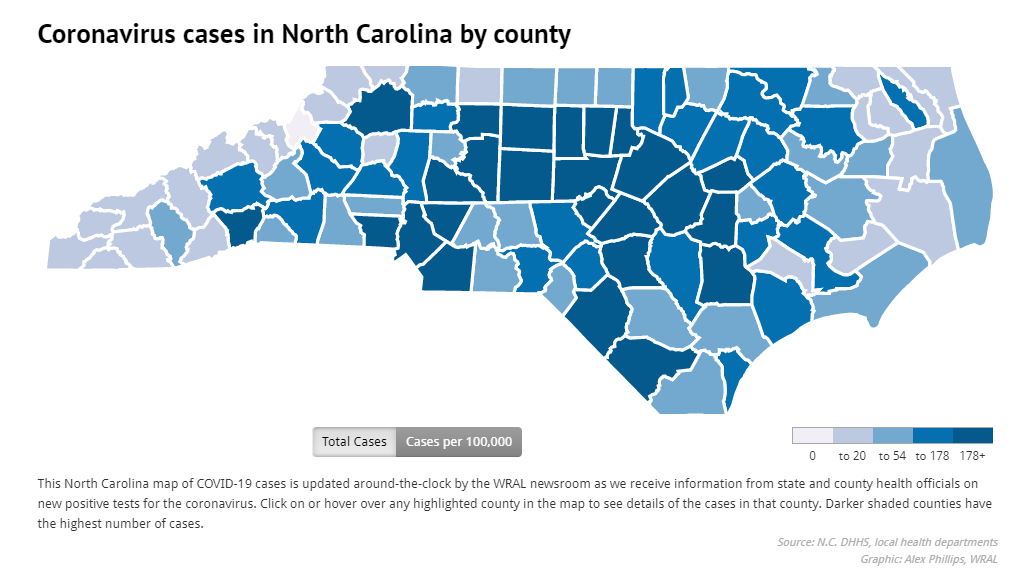
NC and local:
A little fact check on Trump’s little “victory” lap Monday:

It had all the trappings of a “Mission Accomplished” moment: the banner, the presidential pomp, and a message that wasn’t true. 

But what President Donald Trump wanted Monday to be a show of strength over his administration’s coronavirus testing push, complete with a banner touting “AMERICA leads the world in testing,” ended under tough questioning by reporters, causing the president to storm off abruptly. 

When CBS reporter Weijia Jiang asked Trump why it was a competition to the president with those around the globe as the death toll climbs and cases increase, the president used his answer to go on the attack. 

“Well, they’re losing their lives everywhere in the world,” Trump said. “And maybe that’s a question you should ask China. Don’t ask me, ask China that question, OK? When you ask them that question, you may get a very unusual answer.” 

When another female reporter, CNN’s Kaitlan Collins, tried to ask a question, the president got into a brief exchange before ending the event. 

Trump declared Monday that the United States had “prevailed” on testing, saying the nation will “transition into greatness.”

“We have met the moment and we have prevailed,” Trump said. Just two weeks ago, in another press conference, the president said that while his administration had made significant progress in scaling testing, it still had work to do. Monday’s announcement seems to indicate that the president thinks his team did all it needed to on testing in the last 14 days.

On Monday night, the nation’s coronavirus death toll had surpassed 80,000, according to Johns Hopkins University. 

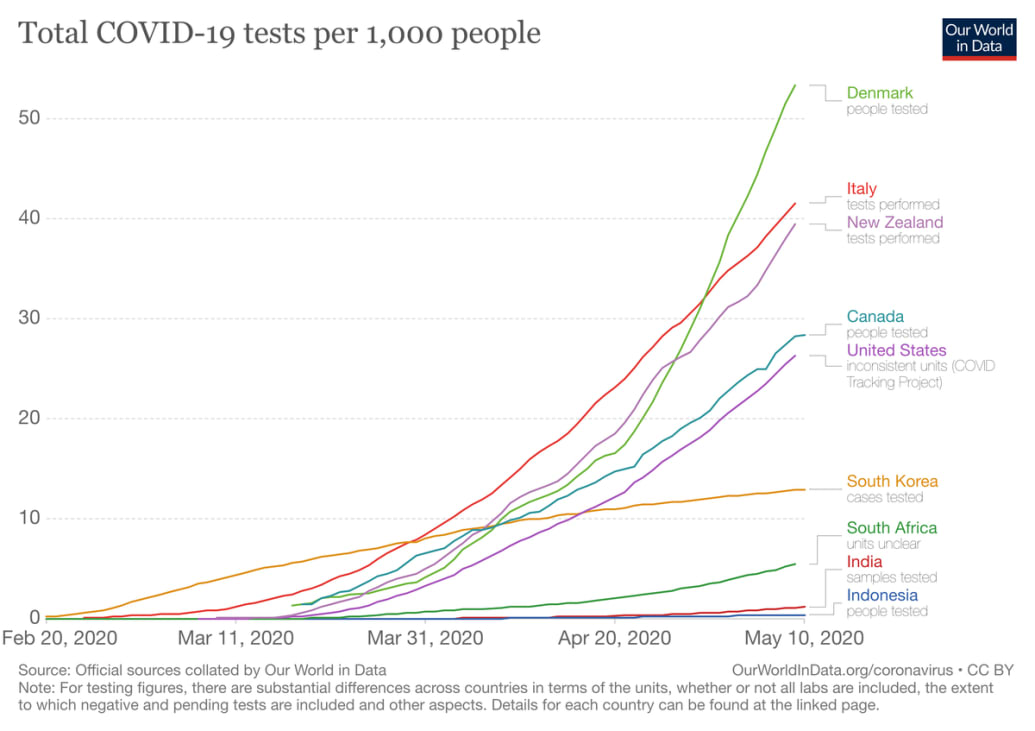
The United States trails countries like Denmark, Italy, and New Zealand for the total number of COVID-19 tests per 1,000 people, according to Our World in Data, as well as the daily number of tests per 1,000 people. While the U.S. is testing a great many people, according to Vox, it is also a large country, with a great many people to test.

In other words, the U.S. is hardly the global testing leader Trump portrayed it to be. 

And the testing number touted by Trump on Monday evening is also behind schedule. In March, Vice President Mike Pence told reporters that by the middle of the month the administration would have shipped 4 million tests. He suggested that the country would, too, test that many people by the end of the month. “Before the end of this week, another 4 million tests will be distributed,” he said. That never happened. 

When pressed by reporters at a press conference last month, Pence said the media was confused—that he meant the administration would facilitate the shipment of those tests and it was up to the states to administer them. It was yet another indication that the administration’s promises on testing fell short of expectations.

Testing for the virus has continued to be a sore spot for Trump during the pandemic, as the public’s ability to actually get tested for the virus has proven to be difficult. 

For the past two months, state and local officials have pleaded with the federal government for assistance on testing, claiming they simply did not have enough tests or supplies to administer them to safely and completely reopen their economies. Trump has deflected criticism, claiming the federal government has gone above and beyond to help states get back on their feet. Trump’s son-in-law, Jared Kushner, earlier this month even called the federal government’s response a “success story.” 

But that rosy picture is a far cry from the reality on the ground in local communities, especially those in hot spot areas. In Jersey City, New Jersey, the mayor and his team fought the state and the federal government for additional testing resources before settling on the idea that they would never have enough tests no matter how much they asked for help. And in other communities officials say that they do not have the staff or supplies to administer the tests they have on hand.

These anecdotes seem to have blowon past officials in the White House, including the president and Kushner, who have spent the majority of the last two weeks publicly praising each other. 

States across the country have continued to reopen, despite concerns from some local officials about the speed of restrictions being eased and testing shortage worries. 

Slides used by officials during the briefing touted the “historic scaling of testing,” along with the administration’s announcement that $11 billion was being sent to the states, via the CARES Act legislation, to be “devoted to testing capability.” 

Trump also struggled to strike a balance at times during Monday’s briefing. 

To one reporter’s question, Trump said, “If somebody wants to be tested right now, they’ll be able to be tested.” 

Minutes later, Trump echoed again that “if people want to get tested, they get tested,” before bragging about the nation’s testing capacity. 

“If people want to get tested, they get tested,” Trump said. “But for the most part, they shouldn’t want to get tested. There’s no reason. They feel good, they don’t have sniffles, they don’t have sore throats. They don’t have any problem.” 

So, he lied. Of course. In fact, he was brittle and testy and he acted like a child, as usual. And demonstrated once again that he simply doesn’t understand this pandemic or the economic challenges and he’s making it worse.

Sometimes it just hits you:

It’s been 111 days since the first reported case of the coronavirus in the United States. It’s been 57 days since President Trump issued social-distancing guidelines, and 12 days since they expired.

Yet the Trump administration still has no plan for dealing with the global pandemic or its fallout. The president has cast doubt on the need for a vaccine or expanded testing. He has no evident plan for contact tracing. He has no treatment ideas beyond the drug remdesivir, since Trump’s marketing campaign for hydroxychloroquine ended in disaster. And, facing the worst economy since the Great Depression, the White House has no plan for that, either, beyond a quixotic hope that consumer demand will snap back as soon as businesses reopen.

Echoing his breezy language in the earliest days of the pandemic, Trump has in recent days returned to a blithe faith that the disease will simply disappear of its own accord, without a major government response.

“I feel about vaccines like I feel about tests: This is going to go away without a vaccine,” Trump said Friday. “It’s going to go away, and we’re not going to see it again, hopefully, after a period of time.”

And because he has a cult following, we now have to be as afraid of many of our fellow Americans as we do of the virus.

But Fauci testified yesterday in the Senate, and expressed his concern that we are opening up the economy too quickly. He reminded everyone of the obvious: if we have more outbreaks, we will see a rise in the death toll AND hurt the economy.

From the AP this morning, we get access to the CDC’s draft recommendation for opening up the economy, which was rejected by the White House.

Hopefully, state governors will grab THIS document and heed it:

There’s other examples of White House meddling with the CDC:

The White House has pressed the CDC, in particular, to work with states to change how they count coronavirus deaths and report them back to the federal government, according to two officials with knowledge of those conversations. And Deborah Birx, the coordinator of the administration’s coronavirus task force, has urged CDC officials to exclude from coronavirus death-count reporting some of those individuals who either do not have confirmed lab results and are presumed positive or who have the virus and may not have died as a direct result of it, according to three senior administration officials. 

Officials inside the CDC, five of whom spoke to The Daily Beast, said they are pushing back against that request, claiming it could falsely skew the mortality rate at a time when state and local governments are already struggling to ensure that every person who dies as a result of the coronavirus is counted. Scientists and doctors working with the task force, including Anthony Fauci, the head of the National Institute of Allergy and Infectious Diseases, have said the U.S. death-toll count is likely higher than is being reflected in government data sets. And several local officials in hot spot areas said they’ve seen hundreds if not thousands more deaths over the last two months than in the same time period over the last several years. They presume many of those individuals contracted the coronavirus. 

Orwellian.

More than 82,000 people in the United States have died of COVID-19 as of Tuesday. How many more lives will be lost? Scientists have built dozens of computational models to answer that question. But the profusion of forecasts poses a challenge: The models use such a wide range of methodologies, formats and time frames that it’s hard to get even a ballpark sense of what the future has in store.

Enter Nicholas Reich, a biostatistician at University of Massachusetts Amherst. Reich and his colleagues have developed a method to compare and ultimately to merge the diverse models of the disease’s progression into one “ensemble” projection. The resulting forecast is sobering. By June 6, it projects, the cumulative death toll in the U.S. will reach 110,000.

Reich’s approach builds on work he has done over the past four years for the Centers for Disease Control and Prevention, pulling together the many forecasts that U.S. experts create annually to predict how that year’s seasonal influenza will play out.

Reich’s team has set up asimilar system to compare coronavirus models. It’s a sort of portal through which the scientists behind each COVID-19 model can communicate key details about their methodology and results so that, as Reich explains, “all of these forecasts can be represented in a single standardized way. And this makes it really easy to make apples-to-apples comparisons between these models.”

The team unveiled the first version four weeks ago and ever since has been adding in more forecasts and updating the projections weekly. The latest update — released Tuesday — incorporates eight models, including some oft-cited ones, such as those built by the Imperial College London, the University of Washington Institute for Health Metrics and Evaluation, Columbia University and Northeastern University. (The team also sends each week’s release to the CDC, which publishes a version with a slight time lag.)

The projections vary substantially — with the most pessimistic forecasting a total death toll of 120,000 by June 6 and the most optimistic forecasting 103,000 deaths by that date. But the models have been inching closer to each other. Over the past several weeks, the distance between the highest and lowest estimates has halved from a gap of 36,000 deaths two weeks ago to a gap of 17,000 deaths in the most recent update released Tuesday.

COVID-19 Update: Oops! White House Becomes Hot Zone While Urging Country To Open Up

Ken AshfordEbola/Zika/COVID-19 Viruses, Election 2020, Trump & AdministrationLeave a Comment

World:

U.S.:

NC and local:

The news of the weekend of course is that yet another White House person has contracted COVID-19. This time it is Pence’s press secrteary, who is also the wife of Trump advisor Stephen Miller.

It’s not a good look when you’re trying to open up the country again so that everything looks good for the 2020 elections. By the way, how are those looking?

According to FiveThirtyEight’s presidential approval tracker, 42.9 percent of Americans approve of the job Trump is doing as president, while 52.4 percent disapprove (a net approval rating of -9.5 points). At this time last week, 43.4 percent approved and 52.6 percent disapproved (for a net approval rating of -9.2 points). One month ago, Trump had an approval rating of 45.8 percent and a disapproval rating of 49.7 percent, for a net approval rating of -3.9 points.

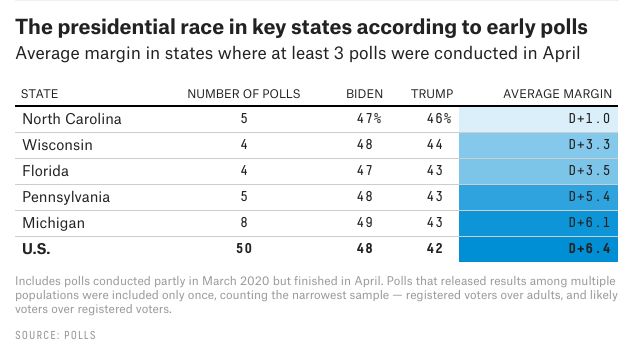
But don’t get too excited. The state by state battleground polls are close:

This data highlights a few things. First, at least at the moment, Florida, Michigan, Pennsylvania and Wisconsin are very close to the national tipping point — so they’re likely to be among the more determinative states this November. Second, the former vice president’s lead nationally is big enough to carry these states. This is important — if Biden wins all of the states Hillary Clinton won in 2016 plus any combination of three of these four, he would be elected president.

But crucially, Biden’s margins in these states are slightly smaller than his advantage in national polls. It’s worth thinking about the race at the state level in these relative terms because there’s still so much time for things to shift. If Biden’s lead nationally narrowed to 2 to 3 percentage points, these states would likely be much closer, if not lean toward Trump. Also, as The New York Times’ Nate Cohn wrote recently, Trump is likely to look stronger when pollsters start limiting their results to “likely voters.” Most of the April surveys in these four states were conducted among registered voters or all adults, two groups that include some people who may not vote in November.4

In other words, this data suggests Trump may have an Electoral College advantage again — he could lose the popular vote and win the election. Of course, this data also suggests that if Biden is winning overall by a margin similar to his advantage now, Trump’s potential Electoral College edge really won’t matter.

And here’s a look at just the states that polled in April. Who knows how meaningful any of that is:

Just remember. If it’s close they’ll steal it in the electoral college. They’ve squeaked through twice in the last 20 years that way . Don’t think for a moment they won’t do it. So, the Democrats and the Biden campaign cannot sleep on any of this.

This New York Times report about the whistleblower complaint by vaccine expert Dr. Bright is just … unbelievable:

The call in early February from the White House Situation Room came as a surprise to Rick Bright: Peter Navarro, President Trump’s trade adviser, wanted him to come present his ideas for fighting the coronavirus, alone.

Dr. Bright, whose tiny federal research agency was pursuing a coronavirus vaccine, had long been at odds with his boss at the Department of Health and Human Services, Robert Kadlec. His White House visits, twice in a single weekend, only exacerbated those tensions. “Weekend at Peter’s,” Dr. Kadlec quipped in the subject line of an email that expressed his displeasure.

The hostility between these two key officials in the government’s response to a pandemic that has claimed more than 75,000 American lives burst into public view Tuesday when Dr. Bright — who was abruptly dismissed last month as head of the Biomedical Advanced Research and Development Authority — filed a formal whistle-blower complaint. The document accuses Dr. Kadlec and other top administration officials of “cronyism” and putting politics ahead of science.

Whether or not the charges are ultimately proven, the 89-page complaint along with other documents and interviews expose troubling infighting at the Health and Human Services Department, the sprawling agency that includes BARDA, the Centers for Disease Control and Prevention, National Institutes of Health, the Food and Drug Administration and other arms of government, as officials there struggled to combat the worst public health crisis in a century.

“BARDA is the front edge of the global response, in terms of organizing the financing, laying down the bets on what’s coming forward as the options on vaccines and therapies,” said J. Stephen Morrison, a global health expert at the Center for Strategic and International Studies, adding that the infighting had consequences. “They need to move with incredible skill and judgment and speed.”

The internal clashes extend beyond Drs. Bright and Kadlec. Fierce battles have erupted between Alex M. Azar II, the health and human services secretary, and Seema Verma, the Medicare and Medicaid administrator. Mr. Azar has also clashed with a senior White House policymaker, Joe Grogan.

But the consequences of such clashes were vividly brought to life by Dr. Bright’s complaint. Email messages show that, as early as January, when President Trump was saying the outbreak was “totally under control,” Dr. Bright was pressing for the government to stock up on masks and drugs and to commence a “Manhattan Project” effort to develop a vaccine.

But Dr. Bright was largely sidelined by personal disputes with Mr. Kadlec and his aides, some of which long predated the coronavirus, the documents suggest. By the time the pandemic arrived in force, the relationship between them had become toxic, with Dr. Bright increasingly left out of key decisions. His ideas about battling the threat “were met with skepticism,” the complaint says, “and were clearly not welcome.”

[…]

Dr. Bright’s allies say he was viewed with suspicion in the Trump administration as an “Obama holdover.” One of his earliest clashes with Dr. Kadlec centered on a long-running contract BARDA had with a small biotechnology company and a consultant who, Dr. Bright said, invoked Jared Kushner, Mr. Trump’s son-in-law and senior adviser, in an apparent effort to salvage that contract.

The company, Aeolus Pharmaceuticals, was developing a drug to treat the effects of radiation from a potential nuclear attack when BARDA employees decided not to extend the contract in early 2017.

John L. McManus, the company’s chief executive, said in an interview that the decision was based on a flawed process, and appealed it directly to Dr. Bright. In August 2017, Dr. Bright’s complaint says, John M. Clerici, a consultant and Aeolus board member who is close to Dr. Kadlec, pleaded the company’s case to Dr. Bright over coffee and emphasized that Mr. McManus was “friends with Jared” and “has Hollywood connections.”

The article goes on to report several instances, going back before COVID, of corrupt practices, specifically trying to promote Jared’s buddies. Currying favor with the Prince is obviously one of the paths to promotion in the Trump White House.

Let’s just say that science and public health and even fiscal responsibility weren’t criteria that the brown-nosing Trump sycophants took into consideration before awarding massive sums to friends of Jared.

The relationship between Dr. Bright and Dr. Kadlec broke last month when Dr. Bright objected to the widespread use of a malaria drug, hydroxychloroquine, that Mr. Trump had promoted as a treatment for Covid-19, and then leaked emails on the subject to a Reuters journalist.

Dr. Bright began sounding alarms on coronavirus within weeks of its emergence in January, expressing a sense of urgency that he felt his superiors and the president did not share. On Jan. 18, the complaint said, he pushed Dr. Kadlec to convene high-level meetings about the virus, but Dr. Kadlec “initially rejected” the request.

Dr. Bright had been in contact with Mike Bowen, an executive at Prestige Ameritech, a mask manufacturer, who had been warning for years that the United States was too dependent on China for its mask supply.

Mr. Bowen, who in an interview called Dr. Bright a “great public servant who didn’t have the authority to do anything,” told Dr. Bright on Feb. 5 that a “Trump insider” had heard his pleas.

“Please ask your associates to convey the gravity of this national security issue to the White House,” Mr. Bowen wrote, two days before Mr. Navarro invited Dr. Bright to meet with him at the White House. “I’m pretty sure you’ll get the chance.”

It’s the combination of ineptitude and corruption that’s killing us.

In further news of the Trump team’s blazing, no-holds-barred incompetence, The Washington Post reported Saturday on still another dropped ball in the earliest days of the pandemic: In late January, the owner of the American medical supply company Prestige Ameritech contacted the Department of Health And Human Services to let it know that the company could ramp up N95 mask production by 1.7 million masks per week, if it proved needed. It would be “very difficult” to get the then-mothballed machines running again, but it could be done “in a dire situation.”

Not only did the administration not see fit to help the company do that, despite numerous government experts sounding dire warnings that masks were in short supply and were going to be urgently needed—even now, it still hasn’t. And it all smells more than a little fishy, to be honest. There’s no question that we still need many more masks, and Trump has gone so far as to invoke the Defense Production Act to order companies to manufacture them. But not this company.

As is usual for this administration, the details as to why Trump’s team could not be mustered into action are now (ahem) somewhat in dispute. An anonymous “senior” government official told the Post that it was a legitimate offer but that HHS “didn’t have the money” to do it; this seems the incontrovertibly true part, evinced by Bright’s unsuccessful early quest to try to procure masks by tapping into funds for other “biodefense measures” that were not as immediately urgent.

White House economic adviser Peter Navarro, however, is suggesting that the company was “extremely difficult to work and communicate with,” compared to the Trump team’s now-preferred companies; this almost assuredly is not the full story. Whatever else could be said about Prestige owner Michael Bowen, the man seems unquestionably to have been on a 13-year tear to convince government to purchase his American-made masks, and went out of his way to warn the government that he was suddenly getting enormous orders for masks from China and Hong Kong—thus giving officials an even stronger clue that U.S. mask supplies were indeed going to be a near-term problem.

Reading between the lines, it seems that Bowen found the right people and made the right case, including to Navarro himself, but that the administration simply botched all follow-up. Instead, the company was put into the bureaucratic hopper of potential mask providers, sent a form letter, and that was that. Also reading between the lines, it sounds much like the major problem was that the company’s offer simply came during the looooong period of time when the Trump White House was actively hostile toward doing anything that might publicly suggest the pandemic would be more severe than Dear Leader’s own burpings claimed it would be, so there simply was no White House or HHS stomach for contradicting him.

(Also, Jared Kushner somehow managed to become involved in medical equipment procurement, along with two dozen or so “volunteers” with no particular experience for procuring anything, and the amount of things this government has done competently when Jared Kushner is even marginally involved continues to be zero point zero.)

Cut to the present, and the company still hasn’t restarted those dormant machines, even as other companies with little or no experience in making the same masks land expensive contracts with a now-desperate government. Reading between the lines yet again, it appears that Bowen’s eventual impatience with the administration’s uberbunglers pissed someone in the Trump administration off: If you’re not polishing every Team Trump shoe you are not going to be seen as an administration ally, worldwide deadly pandemic or no worldwide deadly pandemic, and now that the company has given Trump bad publicity it’s likely to rise rapidly up Trump’s hundred-page enemies list.

The Honeywell people, though, now they were willing to play the White House game. Apparently.

We’re also learning that the Trump administration has cut funding for coronavirus researcher, jeopardizing possible COVID-19 cure.

An American scientist who collaborates with the Wuhan Institute of Virology had his grant terminated in the wake of unsubstantiated claims that COVID-19 is either manmade or leaked out of a Chinese government lab.

Trump, this morning:

If Nothing Bad Was Said, Why Haven’t We Seen Transcripts Of The Flynn-Kislysk Conversation?

Ken AshfordL'Affaire Russe, Trump & AdministrationLeave a Comment

There’s a giant hole in Bill Barr’s motion to dismiss the Mike Flynn prosecution: the call transcripts of the General’s calls with Sergey Kislyak.

The Timothy Shea-signed motion claimed that the transcripts showed “arms-length communications” which provided no suggestion that Flynn might be “directed and controlled” by Russia.

Nor was anything said on the calls themselves to indicate an inappropriate relationship between Mr. Flynn and a foreign power. Indeed, Mr. Flynn’s request that Russia avoid “escalating” tensions in response to U.S. sanctions in an effort to mollify geopolitical tensions was consistent with him advocating for, not against, the interests of the United States. At bottom, the arms-length communications gave no indication that Mr. Flynn was being “directed and controlled by … the Russian federation,” much less in a manner that “threat[ened] … national security.” Ex. 1 at 2, Ex. 2 at 2. They provided no factual basis for positing that Mr. Flynn had violated FARA. Nor did the calls remotely transform Mr. Flynn into a “viable candidate as part of the larger … umbrella case” into Russian interference in the 2016 presidential election. Ex. 1 at 3.

Significantly, Shea doesn’t cite the transcripts here! He cites the Electronic Communication opening the investigation against Flynn and the draft EC closing the Flynn case written 20 days before the Flynn interview. Moreover, he mis-cites the opening EC so as to suggest (as he does elsewhere in the memo), falsely, that Flynn was only being investigated under FARA, which usually has a public component, and not 18 USC 951, which more often does not.

This, then, is an assertion for which Barr provides no evidentiary backup.

Barr makes the assertion in a filing that includes several pieces of evidence that directly conflict with this judgment.

As I’ve noted, Mary McCord thought the idea of a call between the incoming National Security Advisor and the Russian Ambassador was “logical” until she reviewed the transcript of the call. “After reading them, she felt they were ‘worse’ than she initially thought,” in part because, “Flynn proactively raised the issue of sanctions.”

The Sally Yates 302 seems to suggest that as soon as Andrew McCabe read the transcripts it was clear Flynn was lying because he didn’t really engage in the conversation until sanctions came up (a view that is entirely consistent with McCord’s view, though Barr did not provide McCabe’s 302 for us to compare more directly).

This passage may also suggest that Peter Strzok and Joe Pientka did not read the full transcripts of the calls before the interview, which would explain why they might have relied on whether Flynn gave indications he was lying. If that’s true, it would also undermine other key claims made in this motion, most notably that the agents knew what the transcripts said.

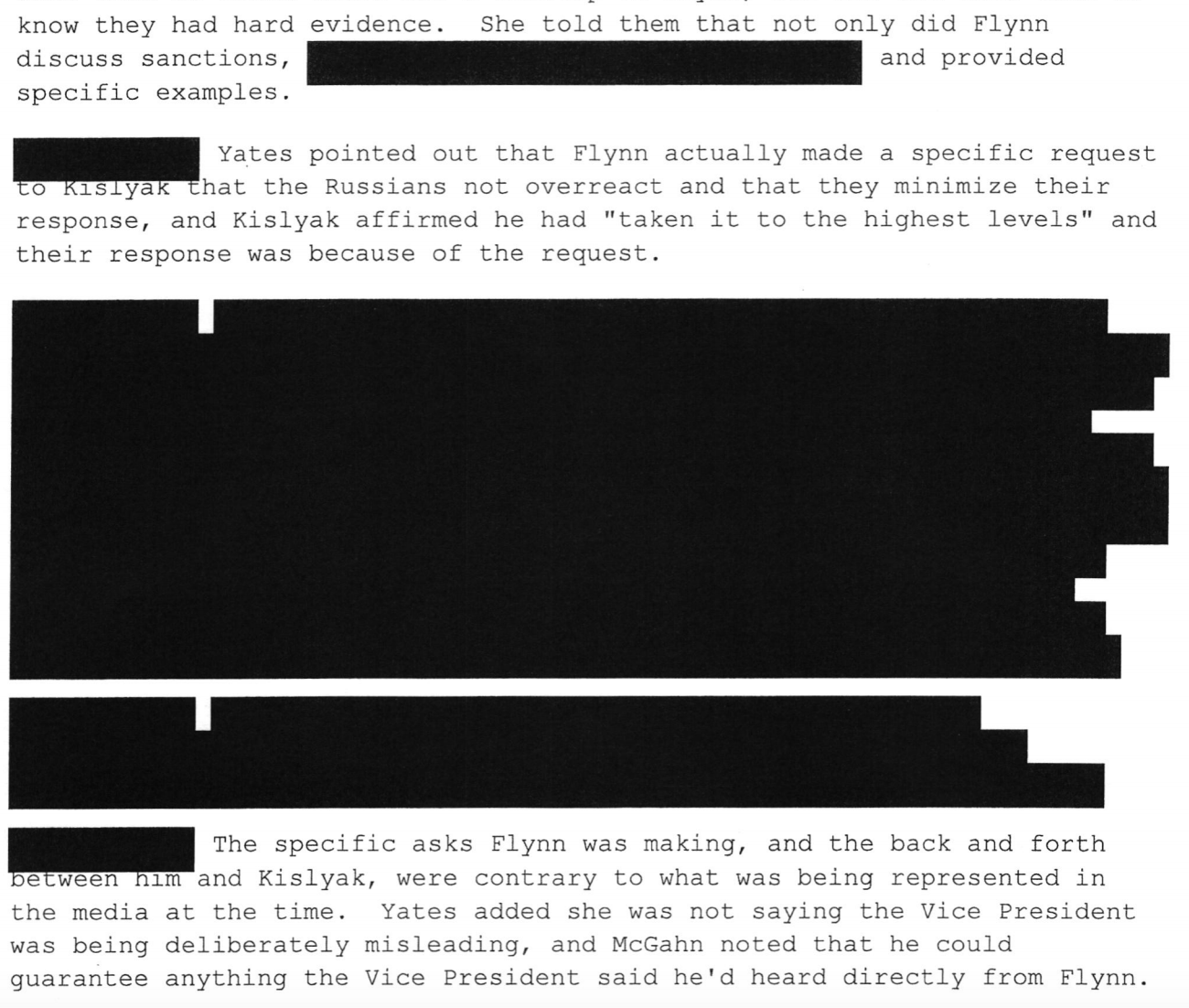
As for Yates herself, she provided Don McGahn several reasons why she believed these transcripts were troubling. Part of that description, as well as two of the examples she provided to substantiate the description, are redacted.

But Yates is specific: the “back and forth” between Kislyak and Flynn was contrary to the descriptions Flynn had offered publicly about the calls. Importantly, Yates’ description rebuts the Shea motion’s claim that this was an “arms-length” conversation.

Which is to say, in a key passage dismissing the possibility that the call transcripts included evidence that Flynn might have a relationship with Russia that could damage national security, the motion provides no evidence and in fact mis-cites something inapt as proof. But elsewhere, the filing does provide evidence about the call transcripts, and that evidence directly refutes the claim. Moreover, the filing redacts a number of other passages that go directly to the claim.

Importantly, whether or not the transcripts showed some reason to think Flynn’s relationship with Russia might affect national security is not an issue that Barr can invoke exclusive Executive judgment on, something on which judges generally defer to the Executive. The record shows that two Acting Attorneys General — one (Rod Rosenstein) appointed by Trump — already deemed the transcripts to include such evidence. Here, Barr isn’t even on the record making the claim. Just an Acting US Attorney who has not been Senate confirmed is.

A year ago, Judge Emmet Sullivan ordered the government to provide the transcripts of the calls between Flynn and Kislyak.

The government is hereby ORDERED to file on the public docket in this case the transcript of the “voicemail recording” referenced in the 75 Addendum to Government’s Memorandum in Aid of Sentencing and the transcripts of any other audio recordings of Mr. Flynn, including, but not limited to, audio recordings of Mr. Flynn’s conversations with Russian officials, by no later than May 31, 2019.

In response, the government obliquely said no, because they were not relying on those recordings for sentencing, effectively pointing out that no claims entered into evidence had relied on the transcripts (by the time Flynn pled guilty, he himself had provided evidence that he lied, and so they didn’t need to rely on the transcripts).

The government further represents that it is not relying on any other recordings, of any person, for purposes of establishing the defendant’s guilt or determining his sentence, nor are there any other recordings that are part of the sentencing record.

Now, however, the transcripts are utterly central to the claims the government is making. Indeed, the only evidence about the transcripts submitted with this motion rebuts the government’s claim.

Emmet Sullivan would be totally within his authority to require the government to provide the actual evidence on which they make at this point unsubstantiated claims in this filing.

Mike Flynn has been demanding these transcripts for quite some time. Given the declassification spree that Barr and Ric Grenell have been on, I would imagine they would have been made public if they helped Flynn at all. So I’m guessing Yates and McCord provided a more accurate description of these transcripts than Timothy Shea.

Anyway, the hearing is coming up and here are 13 questions we would ask of government counsel if we were Judge Sullivan:

  1. One striking feature of your brief is that it does not seem to allege that any of Flynn’s constitutional rights were violated or that you are conceding that any government action with respect to this investigation was illegal. Am I reading the government’s position correctly that you wish to dismiss this case without conceding that Flynn’s rights were actually infringed?
  2. Can you identify another case in which the government has argued for the dismissal of a guilty plea in the absence of either newly discovered evidence of actual innocence or the discovery of some sort of infringement of the defendant’s constitutional rights?
  3. As I understand your position, you are taking the view that Flynn’s case should be dismissed because the investigation lacked a proper predicate at the time the FBI interviewed him, and that his lies thus could not have been material. Are you aware of any other case in which the government has asked for dismissal of any charge on the ground that the investigation lacked a proper predicate? And are you aware of any other circumstances in which the government, in a false-statements case, sought dismissal because the supposed lack of a predicate for the investigation made the lies supposedly immaterial?
  4. The federal government commonly charges defendants with lying to investigators. Does the department intend to perform similar analyses of the predication and materiality of past false-statements cases and seek dismissals of other matters that may currently be pending presentencing that may run afoul of its new position?
  5. In arguing that the investigation was not properly predicated, the government points to documentation of internal FBI discussions concerning whether or not to close its probe into Flynn—discussions that took place before the bureau learned of Flynn’s call with the Russian ambassador. This knowledge, in turn, prompted the FBI to continue its work and ultimately seek an interview with Flynn. The phone call, the government states, was not an adequate predicate for continuing the probe. Is the government’s position that, as a general matter of law or policy, the question of predication must be evaluated anew at each step of an investigation merely because there has been discussion of closing a case? Can the government cite another case in which it has ever taken that view?
  6. The FBI decided to interview Flynn after discovering his phone call with Ambassador Kislyak and learning that Flynn had lied about the matter to Vice President Mike Pence and White House Press Secretary Sean Spicer, both of whom then unknowingly repeated the lie to the public. Justice Department officials have since testified under oath that they worried this placed Flynn at risk of blackmail by the Russian government—because the Kremlin would, of course, know that Flynn had indeed spoken with Kislyak. Does the government really take the view that it would not be a counterintelligence threat for the Russian Federation to know that the national security adviser had lied to the vice president about contacts with its government related to election interference and sanctions? And does it really take the view that it is actually lawful to lie to the FBI in such an investigation?
  7. Robert S. Litt, who served as general counsel to the Office of the Director of National Intelligence through the end of the Obama administration and was thus a sitting intelligence official during the relevant period, has posed the following hypothetical:

    Someone who holds a grudge against you calls an FBI office and says that you are a Russian agent, providing fictitious details of invented meetings you have had with agents from Russia’s Federal Security Service. Before that call, the FBI had no information at all about you—let alone an open predicated investigation—but follows up with a public records search and an interview of you, and determines that there is no basis to the claim.

    The logic of the department’s position in the Flynn case is that the person who maliciously reported you to the FBI could not be prosecuted for making a false statement, because at the time the statements were made, those statements “were not ‘material’ to any viable counterintelligence investigation … initiated by the FBI.” Or, to put it differently, the FBI can’t investigate whether someone is a Russian agent unless it already has evidence that the person is a Russian agent.


    Is this a correct statement of the government’s position? And if not, why not?
  8. In your brief, you argue that even if the statements were material, the “government does not believe it could prove that Mr. Flynn knowingly and willfully made a false statement beyond a reasonable doubt.” Flynn, as you know, twice admitted in open court that he lied, and he signed a statement of the offense that admitted, “In truth and in fact … Flynn then and there knew” that his statements were untrue when he made them to the FBI. What’s more, the charging document to which he pled guilty specifies that his actions were knowing and willful. Your brief makes no mention of the fact that such admissions by Flynn are themselves compelling evidence of his guilt. Do you doubt that they are admissible evidence that could be used against him at trial? And why did the government not take account of them as evidence in determining it would be unable to prove its case?
  9. The motion to dismiss this case is signed not by any career official of the Justice Department, but only by Timothy Shea, the U.S. attorney for the District of Columbia, who is a political appointee. Why did no career Justice Department official, including the assistant U.S. attorneys who have been litigating the case since it was transferred back to the Justice Department from the Special Counsel’s Office, sign the motion?
  10. In particular, I noticed the motion by Brandon Van Grack to withdraw from this case. Van Grack, a career prosecutor, worked on Special Counsel Robert Mueller’s team and has been on this case since the plea agreement was first filed. Indeed, he was one of the signatories to the plea documents. Can you explain to me why Van Grack wishes to withdraw from the case after working on it for so long?
  11. While no career officials of the department appear to have participated in this decision, a number of political officials did. As I understand it, the attorney general himself asked the U.S. attorney in the Eastern District of Missouri, Jeffrey Jensen, to review the case. Jensen recommended dismissing it. And Attorney General William Barr accepted that recommendation, leaving Shea to file the brief currently before me. Barr, Shea, and Jensen are all political appointees. Am I to understand that all of the relevant players in this decision to dismiss a plea agreement whose lawfulness the government’s brief does not seem to challenge were political appointees?
  12. The plea agreement between the government and Flynn specifies that the government cannot further charge Flynn for any of the conduct outlined in the plea documents. This includes not merely Flynn’s false statements about his communications with Russian Ambassador Sergey Kislyak concerning sanctions, but also Flynn’s operating as an unregistered foreign agent for the benefit of Turkey and his false statements both about that and about his negotiations surrounding a U.N. Security Council resolution. The plea agreement, however, also contains a provision specifying that if Flynn “fails specifically to perform or to fulfill completely each and every one of [his] obligations under this Agreement,” the government’s obligations under the plea deal cease.

    Before the government sought to dismiss this case, Flynn filed a motion before the court to withdraw his guilty plea. Is the government’s view that Flynn violated his agreement by seeking to withdraw his plea? In other words, if I grant the government’s motion, is it the government’s view that a future attorney general could refile the charges—other than the specific false-statements charge I am being asked to dismiss—against Flynn that the original plea agreement immunized him against? Or does the government take the view that the original immunity provision of the plea agreement is still in force?
  13. Finally, can you assure me that the many scores of times President Trump has expressed sympathy for Flynn and stated his belief that his former national security adviser was wronged by the FBI have nothing whatsoever to do with the decision by the Justice Department that the continuation of this prosecution would not, as the department asserts, “serve the interests of justice”?

Weekly List 182

Ken AshfordWeekly ListLeave a Comment

This week, despite a White House model showing ending social distancing would result in a spike of 200,000 new cases a day and deaths of 3,000 a day, the majority of the country started to reopen. Public health officials warned of dire consequences, with one likening the premature reopening to genocide, but Trump triumphantly declared Phase 1 was over, and now the American people would need to be “warriors” and return to work — a possible death sentence for many of the vulnerable.

Trump was back out on the campaign trail, visiting a factory in swing state Arizona, where his campaign music played in the background, and Trump continued his strange bravado of not wearing a face mask. Within days, it was discovered that two White House employees in direct contact with Trump and Vice President Mike Pence had tested positive, as had 11 members of the Secret Service, yet Trump continued to flout advice from experts on wearing a mask and social distancing.

This week, the country lost 3.2 million additional jobs, and the April unemployment rate came in at 14.7%, the highest since the Great Depression. It became clear this week, as Trump said the White House coronavirus task force would be shuttered, and then under pressure, instead reconfigured its purpose to planning the reopening, that indeed, Trump and the federal government did not actually have a plan of what to do, or have interest in developing one. Instead, Trump was willing the roll the dice with American lives in hopes of reopening in time to spur the economy ahead of the November election. As one op-ed writer noted, while numerous countries with mass testing and contract tracing were returning to normal, Trump had essentially quit.

  1. On Saturday, New York Gov. Andrew Cuomo said at his daily briefing that based on a CDC report, cases in New York, New Jersey, and Connecticut did not come from China, but from a new strain that came from Europe.
  2. He said in February, 139,000 travelers from Italy and 1.74 million from other European countries, where the virus was already spreading wildly, came to the East Coast, with some taking connecting flights.
  3. Cuomo cited from the report, “Delay in travel bans allowed for the virus to spread throughout the United States and contributed to the initiation and acceleration of domestic COVID cases in March.”
  4. On Saturday, WAPO reported that White House epidemiological models in late March showed deaths from the coronavirus of 100,000 to 240,000, but Trump, eager to reopen, wanted data to justify doing so.
  5. A team led by Kevin Hassett, former chair of Trump’s Council of Economic Advisers with no infectious disease expertise, put together a model which found daily deaths would peak in mid-April and drop off substantially.
  6. Hassett’s model was embraced by Jared and other powerful aides, confirming their skepticism about the severity of the pandemic, and bolstered their case to shift to the economy to help Trump’s re-election.
  7. Trump was so eager to extinguish the virus, he embraced fantasy cure-alls, assured the country the virus would “leave,” and tuned out the reality that the virus had not receded and there would be a second wave.
  8. Marc Short, chief of staff to Vice President Mike Pence, was a skeptic who exerted influence over the task force. He did not believe the death toll would reach 60,000, and encouraged Pence and then Trump to travel.
  9. Hassett, economic adviser Larry Kudlow, and Treasury Department Secretary Steve Mnuchin agitated to reopen. Hassett warned in an April meeting that the GDP could fall 40% and that tens of millions could lose their jobs.
  10. Dr. Deborah Birx knew we were far behind on testing, as governors complained. Gov. Larry Hogan said he had Maryland Army National Guard and state police meet and hide their shipment of tests from South Korea.
  11. On Saturday, Trump sent a flurry of tweets and retweets on a variety of topics while at Camp David, reportedly to meet with economic advisers, Ivanka, and Jared to discuss a pivot towards an economic message.
  12. Trump quoted an article about the FBI plotting to get Michael Flynn to lie, adding, “The Russia Hoax is the biggest political scandal in American history. Treason!!! Lets see how it ends????”
  13. Trump attacked House Speaker Nancy Pelosi and Majority Leader Mitch McConnell for not taking him up on his offer for testing their members, tweeting, “No reason to turn it down, except politics. We have plenty of testing.”
  14. The two leaders had said the tests should go to frontline workers first. Trump added, to both, “Maybe you need a new Doctor over there,” and to Pelosi, “Crazy Nancy will use it as an excuse not to show up to work!
  15. Trump also tweeted, “The Impeachment Hoax will be exposed. Crazy Nancy gets Nothing Done, that’s why she got thrown out as Speaker the first time,” adding, “she should come back to Washington now!”
  16. Trump also attacked MSNBC host Nicole Wallace, tweeting, “She was thrown off The View like a dog, Zero T.V. Personas. Now Wallace is a 3rd rate lapdog for Fake News MSDNC (Concast). Doesn’t have what it takes!”
  17. On Saturday, White House press secretary Kayleigh McEnany told reporters House Democrats were staging a “publicity stunt” by requesting that Dr. Anthony Fauci testify, without giving detail on the subject matter.
  18. Trump later quoted a tweet of her saying this, adding, “Democrats are just, as always, looking for trouble. They do nothing constructive, even in times of crisis. They don’t want to blame their cash cow, China, for the plague.”
  19. On Saturday, in a video message, former president George W. Bush called on Americans to put aside their partisan differences, heed advice of medical professionals, and show empathy for one another in the pandemic.
  20. On Sunday, Trump lashed out, quoting a Fox News personality, tweeting, “Oh bye the way, I appreciate the message from former President Bush, but where was he during Impeachment calling for putting partisanship aside.”
  21. Trump added, “He was nowhere to be found in speaking up against the greatest Hoax in American history!” Bush’s video was broadcast online as part of a project, “The Call to Unite.” More than 66,000 were dead.
  22. On Sunday, which was World Press Freedom Day, Trump quoted one of his tweets about his polling, adding, “The Fake News doesn’t show real polls. Lamestream Media is totally CORRUPT, the Enemy of the People!”
  23. Trump added, “Concast (@NBCNews) and Fake News @CNN are going out of their way to say GREAT things about China. They are Chinese puppets who want to do business there,” adding, “The Enemy of the People!”
  24. Joe Biden tweeted in response, “Trump’s repeated efforts to demonize the media put us on such a dangerous path,” saying Trump “has attacked the independence of journalists and launched an all-out assault on the media.”
  25. Trump also thanked a man who put a Trump flag on his dock, tweeting, “Very cool. Please thank him!” and boaters, “Thank you very much to our beautiful “boaters.” I will never let you down!”
  26. Trump capped off his morning flurry, tweeting, “….And then came a Plague, a great and powerful Plague, and the World was never to be the same again! But America rose from this death and destruction.”
  27. On Sunday, Kudlow got testy when asked on “State of the Union” about his comment that the virus was “contained” in February, saying, “the virus spread exponentially in ways that virtually no one could have predicted.”
  28. Kudlow also said of a needed fourth stimulus package, “there’s kind of a pause period right now,” adding, “next year could be one of the fastest growth rebounds in American history or recent history.”
  29. On Sunday, on “Fox News Sunday,” Birx contradicted Trump, saying, “Our projections have always been between 100,000 and 240,000,” after Trump raised his estimate last week from 50,000 to 60,000, to 60,000 to 70,000.
  30. On Sunday, in an interview with National GeographicFauci shot down the discussion between politicians and pundits, saying there is no scientific evidence that the coronavirus was made in a Chinese lab.
  31. Fauci said the evidence shows “this could not have been artificially or deliberately manipulated,” saying the “evolution over time strongly indicates that [this virus] evolved in nature and then jumped species.”
  32. On Sunday, former FDA commissioner Scott Gottlieb told “Face the Nation” that “while mitigation didn’t fail, I think it’s fair to say that it didn’t work as well as we expected,” saying it did not quell the spread.
  33. Gottlieb said we expected to see “more significant declines in new cases and deaths,” adding the virus could spark a significant outbreak at any time if schools and workplaces “let down their guard.”
  34. On Sunday, Secretary of State Mike Pompeo continued to push the unsubstantiated theory that the virus came from a lab in China on “This Week,” saying, “Remember, China has a history of infecting the world.”
  35. Pompeo added it was not the first time the world was “exposed to viruses as a result of failures in a Chinese lab,” claiming, “there is a significant amount of evidence that this came from that laboratory in Wuhan.”
  36. On Sunday, AP reported a May 1 report by the Department of Homeland Security found Chinese leaders “intentionally concealed the severity” of the pandemic from the rest of the world in early January.
  37. The four-page report was not classified but marked “for official use only,” and said China held off from telling the World Health Organization that the coronavirus “was a contagion” for much of January so it could buy up medical supplies.
  38. Shortly after, Trump tweeted, “Intelligence has just reported to me that I was correct, and that they did NOT bring up the CoronaVirus subject matter until late into January, just prior to my banning China.”
  39. Trump, who has been widely criticized for his slow and scattered response, added, “they only spoke of the Virus in a very non-threatening, or matter of fact, manner,” adding, “Fake News got it wrong again.”
  40. On Sunday, Reuters reported an internal Chinese report by the Ministry of State Security warned top Beijing leaders that the rising wave of hostility from the U.S. could tip the country’s relationship into armed confrontation.
  41. The report warned Beijing faces a growing wave of anti-China sentiment led by the U.S. in the aftermath of the pandemic, concluding anti-China sentiment is at its highest since the 1989 Tiananmen Square crackdown.
  42. On Sunday, “60 Minutes” reported staffers at Memorial Medical Center in rural Texas say they do not have enough medical equipment, and have been reusing masks and mixing their cleaning supplies from home.
  43. While Texas is ranked 9th in cases, it is 48th in testing. The state also has the highest number of uninsured, and as cost of PPE continues to rise, the financial situation is dire. Trump promised funding, but it has not come.
  44. On Sunday, at 7 p.m., the time slot in which “60 Minutes” has reported stories critical of Trump’s pandemic response, Trump participated in a Fox News town hall named “America Together: Returning to Work.”
  45. Trump again upped his prediction as the death toll passed 66,000 saying, “We’re going to lose anywhere from 75, 80 to 100,000 people,” adding, “That’s a horrible thing. We shouldn’t lose one person over this.”
  46. This marked the fifth time in the past 13 days that Trump had tweaked the projected death toll. Just two weeks ago, Trump said the death toll could be as low as 50,000.
  47. Trump contradicted top health officials, saying, “We think we’ll have a vaccine by the end of this year and we’re pushing very hard,” adding, “The doctors would say, well, you shouldn’t say that. I’ll say what I think.”
  48. Trump also returned to promoting hydroxychloroquine, saying, “The Democrats…would rather see people, I’m going to be very nice. I’m not going to say ‘die’…because they think I’m going to get credit” if it works.
  49. Trump said reporters ask him “disgraceful” and “horrible, horrendous, biased” questions during these briefings, adding, “I feel if I was kind to them, I’d be — I’d be walked off the stage.”
  50. Trump compared himself to Lincoln, saying, “I am greeted with a hostile press the likes of which no president has ever seen,” adding, “The closest would be that gentleman right up there… I believe I am treated worse.”
  51. Trump said to his Fox News interviewers of having the event at Lincoln Memorial, “I don’t think it’s ever been done, what we’re doing tonight, here, and I think it’s great for the American people to see.”
  52. On Monday, NYT reported that Interior Department Secretary David Bernhardt, an oil lobbyist who Democrats opposed because of conflicts of interest and ethics violations, ordered the memorial closed for Trump to do the event.
  53. In an order Friday, Bernhardt said, “I am exercising my authority to facilitate the opportunity for the president to conduct this address” there, citing “the extraordinary crisis that the American people have endured.”
  54. The White House made the decision on location. Critics cited the town hall in one of the nation’s most hallowed space was a political event in which Trump attacked Biden, and was not questioned on his past claims about the virus.
  55. At the Fox News town hall, asked about his Mayo Clinic visit, Pence said, “I didn’t think it was necessary, but I should have worn the mask.” He added he did wear a mask visiting a General Motors plant in his home state.
  56. On Sunday, ABC News reported the Navajo community suffered one of the highest infection rates per capita in the nation, and has limited resources to fight the virus, including lack of running water for 30% of the tribe.
  57. The Navajo Nation, with a population of 300,000, has access to only about 20 intensive care unit beds, with the peak weeks away. Congress approved $8 billion of relief to be split among 574 tribes, but the money has yet to arrive.
  58. On Monday, in an interview with New York PostTrump said “everybody” enjoyed his daily briefings, including himself, and that they will be back, just not daily. More than 70,000 had died, with over 1.1 million cases.
  59. Trump added, “I heard, is this true? It was the highest-rated hour in cable television history. That’s what I heard. I don’t know if that’s true.” Trump credited his clashes with reporters for making engaging content.
  60. Trump singled out two CBS News female journalists, Weijia Jiang and Paula Reid, referring to Reid as angry and mean. Trump bragged, “I have a much bigger audience than anybody’s ever had.”
  61. On Monday, a demographer with the Brookings Institution found in the five weeks since March 29, 813 of the 1,103 counties that achieved “high-covid status” (100 or more cases per 100,000) voted for Trump in 2016.
  62. On Monday, Trump promoted a conspiracy theory about an accidental death of an MSNBC intern, tweeting, ““Concast” should open up a long overdue Florida Cold Case against Psycho Joe Scarborough.”
  63. Trump also tweeted, “Getting great reviews, finally, for how well we are handling the pandemic…the great things we are doing on testing,” without citing the source of the review. Obviously this is false.
  64. Trump also tweeted, “Mexico is sadly experiencing very big CoronaVirus problems, and now California, get this, doesn’t want people coming over the Southern Border.” It was unclear what Trump was referring to.
  65. Shortly after, NYT reported an internal White House report projects a steady rise in cases and deaths in the coming weeks, to 200,000 daily cases by the end of May, and a daily death toll of 3,000 as of June 1.
  66. The modeling was put together by the Federal Emergency Management Agency, and showed with reopening there would be a steady increase from the current averages of 1,750 daily deaths and 25,000 daily cases.
  67. WAPO reported Justin Lessler, a professor of epidemiology at Johns Hopkins who did the study said the virus could spiral out of control. The cases could be 100,000 per day instead, depending on reopening.
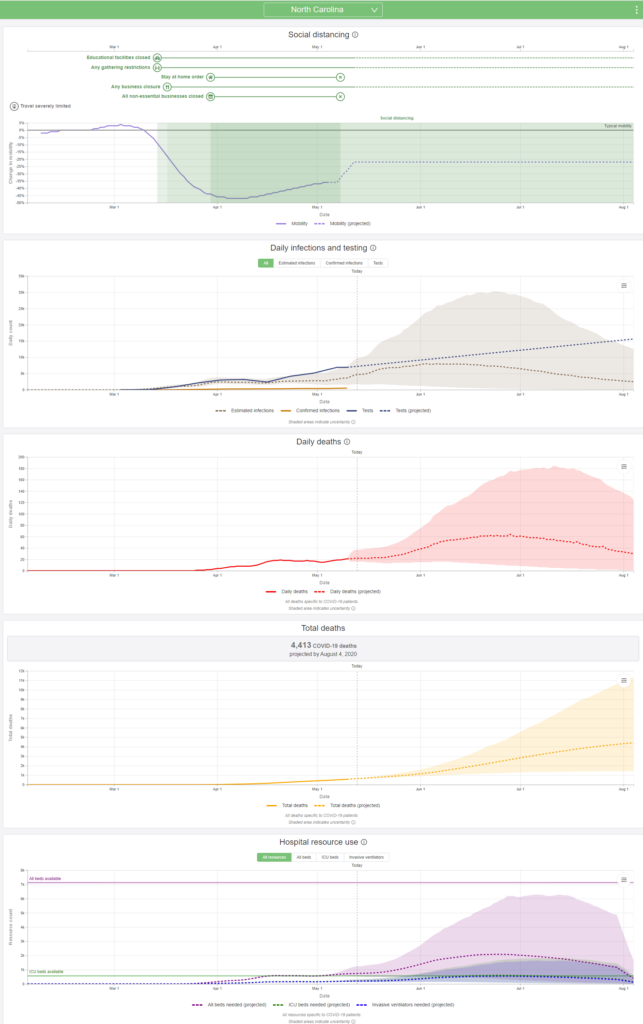
  68. At the same time, the Institute for Health Metrics and Evaluation revised its projection to estimating nearly 135,000 deaths through August 4, double its forecast on April 17 when it estimated 60,308.
  69. The IHME cited, “rising mobility in most U.S. states as well as the easing of social distancing measures expected in 31 states by May 11, indicating that growing contacts among people will promote transmission.”
  70. On Monday, WAPO reported the Trump regime skipped a worldwide virtual global vaccine summit led by the European Commission, on which leaders pledged to fund vaccines and drugs to treat Covid-19.
  71. So far the virus had killed 250,000 worldwide. The goal was to raise $8.2 billion from governments, philanthropies, and the private sector to fund research and mass-produce drugs, vaccines, and testing kits.
  72. Public health officials noted the unusual nature of the U.S. not participating in such an effort. A Trump official noted its “whole-of-America” efforts in the U.S., but declined to comment on the absence.
  73. On Monday, WAPO reported Trump has been the biggest cheerleader for governors reopening, even as their states failed to achieve White House benchmarks for when social distancing measures could be eased.
  74. Trump and some of his aides have backed away from their own guidelines, instead pushing a broad economic message as a rationale to reopen. The White House also moved to distance itself from the leaked report.
  75. On Monday, Pelosi told CNN on Fauci, “We will be very strictly insisting on the truth and they might be afraid,” saying experts should spend less time on Trump’s daily shows, and testify so the House can allocate funding.
  76. On Monday, the White House issued new guidance, prohibiting all task force members from testifying before Congress in May, while other agencies were advised to limit the number of hearings they attend.
  77. The White House said, “While the Trump Administration continues its whole-of-government response to COVID-19, including safely opening up America again,” it is “counter-productive” to have individuals at hearings.
  78. Later Monday, Trump tweeted “MSDNC and FAKE NEWS CNN are going wild trying to protect China!” It was unclear what prompted his tweet.
  79. On Monday, Trump ally and former Gov. Chris Christie said America needs to reopen despite the forecasts showing 3,000 deaths per day, saying, “there are going to be deaths,” and “they’re gonna have to.”
  80. Christie compared reopening the economy to the sacrifice of lives in World War II, saying, “We sent our young men during World War Two over to Europe…knowing that many of them would not come home alive.”
  81. On Monday, Vanity Fair reported that a group associated with Donald Jr. has taken a major stake in OANN, a competitor to Fox News, as Trump continues to feel that Fox has not been sufficiently loyal to him.
  82. One source said that if Trump loses in 2020, he could use OANN as his post-presidential television platform to host shows. Trump continues to promote OANN, and publicly complain about Fox News coverage.
  83. On Tuesday, shortly after midnight, Trump attacked a group of GOP critics for a campaign ad being used against him called “Mourning in America,” citing the economic cost and loss of life of his mishandling the pandemic.
  84. Trump tweeted, “A group of RINO Republicans who failed badly 12 years ago, then again 8 years ago, and then got BADLY beaten by me, a political first timer,” adding, “They’re all LOSERS.”
  85. Trump added, “these loser types don’t care about 252 new Federal Judges, 2 great Supreme Court Justices, a rebuilt military, a protected 2nd Amendment, biggest EVER Tax & Regulation cuts, and much more.”
  86. Trump also attacked Kellyanne Conway’s husband George, who was part of the group, by using an ethnic slur, tweeting, “I don’t know what Kellyanne did to her deranged loser of a husband, Moonface.” Trump insulted others too.
  87. Trump added George is a “stone-cold loser,” and said the group should not call itself The Lincoln Project, saying, “It’s not fair to Abraham Lincoln, a great president. They should call it the losers project.”
  88. On Sunday, LA Times reported a man shopping at a Vons in San Diego County wore a Ku Klux Klan hood in lieu of a face mask while shopping. Grocery workers repeatedly asked him to remove it. He paid and left.
  89. On Monday, three family members were charged in killing a security guard at a Michigan Family Dollar store who told a customer to wear a state-mandated face mask.
  90. On Monday, video surfaced of Ahmaud Arbery, 25, who was shot and killed in February by two white men while out for a jog in Georgia. The two claimed they thought he was a burglar and have not been charged.
  91. On Tuesday, Dr. Julia Iafrate, an assistant professor at Columbia University Medical Center who treated Covid-19 patients, told CNN she was denied a green card. She immigrated from Canada and was in the U.S. for 13 years.
  92. On Monday, NYT reported in a May 1 order, the chief judge for the U.S. Court of Appeals in D.C., Judge Sri Srinivasan, asked Chief Justice John Roberts to open an ethics investigation into a recently vacated court seat.
  93. The order came after Demand Justice noted Senate Majority Leader Mitch McConnell pressured conservative justices to retire while the GOP controls the Senate. The seat is one of the country’s most powerful appeals courts.
  94. Hearings started Wednesday for Trump’s nominee Justin Walker, a 37-year-old federal judge in Kentucky. Critics say he is unqualified given his age, position on Obamacare, and his vocal support of Brett Kavanaugh.
  95. On Monday, BuzzFeed reported former president Obama privately blasted GOP lawmakers’ investigation of Joe Biden and his son in a letter, calling it an effort “to give credence to a Russian disinformation campaign.”
  96. On Tuesday, CNN reported that three Russian doctors who raised questions about the government’s response and hospital conditions in the pandemic have fallen out of a hospital window, with two dead.
  97. On Tuesday, the Straits Times reported Philippine regulators shut down the country’s largest media company, ABS-CBN, a frequent target of President Rodrigo Duterte, the day after its 25-year franchise expired.
  98. On Tuesday, the U.S. surpassed 1,200,000 cases and 76,000 deaths. New York, New Jersey, Massachusetts, and Illinois — all hubs for air traffic from Europe for months, had the highest number of cases and deaths.
  99. On Tuesday, a new study at the Los Alamos National Laboratory found the virus that emerged from Wuhan had mutated into a new dominant strain that has spread across the U.S. and appears to be even more contagious.
  100. The study found the new strain spread from Europe to the U.S. in February, and became the dominant strain here by March. Researchers have identified 14 mutations. The study has yet to be peer reviewed.
  101. On Tuesday, a study by scientists at University College London’s Genetics Institute found the coronavirus spread quickly around the world in late 2019, after emerging from China between October to December.
  102. On Tuesday, Gov. Cuomo said the debate on reopening comes down to the value of human life, saying, “the faster we reopen, the lower the economic cost. But, the higher the human cost,” and said he views life as “priceless.”
  103. On Tuesday, CNN reported that Attorney General William Barr made a last minute push Monday to have the Trump regime modify its position of seeking to fully strike down Obamacare in the Supreme Court case.
  104. Barr warned Pence, White House counsel Pat Cipollone, members of the Domestic Policy Council, press secretary McEnany, and several other officials it could have implications at the polls.
  105. The deadline to revise its argument before the court was Wednesday. Barr has also cited the pandemic, saying if the law is fully repealed it could cause substantial disruptions to the health care of millions and the uninsured rate to spike.
  106. On Tuesday, Dr. Rick Bright filed an 89-page whistleblower complaint, saying he was transferred out of the Biomedical Advanced Research and Development Authority, or BARDA, “without warning or explanation” over his refusal to embrace hydroxychloroquine.
  107. Bright described the Department of Health and Human Services as chaotic, with “pressure from HHS leadership to ignore scientific merit and expert recommendations and instead to award lucrative contracts based on political connections and cronyism.”
  108. Bright said HHS was slow to react to the virus, saying they were fully aware of the threat in early January, and also ignored red flags about the lack of testing materials and PPE, including N95 masks.
  109. Bright also said he “repeatedly clashed with Dr. Kadlec and other HHS leaders” about the outsized role of an industry consultant with ties to pharmaceutical companies “in the award of government contracts.”
  110. On Wednesday, Trump said of whistleblower Dr. Bright, “I don’t know who he is. I did not hear good things about him at all,” adding, “he seems like a disgruntled employee that’s trying to help the Democrats win an election.”
  111. On Tuesday, CNN reported as the House ramps up a new oversight committee to oversee $3 trillion in relief funds, Republicans said they may not participate. Pelosi said the House will forge ahead without them.
  112. On Monday, a Vancouver-based vice president of online retailer Amazon resigned over the company firing whistleblowers who spoke out about unsafe working conditions. He brought up the firings before he quit.
  113. On Tuesday, restaurant chain Wendy’s announced nearly a fifth of its restaurants were out of beef, as the meat supply is under pressure with plants suspending operations due to the pandemic.
  114. On Tuesday, a Dallas county judge sentenced Shelley Luther, owner of Salon À la Mode, to seven days in jail for disobeying the state’s coronavirus shutdown orders. Texas will allow hair salons to reopen Friday.
  115. On Thursday, the Texas Supreme Court ordered Luther’s release. Texas Gov. Greg Abbott on Thursday rewrote his previous coronavirus orders so that no violators will face jail time.
  116. On Tuesday, local ABC news reported the Arizona Department of Health Services told modeling experts at ASU to “pause” its work on Covid-19, as the state is set to reopen. The state will instead rely on a FEMA model.
  117. On Tuesday, Gov. Brian Kemp warned a growing outbreak is stressing resources in northeast Georgia, a part of the state synonymous with the state’s poultry industry.
  118. On Tuesday, WAPO reported according to a complaint submitted by a volunteer and confirmed by officials who worked on Jared’s task force, Jared and his team exacerbated problems with supplies.
  119. The complaint alleged the team had little success in securing PPE, noting they did not have significant experience in health care, procurement, or supply-chain operations, or relationships with manufacturers.
  120. Team volunteers were instructed to fast-track protective equipment leads from “VIPs,” including tips that came from Fox News hosts Brian Kilmeade and Jeanine Pirro. Governors said volunteers lacked basic understanding.
  121. Jared’s volunteer team was part of a broader effort including the White House, FEMA, and HHS. About 30% of supplies went towards drive-thru testing sites — he promised thousands of sites, but only 78 materialized.
  122. On Tuesday, a Monmouth poll found Trump’s approval for his handling of the pandemic has slipped as he is viewed as inconsistent (55%), and changing what he says about the virus day to day.
  123. Trump’s approval for handling the virus was 43% approve, 51% disapprove, down from 44% approve, 49% disapprove in April, and from 46% approve, 48% disapprove in March.
  124. On reopening, 56% said it is more important to make sure as few people get sick as possible, while 33% said it was more important to prevent the economy from sinking.
  125. On Tuesday, Trump took his first major trip in nearly two months to visit battleground state Arizona to visit a facility producing face masks. Trump faced weak ratings for his handling of the crisis and falling poll numbers.
  126. LA Times reported unlike a typical president, Trump is not going to meet with devastated families who have lost loved ones to Covid-19, or to console survivors — part of a pattern of his inability to show empathy.
  127. Before leaving for Arizona, Trump told reporters he blocked Fauci from testifying because the House was “a set up” and “a bunch of Trump haters,” adding “they frankly want our situation to be unsuccessful.”
  128. Trump also falsely claimed that the IMHE model, which was dramatically revised upward, “assumes no mitigation and we’re going to have mitigation.” The death toll was revised because of reopening.
  129. Trump toured the Honeywell factory in Phoenix, which is producing N95 masks. Trump wore safety googles, but not a mask, during the tour, nor did his aides, despite a sign saying “face mask required in this area.”
  130. A White House official claimed a Honeywell official said Trump and aides did not need to wear masks. At one point during the tour, the Guns N’ Roses song “Live and Let Die” was blasted from the factory’s PA system.
  131. At the tour, Trump told reporters that the White House coronavirus task force would wind down as the country moved into Phase 2 with more than 71,000 dead, saying, “We will have something in a different form.”
  132. Trump declared success, saying the country had moved on to “the next stage of the battle” and “reopening our country.” Pence later added, “It really is all a reflection of the tremendous progress we’ve made.”
  133. Trump added of the wind down, “we can’t keep our country closed for the next five years,” adding, “We need to reopen our country. We have a great country. We can’t keep it closed.”
  134. Trump said, “Will some people be affected? Yes. Will some people be affected badly? Yes. But we have to get our country open and we have to get it open soon.”
  135. Trump added he viewed U.S. citizens “to a certain extent and to a large extent as warriors,” adding, “We can’t keep our country closed. We have to open our country … Will some people be badly affected? Yes.”
  136. In heavily political remarks after touring the facility, Trump said our country is now in “the next stage of the battle” boasted of his 2016 victory in the state, and called for “the full truth about the China situation.”
  137. As Trump took to the podium to deliver his remarks, his political rally music was playing, despite the event being billed as an official White House event.
  138. Later Tuesday, in an interview with “World News Tonight,” Trump said, “it’s possible there will be some” deaths as states roll back restrictions, acknowledging it was a choice to reopen to jumpstart the economy.
  139. Trump added, “It’s possible there will be some because you won’t be locked into an apartment or a house,” adding, “But at the same time, we’re going to practice social distancing, we’re going to be washing hands.”
  140. On Wednesday, in a series of tweets, Trump shifted his message on the coronavirus task force, saying it had “done a fantastic job of bringing together vast highly complex resources that have set a high standard.”
  141. Trump also falsely claimed, “Ventilators, which were few & in bad shape, are now being produced in the thousands, and we have many to spare,” adding, “We are helping other countries which are desperate for them.”
  142. Trump also falsely claimed, “we are now doing more testing than all other countries combined, and with superior tests,” and lied saying, “Face masks & shields, gloves, gowns etc. are now plentiful.”
  143. Trump added, “the Task Force will continue on indefinitely with its focus on SAFETY & OPENING UP OUR COUNTRY AGAIN,” adding, “it will also be very focused on Vaccines & Therapeutics.”
  144. The NYT Editorial Board called the shift “a P.R. move, a way for Mr. Trump to push his message — untethered from the consensus view of public health officials or public opinion — that the worst of the pandemic has passed.”
  145. On Wednesday, a Yale epidemiologist slammed Trump’s plan to reopen, calling it “awfully close to genocide” and “mass death by public policy,” noting it would be letting “thousands die by negligence, omission, failure to act.”
  146. On Wednesday, Pompeo defended his Wuhan lab claim in a combative press conference, after public health experts and the Chair of the Joint Chiefs of Staff said evidence showed the virus occurred naturally.
  147. Pompeo said to a woman reporter asking about the contradiction, “Your efforts to try and find — just to spend your whole life trying to drive a little wedge between senior American officials … it’s just false.”
  148. On Wednesday, Pelosi told MSNBC that Trump blocking House testimony is “beneath the dignity of the office,” adding she hoped Fauci would “say things in public that we wouldn’t need him to be subpoenaed.”
  149. On Wednesday, Republicans in Ohio’s House limited Ohio Health Director Dr. Amy Acton’s ability to extend stay-at-home orders. She and Gov. Mike DeWine issued the first order March 23, allowing the state to limit cases.
  150. On Wednesday, a new CDC report detailed the coronavirus spread in the nation’s prisons: in 32 jurisdictions responding, there were 4,893 inmate cases and 88 deaths as of April 21. Staff had 2,778 cases and 15 deaths.
  151. On Wednesday, at a National Nurses Day event at the White House, the president of the American Association of Nurse Practitioners said access to PPE has been “sporadic” and she has reused her N95 mask for weeks.
  152. Trump shot back at the nurse, saying, “Sporadic for you, but not sporadic for a lot of other people,” adding, “Because I’ve heard the opposite. I’ve heard that they are loaded up with gowns now.”
  153. Asked why he did not wear a mask during the factory tour, Trump lied, saying he did have a mask on “for a period of time,” adding, “I can’t help it if you didn’t see me, I mean, I had a mask on.”
  154. Asked about loss of life, Trump also again invoked “warriors,” saying, “hopefully it won’t be the case, but it may very well be the case. We have to be warriors,” adding, “We can’t keep our country closed down for years.”
  155. Later, at an event with Iowa Gov. Kim Reynolds, asked about more than 72,000 deaths so far, Trump said, “It’s a big number, but it’s also a number that’s at the lower scale.”
  156. Trump added, “This virus is going to disappear,” and “It’s a question of when. Will it come back in a small way? Will it come back in a fairly large way? But we know how to deal with it now much better.”
  157. Trump said, “We can’t have our whole country out,” and compared citizens to warriors, blaming China and saying, “This is worse than Pearl Harbor” and the World Trade Center, “There has never been an attack like this.”
  158. Public health experts noted reopening will result in many more deaths, concentrated among the less affluent. Additionally, reopening will be used to justify denying unemployment and vital assistance to those in need.
  159. At the daily press briefing, McEnany defended reopening, saying, “There were supposed to be 2.2 million deaths and we’re at a point where we are far lower,” citing the “great work” of the task force and Trump’s leadership.
  160. On Thursday, WAPO reported as Iowa reopens, workers are being forced to chose between a paycheck and their health, as Gov. Reynolds opened the remaining 22 counties, including retail stores and shopping malls.
  161. More than 200,000 Iowans had filed for unemployment in the past six weeks, the highest since the Great Depression. Reynolds has said Iowans will have to embrace a “new normal” and return to work despite risks.
  162. On Wednesday, Axios reported Trump is complaining about the way the coronavirus death toll is being counted, suggesting the real number should be lower. Several of his senior aides agree.
  163. Trump has also vented about New York adding more than 3,000 probable deaths, saying the number is inflated. A senior official said he expects Trump to start questioning the death toll as it closes in on his predictions.
  164. At a press briefing later, McEnany obfuscated, saying Trump did not mean Americans should be putting their lives at risk, saying, “They’re warriors because they’ve stayed home. They’re warriors because they’ve social distanced.”
  165. Asked about testing, McEnany called it “nonsensical” to think that everyone should be tested in order to go back to work, calling it a “myth,” and saying “we’d have to retest them an hour later and an hour later after that.”
  166. On Wednesday, ProPublica reported on the same day Senate Intelligence Committee Chair Richard Burr dumped stock after being briefed on Covid-19, his brother-in-law sold up to $280,000 of shares in six companies.
  167. Burr backed Trump’s unqualified appointee John Ratcliffe for DNI, saying in a statement Tuesday, “I believe he understands the challenges facing the Intelligence Community in the 21st century.”
  168. Later Wednesday, Mnuchin responded to Guns N’ Roses vocalist Axl Rose, tweeting, “What have you done for the country lately” in response to Rose calling Mnuchin “officially an asshole” on Twitter.
  169. On Wednesday, AP reported that the Trump regime rejected a 17-page draft recommendation by the CDC which offered step-by-step advice for local authorities on reopening, after asking the agency to write it.
  170. The report, “Guidance for Implementing the Opening Up America Again Framework,” was written to help faith leaders, business owners, and state and local officials. The lack of public guidelines is viewed as dangerous.
  171. Traditionally, it is the CDC’s role to provide such information, and has been viewed as the public agency the country turns to. The CDC has not had a regular, pandemic-related news briefing in nearly two months.
  172. Later Wednesday, Trump named Louis DeJoy, a top donor to Trump and the Republican National Committee, as postmaster general, giving Trump influence over the Postal Service. DeJoy starts June 15.
  173. Rep. Gerald Connolly, chair of the House subcommittee that oversees the Postal Service, denounced the move to reward a donor, adding the USPS “is in crisis and needs real leadership…with knowledge of the issues.”
  174. On Thursday, CNN reported the CDC was asked by Birx to prepare the report. A regime official told CNN the report was “overly prescriptive,” and the recommendations did not fit the “phases” outlined by the task force.
  175. On Thursday, the Labor Department reported 3.17 million Americans filed for unemployment, slightly higher than the 3.05 million forecast, bringing the seven-week tally to 33.5 million.
  176. On Thursday, Pompeo reversed himself on the coronavirus, telling ABC News, “There’s evidence that it came from somewhere in the vicinity of the lab, but that could be wrong.”
  177. The shift followed reports by “Five Eyes,” the U.S.’s closest allies — including U.K., New Zealand, Australia, and Canada — who share intelligence, which cast doubt on Pompeo’s statements.
  178. On Thursday, NYT reported that in all, Trump has rolled back 98 environmental protections — viewed by him as a campaign promise. So far 64 have been completed, and 34 are in process ahead of the 2020 election.
  179. The bulk have been carried out by the EPA. Rollbacks included air pollution and emissions (27), drilling and extraction (19), infrastructure and planning (11), animals (11), water pollution (11) and safety (8).
  180. On Thursday, CNN reported a member of the U.S. Navy who serves as one of Trump’s personal valets has tested positive for the coronavirus. The valets often work very close to Trump and the first family.
  181. NBC News reported that when Trump learned of the infection, he became “lava level mad” at his staff for not doing a better job to protect him. A source said the valet was consistently close to Trump during the day.
  182. On Thursday, Reason reported a young woman came forward to say Trump allies provocateurs Jacob Wohl and Jack Burkman offered to pay her to say Fauci sexually assaulted her in 2014 when she was 20 years-old.
  183. On Thursday, Brandon Van Grack, a top prosecutor in the Mueller probe who remained on Michael Flynn’s case after the probe was over, abruptly withdrew from the case without explanation in a court filing.
  184. Shortly after, the DOJ dropped the criminal case against Flynn, a stunning reversal. Flynn admitted in court he had lied to the FBI about his conversations with the Russian ambassador in a January 2017 interview.
  185. The DOJ filing cited “a considered review of all the facts and circumstances of this case, including newly discovered and disclosed information.” Flynn had pleaded guilty to lying in court.
  186. The filing said Flynn’s interview was “untethered to, and unjustified by, the FBI’s counterintelligence investigation into Mr. Flynn,” and that the interview was “conducted without any legitimate investigative basis.”
  187. Shortly after, ABC News reported the White House was made aware of the DOJ’s decision Thursday morning. Trump attorney Jay Sekulow said, “Mueller should be ashamed of the conduct of his agents and lawyers.”
  188. In an afternoon Oval photo-op with Texas Gov. Abbott Thursday, Trump claimed he was not aware of the DOJ move, saying, “I didn’t know that was happening at this moment. I felt it was going to happen.”
  189. Trump called Flynn an “innocent man” and a “great gentleman,” claiming the Obama administration “targeted” Flynn, and said he was “a great warrior, and he still is a great warrior. Now, in my book, he’s an even greater warrior.”
  190. Trump also said, “I hope a lot of people will pay a big price because they are dishonest, crooked people,” adding, “They’re scum, and I say it a lot. They’re human scum.”
  191. Trump also said that he and Pence would start getting tested daily, admitting they were tested once a week prior. There was no word as to whether staffers would also receive a daily test.
  192. On Thursday, WSJ reported that Trump and Russian President Vladimir Putin spoke on Thursday. The White House claimed the two discussed the coronavirus and a planned arms control agreement.
  193. The White House said the U.S. is “ready to provide assistance to any country in need, including Russia.” Trump later said told reporters he offered to provide Russia with ventilators, and Putin accepted.
  194. Trump also told reporters that he told Putin “it’s a very appropriate time” for them to speak, “because things are falling out now and coming in line showing what a hoax this whole investigation was, it was a total disgrace.”
  195. On Thursday, House Judiciary Committee Chair Jerrold Nadler called the DOJ move “outrageous” and called for an “immediate explanation,” adding he would summon Barr to the Capitol to testify as soon as possible.
  196. On Thursday, when Barr was asked on CBS News how history would remember the DOJ move, he responded, “History is written by the winners, so it largely depends on who is writing the history,” with a sly smile.
  197. On Thursday, AP reported a new study at Columbia University found no evidence of benefit from hydroxychloroquine in lowering the risk of dying or needing a breathing tube in patients with coronavirus.
  198. On Thursday, NYT reported of the 40 people arrested by the NYPD for social distancing violations between March 17 and May 4, 35 people were black, four were Hispanic, and just one was white.
  199. On Thursday, NYT reported New York City’s coronavirus outbreak grew so large by early March it become the primary gateway of new infection in the U.S., as people traveled from the city and seeded outbreaks around the country.
  200. In Washington state, another early outbreak, 42% of infections came from NYC, as did 50% in California and Oregon. NYC also sent the majority of cases in many Midwestern, Western, Southern, and Northeastern states.
  201. NYC joined Wuhan and Milan as a vector of spread. New York’s political leaders waited until mid-March to impose a lockdown, even after hundreds of cases were reported, giving the virus a head start.
  202. The lack of testing hid the extent of the outbreak for months. Gov. Cuomo’s office said they were told the state had no cases in February. The state’s growth came from the volume of international travelers.
  203. When Trump imposed travel restrictions on Europe in mid-March, they were essentially worthless since the virus had already spread widely around the country. An earlier move would have blunted the virus’ march.
  204. On Thursday, HHS Secretary Alex Azar blamed meatpacking plant workers for outbreaks that killed 20 and closed nearly two-dozen plants, saying the infections were linked more to “home and social” aspects of workers’ lives.
  205. On Thursday, California Gov. Gavin Newsom said the state identified its first case of community spread had occurred in a nail salon. This, as several states had, or were preparing to reopen nail salons.
  206. On Thursday, NBC News reported at least 85 children have died from a rare but dangerous complication thought to be linked to the coronavirus, in at least seven states and Washington D.C.
  207. On Thursday, a documentary-style video called “Plandemic,” which featured unsubstantiated claims about the coronavirus, was removed from Facebook and YouTube, after millions of view and interactions.
  208. The video featured Judy Mikovits, a discredited medical researcher who is against vaccines, saying the virus was engineered to increase vaccination rates and masks are harmful. It was widely spread on far-right websites.
  209. On Friday, the Labor Department reported 20.5 million Americans lost their jobs in April, with the unemployment rate skyrocketing to 14.7% — both numbers slightly lower than the 21.5 million and 16% expectation.
  210. The unemployment rate topped the previous post-World War II record of 10.8% in October 2009, and was at the highest level since the Great Depression estimated peak of 24.9%.
  211. The “real” unemployment rate, which includes workers not looking for jobs and the underemployed, jumped to 22.8%. Its previous record level was at 17.2% in April 2010.
  212. Economists noted the jump in unemployment was historic: during the Great Depression, it took five years to get to the peak. This time, the level jumped in a period of two months from its level of 3.5%.
  213. On Friday, Trump told “Fox & Friends” on unemployment, “What I can do: I’ll bring it back. It’s fully expected. There’s no surprise. Everybody knows that,” claiming, “Even the Democrats aren’t blaming me for that.”
  214. Trump said of former AG Jeff Sessions, he chose him because he was “the first senator to endorse me” so he felt a little “obligation,” and “he was so bad in his nomination proceedings. I should have gotten rid of him there.”
  215. Asked if there would have been a Russia probe with Barr as AG, Trump said, “No, there wouldn’t be. He would have stopped it immediately,” calling Sessions a “disaster” and “very weak and very sad.”
  216. On Friday, CNBC reported retailer JC Penney is in talks to secure bankruptcy financing, and could file as soon as May 15. Many other retailers, including Stage Stores, are expected to follow suit.
  217. On Friday, CBS News reported of the more than 12,000 Catholic churches that applied for PPP loans, nearly 9,000 were successful. Most small businesses, especially those owned by women and people of color, have not received PPP money.
  218. On Friday, Melinda Gates, co-chairman of the Bill & Melinda Gates Foundation, said in an interview with Politico that the Trump regime’s coronavirus response has created “chaos,” and graded it a D-.
  219. Gates cited the regime “wasted so much time” and has not provided enough tests, protective gear, and other supplies, adding, “we have 50 different homegrown state solutions instead of a national response.”
  220. On Friday, a new poll by Democracy Fund + UCLA found 71% of Americans are more concerned about the government lifting restrictions too early, and 29% said they were not lifted quickly enough.
  221. On Friday, an aide to Pence tested positive to the coronavirus. Pence’s departure to Des Moines, Iowa from Andrews Air Force Base was delayed by nearly an hour as staff dealt with the discovery.
  222. Several reporters who were scheduled to travel with Pence stepped off of Air Force Two before it took off. Staffers on the plane said they were in contact with the infected staffer, and would embark on contract tracing.
  223. On Friday, Trump hosted a number of loyalist Republican lawmakers at the White House for a meeting on the coronavirus recovery. He said, “We’re going into transition,” adding, “I call it transition to greatness.”
  224. Trump said, “It’s going to be a transition to greatness, because we’re going to do something very fast,” adding, “There’s tremendous pent up demand. And next year, we’re going to have a phenomenal year.”
  225. Later Monday, Pence’s office confirmed the staffer was Katie Miller, a spokesperson for Pence, and wife of White House senior adviser Stephen Miller. Miller frequently traveled with and attended meetings with Pence.
  226. Given the role Miller and her husband played, the entire West Wing would have been exposed directly or indirectly to the virus. The White House said she had tested negative Thursday before testing positive Friday.
  227. Trump told reporters Miller “tested very good for a long period of time,” adding, “And then all of the sudden today she tested positive.” Trump said, “She hasn’t come into contact with me,” but spent some time with Pence.
  228. Trump added, “This is why the whole concept of tests aren’t necessarily great. The tests are perfect, but something can happen between a test where it’s good and then something happens and all of the sudden.”
  229. Asked if he was concerned about spread at the White House, Trump said, “I’m not worried. But you know, look, I get things done. I don’t worry about things. I do what I have to do. We’ve taken very strong precautions.”
  230. On Friday, FDA Commissioner Stephen Hahn announced he will self-quarantine for 14 days after exposure to Katie Miller. The White House is using contract tracing to determine who should self-isolate.
  231. On Friday, WAPO reported the infections have sent shock waves through White House staffers, and prompted renewed scrutiny of safety measures. Security officials say Trump has been lax and continues to appear to minimize the threat.
  232. Like Trump, most of his aides, Pence, and chief of staff Mark Meadows have not worn face masks. Trump has also huddled with guests, including a group of GOP lawmakers and World War II veterans Friday, without a mask.
  233. One former security official called it a show of bravado, saying if Trump backtracks and “starts wearing a mask, it will contradict the red meat he’s feeding to his base constantly,” calling it the first politicized health crisis.
  234. During past epidemics, the White House medical unit, run by the Navy and led by the White House physician, have dictated protocols, but under Trump everyone in the White House is doing their own thing.
  235. On Friday, CNN reported Ivanka’s personal assistant tested positive for the coronavirus. Reportedly the assistant has been working remotely for two months, and Ivanka and Jared tested negative on Friday.
  236. On Friday, asked by reporters if Trump considered wearing a mask when meeting with WWII veterans in their 90s, McEnany said, “They made the choice to come here because they’ve chosen to put their nation first.”
  237. On Friday, the Office of Special Counsel found “reasonable grounds” to investigate whether Dr. Bright was ousted in retaliation for questioning Trump regime actions, and says he should be reinstated as it investigates.
  238. The recommendation is not binding. It will now be up to HHS Secretary Azar to decide on the investigation and reinstatement. If he refuses the complaint would ordinarily be sent to the Merit Systems Protection Board.
  239. However, the Senate has not confirmed any of Trump’s nominees to the board, leaving it with no members. A “frequently asked questions” document about the lack of members was removed from its website.
  240. On Friday, AP reported the decision to shelve the CDC report on reopening came from the highest levels of the White House. A trove of emails also revealed after AP reporting, the regime ordered key parts to be approved.
  241. Asked by reporters Friday why the guidance had not been released, McEnany said they had not been approved by CDC Director Robert Redfield. The emails showed Redfield cleared the guidance.
  242. As early as April 10, Redfield, a member of the White House task force, shared the guidance and decision trees with Trump’s inner circle including Jared, McEnany, Kellyanne Conway, Joseph Grogan, Birx, and Fauci.
  243. On April 13, CDC’s upper management sent a 60-page report, including flow charts, to the Office of Management and Budget, a step typically taken seeking final White House approval after prior clearances.
  244. The full 60-page document obtained by AP titled “Steps for All Americans in Every Community” advised communities as a whole on testing, contact tracing, and other fundamental infection control measures.
  245. On April 24, Redfield emailed the document to Birx and Fauci, and asked for their review so the CDC could post the guidelines publicly. On April 26, having not heard back, the CDC reached out to OMB asking about posting.
  246. On April 27, the OMB said they were still waiting to hear from the White House, adding the documents cannot go out right now. On April 30, the CDC documents were killed for good. May 1 was Trump’s reopening day.
  247. On May 7, after AP reported on the guidelines being buried, the White House called the CDC and told them to refile all the decision trees, except the one related to churches.
  248. On Friday, a WAPO op-ed noted while many other countries, including New Zealand, Australia, Germany, Greece, South Korea and more are winning against the virus and safely reopening, Trump has quit.
  249. In October, Johns Hopkins University rated the U.S. best prepared for an epidemic. This week, a JHU scientist told Congress we are “the worst affected country in the world.” States are reopening unprepared.
  250. On Friday, NBC News reported that 73 children in New York have been sickened by a rare Covid-related illness, which some doctors are referring to as “pediatric multisystem inflammatory syndrome.” Two have died.
  251. A state advisory was issued. Notably, features of Kawasaki disease and toxic shock have been seen in patients between the ages of 2 and 15. Some of the children infected had no pre-existing conditions.
  252. On Friday, Gov. Newsom announced California voters would be asked to vote by mail in November due to the coronavirus, the first state in the nation to shift to all mail-in voting.
  253. On Friday, CBS News reported as of Sunday, 44 states would be partially reopened. States in the Northeast, as well as Oregon and Washington, remained in lockdown, despite many having a downtrend of cases.
  254. On Friday, “60 Minutes” released a preview of an interview with Bright. Bright countered Trump saying he is not “disgruntled,” adding, “I am frustrated at a lack of leadership. I am frustrated at a lack of urgency.”
  255. Bright added, “We see too many doctors and nurses now dying…we could have done more to get those masks and those supplies to them sooner. And if we had, would they still be alive today? It’s a horrible thought.”
  256. Bright said he believed he was reassigned in retaliation for raising concerns about hydroxychloroquine, and also for sounding alarms about the lack of testing platforms.
  257. On Friday, CNN reported states are continue to scramble to find PPE and other medical supplies they need, after continuing to bid against each other, and cases of shipments falling through or being delivered unusable.
  258. On Friday, Yahoo News reported on a tape of Obama speaking privately to former members of his administration. Obama said the Trump regime’s handling of the coronavirus is “an absolute chaotic disaster.”
  259. Obama said of the DOJ dismissing Flynn’s case, “there is no precedent that anybody can find for someone who has been charged with perjury just getting off scot-free,” adding the “rule of law is at risk.”
  260. Obama also warned the 3,000 alumni on the call, this is how “democracies become autocracies,” and said the upcoming election is also about “being selfish, being tribal, being divided, and seeing others as an enemy.”
  261. On Saturday, Yahoo News reported according to DHS documents, 11 members of the Secret Service have tested positive for Covid-19. There are also 23 who have recovered, and 60 self-quarantining.
  262. On Saturday, WAPO reported the owner of a medical supply company, Prestige Ameritech, told DHS in a January 22 email that his company could ramp up and produce 1.7 million N95 masks per week.
  263. The owner, Michael Bowen, viewed it as a national security issue, and he had four production lines and “Reactivating these machines would be very difficult and very expensive but could be achieved in a dire situation.”
  264. Bowen communicated with and kept pushing Robert Kadlec, the assistant secretary for preparedness and emergency response, who is mentioned in Bright’s complaint. The Trump regime never took him up on his offer.
  265. On Saturday, Trump sent a flurry of tweets and retweets. He repeated words from his Friday meeting with GOP lawmakers, tweeting, “TRANSITION TO GREATNESS!”
  266. Trump also attacked California, tweeting, “the Democrats, who fought like crazy to get all mail in only ballots, and succeeded,” falsely claiming, “They are trying to steal another election,” and, “It’s all rigged out there.”
  267. Trump also tweeted the false claim, “CA25 is a Rigged Election. Trying to steal it from @MikeGarcia2020. @GavinNewsom must act now!” Trump also retweeted Garcia. The race is to replace Katie Hill.
  268. As the week came to a close, there were 3,979,442 worldwide cases and 276,421 dead from the coronavirus. The U.S. had 1,291,100 cases (32.4%), 77,489 deaths (28.0%), and a mortality rate of 6.0%.

CDC Guidelines That Were Never See The Light Of Day

Ken AshfordEbola/Zika/COVID-19 Viruses, Trump & AdministrationLeave a Comment

Here they are:

The US response is looking more and more like the Soviet response to the Chernobyl nuclear disaster. This is how super-powers on the brink of collapse behave in a crisis:

The Trump administration has shelved a document created by the nation’s top disease investigators with step-by-step advice to local authorities on how and when to reopen restaurants and other public places during the still-raging coronavirus outbreak.

The 17-page report by a Centers for Disease Control and Prevention team, titled “Guidance for Implementing the Opening Up America Again Framework,” was researched and written to help faith leaders, business owners, educators and state and local officials as they begin to reopen.

It was supposed to be published last Friday, but agency scientists were told the guidance “would never see the light of day,” according to a CDC official. The official was not authorized to talk to reporters and spoke to The Associated Press on the condition of anonymity.

The AP obtained a copy from a second federal official who was not authorized to release it. The guidance was described in AP stories last week, prior to the White House decision to shelve it.

The Trump administration has been closely controlling the release of guidance and information during the pandemic spurred by a new coronavirus that scientists are still trying to understand, with the president himself leading freewheeling daily briefings until last week.

Traditionally, it’s been the CDC’s role to give the public and local officials guidance and science-based information during public health crises. During this one, however, the CDC has not had a regular, pandemic-related news briefing in nearly two months. CDC Director Dr. Robert Redfield has been a member of the White House coronavirus task force, but largely absent from public appearances.

The dearth of real-time, public information from the nation’s experts has struck many current and former government health officials as dangerous.

“CDC has always been the public health agency Americans turn to in a time of crisis,” said Dr. Howard Koh, a Harvard professor and former health official in the Obama administration during the H1N1 swine flu pandemic in 2009. “The standard in a crisis is to turn to them for the latest data and latest guidance and the latest press briefing. That has not occurred, and everyone sees that.”

The Trump administration has instead sought to put the onus on states to handle COVID-19 response. This approach to managing the pandemic has been reflected in President Donald Trump’s public statements, from the assertion that he isn’t responsible for the country’s lackluster early testing efforts, to his description last week of the federal government’s role as a “supplier of last resort” for states in need of testing aid.

A person close to the White House’s coronavirus task force said the CDC documents were never cleared by CDC leadership for public release. The person said that White House officials have refrained from offering detailed guidance for how specific sectors should reopen because the virus is affecting various parts of the country differently. The person spoke on the condition of anonymity to discuss internal deliberations.

The rejected reopening guidance was described by one of the federal officials as a touchstone document that was to be used as a blueprint for other groups inside the CDC who are creating the same type of instructional materials for other facilities.

The guidance contained detailed advice for making site-specific decisions related to reopening schools, restaurants, summer camps, churches, day care centers and other institutions. It had been widely shared within the CDC and included detailed “decision trees,” flow charts to be used by local officials to think through different scenarios. One page of the document can be found on the CDC website via search engines, but it did not appear to be linked to any other CDC pages.

Some of the report’s suggestions already appear on federal websites. But the guidance offered specific, tailored recommendations for reopening in one place.

For example, the report suggested restaurants and bars should install sneeze guards at cash registers and avoid having buffets, salad bars and drink stations. Similar tips appear on the CDC’s site and a Food and Drug Administration page.

But the shelved report also said that as restaurants start seating diners again, they should space tables at least 6 feet (1.8 meters) apart and try to use phone app technology to alert a patron when their table is ready to avoid touching and use of buzzers. That’s not on the CDC’s site now.

“You can say that restaurants can open and you need to follow social distancing guidelines. But restaurants want to know, ‘What does that look like?’ States would like more guidance,” said Dr. Marcus Plescia, chief medical officer of the Association of State and Territorial Health Officials.

The White House’s own “Opening Up America Again” guidelines released last month were more vague than the CDC’s unpublished report. They instructed state and local governments to reopen in accordance with federal and local “regulations and guidance” and to monitor employees for symptoms of COVID-19. The White House guidance also included advice developed earlier in the pandemic that remains important like social distancing and encouraging working from home.

At a briefing Wednesday, White House spokeswoman Kayleigh McEnany echoed the administration’s stance that state’s are most responsible for their own COVID-19 response: “We’ve consulted individually with states, but as I said, it’s (a) governor-led effort. It’s a state-led effort on … which the federal government will consult. And we do so each and every day.”

It is no longer debatable that the Trump White House has washed its hands of the problem and plans to blame the governors for the carnage and take credit for anything that goes right. Not that we didn’t know that. But they aren’t even trying to hide it now.

The good news is that if a state or local health official can get through to someone at the CDC they will still share the important information with them. So that’s good. The administration justdoesn’t want to let the public know what the scientists are recommending so they don’t hold their employers and local governments to a standard they don’t want to uphold. That would make it look like the federal government bears some responsibility and we can’ have that.

At this point I think all we can do it grit our teeth, try to protect ourselves and our loved ones as best we can and get through the next few months. The government is actively enabling the deaths of thousands of us in order to cover up for Donald Trump’s monumental ineptitude and there’s not a lot we can do about it except hunker down and get through it.

If It Ain’t COVID, It’s Corruption

Ken AshfordCourts/Law, Trump & AdministrationLeave a Comment

After an extraordinary public campaign by President Trump and his allies, the Justice Department dropped its criminal case on Thursday against Michael T. Flynn, Mr. Trump’s first national security adviser yesterday.

Flynn had previously pleaded guilty twice to lying to F.B.I. agents about his conversations with a Russian diplomat during the presidential transition in late 2016.

The Justice Department’s decision to drop the criminal case against Flynn, Trump’s former national security adviser, even though he had twice pleaded guilty to lying to investigators, was extraordinary and had no obvious precedent, a range of criminal law specialists said on Thursday.

“I’ve been practicing for more time than I care to admit and I’ve never seen anything like this,” said Julie O’Sullivan, a former federal prosecutor who now teaches criminal law at Georgetown University.

The move is the latest in a series that the department, under Attorney General William P. Barr, has taken to undermine and dismantle the work of the investigators and prosecutors who scrutinized Ralussia’s 2016 election interference operation and its links to people associated with the Trump campaign.

NY Times editorial:

But it’s important to understand why all Americans should be not just shocked but outraged. It’s not just because Mr. Flynn won’t go to jail or offer any service toward justice.

It’s because this move embeds into official U.S. policy an extremist view of law enforcement as the enemy of the American people. It’s a deception that Americans must see through — and that the federal judge overseeing Mr. Flynn’s case, Emmet Sullivan, can reject by examining the Justice Department’s rationale in open court and by allowing a future Justice Department to reconsider charges.

In 2017, when he plead guilty, Mr. Flynn apologized to the judge for lying to investigators, saying, “I recognize that the actions I acknowledged in court today were wrong, and through my faith in God, I am working to set things right.”

Sure, sometimes people plead guilty to crimes they never committed, but those people usually lack resources or exposure to the legal system. That is not the case with Mr. Flynn, a retired general and former national security adviser to the president.

So it seems crazy for the Justice Department to abandon criminal charges when the conviction based on them was all but signed, sealed and delivered. Justice is blind — except, it seems, when it comes to friends of President Trump like Mr. Flynn and Roger Stone.

But it requires zooming out to see the real outrage. The Justice Department’s shift reflects a deeply mistaken view of American law enforcement. In this view, federal investigators and prosecutors are a deep threat to the American people. That’s the narrative about the handling of the Flynn case that began on far-right websites, then migrated to Fox News and has now — appallingly — been embraced by President Trump and his attorney general, Bill Barr. They’re all peddling the idea that Mr. Flynn was “set up” by the F.B.I. and the Justice Department.

The capstone to this narrative was the Justice Department’s voluntary release last week of additional materials to Mr. Flynn’s lawyers. This was itself an unusual event: Judge Sullivan had already heard arguments from the prosecution and the defense about these issues and rejected Mr. Flynn’s claims. But suddenly, Mr. Barr’s Justice Department decided to hand over more. Even in those additional materials, there was, as they say, no there there: no smoking gun, no withheld exoneration.

That didn’t stop Mr. Flynn’s lawyers, pro-Trump media and Mr. Trump himself from expressing outrage at the documents’ contents — especially a few pages of F.B.I. notes written down before Mr. Flynn’s interview. Mr. Trump said his former adviser was “tormented” by “dirty, filthy cops at the top of the F.B.I.”

But what the documents actually spoke to was the care taken by F.B.I. investigators in making sure they adopted an approach that even a Trump White House couldn’t see as “playing games” when they interviewed Mr. Flynn. The documents certainly didn’t offer exoneration: They didn’t change the fact that he’d lied or that he’d later admitted he’d lied. Yet, it gave Mr. Trump and his allies something they could claim was … enough.

Enough to do what? Not just exonerate Mr. Flynn, but also — here’s the crucial part — condemn institutions: the F.B.I. and the Justice Department. And that’s just what they’ve done. Mr. Trump, Mr. Barr and those echoing them have used the Flynn case to make condemnation of federal law enforcement official U.S. government policy.

Never mind that the arguments made in the Justice Department’s court filing on Thursday don’t pass the laugh test. Never mind that even Mr. Barr’s Justice Department surely doesn’t intend to apply the same principles to every other case or possibly any other case. Never mind any of that: The point, really, isn’t just to spring Mr. Flynn. It’s to impugn federal law enforcement.

Here’s the tell. The Justice Department’s new position isn’t that Mr. Flynn didn’t lie — that couldn’t be its position, because he did lie, and he admitted in federal court that he lied. Instead, the new filing argues that it was wrong for the F.B.I. to interview him in the first place. Look carefully at who the villain becomes in that narrative: not Mr. Flynn for lying, but the F.B.I. for asking the questions to which he lied in response.

And there’s a second tell. If the goal was just to shield Mr. Flynn, Mr. Trump could simply have pardoned him. That would have been a regrettable abuse of the pardon power — but at least it would have left Mr. Trump owning the decision and would have spared the Justice Department of the patent, destructive corruption that its new filing represents. But that didn’t happen — because institutional destruction isn’t collateral damage for Mr. Trump. It’s the very goal.

Fortunately, in our system, a prosecutor’s say-so is not enough to drop a prosecution; it requires the approval of the court. And while judges rarely interfere with such decisions, this is that rare case. Judge Sullivan, who still presides over Mr. Flynn’s case, has three important lines of inquiry available to him. First, he can examine why the highly regarded former prosecutor of Mr. Flynn withdrew from the case moments before the Justice Department’s astonishing filing. Last year, after the Supreme Court essentially held that the Trump administration had lied about the census and several Justice Department attorneys attempted to withdraw from the case, the presiding federal judge refused and began an inquiry into the attorneys’ withdrawal. A similar inquiry is appropriate here.

Second, the judge can examine the department’s reasoning and inquire into whether it is legally sound, including through on-the-record hearings. And finally, the judge can reject the Justice Department’s request to drop the charges “with prejudice.” Granting the request would mean that no future Justice Department could rethink the matter and revive the charges. There’s no reason for the judge to grant that. If he doesn’t see any wrongdoing by earlier investigators and prosecutors — and he hasn’t so far — then he can allow the charges to be dropped without prejudice. That way, it’s possible that a future Justice Department could take another look.

Presidents are not kings, and federal courts have a vital role to play in protecting our democracy. By carrying out these three lines of inquiry, the judge will be uncovering the truth and withholding his imprimatur from Mr. Trump’s and Mr. Barr’s appalling assault on American law enforcement.

Susan Hennessey, Quinta Jurecic, and Benjamin Wittes have a great piece on the shameless hackery of Bill Barr’s torpedoing of the Flynn case, titled An Ugly Day for the Justice Department. Read it all, but this part is central to rebutting the government’s analysis:

[T]o take the view that the FBI had no reasonable investigative predicate for the Flynn case on Jan. 24, 2017, one has to believe that the following fact-pattern, considered in its entirety, provides no reasonably articulable basis for a counterintelligence concern:

  • A senior official with a TS/SCI (top secret/sensitive compartmented information) clearance working in the White House has ties to various Russian government entities.
  • He has traveled to Russia and taken large sums of money from a state-controlled Russian media outfit.
  • As the investigation of these matters was winding down, he had phone conversations with the Russian ambassador at a time when the United States had just imposed sanctions on Russia for interfering in the 2016 elections. In those conversations, he had asked that Russia to respond only in a measured fashion.
  • He subsequently lied to the vice president of the United States and other White House officials about the substance of those calls, causing the White House to issue inaccurate statements to the public.
  • The Russian government was aware of these lies, having participated in the phone calls, and the official was thus potentially subject to blackmail.

The piece goes on to note the absurdity of the position that, under such circumstances (a clear justification for the interview), it’s totally fine and not illegal for this senior official to lie about the substance of the calls to federal investigators.

As the piece says, the notion that it was wrong for the FBI to continue the investigation after learning about the call means it’s wrong to continue an investigation when you learn new evidence. (Narrator: that is not actually wrong.)

As with the Roger Stone case, the lead prosecutor in this case, Brandon Van Grack, moved to withdraw from the case just before a dishonest defense-oriented brief was submitted by a party hack knowing nothing about the case (and demonstrating that in his factual recitation).

The smirk on his face is really quite something.