
Well, they had Chenowith, so…. why not? She'll be portraying the coach of McKinley High's rival glee club Vocal Adrenaline.
How To Be Nicole Scherzinger (The Middle Judge In “The Sing-Off”)
- If the singing group is all women, be sure to say they were "sassy but classy". In fact, say it two or three times. Unless, of course they weren't, in which case you tell them that you wished they could have been more "sassy" and/or "classy"
- Make a reference to the fashion of the era of the song. For example, if they sing something from the fifties, say how much you wanted to put on bobbie socks and go shagging. If they sing something from the seventies, say how much you wanted to don an afro and boogie down on the disco floor.
- Song titles are easy to incorporate in your criticism, because you can figure out in advance what you will say. For example, if they sing "Come Sail Away", then you can say how they really did take you on a boat ride. If the song title has any fire or heat references, you can tell them how HOT (get it?) they were. Puns, as we all know, are a sure-fire audience-pleaser.
- Similarly, always tell that Latino group that they "took you" to Puerto Rico. They never get tired of hearing that.
- Don't invite comparisons between you and Paula Abdul. For example, show up sober.
- Don't engage in any legitimate music criticism as if you were someone scholared in serious music theory. Ben Folds will show you up and own your ass. Come to think of it, so will the Boyz To Men dude. Let's face it — you wouldn't know a tonic note from a gin-and-tonic, so just stick to how the song made you feel, because nobody can dispute your feelings.
- "You rock" works too, whether you say it once or twenty times. If you're comfortable with the idea, you can modify the phrase a little, as in "you guys rock" or "you were really rockin'".
- But be sure to leave the really hip language ("that was fly", "that was dope") to the Boyz To Men dude. He can get away with it better than you can.
- A little self-promotion of the Pussycat Dolls here and there won't bother anybody. God knows you need it.
- If you want to sound clever, refer to it as someone's "instrument", not as someone's "voice". As in, "Melanie, you have a lovely instrument and it rocked". I know that's confusing because we're incessantly reminded that there are no instruments (really, there aren't any at all), but in this limited instance, it's okay to use that word.
- Other phrases that work, provided that Ben Folds or the Boyz To Men dude don't say them first, include: "You made it all your own", "You deserve to be here", "You're already winners", "This is what a cappella is all about", and "I can't believe there weren't any instruments". Note that these phrases also work particularly well when you want to say something nice following a less-than-stellar performance.
- You can also eat up your alotted time by adding "…am I right, audience?" to any of those phrases mentioned above. It's a virtual lock that 5 to 10 seconds of audience applause and "woots" will follow. Just be sure not to start off your criticism with "Am I right, audience" — it has to come after you've used one of those phrases.
I've been a fan of college a cappella for the last ten years. Of course, I was a fan of the Bubs when I was at Tufts (it's required). It was an interesting time in the evolution of college a cappella. The Bubs were already considered the best a cappella group among the New England college circuit (and in New England, there's a college every half mile, so that's saying something). But during the time I was at Tufts, the Bubs were taking the genre to a different level.
Prior to that time, most of the college a cappella groups, the Bubs included, had a repertoire that included traditional standards. The most "contemporary" anybody got was "Happy Together". The Bubs had already infused their act with humor and charm, which already set them apart from, say, the stale Yale Whiffenpoofs, but during the time I was there, they started adding movement and contemporary songs. Marti, a friend of mine, was the Bub president, and I remember him talking about doing "Thriller", something unheard of. And not just the song, but the dance as well. He did it, and it was a hit not only at Tufts but at other campuses where the Bubs toured. And that set the standard for the next couple decades (I worked with the Bubs on stage movement here and there).
But once I graduated, I never paid much attention to college a cappella until about ten years ago when I happened to hear the Bubs's studio recording of "Owner of A Lonely Heart". And the innovation there was the "mouth percussion" which added a whole new dimension. There was also overdubbing and a few electronic tricks which made the studio recordings simply unbeleiveable. I doubt this was a Bubs innovation, but I dug in a little more and realized that most college a cappella groups were doing, and the sound was amazing. And soon my iPod was full of the stuff.
I've always wondered what the reaction would be if college a cappella went mainstream, so I'm happy for "The Sing-Off". Of course, that show embraces all kinds of a cappella, not just the "contemporary college" kind. But I am glad to see it is out there. And I'm glad to see that the Bubs are still considered among the best of the bunch. There's a lot of good groups out there. The Socal Vocals (not to be confused with their alumni group, which is on the Sing-Off) is consistently good. University of Michigan always has a good sound in the co-ed category. For all-women's groups, the UNC Loreleis actually is a fairly strong group. BU's Dear Abbeys, an all-male group, is currently my favorite.
The problem with ALL these groups, and The Sing-Off's presentation of them, is that they simply cannot replicate LIVE what they do in the studio, where overdubbing and remixing ensures a pitch perfect end-product. But for those who are curious, iTunes and many websites have good samplings of outstanding recordings.
Look At This, Joe Lieberman

Jackie Kelly, 61, with cancer:
Kelly was a stay-at-home mother who raised her six children and went on to help raise her grandchildren, while her husband John worked as a truck driver for 50 years.
When John Kelly, 68, retired he was able to go on Medicare, but Kelly was not old enough.
With no private insurance, the couple was also told she didn’t qualify for social security disability because she had never worked.
When John Kelly went to Welfare, he was told his pension checks were too high for his wife to get benefits.
The family paid for Kelly’s treatments out-of-pocket until the costs recently became too much to bear.
She was treated at Christ Hospital in Jersey City through charity care and Compassionate Care Hospice treated her at home in recent weeks for free through its foundation.
I could add more, but the Rude Pundit covers it all:
Think about that: John and Jacqueline Kelly were like apple pie, they fit so perfectly into the mold of ideal Americans that conservatives propagate. John was able to support his family doing a job that he stayed dedicated to. Jacqueline chose to stay at home and raise a large family. This is also death by sexism in that we live in a nation where full-time motherhood is not valued as a job and never has been. The myth of the American dream is always, always revealed as the lie it always was, and those who continue to foist it upon us are the ones least willing to make it be true. Where were all the alleged Christians, who are now so ready to kill health reform legislation? Where was the charity that's supposed to take care of such things? There was some, but not enough to get her the medical care that might have saved her.
You know who stepped up to help the Kelly family? Professional wrestlers. Yeah, Total Mayhem Pro Wrestling held a fundraiser for Jacqueline about a week ago, raising $4000 for medical expenses. That money will now be used for a funeral.
Pulls at your heartstrings, no? Really gets that lump in your throat going, this story of love and failure? Jacqueline Kelly was one of millions of Americans who would have qualified for help in just about any of the health care reform measures that actually seek to insure people. She'd have qualified for the public option. She'd have qualified for Medicare buy-in. In almost any other country in the developed world, and even in some in the undeveloped part, her care would not have even been an issue.
We are overwhelmed, yes, by tale upon tale of the sadness and horror brought on by this country's willful neglect of its citizens because we need to please some mad god of capitalism. And because we need to soothe the vanity of politicians, like Joe Lieberman.
Sexting Survey Results
Let's break it down, shall we?
Nearly one-sixth of teens who own cell phones have received nude or nearly nude images via text message from someone they know, according to a new survey on "sexting" from the Pew Internet & American Life Project.
Okay. This doesn't necessarily mean they have received nude or nearly nude images of friends/classmates, does it? Might this be the 21st century equivalent of passing around Playboy pictures?
The national telephone survey confirms parent and teacher worries that young people are using cell phones to send out and receive sexually explicit images of themselves and of romantic partners.
Ah, well I guess that answers that question.
The 800-person survey, released Tuesday by the nonprofit research group, found 15 percent of cell-phone-owning teens ages 12 to 17 had received nude or nearly nude photos by phone. Four percent of the teens said they had sent out sexually explicit photos or videos of themselves.
So basically, you have a very small percentage of teens sending out sexually explicit images of themselves to a wider circle. I guess that's better than the other way around.
Older teens were more likely to send sexual images through text messages than younger teens. Four percent of 12-year-olds reported sending sexually suggestive images by text message, while 8 percent of 17-year-olds reported texting nude or partially nude photos.
Presumably, that number goes back down once you hit 50 years old.
The Pew survey suggests teens who pay their own cell phone bills and who have unlimited text messaging plans are more likely to engage in sexting than those who use phones owned by their parents or have restrictions placed on how frequently they can text.
This makes sense, too.
However, teens whose parents searched through their cell phones were no more or less likely to send and receive sexually explicit text messages than those whose phones were kept private, the report says.
Presumably, teens' parents aren't saavy enough to know where to find those photos and texts (or they get erased or downloaded before the parents do their checking).
Boys and girls surveyed were equally likely to say they engage in sexting.
Well, the younger generation understands gender equality better.
The survey results were paired with focus-group interviews of 74 teens in three cities to create Tuesday's report, titled "Teens and Sexting." The report is not the first to try to quantify teenage sexting, a practice that is still so new and little understood that it's difficult to say if it is on the rise or decline among teens.
Let me stop here and say that I'm not too terribly distressed at this survey so far. Fifteen percent is a relatively low number.
Teenage sexting usually is done as part of a relationship or would-be relationship between teens, the Pew focus groups found.
That doesn't quite jibe with the notion that 4-8 percent are sending the sexts, and 15% are receiving them. Unless…
Some teens send sexts only to people with whom they are in a relationship; but those messages often are forwarded to people outside the relationship, especially after a breakup, according to the interviews.
Ah, lovely. Real classy. Hopefully, teens will learn the lessons from other unfortunate teens. Then again, no teen ever thinks their relationship is going to end.
"It doesn't take that many people creating these images for a lot of people to see them," said Amanda Lenhart, a senior research specialist at the Pew Internet & American Life Project and author of the sexting report.
No, I wouldn't think so. Welcome to the digital age.
Lenhart said the focus groups highlighted the fact that teens look at sexting in a range of ways. Some teens interviewed by Pew said sexting was no cause for concern.
"I only do it [sexting] with my girlfriend b/c we have already been sexually active with each other. It's not really a big deal," one high school boy wrote in a Pew focus group.
And that's probably true, pal, until you run for office thirty years from now.
Others said sexting is part of teenage culture — partly because it can be more convenient or less intimidating than traditional dating.
"Most people are too shy to have sex," another high school boy told Pew. "Sexting is not as bad."
And that's probably true, pal, until you run for office thirty years from now.
Still others quoted in the report acknowledge the dangers of sexting — including the fact that recipients of naked pictures can easily forward them to friends or post them on the Internet to fuel a grudge.
"This girl sent pictures to her boyfriend. Then they broke up and he sent them to his friend, who sent them to like everyone in my school. … It ruined high school for her," one older high school boy wrote in the survey.
Imagine my surprise that this happens.
Bill Albert, spokesman for the National Campaign to Prevent Teen and Unplanned Pregnancy, said it's that fine line between private and public that's least understood, but should be of the most concern for teens and their parents.
"Things go from private to global in a nanosecond in this world," he said.
Albert's group published a survey in 2008 that found 20 percent of teens age 13 to 19 said they had texted or posted online sexy photos or videos of themselves.
The number of kids who are sexting should concern parents enough to make them talk to their kids about the dangers of sexting, but should not cause them to panic, he said. Any behavior, including sexting, that contributes to a culture of casual sexual encounters should be of concern to parents, he said.
He urged parents not to blame cell phones for the trend.
"To me, blaming the technology is like blaming an automobile for drunk driving," he said. "It is not the product, it is not the technology that is the problem. It is the judgment of the people using the technology."
The prevalence of sexting coincides with greater cell phone use among teens in general. In a 2004 Pew Internet survey, 18 percent of 12-year-olds said they owned a cell phone; in a 2009 follow-up, 58 percent of kids age 12 reported having their own mobile device.
The Pew report on sexting also underscores the complicated legal climate surrounding teenage sexting.
Teens in some states, like Florida and Pennsylvania, have been prosecuted or threatened with prosecution on child pornography laws because they sent out nude images through text messages, the Pew report says. Ohio is considering legislation to criminalize sexting between minors; Vermont and Utah have downgraded penalties for first-time sexters, the report says.
Parents should concentrate on making their kids aware of the potential legal and emotional ramifications of sexting, Albert said.
Avery Murphy, an 18-year-old member of the National Campaign to Prevent Teen and Unplanned Pregnancy's youth leadership group, said the increasing popularity of phones with cameras seems to be behind the sexting trend as much as anything.
She suggested parents talk to their teens about appropriate cell phone use when their kids first get cell phones. But don't overdo it, she said, because teens generally understand the dangers of sexting.
And James Lipton is always there to help out, being the teen role model that he is.
"Parents think it's happening more than it actually is," she said. "It's not seen as very normal by teenagers."
Yeah, that's why I say too. Fifteen percent really isn't an epidemic. I think MOST kids have more sense than we give them credit for.
The Sing-Off
As a Tufts alumni and fan of a cappella, I was eager to see The Sing Off and I wasn't disappointed.
But I didn't think it was necessary for the host to mention several times that the competitors were singing without instruments. Even if I didn't know what a cappella meant, I would have figured that out within the first few minutes of the show.
Asheville Seeks To Prevent Atheist From Serving On City Council
Here I was thinking Asheville was one of the more progressive little big towns of North Carolina, but nope. Opponents of a man named Cecil Bothwell are seizing on an obscure law to argue he should not be seated as a City Council member today. The North Carolina Constitution, according to this newspaper report, states that a peson is not qualified for public office if he or she doesn't believe in God, and Mr. Bothwell (opponents claim) does not believe in God (For his part, Bothwell says he more of a "post-theist", but claims it is irrelevant anyway).
I found uit hard to believe that the North Carolina Constitution contains such a requirement, but yes, it's true. Right there in Article VI, Section 8:
The following persons shall be disqualified for office:
First, any person who shall deny the being of Almighty God.
Second, with respect to any office that is filled by election by the people, any person who is not qualified to vote in an election for that office.
Third, any person who has been adjudged guilty of treason or any other felony against this State or the United States, or any person who has been adjudged guilty of a felony in another state that also would be a felony if it had been committed in this State, or any person who has been adjudged guilty of corruption or malpractice in any office, or any person who has been removed by impeachment from any office, and who has not been restored to the rights of citizenship in the manner prescribed by law.
Now, Article VI of United States Constitution clearly states that "“no religious Test shall ever be required as a Qualification to any Office or public Trust under the United States.” And since federal law trumps state law, Cecil Bothwell's opponents don't have a legal leg to stand on.
In fact, this exact same issue with the same fact pattern went to the U.S. Supreme Court in 1961. The state was Maryland and the job title was notary public rather than city councilman, but otherwise, everything else was the same. The case was Torasco v. Watkins and the court unanimously found that such constitutional provision requiring a belief in God violates the First and Fourteenth Amendment of the United States Constitution:
There is, and can be, no dispute about the purpose or effect of the Maryland Declaration of Rights requirement before us – it sets up a religious test which was designed to and, if valid, does bar every person who refuses to declare a belief in God from holding a public "office of profit or trust" in Maryland. … We repeat and again reaffirm that neither a State nor the Federal Government can constitutionally force a person "to profess a belief or disbelief in any religion." Neither can constitutionally pass laws or impose requirements which aid all religions as against non-believers, and neither can aid those religions based on a belief in the existence of God as against those religions founded on different beliefs.
What strikes me about the Asheville controversy is that it is SO clear-cut. This issue was resolved legally almost 50 years ago. Seriously, do we have to re-argue slavery, too?
Asheville actually is VERY progressive, but there is a small vocal (and aging) demographic of ultra-conservatives in its citizenry. The city council is almost ALL progressives; this objection to Mr. Bothwell is just the death cry from a dying breed. Still, it makes me shake my head in disbelief.
I’ll Weigh In on This

And by "this", I mean this.
It seems to me that if your neighbors are accusing you of being "white trash", then spraying painting the side of your house with Hitler references tends to re-enforce their point, not yours.
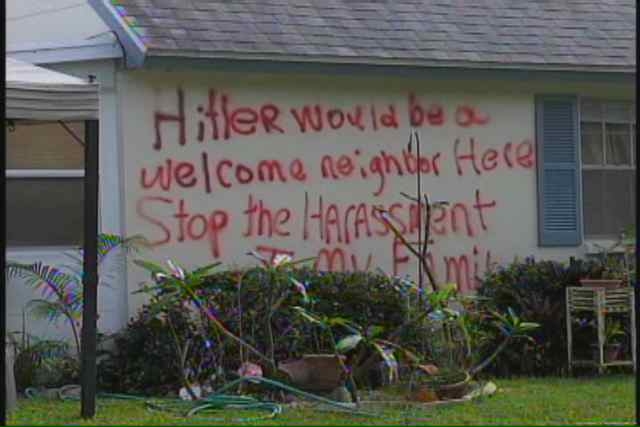
Just sayin'.
Why I Hate These Magazines
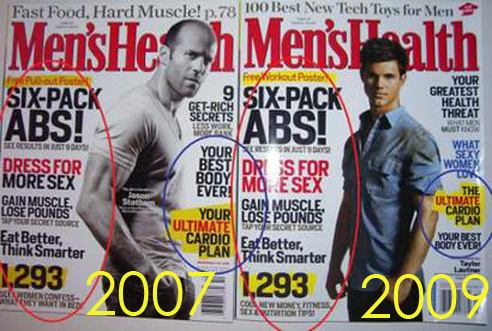
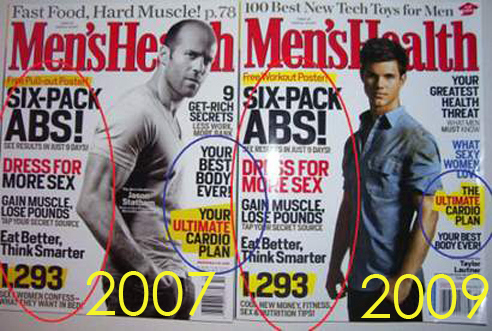
….because they're recycled crap. I mean, how much times care you write about great abs and great sex and not repeat yourself?
And women's magazines (Cosmo, etc.) are worse
Health Insurers Bribe Facebook Users
This is a little complicated to explain, but bear with me.
On Facebook, there are games you can play that require money to advance. They are simulation games — like running your own farm, or rollercoaster theme park, or mafia crime family, or something like that. Of course, these games doesn't involve real money, but fake money — usually given names like "FarmBucks" or something (I don't know for sure — I don't play games on Facebook). You get this "virtual currency" by winning it through the games, or by paying real money for it.
Anyway, the health insurance lobby has found a way to gin up support for their cause — or worse, to make it appear that there is support for their cause. An industry group called Health Reform Right is now providing this "virtual currency" to Facebook players who take a survey. That survey is then forwarded to the Facebook player's congressional representative with the words:
"I am concerned a new government plan could cause me to lose the employer coverage I have today. More government bureaucracy will only create more problems, not solve the ones we have."
It's basically "astroturfing" (a term used to describe creating a false grassroots movement).
It's not illegal to pay somebody to pretend to be a supporter of a cause.
But it's clearly not above-board.
So naturally, the health insurance lobby is doing it.
More Fox Flubs

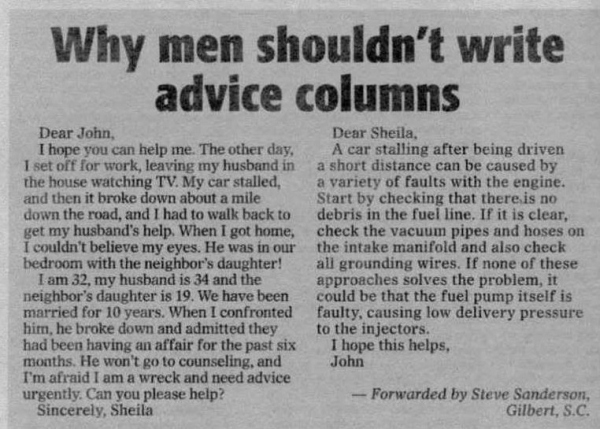
This still hasn't been fixed as I write this, so if you click, you still might catch it.
Anyway, read this poll from the Fox News website, and see if it makes sense to you:
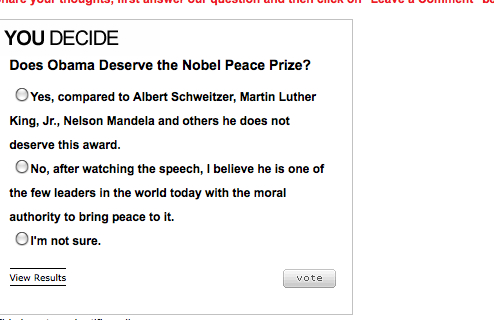
They've got their biased leading answers backwards, no?
Oh Please Oh Please Oh Please Oh Please
Sarah Palin weighed in on climate change this week in a painfully bland op-ed in the Washington Post. (No, of course she didn't actually write it — Bill Kristol, I'm guessing, did). It was largely a rehash of one of her Facebook posts on the subject, where words like "science" and "experts" were put in scare quotes.
On Laura Ingraham’s radio show today, Palin continued her attack on climate change. But when Ingraham asked if she would be willing to debate Al Gore on the issue, Palin demurred, saying that if it was in the wrong “forum” she would “get clobbered”:
INGRAHAM: Would you agree to a debate with Al Gore on this issue?
PALIN: Oh my goodness. You know, it depends on what the venue would be, what the forum. Because Laura, as you know, if it would be some kind of conventional, traditional debate with his friends setting it up or being the commentators I’ll get clobbered because, you know, they don’t want to listen to the facts. They don’t want to listen to some reasonable voices in this. And that was proven with the publication of this op-ed, where they kind of got all we-weed up about it and wanted to call me and others deniers of changing weather patterns and climate conditions. Trying to make the issue into something that it is not.
INGRAHAM: But what if it’s an Oxford-style, proper debate format. I mean, he’s going to chicken out. I mean, if you challenge him to a debate, do you actually think he would accept it?
PALIN: I don’t know, I don’t know. Oh, he wouldn’t want to lower himself, I think, to, you know, my level to debate little old Sarah Palin from Wasilla.
Yeah, Sarah — I don't think the question of whether or not you will get "clobbered" depends on the forum or the debate rules. Okay, maybe you might win the swimsuit competition, but if it was the kind of debate in which you were to argue your position with supportable facts, well, yeah — you might have some problems there.
But anyway, I think this is something I would like to see. Pay good money to see. Let's make it happen.
Stimulus Spending In Forsyth County
I don't want to create problems for anyone, but $221,000 seems like an awfully big chunk of stimulus money to go to a psychiatrist's office (Christopher Spaulding PSY.D). [Source]
Recovery.gov states that the purpose of the loan was:
TO ASSIST SMALL BUSINESS CONCERNS BY PROVIDING LONG TERM FINANCING THROUGH THE SALE OF DEBENTURES TO THE PRIVATE SECTOR
and also says there was a separate $6,000 loan.
I think that's the largest stimulus award from the Small Business Adminstration to a Forsyth business. It's probably legit, but I'm not sure it will stimulate that many jobs — it looks like a one-person (plus staff) operation.
Obama In Norway
It is a little awkward that Obama is receiving the Nobel Peace Prize just weeks after announcing that he is sending more troops into Afghanistan. To his credit, he didn't shy away from addressing this elephant in the room when he received the Prize in Norway today:
And yet I would be remiss if I did not acknowledge the considerable controversy that your generous decision has generated. (Laughter.) In part, this is because I am at the beginning, and not the end, of my labors on the world stage. Compared to some of the giants of history who've received this prize — Schweitzer and King; Marshall and Mandela — my accomplishments are slight. And then there are the men and women around the world who have been jailed and beaten in the pursuit of justice; those who toil in humanitarian organizations to relieve suffering; the unrecognized millions whose quiet acts of courage and compassion inspire even the most hardened cynics. I cannot argue with those who find these men and women — some known, some obscure to all but those they help — to be far more deserving of this honor than I.
But perhaps the most profound issue surrounding my receipt of this prize is the fact that I am the Commander-in-Chief of the military of a nation in the midst of two wars. One of these wars is winding down. The other is a conflict that America did not seek; one in which we are joined by 42 other countries — including Norway — in an effort to defend ourselves and all nations from further attacks.
Still, we are at war, and I'm responsible for the deployment of thousands of young Americans to battle in a distant land. Some will kill, and some will be killed. And so I come here with an acute sense of the costs of armed conflict — filled with difficult questions about the relationship between war and peace, and our effort to replace one with the other.
Now these questions are not new. War, in one form or another, appeared with the first man. At the dawn of history, its morality was not questioned; it was simply a fact, like drought or disease — the manner in which tribes and then civilizations sought which tribes and then civilizations sought power and settled their differences.
And over time, as codes of law sought to control violence within groups, so did philosophers and clerics and statesmen seek to regulate the destructive power of war. The concept of a "just war" emerged, suggesting that war is justified only when certain conditions were met: if it is waged as a last resort or in self-defense; if the force used is proportional; and if, whenever possible, civilians are spared from violence.
***
We must begin by acknowledging the hard truth: We will not eradicate violent conflict in our lifetimes. There will be times when nations — acting individually or in concert — will find the use of force not only necessary but morally justified.
I make this statement mindful of what Martin Luther King Jr. said in this same ceremony years ago: "Violence never brings permanent peace. It solves no social problem: it merely creates new and more complicated ones." As someone who stands here as a direct consequence of Dr. King's life work, I am living testimony to the moral force of non-violence. I know there's nothing weak — nothing passive — nothing naïve — in the creed and lives of Gandhi and King.
But as a head of state sworn to protect and defend my nation, I cannot be guided by their examples alone. I face the world as it is, and cannot stand idle in the face of threats to the American people. For make no mistake: Evil does exist in the world. A non-violent movement could not have halted Hitler's armies. Negotiations cannot convince al Qaeda's leaders to lay down their arms. To say that force may sometimes be necessary is not a call to cynicism — it is a recognition of history; the imperfections of man and the limits of reason.
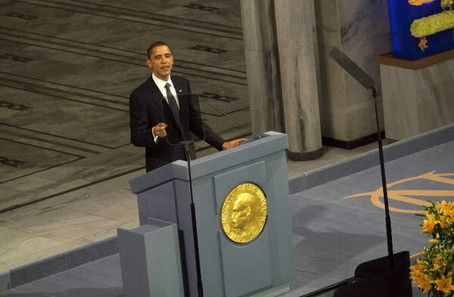
Basically, he's saying that it's the Nobel Peace Prize, folks, not the Nobel Pacifist Prize… and that war is sometimes necessary to preserve the peace.
Well, I guess he has to say that, and there certainly is an unfortunate truth to what he says. However, it only highlights the position held by many that Obama may not have been the best choice for the Peace Prize.
I think, however, he shows himself more worthy of the award toward the end of his speech, when he embraces the so-called "Superman theory" of American warfare — i.e., as the world's remaining superpower, we should behave more like Clark Kent rather than Jack Bauer:
Let me make one final point about the use of force. Even as we make difficult decisions about going to war, we must also think clearly about how we fight it. The Nobel Committee recognized this truth in awarding its first prize for peace to Henry Dunant — the founder of the Red Cross, and a driving force behind the Geneva Conventions.
Where force is necessary, we have a moral and strategic interest in binding ourselves to certain rules of conduct. And even as we confront a vicious adversary that abides by no rules, I believe the United States of America must remain a standard bearer in the conduct of war. That is what makes us different from those whom we fight. That is a source of our strength. That is why I prohibited torture. That is why I ordered the prison at Guantanamo Bay closed. And that is why I have reaffirmed America's commitment to abide by the Geneva Conventions. We lose ourselves when we compromise the very ideals that we fight to defend. (Applause.) And we honor — we honor those ideals by upholding them not when it's easy, but when it is hard.
And moments later:
We do not have to live in an idealized world to still reach for those ideals that will make it a better place. The non-violence practiced by men like Gandhi and King may not have been practical or possible in every circumstance, but the love that they preached — their fundamental faith in human progress — that must always be the North Star that guides us on our journey.
For if we lose that faith — if we dismiss it as silly or naïve; if we divorce it from the decisions that we make on issues of war and peace — then we lose what's best about humanity. We lose our sense of possibility. We lose our moral compass.
Like generations have before us, we must reject that future. As Dr. King said at this occasion so many years ago, "I refuse to accept despair as the final response to the ambiguities of history. I refuse to accept the idea that the 'isness' of man's present condition makes him morally incapable of reaching up for the eternal 'oughtness' that forever confronts him."
Let us reach for the world that ought to be — that spark of the divine that still stirs within each of our souls. (Applause.)
All in all, I believe it was a good speech that threaded the fine line between acknowledging the world as it is, while aspiring to a world that could be.
UPDATE: The Rude Pundit makes an interesting observation:
Here's how you know the way things have changed. In his September 14, 2001 speech at a prayer service for 9/11 victims, George W. Bush said that America's "responsibility to history is already clear: to answer these attacks and rid the world of evil." And today, Barack Obama, in contrast, offered a less utopian view of the future: "We must begin by acknowledging the hard truth that we will not eradicate violent conflict in our lifetimes."
That goes back to the leader-as-tough-talking-movie-hero vs. leader-as-realist issue. Republicans love the former; hate the latter.