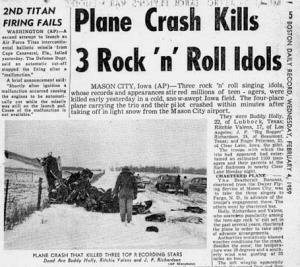
I'm a day late, but the music died 50 years ago yesterday.
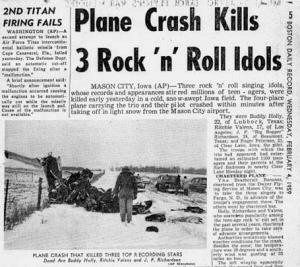


I love this article because it hits upon some of my pet peeves about grammer misuse.
For example:
There. Now try and use better English.
I will have my predictions soon, but in the meantime….
From a Gallup poll released today:
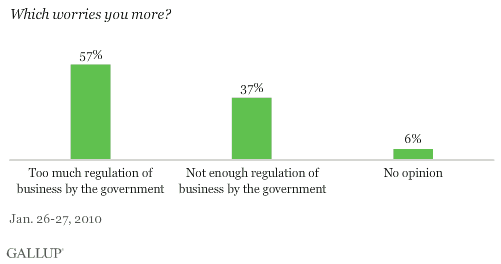
Oy vey. That's depressing
Dear 57%:
The reason we are in the financial crisis today is because of government deregulation of business. Republicans (and not a few Democrats) have subscribed to the montra that government is best left out of meddling in business, a theory disproven by the Great Depression and again these past few years.
It is the nature of capitalism to try to make money by cutting corners, and do things unethically. If there is a way to make quick and easy money on the cheap — say, by selling assets containing bad mortgages — it is the nature of the business world to exploit that method. And that business drive, while bringing great wealth to the country, can also have some tragic repercussions for the country.
We have seen this time and time again throughout American history. Slavery, for example, is a very good business model. Cheap labor means more profits. And the abolition of slavery was, in effect, a government regulation of business. The same can be said of child labor as well. Were these things bad?
Or government regulation of the amount of toxic wastes that can be dumped into the public waters. Is that bad?
Or a million other examples — from food labelling to truth-in-advertising to product safety. These are all things that come about because of government regulation.
Government needs to regulate business, because, when untethered, businesses will effect a huge social cost in their lust for profit. Some people will make money, but others will, literally, die.
So to all those who want less government regulation of business, I ask these questions: Just how much rat feces do you like in your hot dogs?
Sincerely,
Me at The Seventh Sense
I recently had a discussion with someone about the merits of higher education when it comes to future income. And as if on cue, the Wall Street Journal today covers the same subject.
There is a sense that a liberal arts degree doesn't really get you anything in terms of a career, and one would be better off with a post-graduate degree in medicine, law, business, etc.
And that's certainly true, but even getting a college degree can make a staggering difference in income, compared to those who just graduate from high school. At least, that's always been the perception:
For years, higher education was touted as a safe path to professional and financial success. Easy money, in the form of student loans, flowed to help parents and students finance degrees, with the implication that in the long run, a bachelor's degree was a good bet. Graduates, it has long been argued, would be able to build solid careers that would earn them far more than their high-school educated counterparts.
The numbers appeared to back it up. In recent years, the nonprofit College Board touted the difference in lifetime earnings of college grads over high-school graduates at $800,000, a widely circulated figure. Other estimates topped $1 million.
But tuitions have skyrocketed in recent years, and the conventional wisdom, while still true, may not be as true:
The problem stems from the common source of the estimates, a 2002 Census Bureau report titled "The Big Payoff." The report said the average high-school graduate earns $25,900 a year, and the average college graduate earns $45,400, based on 1999 data. The difference between the two figures is $19,500; multiply it by 40 years, as the Census Bureau did, and the result is $780,000.
Others, like Mark Schneider, a vice president of the American Institutes for Research, consider the higher education "payoff" to be even lower:
Mark Schneider, a vice president of the American Institutes for Research, a nonprofit research organization based in Washington, calls it "a million-dollar misunderstanding."
One problem he sees with the estimates: They don't take into account deductions from income taxes or breaks in employment. Nor do they factor in debt, particularly student debt loads, which have ballooned for both public and private colleges in recent years. In addition, the income data used for the Census estimates is from 1999, when total expenses for tuition and fees at the average four-year private college were $15,518 per year. For the 2009-10 school year, that number has risen to $26,273, and it continues to increase at a rate higher than inflation.
Dr. Schneider estimated the actual lifetime-earnings advantage for college graduates is a mere $279,893 in a report he wrote last year. He included tuition payments and discounted earning streams, putting them into present value. He also used actual salary data for graduates 10 years after they completed their degrees to measure incomes. Even among graduates of top-tier institutions, the earnings came in well below the million-dollar mark, he says.
Another estimate puts the gap at more like $450,000.
So the answer to "whither higher education" remains a resounding "yes" with an exclamation point. But not a "yes" with two exclamation points.
The Washington Post reports the following, under the headline "Abstinence-only programs might work, study says":
Sex education classes that focus on encouraging children to remain abstinent can persuade a significant proportion to delay sexual activity, researchers reported Monday in a landmark study that could have major implications for U.S. efforts to protect young people against unwanted pregnancies and sexually transmitted diseases.
Only about a third of sixth- and seventh-graders who completed an abstinence-focused program started having sex within the next two years, researchers found. Nearly half of the students who attended other classes, including ones that combined information about abstinence and contraception, became sexually active.
The findings are the first clear evidence that an abstinence program could work.
Here's how the study was conducted:
The study released Monday involved 662 African American students from four public middle schools in a city in the Northeastern United States. It was conducted between 2001 and 2004.
Students were randomly assigned to go through one of the following: an eight-hour curriculum that encouraged them to delay having sex; an eight-hour program focused on teaching safe sex; an eight- or 12-hour program that did both; or an eight-hour program focused on teaching them other ways to be healthy, such as eating well and exercising. The abstinence-only portion involved a series of sessions in which instructors talked to students in small groups about their views about abstinence and their knowledge of HIV and other sexually transmitted diseases. They also conducted role-playing exercises and brainstorming sessions designed to correct misconceptions about sex and sexually transmitted diseases, encourage abstinence and offer ways to resist pressure to have sex.
Over the next two years, about 33 percent of the students who went through the abstinence program started having sex, compared with about 52 percent who were taught only safe sex. About 42 percent of the students who went through the comprehensive program started having sex, and about 47 percent of those who learned about other ways to be healthy did.
The abstinence program had no negative effects on condom use, which has been a major criticism of the abstinence approach.
On first blush, this might appear to be a victory for the Focus on the Family types. But there are a couple of caveats.
First and foremost, the abstinence-only programs were not moralistic. The kids were not encouraged to "wait until you are married", but merely to "wait until you are ready". And in fact, as written elsewhere:
Jemmott and colleagues indicated that the abstinence-only program used in the study was unusual. In fact, it would not have qualified for abstinence-only federal funding because it did not rely on moral principles, nor did it criticize condom usage.
So right away, we see that this is hardly the type of abstience-only program touted by the conservative christian block.
Secondly, the study relied on the self-reporting of ths students themselves. And I would suggest that a student who went through an abstinence-only program is more likely to lie about his/her failure to abstain, when compared to a student who went through a comprehensive program.
Finally, even the researcher doesn't buy into the notion that abstinence-only is the way to go:
"There are populations that really want an abstinence intervention. They are against telling children about condoms," he said. "This study suggests abstinence programs can be part of the mix of programs that we offer."
That seems to be a direct contradiction of the Washington Post's headline.
Furthermore, the Washington Post glosses over something that medical journals have noted about the study:
Although the abstinence-only program appeared more effective in delaying sexual initiation, it had little or no effect on other sexual behaviors including multiple sex partners, engaging in unprotected sex, and consistency in condom use.
So in other words, with an abstience-only program, about 10% more kids delayed having sex than kids in a more comprehensive program, and when they did so, the program had done nothing to discourage multiple sex partners and unprotected sex.
That's a program that "works"?
It takes a very special sort of stick-up-the-assness to ban The Diary of Anne Frank as being too suggestive ("sexual explcit material" and "homosexual themes") but damned if a town in Virginia didn't do it.
Something unusual happened today in American politics — something never before seen.
President Obama appeared at the Republican party retreat. Their invitation. He gave a speech, hitting on the same points as his State of the Union, and then….
…. he took questions.
He took questions from Republican congressmen.
It was much like "Question Time" that they have in the British parliamentary system.
And reports suggest that when Obama was questioned and put to task by Republican elected officials, who naturally challenged him on every question, he ran rings around them, coming off as far more knowledgeable.
The GOPers asked pretty typical questions. Some of them tried to play "gotcha." Didn't work. Obama answered their questions and provided his own commentary on them. He called Republicans out for their attacks on him. He noted that they've pretty much called his health care plan a "Bolshevik plot." One of the best moments was when Obama dissed Hensarling's question as a recitation of talking points.
Towards the end, Obama pointed to GOP pollster Frank Luntz, who was sitting in the front row. He noted that when many of the GOP Representatives stand on the House floor to talk issues, Luntz "has already polled it" — and they get the talking points from him on how to box Obama in. The President kept going back to the theme that the GOPers were in a constant attack mode — and how that prevented them from being able to work with him.
UPDATE: Video just in….
UPDATE: Transcript here.
And Ezra Klein writes:
Obama's Q&A session with the House Republicans was transfixing. What should have been a banal exchange of talking points was actually a riveting reminder of how rarely you hear actual debate — which is separate from disagreement — between political players.
This was a surprise. The session was clearly proposed so that Obama could appear to be taking real steps to reach out to Republicans. That implied warm feelings and a studied unwillingness to cause offense. But that was not the event we just saw. Instead, Obama stood at a podium for an hour and hammered his assailants. That makes it sound partisan and disrespectful. But it wasn't. It was partisan, but respectful.
***
Yesterday, I interviewed David Axelrod and was struck by his inability to explain how the White House would highlight the the difference between disagreement and obstruction. Today's session, if it becomes a regular event rather than a one-off, provided part of the answer. He'll debate them directly. But that may be tough to do. Republicans are already spreading the word that they made a mistake allowing cameras into the event. Apparently, transparency sounds better in press releases than it does in practice.
But if this is to be the last of these we see for a while, make sure to take the time and watch it, or read the transcript. It's some of the best political television I've seen in memory.
Writes the Atlantic’s Marc Ambinder:
“Debating a law professor is kind of foolish — the Republican House Caucus has managed to turn Obama’s weakness — his penchant for nuance — into a strength. Plenty of Republicans asked good and probing questions, but Mike Pence, among others, found their arguments simply demolished by the president.”
UPDATE: Republicans are beginning to realize how they looked stupid… they now think the whole thing was a "mistake".
I guess it is easy for Republicans to take on Obama on Fox News, but taking him on face-to-face? Not so much.
How remarkable was it? Fox cut away from broadcasting it.
Other reacts from Twitter media people:
marcambinder: Obama looked like a law prof; the GOPers looked like students challenging him.
maddow: This appearance by Obama with House Republicans is really remarkable.
ThePlumLineGS: Imagine if Obama publicly pushed Congressional Dem leaders to pass HCR via reconciliation as aggressively as he's now pushing Republicans.
ezraklein: Obama's Q&A with the House Republicans is the most compelling political television I've seen…maybe ever.
chucktodd: the president should hold Congressional "town halls" more often. Public needs to see this if they'll ever trust washington again
And indeed, they are unconstitutional:
Federal District Court Judge James A. Beaty this morning ruled that Forsyth County is violating the U.S. Constitution by allowing prayers with sectarian references before meetings of the county board of commissioners.
Beaty ordered the county to stop allowing prayers under its current policy, which had come under fire from those who said that the county was promoting Christianity because most of the prayers have made reference to Jesus.
Beaty gave the county several options in his order. He said that the county could choose to open meetings without a prayer, or could require that prayers contain no sectarian references.
Mike Johnson, the attorney representing the county, told commissioners this morning that he hopes they will appeal the case to the U.S. Court of Appeals for the Fourth Circuit. That court traditionally also has ruled against sectarian prayer at public meetings.
Today's ruling by Beaty confirms what a magistrate recommended in November. The lawsuit was filed in March 2007 by several county residents, supported by the American Civil Liberties Union. They asked that the commission only allow non-sectarian prayer at meetings; in those, references to God are allowed, but to specific deities such as Jesus Christ or Buddha are not.
The lawsuit prompted other counties to study their policies on invocations before public meetings. Several, such as Yadkin County, changed their policies to eliminate sectarian prayer. Others, such as the Winston-Salem City Council, have held off, saying they would wait to see the outcome of the Forsyth County case.
And now it is time for the people of Winston-Salem to speak up in insane rants to the newspaper:
This third comment amuses me. No, there is no law or clause prohibiting prayer — there is, however, a law which prohibits government endorsement of religion (particularly one religion over all others). It's called the First Amendment. And when a government body like the Forsyth County board of commissioners engages in prayer — Christian prayer — to the exclusion of all other forms of worship from other religions, that clearly violates the Constitution.

WICHITA, Kan. – A man who says he killed prominent Kansas abortion provider Dr. George Tiller to protect unborn children has been convicted of murdering the doctor.
A jury deliberated for 37 minutes Friday before finding Scott Roeder guilty of premeditated, first-degree murder. The 51-year-old Kansas City, Mo., man faces a mandatory sentence of life imprisonment with the possibility of parole after 25 years.
Roeder testified that he shot Tiller in the head May 31 in the foyer of Tiller's church in Wichita because he believed Tiller posed an "immediate danger" to unborn children.
His attorneys were hoping to get a lesser charge of voluntary manslaughter for Roeder, but the judge ruled that the jury could not consider such a verdict.
The judge's ruling will no doubt be the basis of an appeal. The defense tried to argue that the jury should be allowed to consider manslaughter, based on the Kansas statute which permits a killing when the killer "is justified in the use of force against another when and to the extent it appears to such person and such person reasonably believes that such force is necessary to defend such person or a third person against such other's imminent use of unlawful force."
The only problem with that is that the last two word "unlawful force". Abortion is not unlawful. And that's probably why the judge in the Roeder case didn't allow the jury to consider manslaugher. Roeder could use force, even deadly force, to prevent somone else's unlawful acts, but not their lawful act.
It makes perfect sense from a public policy standpoint as well. If we allowed people to decide on their own volition when a murder is "justified" or not, then we basically make murder statutes into a dead letter law. I would venture to say that many murders are justified in the eyes of the murderer. But a criminal law system cannot work that way.